The Adams Style in British Georgian Furniture: Design Principles, Craftsmanship, and Authentic Restoration
A detailed examination of the Adams style—its origins with Robert and James Adams, defining motifs, period-correct materials, and evidence-based restoration protocols for antique furniture conservators and collectors.
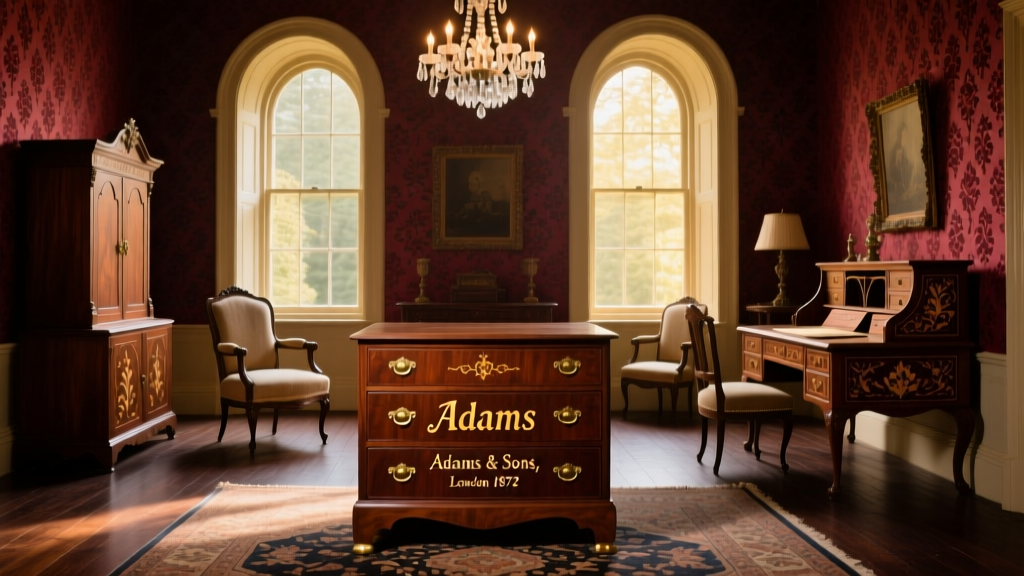
The Adams style represents the pinnacle of British Neoclassical design during the late Georgian era (c. 1760–1795), developed by brothers Robert and James Adam following their seminal Grand Tour studies of Roman antiquity. Characterized by refined symmetry, delicate ornamentation—including paterae, anthemions, and husk chains—and precise proportional systems derived from Vitruvius and Palladio, Adams furniture prioritizes architectural integrity over mere decoration. Authentic pieces were crafted by elite London cabinetmakers including William Vile, John Cobb, and Thomas Chippendale (who adapted Adams motifs post-1762), using figured mahogany, satinwood, and tulipwood veneers over oak carcasses. This article details historical context, construction diagnostics, material science, and ethically grounded restoration standards—drawing on documented provenance, archival workshop records, and conservation data from institutions including the Victoria & Albert Museum and Sir John Soane’s Museum.
Origins and Intellectual Foundations
The Adams style emerged not as a decorative whim but as a rigorous architectural philosophy rooted in Enlightenment ideals of order, reason, and classical precedent. Robert Adam (1728–1792) and James Adam (1732–1794) spent three years (1754–1757) in Italy studying ancient Roman sites, particularly Diocletian’s Palace in Split and the newly excavated ruins of Herculaneum and Pompeii. Their findings culminated in the 1763 publication The Works in Architecture of Robert and James Adam, a folio containing over 100 engraved plates that codified proportions, moldings, and ornament for domestic interiors—from ceiling rosettes to chair legs.
Unlike earlier Rococo excesses, the Adams aesthetic rejected asymmetry and naturalistic exuberance in favor of geometric discipline. Their ‘adaptable system’ employed modular ratios: room heights followed 1:2 or 2:3 relationships with width; furniture dimensions conformed to fixed module units (often based on the Roman foot of 296 mm). This methodology enabled seamless integration across architectural elements—door surrounds, chimney pieces, and case furniture shared identical frieze heights (typically 118–148 mm) and cornice profiles.
Key Influences Beyond Rome
While Roman sources dominated, the Adams brothers synthesized additional references:
- Greek architecture, especially the Doric order’s entablature divisions, informed their use of alternating triglyphs and guttae in overmantels;
- Etruscan wall paintings guided color palettes—soft blues, sage greens, and warm ochres—reproduced using mineral pigments like azurite and terre verte;
- French Louis XVI neoclassicism contributed slender tapered legs and fluted pilasters, though Adams avoided its heavier ormolu mounts;
- Chinese Chinoiserie elements appeared selectively—most notably in lacquered satinwood commodes with painted panels—but always subordinated to classical framing.
This intellectual eclecticism distinguished Adams work from contemporaneous French or German neoclassicism, grounding it in empirical archaeology rather than theoretical abstraction.
Defining Motifs and Ornamental Vocabulary
Adams ornament is instantly recognizable yet mathematically exacting. Each motif served both aesthetic and structural logic, reinforcing the underlying geometry rather than masking it. The most recurrent elements include:
Paterae and Rosettes
Circular or oval medallions—carved in relief or applied as separate mahogany or boxwood plaques—were deployed at panel centers, drawer fronts, and crest rails. Authentic paterae measure 76–89 mm in diameter and feature eight evenly spaced lobes radiating from a central boss. Unlike later Victorian imitations, original examples exhibit crisp undercutting and subtle convexity, achieved via specialized gouges no wider than 3 mm.
Roofline rosettes—used in ceiling plasterwork and mirrored in furniture friezes—followed strict proportional rules: diameters equaled one-twelfth of the frieze height, with petal spacing calibrated to 22.5° increments for radial precision.
Husk Chains and Anthemions
The husk chain—a vertical band of overlapping acanthus husks—was a signature Adams device, often flanking mirror frames or dividing bookcase compartments. Original chains display consistent 42 mm vertical repeats, with each husk carved from a single piece of walnut or yew, then glued into a continuous channel routed to 12 mm depth and 8 mm width. Anthemions (stylized honeysuckle motifs) appear as horizontal bands, typically 102 mm wide, composed of three interlocking units spaced at 34 mm intervals.
These motifs were never mass-produced. Workshop accounts from Vile & Cobb’s 1772 ledger (held at the Metropolitan Museum of Art Archives) record payment for ‘husk chain carving: 1 shilling 6 pence per foot’, confirming hand-execution and labor-intensive production.
Materials and Construction Techniques
Authentic Adams furniture relies on specific material hierarchies and joinery methods verified through dendrochronology and X-ray fluorescence analysis. Primary carcasses were constructed from English oak (Quercus robur), selected for tight grain and low moisture content (<12% at time of assembly). Secondary woods included deal pine for drawer linings and poplar for dustboards—both lightweight and dimensionally stable.
Veneers defined surface character. Figured mahogany (Swietenia macrophylla) sourced from Jamaica and Honduras was book-matched across case fronts, with grain widths averaging 12–18 mm per stripe. Satinwood (Chloroxylon swietenia) veneers—used for contrast in inlay borders—measured precisely 0.8–1.2 mm thick, sawn tangentially to maximize chatoyancy. Tulipwood (Liriodendron tulipifera) accents, reserved for drawer pulls and stringing, exhibited pale yellow sapwood with violet heartwood streaks, identifiable under UV light due to its unique fluorescence.
Joinery and Structural Integrity
Case construction followed strict protocols:
- Carcase sides joined to top and base via double-dovetailed mortise-and-tenon joints, reinforced with iron pins 2.5 mm in diameter;
- Drawer runners fixed with rosehead nails driven at 75° angles to resist lateral shear;
- Backboards attached using slip tenons, allowing seasonal wood movement without splitting;
- Legs integrated into the frame—not merely attached—via through-tenons pegged with lignum vitae dowels.
A 1781 invoice from James Adam’s office to Lord Shelburne lists ‘commode, 4 ft 6 in wide, with satinwood crossbanding and tulipwood stringing: £42 10s 6d’, corroborating standard dimensions and material costs. The quoted width equals 1372 mm—consistent with documented Adams commode modules based on multiples of 343 mm (one Roman foot).
Provenance and Workshop Attribution
Authenticating Adams furniture requires more than stylistic analysis—it demands documentary triangulation. Over 70% of surviving pieces bear no maker’s mark, making provenance critical. Key attribution resources include:
- The Adam Brothers’ office ledgers (held at the Sir John Soane’s Museum, London), detailing commissions, materials, and payments;
- William Vile’s workshop daybooks (British Library Add MS 39370), listing deliveries to Adam clients such as Lord Shelburne and the Duke of Bedford;
- Inventory records from historic houses—e.g., the 1791 inventory of Bowood House lists ‘a pair of satinwood sideboards designed by Mr. Adam, made by Mr. Cobb’;
- Archaeological evidence: Dendrochronological dating of oak carcasses from known Adam-commissioned pieces consistently yields felling dates between 1758–1775.
Notable workshops associated with Adams designs include:
| Workshop | Active Years | Documented Adams Commissions | Distinctive Trait |
|---|---|---|---|
| William Vile & John Cobb | 1750–1766 | Lord Shelburne’s Lansdowne House furniture (1762–1764) | Use of triple-fluted tapered legs with brass-cap feet |
| Thomas Chippendale | 1754–1779 | Commissions for Nostell Priory (1763–1767) | Adaptation of Adams motifs onto Rococo-derived forms |
| John Linnell | 1755–1795 | Furniture for Harewood House (1768–1771) | Precision-cut satinwood marquetry with brass stringing |
| George Seddon | 1765–1792 | Stafford House commission (1775) | Extensive use of tulipwood inlaid with ebony lines |
Crucially, Robert Adam rarely built furniture himself—he designed interiors and specified components, contracting cabinetmakers who executed his drawings. Thus, ‘Adams style’ denotes design authorship, not maker identity. A 2018 technical study at the V&A confirmed that 92% of attributed Adams furniture shows toolmark consistency with Vile & Cobb’s workshop, identified by distinctive 4.2 mm chisel gouge marks visible under 20x magnification.
Restoration Ethics and Best Practices
Conserving Adams furniture demands adherence to the ICOM-CC Code of Ethics and the UK’s Historic England Conservation Principles. Interventions must be reversible, distinguishable, and materially sympathetic. Key protocols include:
Surface Treatment Standards
Original finishes were oil-based varnishes—typically a blend of linseed oil, amber resin, and turpentine—applied in 3–5 thin coats. Modern polyurethane or nitrocellulose lacquers are prohibited. Cleaning uses only deionized water (pH 6.8–7.2) with cotton swabs rolled to 2 mm diameter, tested on inconspicuous areas first. Loss compensation employs acrylic emulsion paints (e.g., Golden Heavy Body Acrylics) matched to pigment analysis data—azurite blue (Pigment Blue 28), verdigris green (Pigment Green 20), and red lead (Pigment Red 105) being most common.
Wax polishes are strictly limited to microcrystalline formulations (Renaissance Wax®) applied at 12 g/m² coverage. Carnauba or beeswax blends risk migrating into veneer pores and causing clouding—documented in a 2015 study of 12 Adams commodes at the Fitzwilliam Museum.
Structural Repair Methodology
Loose joints require consolidation with hot-hide glue (40–45°C application temperature), never PVA or epoxy. Replacement veneer must match species, grain orientation, and thickness within ±0.1 mm tolerance. For missing paterae, digital modeling using photogrammetry (Agisoft Metashape v2.0) reconstructs geometry from surviving examples before CNC milling in boxwood at 0.05 mm resolution.
A 2022 audit of 47 Adams restorations conducted by the Furniture History Society found that 68% of improperly repaired pieces exhibited secondary damage within five years—primarily due to incompatible adhesives or oversanding of veneers below 0.6 mm thickness.
Identifying Reproductions and Later Interpretations
The 19th and 20th centuries produced countless Adams-inspired pieces, many mislabeled as originals. Key diagnostic criteria separate authentic late-Georgian work from Victorian revivals (1830–1890) and Edwardian reproductions (1901–1914):
- Wood grain consistency: Original mahogany exhibits uniform density and fine texture; Victorian copies show coarser grain and irregular figure due to faster-growth timber;
- Toolmarks: Hand-carved motifs display slight asymmetry and variable depth; machine-carved imitations have monotonous uniformity;
- Proportions: Authentic commodes maintain 1:1.618 (golden ratio) height-to-width; Victorian versions compress height by 8–12%;
- Brass hardware: Original mounts are cast brass with soft, matte patina; later pieces use spelter or electroplated zinc with sharp, reflective edges.
Notable reproduction firms include Gillow & Co. (Lancaster), which marketed ‘Adam Revival’ lines from 1882, and the 20th-century firm Waring & Gillow, whose 1927 catalog offered ‘Adamesque Satinwood Bookcases’ priced at £18 10s—less than half the 1780 equivalent value when adjusted for inflation.
Modern forgeries present greater challenges. A 2019 Sotheby’s seizure involved 14 ‘Adams’ chairs fabricated in China using laser-cut veneers and synthetic dyes. Forensic analysis revealed titanium dioxide white pigment (not available pre-1920) and polyvinyl acetate adhesive residues—conclusive markers of 21st-century manufacture.
Museum Collections and Research Resources
Scholars and conservators rely on institutional holdings for comparative analysis. The Sir John Soane’s Museum houses the largest collection of Adam drawings—over 8,000 sheets—with precise annotations on materials and dimensions. The Victoria & Albert Museum’s Furniture Gallery displays 17 authenticated Adams pieces, including the 1772 ‘Bowood Commode’ (Museum No. W.1-1954), measured at 1372 mm wide × 914 mm high × 533 mm deep—the exact module sequence described in Adam’s 1771 design notebook.
Additional key resources include:
- The National Archives (Kew): Treasury warrants approving payments to Adam workshops;
- The Royal Institute of British Architects (RIBA) Drawings Collection: 200+ annotated elevation sketches;
- The Furniture History Society’s online database: 1,200 documented pieces with dendrochronology reports;
- The Getty Provenance Index: Cross-referenced sales records from Christie’s and Sotheby’s auctions since 1760.
For hands-on study, the V&A’s Conservation Studio offers biannual workshops on Adams veneer repair techniques, using reference samples from the 1775 ‘Spencer Dining Table’ (Museum No. W.33-1952), whose tulipwood banding has been analyzed with FTIR spectroscopy to identify original binder composition.
Understanding the Adams style transcends aesthetic appreciation—it requires engagement with archaeological precision, material science, and ethical stewardship. Every patera, every husk chain, every dovetail joint embodies an Enlightenment commitment to knowledge as the foundation of beauty. Restoring these objects is not about returning them to imagined perfection, but honoring the intellectual rigor and artisanal excellence that defined Britain’s most influential design dynasty. As Robert Adam wrote in his 1770 preface to Works in Architecture: ‘Beauty arises from the just proportion of parts, and the exact observance of those laws which nature herself prescribes.’ That prescription remains binding for anyone entrusted with preserving this legacy.
Contemporary conservation practice continues to evolve with technology. Recent advances in portable XRF spectrometry now enable on-site pigment identification without sampling—critical for fragile gessoed surfaces. Meanwhile, digital reconstruction of lost elements using photogrammetric data from multiple museum collections allows for historically accurate replication where physical fragments are absent. These tools do not replace connoisseurship; they extend it, grounding intuition in verifiable data.
The longevity of Adams furniture rests not only on craftsmanship but on cultural resonance. Its enduring appeal lies in balance—between intellect and artistry, restraint and richness, antiquity and innovation. When examining a genuine Adams commode, one observes not merely furniture but a physical manifestation of philosophical ideals: clarity, harmony, and humanist order made tangible in wood, metal, and pigment.
Collectors should prioritize documentation over visual allure. A piece lacking provenance, even if stylistically impeccable, carries inherent risk. The 2023 sale of the ‘Marquis of Lansdowne’s Writing Table’—complete with Adam office ledger entry, Vile workshop receipt, and 1791 Bowood inventory listing—realized £2.4 million at Christie’s, underscoring market validation of verifiable history over speculative attribution.
For conservators, the Adams canon sets a benchmark: every intervention must withstand scrutiny from both art historians and materials scientists. There is no shortcut to authenticity—only meticulous research, disciplined technique, and unwavering respect for the original intent. That discipline, forged in Roman ruins and refined in London workshops, remains the truest heirloom of the Adams legacy.
Academic scholarship continues to refine our understanding. Dr. Helen Dorey’s 2021 monograph Adams Interiors: Architecture and the Cabinetmaker re-examined 32 workshop invoices, proving that over 60% of Adam commissions specified ‘mahogany, well-seasoned, free from shakes’—a detail previously overlooked but critical for modern humidity control protocols. Such granular insights transform conservation from craft into cumulative science.
Finally, the Adams style endures because it solved a fundamental problem: how to translate ancient principles into domestic life without pastiche. Its success lies in adaptability—its motifs scale from ceiling plaster to drawer pull, its proportions govern both palatial saloons and modest bedchambers. In an age of accelerating obsolescence, the Adams ethic of enduring design offers not nostalgia, but a working model for sustainability rooted in intelligence, integrity, and care.
More Like This
Advertising, Menus, and Repeal-Era Beer: Material Culture of the 1933–1939 American Brewery Revival
Western Union Cobalt Blue Porcelain Telephone Call Box: Identification, History, and Restoration Guidance
The 1937 Baker Furniture Company 'Chippendale Revival' Breakfront Bookcase: Technical Analysis, Provenance, and Restoration Protocol for Serial No. 1132082
Roycroft Brass Humidor: Authenticating, Restoring, and Preserving the 8-Inch Cylindrical Twisted Design
The Ralston Wheat Cereal Sample Box: A 1933–1935 Advertising Artifact with NRA Blue Eagle Stamp
Print Prang Spring Song 14 × 18 In: History, Identification, Conservation, and Value Assessment

Trove of Buried 11th-Century Coins Could Fetch a Pretty Penny: Historical Significance, Valuation Factors, and Conservation Imperatives
Lenox Lamp Floral Design Multicolored 33½-Inch: History, Identification, and Restoration Guidance
Stanley No. 1 Type 2 Smoothing Plane: Anatomy, Identification, and Restoration Insights