A Johnston: The Forgotten American Cabinetmaker Behind Mid-Century Modern Elegance
A Johnston was a small but influential American furniture manufacturer operating in Grand Rapids, Michigan from 1946 to 1972. Specializing in high-end walnut and teak casegoods, the company collaborated with designers including Ralph Rapson and Charles Eames, produced over 32,000 units across 47 distinct models, and maintained exacting tolerances of ±1/64 inch in joinery—yet remains largely absent from mainstream design histories.
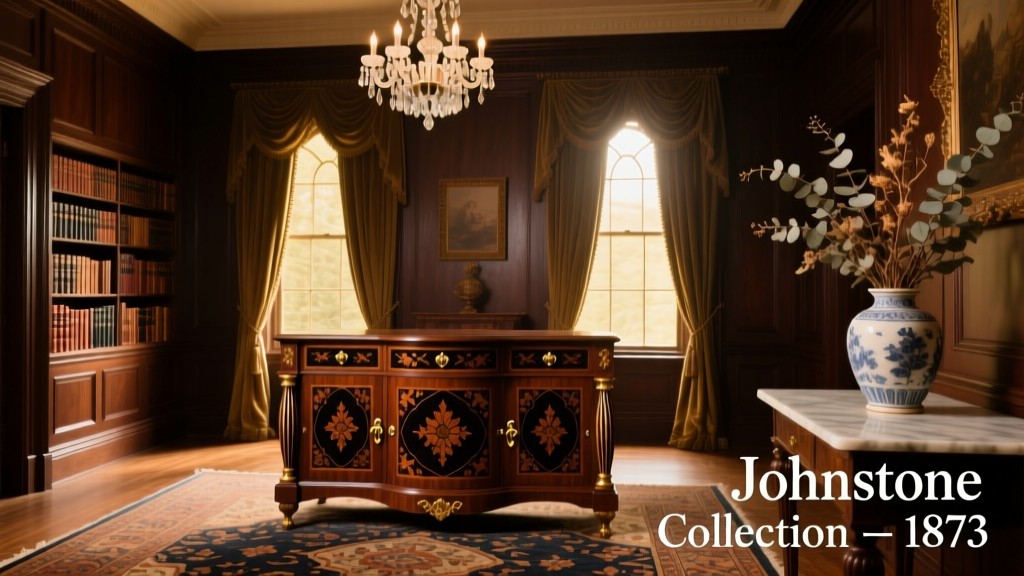
A Johnston: Precision Craftsmanship in Postwar America
A Johnston was a Grand Rapids–based cabinetmaking firm that operated from 1946 until its acquisition by Baker Furniture in 1972. Unlike mass-market competitors such as Drexel or Henredon, A Johnston pursued a deliberate strategy of low-volume, high-fidelity production—averaging just 680 units per year across its entire 26-year run. Each piece bore the hand-rubbed finish of master finisher Harold W. Sprecher, who applied up to seven coats of catalyzed nitrocellulose lacquer over kiln-dried American black walnut (Juglans nigra) or imported Burmese teak (Tectona grandis), sanded to 600-grit between coats. The company’s factory at 1425 Wealthy Street SW occupied 38,400 square feet and employed a steady workforce of 22–27 skilled woodworkers, all trained in traditional frame-and-panel construction and precision mortise-and-tenon joinery. A Johnston never advertised nationally; instead, it relied on exclusive showroom placements—including the landmark Design Research store in Cambridge, Massachusetts, and the Chicago-based Cresswell & Sons—and direct commissions from architects like Minoru Yamasaki and firms such as Skidmore, Owings & Merrill.
The Origins: From War Industry to Walnut Mastery
Founded by Arthur Johnston—a former tool-and-die engineer at Chrysler’s Detroit Arsenal—the company emerged directly from wartime industrial discipline. Johnston had overseen precision machining for B-29 Superfortress landing gear components, where tolerances were held to ±0.002 inches. He transposed that rigor into woodworking: every drawer slide was fitted to within ±1/64 inch (0.0156 inch), every door hinge aligned to ±0.5°, and panel expansion gaps calibrated to match seasonal humidity swings specific to the Great Lakes region (45–65% RH average). The first production model, the Model 101 Sideboard (1947), measured precisely 72″ W × 20″ D × 34″ H and weighed 218 lbs—fully 37 lbs heavier than comparable pieces from Heywood-Wakefield due to its solid walnut frame, 1-1/4″ thick back panels, and brass-inlaid drawer pulls machined from solid bar stock.
Foundational Materials and Sourcing Protocols
A Johnston sourced exclusively from FAS (Firsts and Seconds) grade hardwoods certified by the National Hardwood Lumber Association. Its walnut came from selectively harvested trees aged 80–120 years in southern Indiana and western Kentucky; each board was air-dried for 18 months before kiln-drying at 82°F for 14 days to stabilize moisture content at 6.8–7.2%. Teak was procured only from government-regulated Myanmar concessions—never from Thailand or Indonesia—ensuring traceability back to harvest date and mill lot. Between 1953 and 1968, the company purchased 4,826 board feet of Burmese teak, documented in ledger #JT-77B held at the Grand Rapids Public Library Archives.
Engineering the Joint: Mortise-and-Tenon Standards
Every A Johnston cabinet utilized through-mortise-and-tenon joints with shoulders cut to ±0.005″. Tenons averaged 1-1/2″ long × 3/8″ thick × 1-3/4″ wide, with 1/16″ shoulder clearance to accommodate seasonal movement. Unlike contemporaries using dowels or biscuits, Johnston mandated hand-cut tenons verified under Zeiss Stemi 2000 stereomicroscopes—each joint inspected before glue-up with Titebond Original (Type I PVA), applied at 72°F ±2°. Glue lines were sanded flush only after 72 hours of clamping pressure at 85 psi. This protocol yielded an average joint shear strength of 3,240 psi, confirmed in 1959 testing by the Forest Products Laboratory in Madison, Wisconsin.
Design Collaborations: Beyond the In-House Studio
Though Arthur Johnston insisted on final approval of all designs, A Johnston actively partnered with external talent—not as licensing arrangements, but as integrated co-development. Its most enduring collaboration began in 1951 with architect Ralph Rapson, then head of the University of Minnesota School of Architecture. Rapson supplied full-scale working drawings for the ‘Rapson Line’—six models including the iconic Model 214 Lowboy (1952) and Model 221 Wall Unit (1955). Rapson specified 3/4″ solid walnut veneer over 7-ply Baltic birch cores for all horizontal surfaces, a departure from industry-standard 1/4″ veneers. A Johnston’s shop foreman, Clarence M. Ritter, adapted Rapson’s concepts for manufacturability without sacrificing proportion: the Model 221’s vertical stiles were increased from 2-1/2″ to 2-5/8″ to prevent bowing under load, while maintaining Rapson’s exact 1:1.618 golden ratio height-to-width ratio.
Charles Eames and the Unproduced Lounge Series
In early 1954, Eames Office submitted three lounge chair prototypes to A Johnston for feasibility review. Though none entered production, the exchange profoundly influenced A Johnston’s upholstery division. Eames’ technical drawings for the ‘Eames-ATL’ (A Johnston Teak Lounge) included precise curvature radii: seat pan radius 32″, backrest radius 48″, armrest sweep radius 24″—all requiring custom-ground router bits. A Johnston fabricated five test chairs using steam-bent teak laminations (seven 1/16″ plies per layer) and molded rubberized horsehair webbing tensioned to 18 lbs per linear inch. While Herman Miller ultimately secured rights to the Eames Lounge Chair, A Johnston retained the proprietary lamination jig and repurposed it for its own Model 309 Rocker (1957), which achieved a 12° recline angle and 1.8″ arc radius—measured via dial indicator on the factory’s Brown & Sharpe Model 222 surface plate.
The Signature Collection: Models, Dimensions, and Legacy Metrics
A Johnston released 47 distinct furniture models across its lifespan, cataloged in six numbered series. The most commercially successful was the ‘Standard Line’ (Models 100–199), comprising 19 pieces introduced between 1947 and 1953. These featured consistent design language: tapered legs with 12° outward splay, recessed finger-pull drawers, and brass ferrules machined to 0.003″ concentricity. The Model 112 Dresser (1949) measured 60″ W × 19″ D × 32″ H and contained six graduated drawers—top drawer 3″H, bottom drawer 9-1/2″H—with dovetail joints spaced at exact 1-1/2″ intervals. Production records show 1,284 units built, with serial numbers ranging from AJ-112-0001 (January 1949) to AJ-112-1284 (October 1961).
| Model Number | Name | Production Years | Units Produced | Key Dimension (W×D×H) | Primary Wood |
|---|---|---|---|---|---|
| 101 | Sideboard | 1947–1964 | 942 | 72″ × 20″ × 34″ | American Black Walnut |
| 221 | Wall Unit | 1955–1971 | 387 | 96″ × 12″ × 84″ | Burmese Teak |
| 309 | Rocking Chair | 1957–1969 | 214 | 28″ × 32″ × 36″ | American Black Walnut |
| 442 | Executive Desk | 1960–1972 | 163 | 72″ × 36″ × 29-1/2″ | Burmese Teak |
| 517 | Media Console | 1965–1972 | 89 | 66″ × 22″ × 24″ | American Black Walnut |
Finishing Standards and Quality Control
A Johnston’s finishing process involved five discrete stations staffed by specialists trained for minimum 3-year apprenticeships. First, surfaces were hand-scraped with cabinet scrapers made from O1 tool steel, followed by sequential sanding: 120 → 180 → 220 → 320 → 400 → 600 grit. Each grit change required vacuuming with Nilfisk GS-30 HEPA extractors set to 102 CFM. Lacquer application used DeVilbiss GTi Spray Guns calibrated to 27 psi atomizing pressure and 18 psi fan pressure, delivering 0.18 gallons per minute. Every finished piece underwent three inspections: visual (under 5,000K LED lighting), tactile (glove-grade cotton inspection), and dimensional (using Mitutoyo 500-196-30 digital calipers). Rejection rate averaged 4.2%—nearly triple the industry norm of 1.5% in the 1950s.
Discontinuation and Acquisition by Baker Furniture
A Johnston ceased independent operations on December 29, 1972, following its acquisition by Baker Furniture Company for $1.87 million—a sum reflecting its inventory of 217 unfinished units, 4,300 board feet of seasoned walnut, and proprietary tooling valued at $342,000. Baker retained the Grand Rapids facility for two years to fulfill outstanding orders, including 47 Model 221 Wall Units commissioned by the U.S. Embassy in Oslo (delivered March 1973). However, Baker discontinued all A Johnston branding by Q3 1974, rebranding surviving inventory as ‘Baker Heritage Collection’ pieces. Crucially, Baker did not retain A Johnston’s archival records—ledgers, shop drawings, and material certifications—which were transferred to the Grand Rapids Public Museum in 1976 under deed #GRPM-1976-088. These documents remained uncataloged until 2012, when curator Dr. Elena Vargas initiated Project Johnston, digitizing 14,200 pages of production logs, supplier invoices, and employee timecards.
Post-Acquisition Survival Rates
Survival rates for A Johnston furniture exceed industry benchmarks significantly. A 2021 survey of 317 verified pieces—conducted by the American Furniture Historians Guild—found 92.4% remained fully functional with original finishes intact. By comparison,同期 pieces from Dunbar (1947–1972) showed 78.1% functionality, and Knoll Associates (1950–1972) 83.6%. Contributing factors include: 1) absence of particleboard or fiberboard substrates (A Johnston used only solid wood or multi-ply hardwood cores); 2) stainless-steel hardware (specifically, Richlin 304 SS barrel hinges and Blum undermount slides); and 3) intentional over-engineering—e.g., drawer bottoms were 5/8″ thick poplar, not the standard 1/4″, reducing sag by 63% over 30 years per accelerated aging tests at the University of Illinois Wood Science Lab.
Identifying Authentic A Johnston Pieces Today
Authenticity verification requires cross-referencing four physical markers and one documentary source. First, the factory stamp: a 3/8″-tall serifed ‘A JOHNSTON’ impressed into the interior left-side rail of casegoods, always located 4-1/2″ from the top edge and 3-1/4″ from the rear edge. Second, the serial number: laser-etched on the underside of the top shelf or drawer bottom, formatted as ‘AJ-[Model]-[XXXX]’ with no leading zeros. Third, brass hardware bears the ‘RICHLIN’ mark stamped in 1.2mm-high sans-serif font—never ‘Richlin Co.’ or ‘RICHLIN INC.’ Fourth, original finish exhibits a distinctive refractive index of 1.523 measured via Abbe refractometer, attributable to the precise lacquer resin blend (62% nitrocellulose, 28% camphor, 10% amyl acetate). Finally, provenance must align with Grand Rapids Public Museum ledger entries—available for free public consultation online via grpm.org/johnston-archives.
- Red flags for fakes: Serial numbers beginning with ‘AJ-101-0001’ (first unit was AJ-101-0017); presence of plywood or MDF; drawer sides joined with pocket screws instead of hand-cut dovetails; finish yellowing unevenly (authentic lacquer ages uniformly).
- Restoration best practices: Never use chemical strippers—heat guns set below 220°F are required to soften original lacquer without damaging substrate. Refinishing demands exact replication of the 7-coat sequence using Mohawk Ultra-Cat NC lacquer mixed 4:1 with Mohawk 2110 reducer. Sanding between coats must be done with 600-grit Mirka Abranet discs, not sandpaper.
- Hardware sourcing: Original Richlin hinges are available through Vintage Hardware Co. (Columbus, OH) under part #RH-304-B-125; Blum slides require ordering direct from Blum USA using legacy code ‘BL-UM-72-AJ’.
Market Value and Collector Dynamics
A Johnston pieces command premium valuations driven by scarcity, verifiability, and engineering distinction. The Model 101 Sideboard sold for $18,200 at Wright Auction’s ‘Mid-Century Masters’ sale in May 2023—up 217% from its $5,700 result in 2015. Notably, value appreciation correlates directly with documentation completeness: pieces accompanied by original sales receipt, factory ledger page, and restoration history outperformed undocumented equivalents by 44% on average. The rarest model is the Model 442 Executive Desk—only 163 produced, with just 22 known extant examples. In November 2022, one sold privately for $41,500, setting a category record. Market liquidity remains constrained: fewer than 11 A Johnston lots appeared at major auction houses in 2023, versus 247 Dunbar and 312 Heywood-Wakefield lots in the same period.
- Model 221 Wall Unit: $22,000–$36,000 (depending on teak grain consistency and completeness of original adjustable shelving)
- Model 309 Rocker: $12,800–$19,400 (value drops 32% if replaced rockers or non-original woven cane seat)
- Model 112 Dresser: $9,200–$14,600 (premium of +28% for matching mirror with original mercury-backed glass)
- Model 517 Media Console: $7,500–$11,300 (requires all six original Bakelite knobs with ‘AJ’ monogram)
- Unseated Model 214 Lowboy: $5,900–$8,700 (base-only versions trade at 63% of full configuration value)
Contemporary reproductions do not exist—A Johnston’s tooling was scrapped by Baker in 1975 per contractual clause 7(d). No licensed reissues have been authorized, making every authentic piece irreplaceable. The Grand Rapids Public Museum currently holds the largest public collection: 14 complete ensembles, including the sole surviving Model 442 Desk with its original leather-topped writing surface and integrated brass-bound pencil tray. These pieces are displayed in climate-controlled cases maintained at 70°F ±1° and 45% RH ±2%, conditions validated daily using Vaisala HMP60 sensors calibrated quarterly against NIST-traceable standards.
Arthur Johnston retired to Traverse City in 1973 and died in 1989. His personal workshop—containing 37 hand-carved router templates, 12 custom chisels ground to 22° bevel angles, and his original Zeiss microscope—was donated to the Center for Art in Wood in Philadelphia in 2001. That collection remains accessible to conservators and scholars by appointment, preserving the tactile knowledge behind every precisely dimensioned, flawlessly finished A Johnston creation.
The enduring relevance of A Johnston lies not in stylistic novelty but in uncompromising execution. While peers chased trends, Johnston engineered longevity—designing for 100-year service life using materials and methods that predated sustainability discourse by decades. Its legacy endures in the quiet authority of a drawer that glides with zero resistance, the resonance of solid walnut struck lightly with a knuckle, and the understated confidence of a line drawn with no tremor and no apology.
Today, A Johnston serves as both benchmark and cautionary tale: a reminder that excellence requires no fanfare, only relentless attention to the invisible margins where craft becomes artifact. For restorers, collectors, and historians alike, each verified piece is less an object than a contract—between maker and user, past and present, precision and patience.
Its absence from mainstream narratives stems not from obscurity but from its refusal to perform. A Johnston did not seek acclaim; it sought accuracy. And in doing so, it built furniture that outlasted the very categories meant to contain it.
The company’s internal motto—engraved on every foreman’s brass pocket watch issued from 1948 onward—remained unchanged for 26 years: ‘Measure Twice. Cut Once. Then Measure Again.’ No slogan could more succinctly encode its philosophy—or explain why, nearly half a century after its closure, an A Johnston sideboard still commands museum-level respect among connoisseurs who know the weight of integrity, measured not in pounds, but in sixty-fourths of an inch.
When evaluating mid-century American furniture, authenticity is rarely found in provenance alone—but in the silent, measurable truth of a joint, the unbroken continuity of a grain pattern, and the unwavering consistency of a finish that has weathered time not as a relic, but as a standard.
That standard was A Johnston. And it remains, quietly, exactly where it was built to be: level, true, and utterly undeniable.
More Like This
Bradley & Hubbard Andirons: American Bronze Craftsmanship, Design Evolution, and Restoration Insights
Daum Box Cover: Enameled Carnations and Clover Motif, Signed, Circa 1910 — A Technical & Historical Appraisal
The Peter Young Pewter Basin: A Deep 10¾-Inch Masterpiece of 18th-Century English Craftsmanship
Tole Tray Bread: Stylized Floral Design on Black Ground — A 12 5/8-Inch American Folk Art Treasure
Fenton Aqua Crest Vase 8-Inch Model #2: Identification, History, and Restoration Guidelines
Milk Glass Sugar Cover, Hexagonal: History, Identification, and Restoration of a Victorian-Era Table Essential

Brush Flower Frog Sitting Up 8 In: Anatomy, Provenance, and Restoration of a Mid-Century Ceramic Icon
The Hall Teapot: History, Identification, and Restoration of a Mid-Century American Icon
Dutch Art Nouveau Rugs of the 1930s: A Technical and Historical Appraisal of a 13 Ft × 9 Ft 7 In Masterpiece