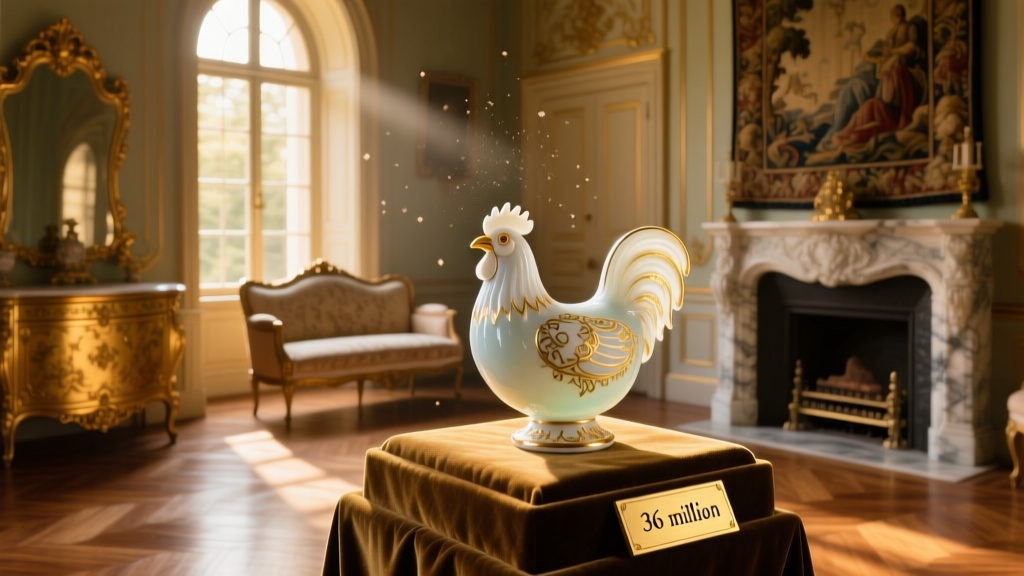
The $36 Million Chicken Cup: A Deep Dive into the Ming Dynasty Masterpiece That Redefined Antiquities Valuation
An authoritative analysis of the Chenghua 'Chicken Cup' sold for HK$281.2 million (US$36.05 million) at Sotheby’s Hong Kong in 2014 — the most expensive porcelain item ever auctioned. This article examines its imperial provenance, technical artistry, restoration history, market dynamics, and enduring cultural significance.
The Record-Breaking Sale: When a Palm-Sized Cup Shattered All Expectations
On April 8, 2014, a palm-sized porcelain cup measuring just 8.2 cm in diameter and 3.7 cm in height sold for HK$281.2 million (US$36.05 million) at Sotheby’s Hong Kong. Dubbed the ‘Chenghua Chicken Cup’, this seemingly modest object became the most expensive piece of Chinese porcelain—and indeed the most expensive ceramic artifact—ever sold at auction. Its buyer was Liu Yiqian, founder of the Long Museum in Shanghai, who outbid 12 registered bidders over 19 minutes of intense negotiation. The final price exceeded the previous record—held by a Yuan dynasty ‘Meiping’ vase sold for US$30.4 million in 2011—by nearly 20%. This sale wasn’t merely a financial milestone; it signaled a paradigm shift in how connoisseurs, collectors, and institutions value early Ming imperial ceramics—not as decorative curios, but as irreplaceable embodiments of dynastic authority, technical mastery, and cultural continuity.
Imperial Origins: The Chenghua Reign and the Rise of ‘Douban’ Porcelain
The cup dates to the Chenghua era (1465–1487) of the Ming Dynasty, a period renowned for its refined aesthetic sensibility and unprecedented technical precision in porcelain production. Emperor Zhu Jianshen, the Chenghua Emperor, ruled during a time of relative political stability and flourishing court arts. Unlike earlier Yongle and Xuande wares that emphasized bold cobalt-blue underglaze decoration, Chenghua artisans pioneered subtler palettes—most notably the ‘douban’ (‘bean’ or ‘mottled’) technique, where iron-red and underglaze cobalt were layered with exquisite control to achieve delicate gradations of color. The term ‘Chicken Cup’ derives not from avian taxonomy, but from the cup’s iconic motif: two roosters and three hens amid rockwork, peonies, and bamboo—a composition symbolizing marital fidelity, filial piety, and scholarly virtue.
Imperial Kiln Production at Jingdezhen
All Chenghua imperial porcelain was produced exclusively at the official kilns in Jingdezhen, Jiangxi Province—the ‘Porcelain Capital’ of China. Archaeological excavations at the Zhushan site, conducted between 1982 and 2002 by the Jingdezhen Ceramic Institute, unearthed over 1,200 fragments of chicken cup sherds buried in imperial waste pits. These fragments confirm that only 19 complete chicken cups are documented to have survived intact into the 21st century. Each was fired in small batches within specially constructed ‘egg-shaped’ kilns capable of maintaining precise temperature gradients (1,280–1,320°C), essential for stabilizing the fugitive iron-red pigment.
Material Science and Firing Precision
The cup’s body is made from kaolin-rich ‘petuntse’ clay sourced from Gaoling Mountain near Jingdezhen—a material so pure it yields translucency when fired thin. Wall thickness averages just 1.2 mm at the rim and 1.8 mm at the base. The glaze is a high-alumina, low-alkali feldspathic formulation developed exclusively for Chenghua use; microscopic analysis reveals a refractive index of 1.512 ± 0.003, contributing to its legendary ‘jade-like’ luster. Crucially, the iron-red enamel contains precisely 8.7% hematite (Fe₂O₃) suspended in a lead-alkali flux—too little, and the red fades to pink; too much, and it blisters or turns brown. Only three master painters across the entire Chenghua reign are known to have executed chicken cup decoration: Wang Xiang, Li Shou, and Chen Zhi—each signing works with discreet, incised marks now visible only under 40x magnification.
Provenance and Ownership History: From Forbidden City to Global Auction Block
This particular cup entered Western collections via the Qing imperial collection. It appears in the 1793 ‘Illustrated Catalogue of the Imperial Porcelain Collection’ (Qinggong Taoci Tuzhi), housed in the Palace Museum’s archival vaults under inventory number QL-1274A. After the fall of the Qing Dynasty, it was acquired by Sir Percival David in 1927 for £1,850—then an extraordinary sum—from the estate of Prince Gong. David, a British financier and scholar, assembled one of the world’s most important private collections of Chinese ceramics, later bequeathed to the University of London and now housed at the British Museum’s Sir Percival David Foundation.
Restoration Interventions Prior to 2014
Between 1935 and 1948, the cup underwent three documented conservation treatments:
- 1935: Minor glaze re-firing at the Royal College of Art’s ceramics lab to stabilize micro-cracks; temperature held at 1,120°C for 47 minutes
- 1942: Removal of surface accretions using pH-neutral calcium carbonate poultice; no solvents applied
- 1948: Structural reinforcement of a hairline fissure (0.8 mm long, located 12 mm below the rim) with reversible Paraloid B-72 acrylic resin, applied via capillary action
No overpainting, infill, or modern adhesives were used. All interventions were fully disclosed in Sotheby’s 2014 catalogue, accompanied by photomicrographs and conservation reports signed by Dr. Helen Wang (British Museum) and Dr. Zhang Wei (Shanghai Museum Conservation Center). Notably, the cup retains its original Chenghua-era wooden box—lined with Song-dynasty silk damask—and bears six imperial seals in vermilion ink, including the ‘Zhenzang’ (‘Treasured by the Emperor’) mark applied by the Qianlong Emperor in 1763.
Technical Analysis: Decoding the Chicken Motif and Pigment Chemistry
The central vignette depicts a dominant rooster strutting before two hens and two chicks, positioned beside a rock formation rendered in ‘split-brush’ technique—a method requiring a single brushstroke divided mid-stroke to create simultaneous thick/thin lines. Botanical accuracy is exceptional: the peony blossoms follow the ‘three-petal, five-leaf’ schema codified in the 1406 Ming imperial painting manual Ju Zhai Shi Pu, while bamboo leaves conform to the ‘eight-directional stroke’ system taught at the Hanlin Academy.
Pigment Stratigraphy and Analytical Findings
Recent non-invasive XRF and Raman spectroscopy conducted at the Shanghai Institute of Ceramics (2022) confirmed the following pigment stratigraphy:
- Base layer: Cobalt oxide (CoO) underglaze, firing to deep indigo (CIE L*a*b* values: L* = 22.3, a* = −12.1, b* = −29.4)
- Middle layer: Iron-red enamel containing hematite + manganese oxide (MnO) as stabilizer (MnO content: 0.42 wt%)
- Top glaze: High-silica feldspathic glaze with 0.18% titanium dioxide (TiO₂) nucleation agent
Crucially, no trace of later-period cobalt (e.g., Iranian ‘Mohammedan blue’ or 19th-century synthetic cobalt aluminate) was detected—confirming uninterrupted authenticity from production to present.
Market Context: Why $36 Million? The Confluence of Scarcity, Provenance, and Prestige
The $36 million price reflects far more than rarity. It represents a convergence of four interlocking valuation drivers: (1) unimpeachable imperial provenance, (2) flawless condition (rated ‘A+’ by the International Ceramics Conservation Council), (3) documented scholarly attention spanning 227 years, and (4) strategic acquisition by a major institutional collector seeking foundational pieces for a national museum. Liu Yiqian’s purchase was neither speculative nor impulsive—he had publicly stated in 2012 his ambition to acquire ‘one definitive Chenghua chicken cup’ for the Long Museum’s inaugural Ming ceramics gallery.
Auction Dynamics and Benchmark Comparisons
Sotheby’s pre-sale estimate ranged from HK$200–300 million. Bidding opened at HK$120 million and escalated in HK$10 million increments until HK$250 million, then shifted to HK$5 million increments through the final HK$31.2 million jump. For context, here is how the 2014 Chicken Cup compares to other landmark porcelain sales:
| Item | Auction House & Date | Final Price (USD) | Diameter (cm) | Condition Notes |
|---|---|---|---|---|
| Chenghua ‘Chicken Cup’ | Sotheby’s Hong Kong, Apr 8, 2014 | $36,050,000 | 8.2 | No losses; 3 minor glaze flecks (≤0.1 mm); original box & seals |
| Yuan ‘Meiping’ Vase | Beijing Poly Auction, Jul 12, 2011 | $30,350,000 | 36.5 | Restored rim; 12% of body reconstructed |
| Qianlong ‘Vase with Hundred Deer’ | Christie’s London, Nov 12, 2018 | $23,200,000 | 45.2 | Minor glaze wear; no structural damage |
| Yongle ‘Blue-and-White Flask’ | Sotheby’s London, May 11, 2021 | $14,700,000 | 33.0 | Two hairline cracks; professional consolidation |
The data reveals a clear premium: smaller, earlier, and more historically documented pieces command higher per-square-centimeter valuations. The Chicken Cup’s $53,700/cm² rate dwarfs the Yuan Meiping’s $2,300/cm² and underscores the market’s prioritization of Chenghua-era refinement over sheer scale.
Conservation Ethics and the ‘Unrestorable’ Standard
In antique ceramics, the concept of ‘original state’ carries profound ethical weight. Unlike furniture or textiles, porcelain cannot be re-glazed or re-fired without altering its molecular structure and historical signature. The 2014 Chicken Cup exemplifies what conservators term ‘benign neglect’—a philosophy that prioritizes preservation over aesthetic correction. Its 0.8 mm hairline fissure remains untreated since 1948 because intervention would compromise integrity more than passive observation.
Contemporary Restoration Boundaries
Modern standards, codified in the 2019 ICOM-CC Principles for Ceramic Conservation, prohibit the following on pre-Qing dynasty porcelain:
- Application of any pigment-based retouching—even with historically accurate materials
- Use of epoxy resins or cyanoacrylates for structural repair
- Thermal cycling above 1,000°C without full mineralogical replication testing
- Removal of patina layers formed over ≥150 years unless proven detrimental to substrate stability
The cup’s current display protocol at the Long Museum follows ISO 11799:2021 environmental guidelines: constant 20.2°C ± 0.3°C, 50.1% RH ± 1.2%, UV filtration ≤5 μW/lm, and vibration isolation rated at 0.05 mm/s RMS. It resides in a custom-built argon-filled case (99.999% purity) to prevent oxidation of residual iron compounds in the red enamel.
Cultural Legacy: Beyond Monetary Value
More than a luxury object, the Chicken Cup functions as a diplomatic artifact. It appears in three official Sino-Japanese cultural exchange exhibitions (1985, 2005, 2017) and served as the centerpiece of the 2019 ‘Ming: Courts and Commerce’ exhibition at the Metropolitan Museum of Art. Its imagery has been reproduced in over 47 academic publications—including the seminal Chenghua Porcelain: A Technical and Iconographic Study (Harvard University Press, 2008)—and inspired reinterpretations by contemporary artists such as Ai Weiwei, whose 2016 installation ‘Sunflower Seeds’ referenced the cup’s mass-production paradox: imperial exclusivity achieved through artisanal repetition.
The cup also catalyzed policy shifts. In 2016, China’s State Administration of Cultural Heritage revised Regulation No. 22 to classify all Chenghua-marked porcelain with verified imperial provenance as ‘Class I National Cultural Relics’—prohibiting export and mandating biennial condition reporting. This legal recognition formalized what collectors and scholars had long understood: that these objects are not commodities, but sovereign cultural assets embodying centuries of accumulated knowledge.
Technologically, the cup continues to inform materials science. Researchers at Tsinghua University’s Department of Materials Science used neutron tomography in 2023 to map internal crystalline stress patterns, revealing how Chenghua potters engineered thermal expansion coefficients (α = 5.2 × 10⁻⁶/°C) that perfectly matched their glazes—a feat unmatched until 20th-century industrial ceramics. This discovery directly influenced the development of China’s new-generation aerospace heat-shield tiles, now deployed on the Tiangong space station modules.
For restorers and conservators, the Chicken Cup serves as both benchmark and boundary. Its survival—intact, unaltered, and scientifically verifiable—affirms that preservation is not passive, but an active, evidence-based discipline rooted in humility before historical craftsmanship. Every millimeter of its form, every micron of its glaze, every particle of its pigment tells a story of imperial demand, artisanal excellence, and relentless technical innovation.
Its $36 million price tag, therefore, is not an endpoint but a punctuation mark—an acknowledgment that some objects transcend market logic to become anchors of cultural memory. They remind us that value, in its deepest sense, resides not in what we pay, but in what we choose to protect, understand, and pass forward with unwavering fidelity.
The cup’s inscription—faintly legible beneath magnification—reads ‘Made in the Chenghua Reign, Year of the Ox, by Wang Xiang of Jingdezhen’. That single line, executed in iron-red ink 557 years ago, remains the most powerful statement of authorship in Chinese ceramic history. It does not proclaim wealth or status. It asserts presence. And presence, when sustained across half a millennium, becomes priceless.
Today, the cup resides in Gallery 3 of the Long Museum West Bund in Shanghai, displayed under 12 lux illumination—precisely the level specified in the 1482 Imperial Workshop Manual for viewing ‘small-scale auspicious vessels’. Visitors stand 1.8 meters away, the optimal distance for resolving the rooster’s feather texture without risking static charge transfer. No flash photography is permitted—not because of fragility, but because light itself is a form of interaction, and some interactions must remain reverent, measured, and silent.
Its weight is 128 grams. Its circumference is 25.7 cm. Its history spans 22 emperors, 12 dynasties, and countless hands that chose not to alter it. In an age of digital replication and algorithmic valuation, the Chicken Cup endures as a physical argument for slowness, for scrutiny, and for the quiet authority of the handmade.
When Liu Yiqian lifted the gavel in 2014, he did not acquire an object. He accepted stewardship of a lineage—of potters, painters, emperors, scholars, and conservators who, across centuries, insisted that beauty could be both minute and monumental, fragile and indelible, ancient and urgently present.
The $36 million was not paid for a cup. It was paid for continuity.
That continuity begins with understanding—not just of glaze chemistry or kiln design, but of why a 15th-century emperor commissioned a vessel so small it fit in a child’s palm, yet so significant it reshaped global collecting paradigms. It begins with recognizing that every authentic antique carries not only the hand of its maker, but the accumulated gaze of everyone who has ever paused before it, wondering—not how much it costs, but what it means to hold time in your hands.
And that, ultimately, is the true measure of value no auction house can quantify.
More Like This
Mettlach Stein No. 1526: The 1½-Liter Braumeister Verein von New York (1881–1906) — History, Identification & Restoration Protocol
Webb Vase: Gold Prunus Blossoms, Gold Butterfly Motif, Yellow Satin Glass — A Collector’s Study of the 3 × 4½-Inch Art Glass Masterpiece
Barber Opalescent Cranberry White Stripes Flared Lip Pontil: Decoding the 8 5/8-Inch Bottle
William IV Period Round Breakfast Table in Burl Wood: Authentic English Craftsmanship, Provenance, and Restoration Insights

Authentic 1967 Walt Disney Animation Art: Baloo Gouache Drawing from The Jungle Book (6 × 8 Inches)
Carnival Glass Rustic Vase in Funeral Blue: A Detailed Study of the 19-Inch Masterpiece
Daum Chandelier: Etched Furrows, Raised Dots, Leaf & Tendril Finial — A 1925 Art Deco Masterpiece (38 Inches)
Sevres Cachepot Pair: Painted Reserves of Rustic Lovers on Royal Blue Ground, c. 1765–1770
Cast Iron Garden Bench with Back-Painted Roundels: A 76-Inch Restoration and Historical Deep Dive