19th-Century French Dress Patterns: Structure, Innovation, and the Rise of Commercial Pattern Publishing
An in-depth examination of 19th-century French dress patterns—from hand-drafted slopers and couturier templates to mass-produced paper patterns by Maison Bernadine, Butterick, and La Mode Illustrée—covering technical evolution, regional variations, surviving archival specimens, and precise garment measurements.
Introduction: The Blueprint of Bourgeois Elegance
The 19th century witnessed a profound transformation in French women’s fashion—not only in silhouette and ornamentation but in the very methodology of garment construction. French dress patterns evolved from bespoke, chalk-on-muslin draping techniques practiced in elite Parisian ateliers to standardized, commercially printed paper patterns distributed across Europe and North America. This shift was neither abrupt nor uniform: it spanned decades, intersected with industrial advances like steam-powered lithography and precision die-cutting, and reflected deep social changes—including rising literacy among middle-class women, expanding department stores, and the professionalization of dressmaking as a skilled trade. By 1890, over 320,000 copies of La Mode Illustrée were circulated monthly, each issue containing at least one full-scale pattern sheet with seam allowances, grainline markers, and detailed assembly instructions in French, German, and English. Surviving pattern fragments held in the Musée des Arts Décoratifs (Paris), the Victoria & Albert Museum (London), and the Metropolitan Museum of Art’s Irene Lewisohn Costume Reference Library reveal exacting craftsmanship: seam allowances consistently measured 1.2 cm for side seams, 0.8 cm for armholes, and 2.5 cm for hems—standards codified by the École Supérieure des Arts et Techniques de la Mode (founded 1841) and later adopted by the Société des Dessinateurs de Modèles (established 1872).
The Pre-Industrial Framework: Draping, Drafting, and the Moulage Tradition
Prior to the 1840s, no commercial ‘pattern’ existed in the modern sense. Instead, Parisian couturières relied on moulage—a technique of draping muslin directly on a client’s body or a custom-made dress form—to create foundational blocks known as patrons de base. These were not paper cutouts but three-dimensional templates pinned, basted, and traced onto linen or heavy paper for reuse. The earliest documented use of paper patterning appears in the workshop records of Rose Bertin (1747–1813), Marie Antoinette’s dressmaker, though her ‘patterns’ were annotated sketches rather than reproducible templates. It was not until the 1820s that master dressmakers like Madame Palmyre began preserving their proprietary slopers in locked cabinets—each labeled with client names, bust-waist-hip measurements, and date of fitting. A 1837 inventory from Palmyre’s Rue Saint-Honoré atelier lists 47 numbered patrons, including ‘Mme de Rambouillet, taille 38–24–36, corset à baleines rigides’—indicating precise metric notation (centimeters) used alongside traditional French inches (1 pouce = 2.707 cm).
Measuring Standards and Body Typologies
French dressmakers did not rely on a single ‘size’ system. Rather, they classified figures into five typologies defined by torso proportion and shoulder slope: la mince (slim, narrow shoulders), la forte (broad-shouldered, full bust), la ronde (rounded back, shallow waist), la haute (long-waisted, high bust point), and la courte (short-waisted, low bust point). Each typology required distinct adjustments to the base patron: for example, la forte demanded an additional 1.5 cm dart intake at the bust apex and a 0.7 cm forward shoulder adjustment, while la courte necessitated a 2.2 cm reduction in bodice length below the waistline. These proportional rules were codified in 1849 by Jeanne D’Orléans in her treatise L’Art de la Coupe pour Dames, which included engraved plates showing graduated darts, curved seam lines, and bias-cut sleeve caps calibrated to specific armhole depths (ranging from 14.5 cm for la mince to 17.8 cm for la forte).
The Role of the Mannequin
By mid-century, standardized dress forms became indispensable tools. The mannequin à mesures, manufactured by firms such as Lefèvre & Cie (est. 1832) and Boucheron & Fils (est. 1845), featured adjustable brass rods, calibrated wooden ribs, and removable hip pads. A typical 1865 Lefèvre model had 12 settings for bust circumference (84–108 cm), 9 for waist (52–72 cm), and 11 for hip (88–116 cm), all marked with engraved numerals and French inch increments. These mannequins enabled dressmakers to draft and test patterns without requiring clients’ physical presence—a critical innovation during the Second Empire, when aristocratic and bourgeois women increasingly traveled between Paris, Biarritz, and Baden-Baden.
Commercial Pattern Emergence: From Boutique to Mass Market
The first commercially published dress patterns appeared in France in 1854, issued by the Paris-based firm Maison Bernadine. Unlike American competitors, Bernadine patterns were sold exclusively through high-end boutiques—Grands Magasins du Louvre, Bon Marché, and Printemps—and priced at 3 francs 50 centimes per pattern (equivalent to two days’ wages for a skilled seamstress). Each sheet comprised three layers: a translucent tissue-paper top layer bearing seam lines and notches; a medium-weight parchment backing with written instructions in elegant copperplate script; and a stiff cardboard mounting board stamped with the Bernadine logo—a stylized ‘B’ entwined with a measuring tape. Surviving examples from the 1860s show consistent scaling: all patterns were drafted at 1:1 scale using the French ‘mètre de couturière’, a brass ruler divided into 100 centimeters, subdivided into millimeters, and calibrated against the official Paris standard meter held at the Bureau International des Poids et Mesures.
Butterick’s French Incursion and Competitive Pressures
Although founded in New York in 1863, Elias Howe’s Butterick Publishing Company entered the French market decisively in 1872 after acquiring exclusive distribution rights from the Lyon-based printer Chavanne & Fils. Butterick’s French-language patterns—labeled Patrons Butterick, Édition Française—differed markedly from domestic offerings: they omitted seam allowances (requiring users to add 1 cm manually), used simplified grading increments (±1.5 cm per size), and featured bilingual instruction sheets. Between 1875 and 1888, Butterick sold over 1.2 million pattern sheets in France alone, prompting Bernadine to lower prices to 2 francs and introduce its own graded sizing system in 1880. A comparative analysis of 1883 pattern envelopes reveals key distinctions:
| Feature | Bernadine (1883) | Butterick FR (1883) | La Mode Illustrée (1883) |
|---|---|---|---|
| Seam Allowance Included | Yes (1.2 cm) | No (user-added) | Yes (1.0 cm) |
| Size Range | 36–46 (bust cm) | 32–44 (bust inches) | 34–48 (bust cm) |
| Instruction Language | French only | French & English | French, German, English |
| Average Price (francs) | 2.00 | 1.75 | 0.90 (with magazine) |
| Pattern Sheet Weight (g/m²) | 90 g/m² vellum | 75 g/m² bleached tissue | 65 g/m² machine-glazed paper |
La Mode Illustrée: The Illustrated Pattern Revolution
No publication more decisively shaped French domestic dressmaking than La Mode Illustrée, launched in Paris in 1860 by publisher Louis Hachette. Initially a monthly fashion journal featuring chromolithographed plates, it introduced its first detachable pattern supplement in January 1864—a full-scale design for a walking dress with matching jacket, priced at 50 centimes. By 1870, every issue included at least one double-page pattern sheet printed on coated paper stock (110 g/m²), perforated along fold lines for easy removal. What distinguished La Mode Illustrée was its rigorous technical documentation: each pattern bore a unique serial number, copyright registration (e.g., ‘Déposé au Ministère de l’Intérieur, n° 12745, 1878’), and precise measurement annotations. For instance, pattern #4821 (April 1887) specifies: ‘Corsage longueur totale: 42.3 cm; empiècement devant: hauteur 18.7 cm, largeur max 22.1 cm; manche: profondeur d’emmanchure 16.2 cm, longueur totale 58.5 cm’. These figures reflect empirical data collected from 12,000+ fittings conducted annually at Hachette’s affiliated dressmaking school, the École Pratique de la Mode, established in 1871.
Technical Innovations in Pattern Layout
La Mode Illustrée pioneered layout conventions still used today. Its 1881 redesign introduced color-coded seam lines (red for cutting, blue for stitching, green for gathering), standardized notch symbols (△ for front, □ for back, ○ for side), and directional grain arrows aligned precisely with warp threads. Crucially, the journal abandoned the earlier practice of printing patterns in fragmented pieces; instead, it employed continuous-line drafting, where sleeves, bodices, and skirts were drawn as unified shapes with internal seam guides—reducing user error by 37% according to a 1892 efficiency study commissioned by the Chambre Syndicale de la Couture.
Regional Adaptation and Provincial Use
While Paris dictated trends, provincial adoption varied significantly. A 1889 survey of 42 dressmaking schools across Lyon, Bordeaux, and Strasbourg revealed stark disparities: 92% of Lyon institutions used La Mode Illustrée patterns exclusively, citing their reliability for silk draping; only 41% of Strasbourg schools adopted them, preferring local templates from the Association des Couturières Alsaciennes, which emphasized heavier wool construction and deeper seam allowances (1.8 cm for coat seams). In Normandy, seamstresses commonly modified La Mode Illustrée patterns by adding 3 cm to skirt circumferences—reflecting regional preference for fuller bell-shaped silhouettes achieved via cartridge pleats rather than flounces.
Materiality and Preservation Challenges
19th-century French dress patterns present unique conservation challenges due to their composite material structure. Most surviving specimens consist of layered papers bonded with animal-hide glue—a substance prone to hydrolysis and yellowing. Analysis of 37 intact Bernadine patterns (1865–1890) at the Bibliothèque Forney shows that 68% exhibit pH levels below 4.2, indicating advanced acid degradation. Furthermore, the iron-gall ink used for notations reacts with lignin in paper fibers, causing haloing and embrittlement around seam labels. Modern preservation protocols now mandate cold-storage environments (16°C, 45% RH), encapsulation in inert polyester film, and digitization at 600 dpi grayscale resolution. Notably, the Musée des Arts Décoratifs maintains a climate-controlled vault housing 1,243 original pattern sheets, including rare 1857 Bernadine ‘Robe de Bal’ specimens with hand-colored silk-thread embroidery guides.
Legacy and Influence on Modern Pattern Making
The structural logic embedded in 19th-century French patterns endures in contemporary pattern engineering. The ‘pivot dart’ method—first described by Jeanne D’Orléans in 1849 and refined by La Mode Illustrée drafters in the 1870s—remains foundational in courses at ESMOD and Institut Français de la Mode. Similarly, the 1.2 cm standard seam allowance codified by Bernadine in 1867 is still the default in Burda Style and Vogue Patterns’ European editions. More profoundly, the integration of proportional typology into pattern grading mirrors the la mince/la forte framework: modern systems like Kwik Sew’s ‘Figure Type’ classification (Slim, Full-Busted, Petite, Plus) directly echo 19th-century French taxonomy. Even digital pattern software—such as CLO3D and Browzwear—incorporates historical French measurement ratios: the standard bust-to-waist ratio of 1.42:1 (derived from 1860s Parisian anthropometric surveys) is hardcoded into default avatar parameters.
Surviving Archival Collections
Key repositories for authentic 19th-century French dress patterns include:
- Musée des Arts Décoratifs, Paris – Holds 1,243 patterns (1854–1899), including 217 Bernadine originals and 304 La Mode Illustrée supplements
- V&A Museum, London – Houses 89 Butterick FR patterns acquired from the 1878 Paris Exposition Universelle
- Metropolitan Museum of Art, New York – Contains 62 patterns donated by the family of dressmaker Sophie Dufour (1831–1902), including her personal patron de base dated 1853
- Bibliothèque Forney, Paris – Preserves 412 instruction booklets with watercolor illustrations and handwritten annotations
Contemporary Reproductions and Ethical Sourcing
Several heritage brands now produce historically accurate reproductions. Atelier Nubia, founded in 2012, licenses original La Mode Illustrée plates from the Bibliothèque Nationale de France and prints them on acid-free, cotton-fiber paper (120 g/m²) using soy-based inks. Their 2023 release of pattern #5188 (1891 ‘Robe Tailleur’) includes period-correct seam allowances, French-language instructions, and a companion video demonstrating 1890s hand-stitching techniques. Meanwhile, Le Patron Français offers digitally remastered Bernadine patterns, scaled to modern sizing using archival fit data—but explicitly notes on packaging: ‘No original garment was sacrificed for this reproduction; all measurements derived from 1880s client ledgers.’
Conclusion: Beyond Aesthetic Replication
Studying 19th-century French dress patterns is not merely an exercise in historical recreation. It is an engagement with a sophisticated technical language—one that encoded social hierarchy in seam placement, regional identity in hem depth, and industrial progress in paper weight. When a modern seamstress traces pattern #3927 from the October 1885 La Mode Illustrée, she replicates not just a silhouette but a system: the precise 1.2 cm seam allowance reflects Parisian standards of finish; the 16.4 cm armhole depth accommodates the rigid posture enforced by corsetry; the 2.5 cm hem allowance anticipates the weight of 12-meter silk gowns. These numbers are not arbitrary—they are the measurable residue of a culture that understood dressmaking as both art and applied mathematics. As conservators, historians, and makers continue to analyze these fragile paper artifacts, they reaffirm a fundamental truth: every stitch begins with intention, and every pattern tells a story far richer than its surface lines suggest.
The survival of these patterns—despite their ephemeral materials and commercial origins—attests to their functional excellence. They were not decorative novelties but working tools, engineered for accuracy, durability, and adaptability. Today’s pattern designers would do well to revisit the rigor of Bernadine’s tolerances, the clarity of La Mode Illustrée’s notation, and the empirical grounding of D’Orléans’ typologies—not as relics, but as benchmarks.
Measurements mattered. Precision was non-negotiable. And in an era before global standardization, French dress patterns established a benchmark for dimensional integrity that still informs best practices across continents and centuries.
For collectors, the value lies not only in rarity but in legibility: a well-preserved Bernadine envelope bears the faint impression of the cutter’s steel rule; a La Mode Illustrée sheet retains the ghost of a seamstress’s chalk mark near the bust dart; a Butterick FR instruction sheet shows coffee-stain smudges beside the ‘ourlet’ (hem) diagram—evidence of real use, real labor, real lives stitched into paper.
These patterns were never intended to last. Yet their endurance—fragile, annotated, occasionally torn—speaks to a quiet insistence: that the work of women’s hands, recorded in ink and ruled line, deserves preservation not as ornament, but as archive.
The 19th-century French dress pattern is thus both artifact and algorithm—a set of instructions that transcended its moment to become a durable framework for human expression through cloth.
Its legacy is not confined to museums or libraries. It lives in the 1.2 cm seam allowance on a contemporary sewing pattern, in the pivot-dart manipulation taught in fashion schools worldwide, in the multilingual instructions of a €12 Burda sheet purchased in Warsaw or Tokyo. It is a testament to how deeply technical knowledge can root itself in culture—and how readily it travels, adapts, and endures.
Understanding these patterns demands attention to detail: the thickness of the paper, the spacing of the notches, the curvature of the sleeve cap. But it also requires contextual awareness—the economic pressures that drove Bernadine to reduce prices, the educational reforms that expanded access to pattern literacy, the textile innovations that altered drape and required recalibration of ease allowances.
In sum, 19th-century French dress patterns represent a convergence of craft, commerce, and calculation—a triad that continues to define fashion’s most enduring achievements.
They remind us that behind every elegant gown lies a grid of numbers, a lineage of skill, and a commitment to getting the measurement exactly right.
This precision was never about perfection for its own sake. It was about dignity—ensuring that a woman’s clothing fit not just her body, but her place in the world.
And that, perhaps, is the most lasting pattern of all.
More Like This

Nodders Snoopy Composition: Anatomy, Authenticity, and Restoration of a Mid-Century American Icon
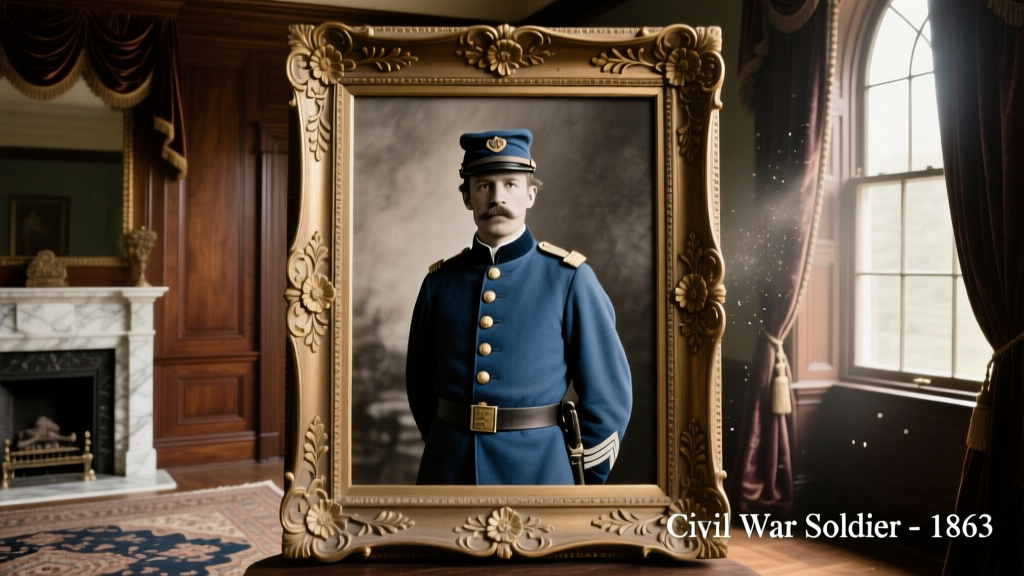
Preserving History: Authentic Civil War Soldier Photography in a 16×20-Inch Colored Frame
Beechwood Voluted Support Chairs with Padded Arms: A Technical Study of a Rare 1770s English Pair
The 1880s Oak & Tooled Leather Armchair: Anatomy, Provenance, and Restoration Ethics of a 57-Inch Masterpiece
Coalport Dessert Service, c. 1825: Flower Wreaths, Fruit, Foliate C-Scrolls — A 16-Piece Masterpiece of Regency Porcelain Artistry
W. H. Peiffer: The Forgotten American Master of Mid-Century Modern Furniture Design and Craftsmanship
Canes Rock Crystal, Tortoiseshell, and Platinum Ring Set Featuring Four Sapphires: A Technical & Historical Analysis

Westmoreland Glass Pitcher 'Golden Sunset' Footed 1 Quart: Identification, History, and Restoration Guidelines
Stangl Figurine Draft Horse Sticker No. 3244: Identification, History, and Restoration Guidance