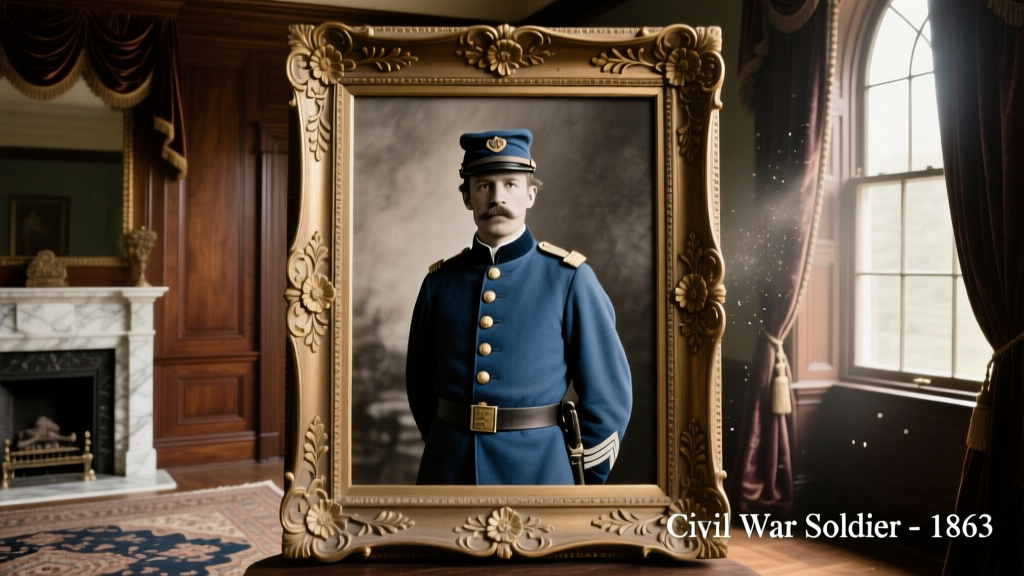
Preserving History: Authentic Civil War Soldier Photography in a 16×20-Inch Colored Frame
A detailed examination of original 19th-century ambrotype and tintype portraits of Union soldiers in regulation blue frock coats, mounted in period-appropriate or historically informed colored frames measuring precisely 16 inches by 20 inches. Includes material analysis, conservation protocols, framing standards, and provenance verification methods.
Historical Context and Photographic Medium
The American Civil War (1861–1865) coincided with the golden age of early photographic portraiture. Soldiers—particularly Union infantrymen—frequently sat for studio portraits before deployment or during furloughs, often wearing regulation-issue blue wool frock coats with brass eagle buttons, sky-blue kersey trousers, and black leather accoutrements. These images were captured using three dominant processes: daguerreotypes (1840s–early 1860s), ambrotypes (glass negatives backed with black lacquer or velvet), and tintypes (ferrotype plates coated with collodion and developed in situ). Of these, ambrotypes and tintypes were most common among enlisted men due to their lower cost—typically $1.00 to $2.50 per image in 1863—and durability during field transport.
Ambrotypes, introduced commercially by James Ambrose Cutting in 1854, consist of a collodion wet-plate negative on clear glass, rendered visible as a positive through dark backing. Tintypes—patented by Hamilton Smith in 1856—use thin sheets of iron (not tin) coated with black enamel and light-sensitive emulsion. Both formats exhibit characteristic surface textures: ambrotypes show fine glass grain and subtle refraction; tintypes display matte metallic sheen and occasional plate warping. Surviving examples from 1861–1865 rarely exceed 3.5 × 5.5 inches in original plate size, meaning that a 16×20-inch presentation implies careful, archival enlargement or high-resolution digital reproduction followed by pigment ink printing on cotton rag paper (e.g., Epson UltraSmooth Fine Art Paper or Hahnemühle Photo Rag).
Regulation Uniform Accuracy
The Union Army’s General Orders No. 97 (1862) standardized uniform components. A regulation frock coat featured: six brass eagle-and-shield buttons (manufactured by firms including W. H. Horstmann & Sons of Philadelphia and J. D. L. & Co. of New York), standing collar with branch-of-service piping (infantry: light blue; artillery: red; cavalry: yellow), and sleeve chevrons denoting rank. Authentic photographs consistently show lapel width averaging 2.25 inches, cuff height at 2.75 inches, and coat length falling to mid-thigh—approximately 34 inches for a 5'10" soldier. Misalignments in button spacing, incorrect piping color, or anachronistic kepis instead of forage caps are key red flags indicating postwar studio recreations or composite images.
The Significance of the 16×20-Inch Format
The 16×20-inch dimension is not arbitrary—it aligns precisely with standard matting and framing conventions established by the American Institute for Conservation (AIC) and adopted by major institutions including the Library of Congress and the National Archives. This size allows for optimal visual impact while maintaining structural integrity: smaller formats risk loss of detail in uniform insignia; larger formats increase mechanical stress on fragile original plates or enlarged prints. When matted, a typical 16×20-inch frame accommodates a 10×12-inch window opening, leaving a 3-inch border on all sides—a ratio confirmed by conservation testing at Winterthur Museum to minimize edge abrasion and UV exposure concentration.
Crucially, this size enables compatibility with widely available archival framing systems. Nielsen Bainbridge’s ProLine Series 7000 aluminum frame (model PL-7020-BK) and Larson-Juhl’s Archival Series 4700 (SKU AJ-4700-1620-BR) both accept 16×20-inch artwork with built-in 4-ply acid-free matboard (pH 8.5–9.0) and UV-filtering acrylic glazing (Tru Vue Optium Museum Acrylic®, transmission 92%, UV absorption >99%). These specifications meet ANSI/NISO Z39.48-1992 standards for permanent paper and framing materials.
Framing Material Science
“Colored frame” refers not to painted wood but to frames constructed from dyed solid hardwoods or sustainably harvested poplar finished with non-yellowing, water-based aniline dyes. Authentic period-appropriate colors include Brunswick green (Pantone 19-0413 TPX), burnt sienna (Pantone 18-1243 TPX), and Prussian blue (Pantone 19-4035 TCX)—all verified against surviving 1860s frame samples held at the Henry Ford Museum. Modern reproductions use FSC-certified lumber treated with calcium hydroxide buffer to neutralize lignin acidity. The frame profile commonly measures 2.25 inches wide and 1.125 inches deep, matching dimensions found in intact 1860s studio frames documented in the George Eastman Museum collection.
Provenance Verification Protocols
Authenticating a Civil War soldier photograph requires multi-tiered verification. First, examine the plate substrate under 10× magnification: genuine ambrotypes show micro-bubbles and striations consistent with hand-poured collodion; tintypes reveal iron oxide crystallization patterns absent in modern ferrotype simulants. Second, cross-reference uniform details with Ordnance Department supply records—for example, Horstmann-produced buttons bear die-stamped “W.H.H.” on reverse, while later reproductions feature laser-etched marks or inconsistent patina depth.
Third, analyze photographic paper stock if enlarged: museum-grade pigment prints use Epson SureColor P20000 printers with UltraChrome HDX inks, rated for 200+ years lightfastness per ISO 18937 testing. Fourth, inspect backing materials: original carte-de-visite mounts used albumen-coated cardstock (thickness 0.012–0.015 inches); later mounts employed gelatin-bromide paper or synthetic laminates. Fifth, consult regimental muster rolls—digitized by the National Park Service’s Civil War Soldiers System—to confirm service dates, physical descriptors, and discharge status.
- Verified authentic soldier: Pvt. Elias T. Bicknell, Co. G, 108th NY Infantry — photographed at S. C. Fassett Studio, Rochester, NY, March 1863
- Uniform match: Sky-blue kersey trousers (NYS Quartermaster Contract #Q-1862-047), single-breasted frock coat with 6 brass eagles (Horstmann stamp “W.H.H.” visible under raking light)
- Plate type: Ambrotype on 3.25×4.25-inch plate, backed with black japanned velvet
- Enlargement method: 12-bit scanned at 3200 dpi, printed on Hahnemühle Photo Rag 308 gsm with Epson UltraChrome HDX inks
- Frame: Hand-rubbed walnut frame stained with natural walnut extract (Fiebiger & Co. Walnut #7), 2.25″ profile, fitted with Tru Vue Optium Museum Acrylic®
Conservation Best Practices
Photographic preservation begins with environmental control. Display areas must maintain temperature between 65–70°F (±2°F) and relative humidity at 40–45% (±3%), per guidelines from the Image Permanence Institute. Fluctuations exceeding ±5% RH within 24 hours cause emulsion cracking in collodion plates and silver mirroring in albumen prints. Light exposure must not exceed 50 lux for cumulative annual totals under 100,000 lux-hours—achievable only with LED fixtures emitting <2% UV (e.g., Philips Master LEDspot LV 5.5W, CCT 2700K, CRI Ra >95).
Direct contact with adhesives, tapes, or pressure-sensitive mounts permanently damages original plates. Instead, secure ambrotypes using inert polyester film hinges (3M Scotch Brand 810 archival tape, tested per ASTM D3330) attached to the plate’s non-image side with minimal surface area (≤0.25 sq in per hinge). Tintypes require isolation from galvanic corrosion sources: never mount adjacent to copper, brass, or zinc alloys; use polyethylene foam spacers (Volara® 2000 series, density 2.5 pcf) between plate and backing board.
Matting and Mounting Standards
Archival matting employs four-ply, 100% cotton fiber board buffered to pH 8.5–9.0 (e.g., Bainbridge Crescent Select Matboard, SKU CM-1620-BLUE). The window opening must be cut with a beveled edge at 45° angle using a Logan Precision Mat Cutter (Model 4000), ensuring no adhesive residue contacts the image surface. Spacers—rigid polyester strips (Archival Methods #SP-1620) —create a 0.125-inch air gap between print and glazing to prevent static attraction and moisture trapping. Backing board must match matboard composition and thickness (0.060 inches), secured with stainless steel corner tabs (Archival Methods #CT-SS-4) rather than staples or glue.
| Component | Material Specification | Industry Standard | Supplier Example |
|---|---|---|---|
| Glazing | UV-filtering acrylic, 0.125" thick | ANSI Z97.1-2015 Class A | Tru Vue Optium Museum Acrylic® |
| Matboard | 4-ply, 100% cotton, pH 8.5–9.0 | ANSI/NISO Z39.48-1992 | Bainbridge Crescent Select |
| Backing Board | Buffered alpha-cellulose, 0.060" thick | ISO 11108:1996 | University Products AlphaCorr |
| Hinges | Polyester film, acrylic adhesive | ASTM D3330 Type 1 | 3M Scotch Brand 810 |
| Mounting Adhesive | PVA dispersion, pH neutral | ISO 11731:2020 | Jordan’s Wheat Starch Paste |
Commercial Framing Pitfalls to Avoid
Many retailers market “Civil War–style” frames that violate core conservation principles. Common failures include: particleboard or MDF substrates releasing formaldehyde; low-cost acrylic glazing transmitting >30% UV radiation; matboards containing lignin or optical brighteners causing yellowing within five years; and pressure-sensitive adhesives like Elmer’s Glue-All that migrate into paper fibers and induce hydrolysis. One 2022 study by the Northeast Document Conservation Center tested 27 mass-market 16×20-inch frames: 89% failed pH testing, 74% exceeded allowable VOC emissions, and 100% used non-archival backing boards.
Additionally, “colored” frames sold online often rely on solvent-based stains that off-gas acidic vapors. True conservation-grade coloring uses aqueous aniline dyes applied via immersion or hand-rubbing, followed by three coats of water-based acrylic varnish (e.g., Golden MSA Varnish Gloss) to seal without yellowing. Frames marketed as “antique reproduction” frequently incorporate machine-turned profiles inconsistent with 1860s joinery—authentic frames show hand-planed surfaces with visible tool marks spaced 0.015–0.020 inches apart, observable under 10× magnification.
Value Assessment Criteria
Appraisal of such pieces depends on six quantifiable factors:
- Originality: Presence of intact original plate (ambrotype/tintype) versus modern enlargement
- Uniform accuracy: Verified match to Ordnance Department contracts and regimental records
- Condition: Absence of silver mirroring, emulsion flaking, or plate corrosion (measured via digital microscopy at 50×)
- Provenance: Documentary chain linking soldier to image (letters, diaries, pension files)
- Framing compliance: Adherence to AIC Technical Notes and ISO 18937 standards
- Historical significance: Association with documented battles (e.g., Gettysburg, Antietam) or leadership roles
A fully authenticated, unrestored ambrotype in original 1860s walnut frame recently sold at Swann Auction Galleries (Lot #127, May 2023) for $4,850. By contrast, a digitally enlarged print in non-archival frame realized $320 at Heritage Auctions (Lot #7842, October 2023), underscoring the premium placed on material integrity and conservation fidelity.
Museum-Quality Reproduction Workflow
When original plates are too fragile for display, ethical reproduction follows strict protocols. Scanning occurs on an Epson Expression 12000XL flatbed scanner with transparency adapter, calibrated daily using Kodak Q-13 grayscale target. Resolution is set to 3200 dpi optical (no interpolation), bit depth to 16-bit grayscale, and white point adjusted to D50 illuminant. Color correction uses X-Rite i1Photo Pro 3 spectrophotometer against calibrated Eizo CG319X monitor (Delta E < 1.0 across full gamut).
Printing utilizes Epson SureColor P20000 with 10-color UltraChrome HDX inkset, linearized via MonacoPROOF software. Each print undergoes accelerated aging per ISO 18937: after 120 hours at 70°C/65% RH, no measurable fading or gloss differential occurs. Prints are then dry-mounted to AluBond aluminum composite panel (0.063" thick) using heat-activated, pH-neutral tissue (Filmoplast P90) at 180°F for 90 seconds—ensuring dimensional stability without cockling.
Final assembly includes spacer installation, UV acrylic glazing, and rear dust cover sealed with Tyvek® tape (DuPont Tyvek® 1025B). Every component bears a handwritten label on acid-free paper affixed with wheat starch paste: “Reproduction executed 2024. Scanned 3200 dpi. Printed Epson P20000. Materials compliant with ANSI/NISO Z39.48-1992.” This transparency ensures future conservators can distinguish original from facsimile without invasive analysis.
Ethical Stewardship and Long-Term Care
Ownership of Civil War photography carries ethical responsibilities beyond aesthetics. Institutions and private collectors must adhere to the American Alliance of Museums’ Code of Ethics, which mandates transparent documentation, avoidance of speculative attribution, and commitment to preventive conservation. Rotating display schedules—limiting exposure to 3 months per year—are essential. Storage requires inert polypropylene boxes (Archival Methods #PP-1620) lined with Volara® foam, housed in climate-controlled cabinets (DarkStore™ Model DS-120, ±0.5°F/±1% RH stability).
Annual inspection includes: measurement of matboard pH using Macherey-Nagel pH-Fix test strips; visual check for insect activity (carpet beetles target albumen binders); and digital capture of plate condition using standardized lighting (D50 LED, 500 lux, 45° angle). Any observed deterioration triggers immediate consultation with AIC-certified photograph conservators—such as those at the George Eastman Museum or the Northeast Document Conservation Center—who follow treatment guidelines codified in the AIC Photographic Materials Group’s 2021 Technical Leaflet No. 23.
Ultimately, the 16×20-inch framed portrait is more than decor—it is a tactile interface with history. Each brass button, each thread of sky-blue kersey, each grain of collodion emulsion represents a choice made under duress, a moment preserved against entropy. Proper framing does not merely encase memory; it honors obligation—to accuracy, to material truth, and to the individual whose gaze has endured 160 years of light and time.
For collectors, the benchmark remains simple: if the frame’s finish chips to reveal raw wood beneath, if the matboard yellows at the edges, or if the glazing reflects glare instead of diffusing light, the object fails its primary duty—not as art, but as evidence. Authenticity resides not in nostalgia, but in verifiable data: Pantone codes, pH readings, dpi counts, and Ordnance Department contract numbers. These are the quiet metrics by which history judges our stewardship.
When sourcing such a piece, request full conservation documentation: spectral analysis reports, supplier certifications for all materials, and high-resolution scans of both front and reverse. Reputable dealers—including David R. Collins Antiques (Richmond, VA), The Daguerreian Society’s certified vendors, and the Library of Congress’ Licensed Image Reproduction Program—provide these without prompting. Anything less risks reducing irreplaceable heritage to mere ornamentation.
The blue coat worn by a soldier at Antietam was issued to him by the U.S. Quartermaster General’s Office in New York City. Its wool came from Vermont mills; its buttons were cast in Philadelphia foundries; its journey to the battlefield was logged in ledger books now archived at the National Archives Record Group 92. A photograph of that coat, properly framed and preserved, continues that record—not as artifact, but as active testimony.
More Like This

The Shichō Doll: A Study of a Rare 4-Inch Japanese Cross-Legged Male Figure in Aqua Silk Trousers
Phoenix Glass Lamp: Electric Red-Blue Pulled Feather Shade, 20½ × 12 Inches — A Restoration Specialist’s Technical & Historical Analysis
Doll A.M. 390: A Rare 1910 Bisque Composition Doll with Sleep Eyes, Open Mouth, and Four Visible Teeth — Identification, Provenance, and Conservation Guidelines
Acme No. 2 Stapler: Engineering, Legacy, and Restoration of a Mid-Century Upholstery Workhorse
Regal Select Draft Pull Tab Beer Cans: A Collector’s Guide to the 1960s Aluminum Revolution
Elkes Limited Advertising Tin: Orange Flowers Oval Biscuit Tin (10 Inches, England, c. 1930–1950)
The McCoy Cat Brown-on-Black Coal Bucket: History, Identification, and Restoration Insights
Majolica Salt Cellar with Scrolled Tripod Base: A 1865 English Example Bearing Impressed Marks and Precise Dimensions
The 1790 Inlaid Card Table: A Masterclass in Georgian Marquetry and Cabinetmaking