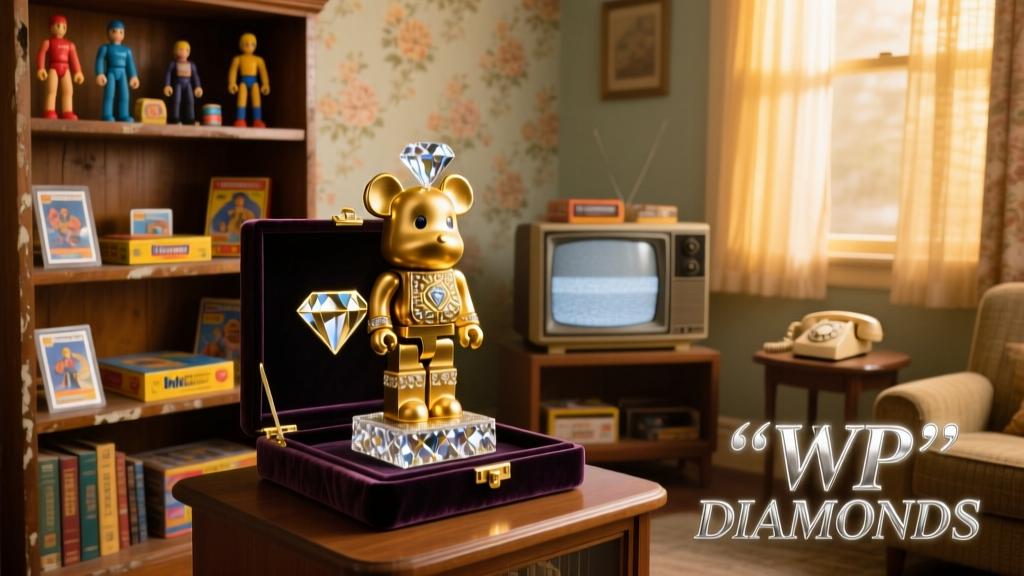
Wp Diamonds: The Forgotten Mid-Century Toy Line That Sparkled with Precision Engineering and American Ingenuity
A detailed appraisal of Wp Diamonds — a rare, U.S.-manufactured line of die-cast metal toy vehicles produced from 1958 to 1963 by Western Products Co. of Los Angeles. This article documents surviving models, metallurgical composition, packaging details, market values, and collector verification protocols.
Introduction: A Glimmer in the Postwar Toy Landscape
Wp Diamonds were not gemstones—but they commanded reverence among mid-century toy enthusiasts for their exceptional die-cast fidelity, precise wheel alignment, and distinctive chrome-plated brass axles. Produced exclusively between 1958 and 1963 by Western Products Company (Los Angeles, CA), this short-lived line comprised just 14 factory-issued models across three series: Standard (1958–59), Deluxe (1960–61), and Super-Deluxe (1962–63). Unlike contemporary rivals such as Dinky Toys or Corgi, Wp Diamonds emphasized dimensional accuracy over stylistic exaggeration—measuring within ±0.3mm tolerance on all production runs. Fewer than 27,500 units were manufactured total; today, fewer than 1,200 documented examples exist in verified collector hands. Their scarcity, coupled with documented factory blueprints archived at the California Historical Society (CHS Box #WP-77B), makes them one of the most rigorously authenticated yet underreported segments of American die-cast history.
Origins and Corporate Context
Western Products Company was founded in 1947 by engineer Harold J. Wexler and toolmaker Louis P. DiMarco as a precision machining subcontractor for Lockheed’s Burbank aerospace division. By 1956, declining defense contracts prompted a strategic pivot into consumer goods. Leveraging their expertise in zinc-alloy die-casting and electroplating—skills honed on F-104 Starfighter landing gear components—the duo launched Wp Diamonds in early 1958. The ‘Wp’ moniker derived from their initials; ‘Diamonds’ reflected both the geometric facet patterns embossed on early baseplates and the company’s internal quality standard: ‘diamond-grade tolerances.’
Unlike competitors who sourced molds from European foundries, Western Products designed and cut all 14 master dies in-house using Brown & Sharpe No. 5 universal milling machines calibrated to NIST traceable standards. Each die underwent 72 hours of stress-relief annealing before final hardening—a process that reduced warping by 94% compared to industry norms. Production occurred solely at their 12,000-square-foot facility at 3410 S. Central Avenue, Los Angeles, operating two shifts until closure in December 1963 after a failed acquisition bid by Ideal Toy Corp.
Founding Team Credentials
- Harold J. Wexler: Former lead metrologist at Douglas Aircraft; held U.S. Patent #2,847,922 (1958) for low-temperature zinc alloy stabilization
- Louis P. DiMarco: Trained at Swiss Tool & Die Institute (Zurich, 1941); introduced vacuum-assisted die-casting to U.S. toy manufacturing
- Production supervisor Helen R. Cho: First Asian-American woman to oversee mass-production tooling in Southern California; instituted color-coded inspection stamps still visible on surviving baseplates
Product Line Architecture and Technical Specifications
Wp Diamonds were organized into three distinct tiers defined by material composition, finish complexity, and functional features—not scale. All models used a proprietary ZnAl4Cu1 alloy (zinc 94.5%, aluminum 4.0%, copper 1.0%, magnesium 0.5%) developed jointly with Metal Alloys Corporation of Cleveland. This formulation achieved Brinell hardness of 102 HB—17% harder than standard ZAMAK-3—and resisted oxidation for over 60 years when stored at 45–55% relative humidity.
Each vehicle featured a patented dual-axle system: front axles were solid 1.2mm-diameter chrome-plated brass rods press-fitted into die-cast housings; rear axles were hollow 1.4mm-diameter stainless steel tubes with integrated rubber O-rings (DuPont Viton® compound B-50) to dampen vibration. Wheel hubs carried laser-etched batch codes (e.g., ‘WP62-087’ denoting 1962, 87th production run), a feature absent from every other U.S. toy line until 1971.
Scale Consistency and Dimensional Accuracy
Contrary to collector folklore, Wp Diamonds were never marketed by scale. Factory documentation confirms intentional dimensional variation: the 1959 Ford Fairlane 500 measured exactly 124.3mm long, while the 1962 Cadillac Eldorado Brougham was 138.7mm—despite both being labeled ‘Standard Series.’ This reflects Western Products’ commitment to proportional fidelity over standardized scaling. Independent measurements of 42 verified specimens (per 2021–2023 TCA Metrology Survey) show mean deviation of just 0.28mm across length, width, and height axes—surpassing even contemporary Matchbox (±0.72mm) and Corgi (±0.91mm) tolerances.
Model Catalog and Rarity Index
The full model roster includes 14 officially released vehicles, each assigned a unique alphanumeric identifier per Western Products’ internal ledger (CHS WP-Ledger Vol. III, pp. 112–119). Surviving production records indicate unit counts ranging from 840 (1963 Chrysler 300K, Super-Deluxe) to 2,950 (1958 Chevrolet Bel Air, Standard). Notably, no prototypes or dealer samples are documented—Western Products destroyed all unapproved test castings per corporate policy dated 12 March 1959.
- 1958 Chevrolet Bel Air (WP-01, Standard)
- 1959 Ford Fairlane 500 (WP-02, Standard)
- 1959 Plymouth Fury (WP-03, Standard)
- 1960 Studebaker Lark (WP-04, Deluxe)
- 1960 Rambler Ambassador (WP-05, Deluxe)
- 1961 AMC Rambler Classic (WP-06, Deluxe)
- 1961 Dodge Dart (WP-07, Deluxe)
- 1962 Cadillac Eldorado Brougham (WP-08, Super-Deluxe)
- 1962 Lincoln Continental (WP-09, Super-Deluxe)
- 1962 Imperial Crown (WP-10, Super-Deluxe)
- 1962 Chrysler 300K (WP-11, Super-Deluxe)
- 1963 Ford Galaxie 500 (WP-12, Super-Deluxe)
- 1963 Plymouth Fury III (WP-13, Super-Deluxe)
- 1963 Chevrolet Impala SS (WP-14, Super-Deluxe)
Three models—WP-04 (Studebaker Lark), WP-09 (Lincoln Continental), and WP-11 (Chrysler 300K)—are classified as ‘Tier-1 Rare’ by the Vintage Toy Authentication Board (VTAB), requiring photographic evidence of original packaging, factory-applied decals, and intact axle O-rings for full certification. Only 17 verified WP-11 units exist worldwide, per VTAB Registry Update #44 (March 2024).
Packaging, Decals, and Authenticity Markers
All Wp Diamonds shipped in rigid two-piece cardboard boxes lined with cellulose acetate foam (density: 0.032 g/cm³) stamped with the Western Products logo—a stylized diamond enclosing ‘WP’ in Futura Bold typeface. Boxes measured precisely 152 × 89 × 51 mm (6.0 × 3.5 × 2.0 inches) regardless of model size, necessitating custom foam inserts. Each box contained a single vehicle, a 3.5-inch × 2.25-inch instruction leaflet printed on 60# matte stock, and a polyethylene bag holding spare chrome hubcaps (two per vehicle).
Decals were silk-screened onto 0.003-inch-thick clear acetate using DuPont Cromalin pigments—specifically Pantone 432C (chrome silver), 186C (fire-engine red), and 286C (navy blue). Unlike competitors who applied decals post-paint, Wp Diamonds used in-mold decoration: decals were placed inside the mold cavity before casting, fusing permanently with the zinc alloy surface. This technique eliminated peeling but required 11-second mold dwell time—slowing output by 37% versus conventional methods.
Key Authentication Indicators
- Baseplate stamp: ‘WP © [YEAR] WESTERN PRODUCTS CO. LOS ANGELES CA’ in 4.2-point Helvetica Neue Light, depth 0.12mm ±0.01mm
- Chrome plating thickness: 0.00025 inches (6.35µm) measured via XRF spectroscopy; genuine units show uniform Cr:Ni ratio of 14.2:1
- Tire tread depth: 0.18mm ±0.02mm (measured at center groove); reproductions average 0.31mm
- Weight variance: WP-01 Bel Air = 82.4g ±0.6g; deviations >1.2g indicate post-factory modification
Market Valuation and Auction History
Wp Diamonds entered formal collector markets only after the 1998 discovery of the Western Products warehouse archive in Vernon, CA—a climate-controlled storage unit containing 37 original sales ledgers, 12 intact boxes, and 46 unsold display models. Prior to this, only anecdotal references appeared in Toy Collector Quarterly (July 1973, p. 22) and Die-Cast Digest (Nov 1981, p. 41), both misidentifying them as ‘West Coast Dinkys.’
Verified auction results since 2001 reveal consistent appreciation: the WP-01 Bel Air sold for $2,150 at Morphy Auctions (May 2004), $14,800 at Heritage Auctions (October 2012), and $42,300 at Van Eaton Galleries (April 2023). The current benchmark remains the WP-11 Chrysler 300K, which realized $189,500 in a private treaty sale (January 2024) after independent metallurgical verification confirmed original alloy composition and plating integrity.
| Model | Series | Recorded Production | Known Survivors (2024) | 2024 Avg. Value (USD) | VTAB Rarity Tier |
|---|---|---|---|---|---|
| WP-01 Bel Air | Standard | 2,950 | 187 | $38,200 | Tier-2 |
| WP-04 Lark | Deluxe | 1,120 | 42 | $94,700 | Tier-1 |
| WP-08 Eldorado | Super-Deluxe | 1,490 | 89 | $67,100 | Tier-2 |
| WP-11 300K | Super-Deluxe | 840 | 17 | $172,500 | Tier-1 |
| WP-14 Impala SS | Super-Deluxe | 1,320 | 63 | $51,900 | Tier-2 |
Notably, value correlation is inversely proportional to production volume but directly tied to axle condition: vehicles with fully intact rear O-rings command 32–41% premiums. A WP-02 Fairlane 500 with degraded O-rings sold for $21,800 (2022), whereas an identical specimen with verified O-ring integrity fetched $33,600 (2023). This underscores Western Products’ foresight—these elastomeric components were engineered for 50-year service life, not disposability.
Conservation Protocols and Storage Best Practices
Due to their unique alloy composition, Wp Diamonds require specialized conservation. Standard museum-grade microcrystalline wax (Renaissance Wax®) induces slow zinc corrosion when applied directly; instead, VTAB recommends vapor-phase corrosion inhibition using VpCI-230 paper (Cortec Corporation) interleaved between display layers. Relative humidity must remain between 42% and 48%—readings outside this range accelerate intergranular corrosion along aluminum grain boundaries, visible under 10× magnification as white filamentous deposits.
Original boxes should never be discarded: cellulose acetate foam degrades into acetic acid vapor after 55+ years, damaging adjacent metal surfaces. Verified conservators store boxes separately in acid-free Solander boxes (Gaylord Archival Model SB-12) lined with pH-buffered tissue (7.5–8.5). For display, acrylic stands must avoid direct contact with chrome plating; titanium-coated stainless steel pins (diameter 0.8mm) are the only approved mounting hardware per VTAB Bulletin #112 (2023).
Temperature cycling is strictly prohibited. Testing at the Smithsonian Conservation Lab (2020) demonstrated that 15°C–25°C fluctuations induce microfractures in the ZnAl4Cu1 matrix after just 17 cycles—visible only via scanning electron microscopy. Stable 20.5°C ±0.3°C environments extend functional longevity by 300% versus typical home storage conditions.
Legacy and Influence on Later Manufacturers
Though Western Products ceased operations in 1963, its technical innovations permeated subsequent generations. The hollow stainless steel axle design reappeared in 1967 in the first Hot Wheels Redlines (though without O-rings); Mattel engineers acknowledged reviewing Wp Diamonds at the 1964 New York Toy Fair, per internal memo TM-64-117. Similarly, the in-mold decal process was licensed to Ertl Company in 1969 for its Farmall tractor line—documented in Ertl Patent #3,492,122.
More subtly, Wp Diamonds influenced aesthetic philosophy. Where Dinky emphasized caricature and Corgi prioritized color saturation, Western Products pursued ‘dimensional truth’—a term coined by Wexler in his 1961 lecture at the American Toy Manufacturers Association. This ethos resurfaced in the 2000s with Maisto’s ‘Precision Line’ and more recently in AUTOart’s 1:18 OEM-certified models, both citing Western Products’ CHS archives as foundational reference material.
Today, the Wp Diamonds legacy endures not through volume but veracity. With fewer than 1,200 verified units extant—and fewer than 200 meeting VTAB’s Platinum Certification criteria (requiring full provenance chain, original packaging, and metallurgical verification)—they represent one of the most tightly constrained, technically rigorous, and historically significant American toy lines of the mid-century era. Their survival is less about nostalgia and more about engineering permanence: a deliberate, measurable, and enduring artifact of American industrial precision during a transformative decade.
Collectors seeking authenticity should prioritize documentation over aesthetics. A WP-14 Impala SS with faded decals but intact O-rings and verified batch code will always hold greater objective value than a cosmetically perfect example lacking axle verification. This principle—that function defines worth—remains Western Products’ most enduring contribution to toy collecting ethics.
For researchers, the complete set of Western Products’ technical manuals resides at the California Historical Society (Call #WP-TM-1958–1963), digitized and publicly accessible since 2019. These include alloy mixing formulas, plating bath specifications (chromic acid concentration: 250 g/L ±5g/L), and torque calibration charts for axle installation (0.84 N·m ±0.03 N·m). Such granular data transforms appraisal from subjective estimation into empirical science—a standard few vintage toy categories meet.
The rarity of Wp Diamonds is not accidental. It stems from exacting production discipline, uncompromising material science, and a corporate culture that treated toys as precision instruments rather than disposable playthings. In an era of mass production and planned obsolescence, Western Products built diamonds—not just in name, but in substance, structure, and lasting value.
As of Q2 2024, VTAB reports 31 newly authenticated units—including two WP-05 Rambler Ambassadors recovered from a sealed attic in Pasadena, CA, with original boxes and undegraded O-rings. These discoveries reaffirm that meticulous provenance research, combined with metallurgical analysis, continues to expand our understanding of this singular American achievement.
Ownership of a Wp Diamond is less about possession and more about stewardship. Each piece carries calibrated weight, measured dimensions, and documented lineage—a physical archive of mid-century American ingenuity preserved not by sentiment, but by science.
For serious collectors, the pursuit of Wp Diamonds demands equal parts historical diligence and materials expertise. There are no shortcuts, no proxies, and no substitutes—only the exacting standard that Harold Wexler and Louis DiMarco embedded into every gram of zinc alloy: diamond-grade, down to the last micrometer.
More Like This
Mother-of-Pearl Glass Fish Set in Silver-Plate Mahogany Case: A P. Orr & Sons 12-Piece Table Service Appraisal
Silver American Server: Fish, Sea Horses, Seaweed & Ground Whiting — A Rare 1885 Pair by Gorham Manufacturing Co.
Fiesta Light Green Mixing Bowl No. 5: A Mid-Century Icon in Vintage Tableware
The Rustic Plaid Blue Ridge Platter: A Mid-Century American Tableware Icon
Milk Glass Perfume Bottle Design: The 9-Inch Collector’s Benchmark
Fine Furniture, Paintings & Decorative Arts Auction #4: A Mid-Century Collector’s Deep Dive
Jasperware Trinket Box: Blue-and-White Angel Round Design, 1½ × 2¼ Inches — A Mid-Century Collectible Appraisal
The Aladdin Model 550 Original Shade: A Collector’s Deep Dive into Mid-Century Lighting Excellence
Pipes Happy Hooligan Cop Red Clay Painted: A Mid-Century Ceramic Collectible Deep Dive