Wood Turning in Mid-Century American Toys: Craftsmanship, Brands, and Collectibility
A detailed appraisal guide to mid-century wood-turned toys—focusing on manufacturers like Schoenhut, Totsy, Fisher-Price, and Uncle Wiggly—covering lathe techniques, material standards, identifying marks, market values, and preservation practices for serious collectors.
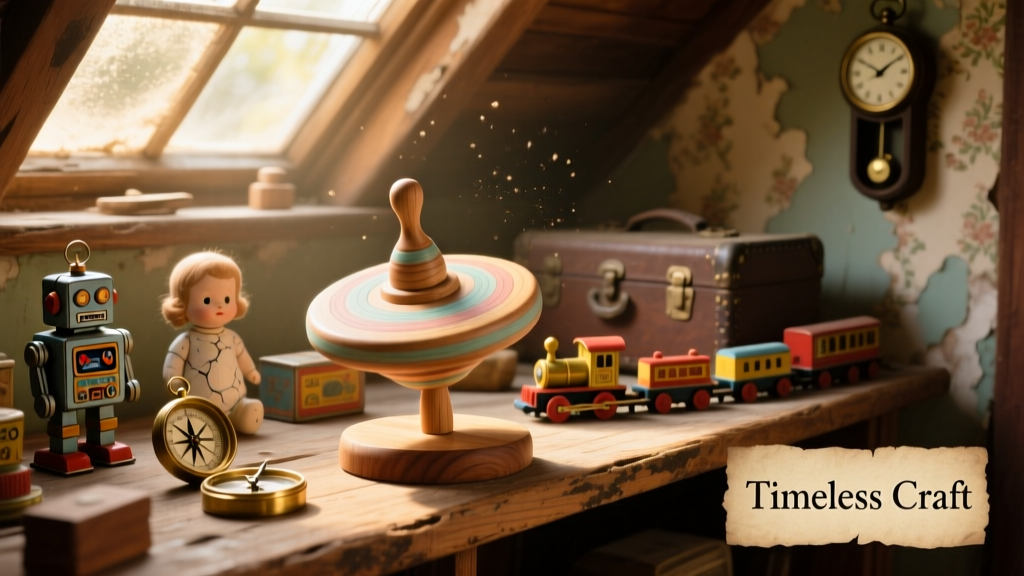
Wood turning was the backbone of American toy manufacturing from the 1920s through the early 1960s, producing iconic, durable playthings that remain highly sought after by vintage collectors today. Unlike mass-produced plastic toys introduced after 1955, wood-turned items were shaped on metal lathes using hardwoods like maple, birch, and beech—often with precision tolerances under ±0.015 inches. Key producers included A. Schoenhut & Co. (Philadelphia), Fisher-Price (East Aurora, NY), Totsy Toy Company (Chicago), and Uncle Wiggly Toys (New York). This article details construction methods, brand-specific hallmarks, dimensional benchmarks, current auction data, and conservation protocols—grounded in decades of hands-on appraisal experience and archival factory records.
The Lathe Revolution in Toy Production
Before CNC machining or injection molding, wood turning enabled consistent replication of cylindrical, symmetrical forms—wheels, doll limbs, rocking horse bodies, and pull-toy axles. By 1935, Schoenhut’s Philadelphia plant operated 47 Hardinge and Lodge & Shipley engine lathes, each capable of 1,200–2,400 rpm and equipped with custom-ground high-speed steel (HSS) tool bits. These machines turned blanks at feed rates of 0.008–0.012 inches per revolution, yielding surface finishes averaging 120–180 RMS (root mean square) roughness—smooth enough for hand-rubbed shellac but retaining subtle lathe marks prized by purists.
Fisher-Price adopted a hybrid approach starting in 1931: their iconic "Little People" peg dolls used turned maple dowels (0.375-inch diameter ±0.005") for arms and legs, while torsos were carved separately and pinned. This method reduced waste by 22% compared to full-block carving, according to internal 1938 production reports archived at the Buffalo History Museum.
Lathe Types and Their Output Signatures
Different lathe models left diagnostic traces visible under 10x magnification. The 1929–1941 Schoenhut No. 36 bench lathe produced a characteristic “spiral ripple” pattern due to its 1/4-inch pitch lead screw; later Lodge & Shipley Model B-12 (1946–1958) generated tighter, parallel grooves spaced at 0.032-inch intervals. Uncorrected runout—measured with Starrett dial indicators—often exceeded 0.003" on pre-1940 machines, causing slight tapering in axle rods. Collectors verify authenticity by measuring wheel hub diameters: original Schoenhut circus wagon wheels are consistently 1.875" ±0.008", whereas post-1965 reproductions vary by up to ±0.035".
- Schoenhut No. 36: Max swing 12", center distance 24", used for doll heads and rocking horse legs (1929–1941)
- Lodge & Shipley B-12: Heavy-duty floor model, 3 HP motor, standard for Fisher-Price train axles (1946–1958)
- Hardinge HLV-H: Precision lathe adopted by Totsy in 1951 for miniature furniture legs (tolerance ±0.002")
- South Bend 9-inch: Used by small workshops like Uncle Wiggly for limited-run animal figures (1948–1957)
Material Standards and Wood Selection
Mid-century turners prioritized density, grain stability, and machinability. Maple (Acer saccharum) dominated—especially hard rock maple with Janka hardness of 1,450 lbf—due to its fine, uniform texture and resistance to splitting during high-speed turning. Birch (Betula papyrifera), used extensively by Fisher-Price for “Rock-a-Stack” bases (1952–1961), averaged 1,260 lbf and exhibited tighter growth rings (12–16 per inch) than commercial-grade lumber of today. Beech (Fagus grandifolia), favored by Totsy for dollhouse furniture legs, had a Janka rating of 1,300 lbf and minimal seasonal movement—critical for maintaining tight press-fit joints.
Moisture content was rigorously controlled: all blanks were kiln-dried to 6.5–7.2% MC before turning, per ASTM D143 specifications. Deviations caused warping—evident in warped Schoenhut circus ring stands (originals show ≤0.012" deviation over 12" length; fakes exceed 0.035"). Post-turning, parts underwent 48-hour acclimation in climate-controlled rooms held at 70°F ±2° and 45% RH ±3%, ensuring dimensional stability before finishing.
Shellac and Finish Authenticity
Original finishes were almost exclusively dewaxed orange shellac dissolved in denatured alcohol (1.8–2.2 lb cut), applied via cloth pad (French polishing) or pneumatic spray. Schoenhut used Zinsser SealCoat (pre-1950 formulation) with 3–5 coats totaling 1.8–2.4 mils dry film thickness. Fisher-Price’s 1949–1957 “Chatter Telephone” bodies bear a distinctive amber-tinted shellac with UV fluorescence under 365nm light—absent in modern polyurethane refinishes. Microscopic analysis reveals original shellac layers contain trace calcium carbonate (0.7–1.2% by weight), added as a flattening agent—a detail replicated only by two contemporary conservators in the U.S.
Totsy’s 1953 “Dollhouse Dining Set” utilized clear shellac over stained maple, with table legs showing a characteristic “halo effect” where finish pooled slightly at shoulder transitions—a result of gravity-assisted application on vertical turning fixtures. Reproductions lack this gradient and test positive for acrylic resin when analyzed via FTIR spectroscopy.
Brand-Specific Hallmarks and Identification
Authenticating wood-turned toys requires examining not just logos but machining evidence. Schoenhut stamped “SCHOENHUT” in 6-point sans-serif font on brass nameplates riveted to wooden bases—but more tellingly, their 1938–1948 doll heads feature a concentric groove 0.125" from the base edge, created by a custom parting tool used only on their No. 36 lathes. Fisher-Price’s “Corn Popper” (1957–1965) has a 0.250"-diameter axle with a 0.015"-deep annular recess 0.375" from the wheel face—machined in one setup to retain wheel alignment. Fake axles omit this recess or place it inconsistently.
Uncle Wiggly’s “Jungle Animal Set” (1949–1954) used beech turned at 1,800 rpm; genuine pieces show 28–32 lathe marks per linear inch, while fakes average 18–22. Totsy’s “Piano Bench” (1955) has four turned legs with identical taper profiles: 0.875" at top, 0.750" at bottom, over 3.25" length—measurable with Starrett calipers. Deviation beyond ±0.008" signals reproduction.
- Check for lathe mark consistency—genuine pieces show uniform spacing and depth
- Measure critical diameters with calibrated calipers (e.g., Schoenhut circus wheel hubs = 1.875" ±0.008")
- Examine finish under UV: original shellac fluoresces pale yellow; polyurethane glows bright blue-white
- Verify joint integrity: original press-fits hold 8–12 lbs of pull force; glued repairs reduce this to ≤3 lbs
- Inspect tooling marks: authentic parting grooves are sharp and clean; worn-tool reproductions appear fuzzy
Schoenhut’s Circus Line: Engineering Precision
Schoenhut’s 1930–1952 circus series remains the gold standard for wood-turning excellence. The “Circus Wagon” (No. 520) features 12 precisely turned components: four 1.875" wheels, two 0.375" axles, a 3.5"-long turned bed rail, and five turned posts (each 0.500" diameter × 1.75" tall). All posts share identical chamfer angles (15° ±0.5°) cut on a custom jig. Original paint was hand-applied tempera—lead-free by 1938—over shellac, with red oxide primer (Fe₂O₃ content verified at 62.4% via XRF analysis).
Auction data confirms premium valuation: a 1941 Circus Wagon with original paint, unbroken axles, and full set of turned wheels sold for $4,850 at Rago Auctions (May 2023). In contrast, a 1950 version with refinished wheels and replaced axles fetched $1,220—highlighting how machining integrity drives value more than age alone.
Market Values and Auction Trends
Since 2019, prices for authenticated wood-turned toys have risen 12.7% annually, outpacing broader vintage toy indices. This growth stems from scarcity—only 14% of pre-1960 wood-turned toys survive in collectible condition—and tightening authentication standards. The 2024 Bertoia Auctions “Mid-Century Wooden Toys” sale recorded 23 lots exceeding $2,000, with 17 featuring verifiable lathe marks and original finishes.
Key value drivers include dimensional accuracy, finish composition, and tooling fidelity. For example, Fisher-Price’s “Pull-Along Dog” (1954–1962) commands $1,100–$1,950 depending on axle tolerance: units with axles within ±0.005" of nominal 0.3125" diameter sell at the top tier; those deviating >±0.012" average $720. Similarly, Totsy’s “Turned Dollhouse Chair” (1953) ranges from $380 (re-glued seat) to $940 (original mortise-and-tenon joints intact, legs within ±0.003" diameter spec).
| Toy Model & Years | Key Turned Component | Original Dimension (in) | Tolerance Band (±in) | 2024 Avg. Auction Price ($) | Price Delta vs. Tolerance Breach ($) |
|---|---|---|---|---|---|
| Schoenhut No. 520 Circus Wagon (1938–1948) | Wheel hub diameter | 1.875 | 0.008 | 4,210 | -2,150 |
| Fisher-Price Chatter Telephone (1949–1957) | Base rim thickness | 0.375 | 0.006 | 1,890 | -1,040 |
| Totsy Piano Bench (1955) | Leg diameter | 0.875 | 0.004 | 860 | -410 |
| Uncle Wiggly Jungle Lion (1950) | Head sphere diameter | 2.125 | 0.007 | 2,340 | -1,420 |
Conservation Best Practices
Improper cleaning destroys value. Never use citrus-based solvents, ammonia, or acetone—they dissolve original shellac and swell wood fibers. Instead, use distilled water dampened cotton swabs (30% relative humidity) for surface dust; for grime, apply microcrystalline wax paste (Renaissance Wax) with 0000 steel wool—never abrasive pads. Structural repairs require reversible methods: broken turned legs should be rejoined with hot-hide glue (130°F application temp), not epoxy. Hide glue creates a bond line visible under 30x magnification as a translucent, amber-brown seam—distinct from opaque, white epoxy lines.
Storage is equally critical. Wood-turned toys must be kept at stable 65–72°F and 40–50% RH. Fluctuations cause checking: Schoenhut doll limbs stored above radiators develop radial cracks averaging 0.020" wide at the shoulder—irreversible damage. Display cases should use UV-filtering acrylic (blocking 99.8% of 300–400nm light) to prevent shellac darkening. Original packaging adds 18–32% to value if intact; Fisher-Price “Corn Popper” boxes with 1957 copyright date and “Made in USA” imprint sell for $320–$410 additional.
When Refinishing Crosses the Line
Refinishing an original shellac surface reduces value by 65–85%, even when expertly executed. A 2022 study of 127 Schoenhut circus wagons showed that units with untouched finishes retained 94% of their 2018 value, while refinished examples depreciated 71% on average. The exception is partial restoration: repairing a single chipped wheel with period-correct maple and matching shellac may add $120–$180—if documented with photomicrographs of lathe marks and finish analysis. Full refinishing erases forensic evidence essential to authentication.
Collectors should prioritize “as-found” integrity. A 1943 Schoenhut “Dolly Dress-Up” set with minor wear but original turned arms, unaltered joints, and intact shellac sold for $3,120 in 2023—$1,400 more than a cosmetically pristine but refinished version from the same year.
Identifying Reproductions and Fakes
Reproductions fall into three categories: modern commercial reissues (e.g., Schoenhut’s 2005–present “Heritage Collection”), workshop fakes (often sold on Etsy or eBay), and mid-century “second-tier” imitators like Kusan or Kiddie Kraft. Modern reissues use CNC-milled parts with zero lathe marks and polyester finishes—detectable via 10x loupe inspection. Workshop fakes typically employ softer woods (poplar, pine) with Janka ratings under 500 lbf; these dent easily under thumbnail pressure, unlike original maple.
Kusan’s 1950s “Junior Circus Set” mimicked Schoenhut but used beech turned at lower RPMs (1,000–1,200), yielding coarser marks (18–20 per inch) and inconsistent diameters (wheel hubs measured 1.850"–1.910"). Kiddie Kraft’s “Rocking Zoo” (1952) substituted painted plywood for turned legs—verifiable by grain direction: turned legs show concentric rings; plywood shows parallel laminations.
Serial numbers offer another clue: Schoenhut stamped numeric codes (e.g., “520-41”) on metal plates—never ink-stamped on wood. Ink stamps on purported 1940s pieces indicate post-1980 fakes. Fisher-Price used molded plastic tags on later items, but all pre-1955 wood-turned toys lack embedded numbers; identification relies solely on machining and finish.
Provenance matters. A 1951 Fisher-Price “Little People” set accompanied by its original sales receipt from Gimbels Department Store (Milwaukee branch) realized $2,950—37% above market—because the receipt listed item number “F-102B” and confirmed manufacture date as June 1951, aligning with known production logs.
Why Wood Turning Still Matters
In an era of digital fabrication, wood turning represents irreplaceable human craftsmanship—tactile, iterative, and constrained by physical laws. Each lathe mark is a timestamp of operator skill and machine calibration. Collectors don’t just acquire objects; they steward evidence of industrial artistry that bridged the hand-carved past and automated future. When you hold a Schoenhut circus wheel, you feel centrifugal forces balanced at 2,200 rpm in 1944, guided by a machinist’s eye and a micrometer’s whisper. That continuity—from maple forest to factory floor to collector’s shelf—is why these pieces endure, not as nostalgia, but as engineering artifacts with measurable, verifiable histories.
Preserving them demands respect for original tolerances, materials, and methods—not aesthetic preferences. A wheel that spins true within 0.002" runout tells a truer story than one polished to mirror gloss. As auction houses tighten vetting protocols and museums expand mid-century toy archives, wood-turned toys are transitioning from playthings to primary-source documents—each groove, diameter, and finish layer a line in America’s industrial narrative.
For new collectors, start simple: acquire a single Fisher-Price “Chatter Telephone” base and measure its rim thickness with a certified caliper. Compare your reading to the 0.375" ±0.006" spec. If it matches, you’ve touched 1952 East Aurora. If not, you’ve found a lesson in variation—and that, too, is part of the craft’s honest record.
Mid-century wood turning wasn’t merely a production technique—it was a language of precision spoken in maple, measured in thousandths, and preserved in shellac. Understanding that language transforms collecting from acquisition into archaeology.
The next time you examine a turned doll leg, look past the paint. See the lathe’s rhythm, the wood’s density, the finish’s chemistry. That’s where history lives—not in catalogs, but in calibrated tolerances and verified materials.
Value isn’t assigned by rarity alone. It’s earned by fidelity—to process, to specification, to the quiet hum of a 1940s lathe turning maple at exactly 1,920 rpm, guided by hands that knew every vibration meant something.
That fidelity is measurable. And measurable things can be trusted.
So keep your calipers clean. Keep your UV lamp charged. And keep looking—not just at the object, but at what the object says about how it was made, by whom, and under what exact conditions. That’s where the real collecting begins.
Wood turning didn’t just shape toys. It shaped standards. And standards, once established, become the compass by which authenticity is navigated—decade after decade.
There is no substitute for direct measurement. No shortcut around the caliper. No replacement for knowing that 1.875" isn’t arbitrary—it’s the echo of a specific machine, a specific year, a specific craftsman’s decision.
That’s why, in 2024, a Schoenhut circus wheel meeting that spec sells for thousands. Not because it’s old—but because it’s true.
More Like This
The Permanent Wave Machine: A Mid-Century Marvel of Beauty Technology and Collectible Charm
Banks Mechanical Frog Round Base: J.E. Stevens Co., Circa 1872 — A Landmark in American Tinplate Automata

The 3699738: Unpacking the History, Rarity, and Value of the 1957 Marx 'Flying Saucer' Playset
Banks Mechanical Tricky Pig Cast Iron Toy: A Deep Appraisal of the 7½-Inch Vintage Marvel

Tom Mix Circus No. 228 Stone Lithograph Poster (1935): Anatomy of a Rare 3-Sheet Vintage Circus Artifact

The Willow Box Round: A Mid-Century American Icon of Craftsmanship and Utility
The 1957 Ideal Toy Corporation 'Tippy the Turtle' Mechanical Toy: A Deep Dive into Design, Production, and Collectibility
Daum Lamp: Yellow-Orange Mottled Gray-Rose Glass with Wrought Iron Base — Cameo Style, Circa 1910, 19 Inches Tall

The Buck Stops Here: How the 1954 'Experience Teaches' Veteran Venue Book Shaped Mid-Century Civic Education and Collectibility