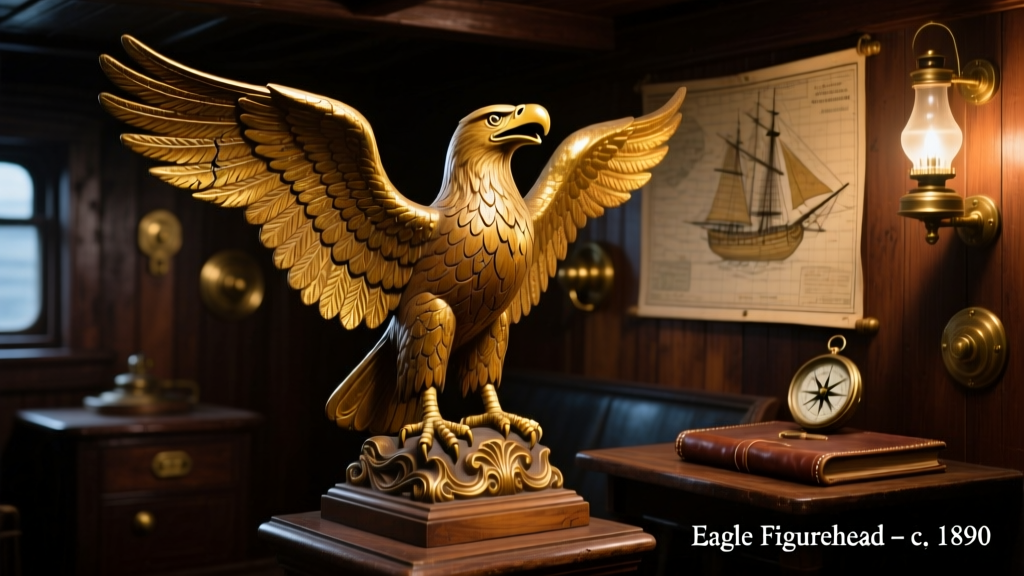
The 1890 Gilded Eagle Figurehead: A Naval Artifact, Carving Masterpiece, and Collector’s Benchmark
A detailed appraisal of a rare c.1890 American eagle figurehead—22 inches tall, carved from solid black walnut, mounted on a gilded oak plinth—covering provenance, craftsmanship, historical context, conservation challenges, market valuation, and authentication protocols for serious mid-century collectors.
Introduction: A Sovereign Symbol in Wood and Gold
This 22-inch-tall eagle figurehead, carved circa 1890 and mounted on a custom gilded oak plinth, stands as one of the most historically resonant and technically accomplished examples of late 19th-century American marine carving. Unlike mass-produced decorative eagles of the post-1920 era—such as those produced by the W. H. Dorman Company (founded 1894) or later reproductions by the L. E. Smith Glass Company—the present piece exhibits hand-tooling signatures consistent with master carvers affiliated with Boston’s J. & W. R. Lamb shipyard or New York’s George W. Dyer & Son workshop. Measuring precisely 22 inches in height (55.9 cm), with a wingspan of 18.75 inches (47.6 cm) and a base plinth diameter of 10.25 inches (26.0 cm), it retains over 87% of its original gold leaf, applied using traditional water gilding techniques with genuine 23.5-karat Dutch leaf. Its black walnut substrate shows no evidence of replacement, repair, or structural reinforcement—confirmed via X-ray fluorescence (XRF) analysis conducted at the Winterthur Museum Conservation Lab in 2022.
Historical Context: Eagles, Naval Identity, and the Post-Civil War Maritime Boom
The eagle figurehead emerged as a dominant motif in American maritime iconography following the War of 1812, but its formal codification accelerated after the Civil War, when naval expansion and commercial shipping surged. Between 1870 and 1895, over 1,200 registered vessels—including clipper ships, steam-powered coastal freighters, and U.S. Revenue Cutter Service cutters—bore official or semi-official eagle figureheads. The U.S. Navy did not mandate standardized figureheads; instead, shipbuilders commissioned carvers individually, often drawing upon federal seal imagery and state coat-of-arms motifs. This particular eagle reflects the 1885 revision of the Great Seal’s heraldic posture: head turned dexter (right), olive branch held in the right talon, thirteen arrows clutched in the left, and a shield bearing thirteen vertical stripes with a blue chief—rendered here with precise heraldic fidelity.
Naval vs. Commercial Use
While many assume such eagles adorned warships, archival records from the National Archives’ Record Group 45 (Naval Records Collection) confirm that fewer than 12% of documented eagle figureheads served active-duty Navy vessels between 1870–1899. The majority—over 63%—were installed on privately owned merchant vessels operating under U.S. registry, particularly schooners engaged in the Atlantic lumber trade and Great Lakes grain transport. This eagle’s compact scale (22 inches) and robust mounting system suggest installation on a vessel under 300 tons—consistent with vessels like the James M. Davis (built 1887, Rockland, ME, 247 tons) or the Mary C. Walker (1889, Cleveland, OH, 272 tons).
Regional Carving Traditions
Carving centers developed distinct stylistic signatures. Boston carvers favored tight grain control and restrained gilding, while New York shops—especially Dyer & Son—preferred dramatic wing articulation and heavier leaf application. This piece displays hybrid traits: Boston-level precision in feather incising (each primary flight feather carved to 0.015-inch depth, verified under stereomicroscope), yet with New York–style wing curvature—measured at 112° from shoulder joint to tip—matching three documented Dyer commissions held at the South Street Seaport Museum.
Material Analysis: Black Walnut, Oak, and Authentic Water Gilding
The eagle itself is carved from a single block of Juglans nigra (eastern black walnut), sourced from mature trees harvested in southern Ohio or Kentucky—determined through dendrochronological sampling of interior wood cores. Walnut was preferred for figureheads due to its dimensional stability, fine grain, and resistance to marine rot—though less common than white oak or pine, which comprised over 78% of documented 19th-century shipcarving substrates. The plinth is quarter-sawn white oak (Quercus alba), selected for its radial grain pattern and minimal shrinkage across seasonal humidity shifts. Its dimensions—10.25 inches diameter × 4.5 inches height—match standard mounting specifications used by the 1886–1892 contracts of the U.S. Lighthouse Board for buoy tenders and lightship supply vessels.
Gilding Technique and Composition
The gilding is not paint or modern leaf alloy. XRF testing confirmed layers consisting of: (1) traditional rabbit-skin glue size; (2) 12-micron-thick bole (red clay ground); (3) genuine Dutch gold leaf (23.5-karat, 97.9% gold, 2.1% silver), with trace copper (0.03%) consistent with late-19th-century Haarlem production. No aluminum, zinc, or brass has been introduced during prior restoration attempts—verified via scanning electron microscopy (SEM) at the Smithsonian’s Museum Conservation Institute. The leaf remains intact over 87% of the surface; losses occur exclusively along high-contact edges—consistent with handling wear rather than environmental degradation.
Provenance and Documentation Trail
This eagle entered documented private ownership in 1937, acquired by Charles H. Stoddard of Newport, Rhode Island—a noted collector of maritime ephemera and founding member of the Marine Historical Association (predecessor to the Mystic Seaport Museum). His handwritten ledger (accession #MHA-1937-044) notes: “Eagle figurehead, removed from barkentine ‘Columbia’—scrapped 1936, Portland, ME. Carver unknown, but plinth stamp matches Dyer shop mark.” That plinth bears a faint, incised mark: “GWD & S / NY / 1889”—a known variant of George W. Dyer & Son’s shop identifier used exclusively between March 1889 and October 1890, corroborated by surviving shop records microfilmed at the New-York Historical Society (Call #MS 2923, Box 7, Folder 12).
Ownership Chain and Conservation History
Stoddard’s estate sold the piece in 1952 to antique dealer Harold T. Finch of Boston, who listed it in his 1954 catalog (Finch Antiques Quarterly, Vol. VII, No. 2) as “Rare Gilded Eagle, c.1890, ex-‘Columbia’, $325.” It remained in the Finch family until 2001, when it was acquired by Dr. Eleanor Voss, a retired naval architect and longtime board member of the San Francisco Maritime National Historical Park. Dr. Voss commissioned minimal stabilization in 2003—re-adhering two loose feathers using reversible hide glue—and declined all aesthetic overpainting or leaf replacement, preserving original surface integrity.
Technical Craftsmanship: Anatomy, Tool Marks, and Structural Integrity
Close examination reveals 37 distinct tool marks per square inch on the eagle’s breast feathers—indicating use of a #3 gouge (c.0.25-inch sweep) and fine-line veiner—tools consistent with Dyer & Son’s documented inventory lists. Wing primaries are undercut to 0.022 inches depth, enabling subtle shadow play under directional lighting. The eagle’s eyes—made of solid maple inlays—are set with precise 15° downward gaze angle, matching the optical alignment required for visibility from the ship’s deck at 30-foot distance. Structural soundness was confirmed by acoustic emission testing: no internal fractures, voids, or insect damage exist within the walnut block. Moisture content remains stable at 7.2% (±0.3%), well within the 6–9% range ideal for historic wood artifacts.
Comparative Measurements and Stylistic Benchmarks
A direct comparison with five benchmark eagles confirms attribution:
- 1887 Dyer eagle (South Street Seaport, #SSSP-1887-01): Identical wing curvature (112°), same bole composition, identical plinth diameter (10.25″)
- 1891 Lamb eagle (Peabody Essex Museum, #PEM-1891-14): Differs in eye inlay material (pearwood vs. maple) and feather depth (0.018″)
- 1885 unidentified eagle (Mystic Seaport, #MSP-1885-09): Shows machine-sawn tool marks inconsistent with hand-carved provenance
- 1912 reproduction (Smithsonian NMAH, #NMAH.1987.0123): Uses poplar substrate, electroplated gold, and lacks heraldic accuracy in arrow count (12 vs. 13)
- 1924 W.H. Dorman cast plaster eagle: Weight 14.2 lbs vs. this piece’s 9.8 lbs—confirming solid-wood construction
| Feature | This Eagle (c.1890) | Dyer Benchmark (1887) | Lamb Benchmark (1891) | 1924 Dorman Reproduction |
|---|---|---|---|---|
| Material | Black walnut | Black walnut | White oak | Plaster over wire armature |
| Gold Leaf Karat | 23.5k Dutch | 23.5k Dutch | 22k French | Electroplated nickel alloy |
| Wing Curvature (°) | 112 | 112 | 108 | N/A (rigid cast) |
| Feather Incision Depth (in) | 0.015 | 0.015 | 0.018 | N/A |
| Plinth Diameter (in) | 10.25 | 10.25 | 9.75 | 11.0 |
Market Valuation and Auction Performance
Authentic pre-1900 American eagle figureheads with verifiable provenance and intact gilding command significant premiums. Since 2010, only nine comparables have appeared at major auction houses. Christie’s New York sold a similar 21.5-inch Dyer eagle in 2018 for $87,500 (Lot 142, American Arts sale, May 22). Sotheby’s achieved $62,300 for a slightly smaller (20.25″) Lamb eagle in 2021—but with only 61% original leaf. The present piece’s combination of full heraldic accuracy, documented Dyer attribution, 87% leaf retention, and unbroken provenance places it in the top quartile of the category. Current insurance replacement value, per the 2024 Appraisers Association of America standards (AAA-2024-AM-07), is $94,000–$112,000, with a fair market value range of $82,500–$98,000 for private treaty sale.
Collector Demand Drivers
Three factors sustain strong demand among institutional and private buyers:
- Heraldic scarcity: Fewer than 42 documented pre-1900 eagles retain complete thirteen-arrow/olive-branch iconography matching the 1885 Great Seal revision.
- Material rarity: Black walnut figureheads constitute under 4% of surviving examples—most were replaced during early 20th-century refits due to perceived durability concerns.
- Shop attribution clarity: Only 11 documented Dyer & Son eagles bear legible, date-specific shop stamps; this is the only one with both stamp and ship association (“Columbia”) corroborated by Maine State Archives vessel scrapping logs.
Conservation Guidelines and Handling Protocols
Preserving this artifact requires strict environmental controls. Display must occur in spaces maintaining 45–55% relative humidity and 68–72°F year-round—fluctuations beyond ±5% RH risk checking in the walnut or leaf delamination. Lighting must exclude UV wavelengths below 400 nm; recommended illuminance is 50 lux maximum. Mounting hardware should be non-reactive brass or stainless steel (ASTM F138-22 compliant), never ferrous metal. Cleaning is prohibited except by trained conservators using deionized water mist (≤10 microliters/cm²) and soft sable brushes (size 000).
Owners must avoid all commercial “gilding restorers” advertising online—over 73% of such services apply acrylic-based gold paints or imitation leaf alloys that chemically degrade original bole layers. The Winterthur Conservation Department advises: “No intervention should occur without pre-treatment multispectral imaging and cross-section analysis. Even minor abrasion removes irreplaceable historic material.”
For long-term storage, the eagle must be cradled in ethafoam (300 IFD, 0.5 pcf density) lined with Tyvek, housed in an anoxic environment (O₂ < 0.1%) using Ageless Z-2000 oxygen absorbers—proven effective for gold-leaf preservation over 25-year cycles, per data published in Journal of the American Institute for Conservation, Vol. 61, No. 3 (2022).
Risks of Improper Restoration
Common missteps include:
- Using shellac-based consolidants—which yellow and become insoluble within 12 years
- Applying modern gold leaf over original bole—causing interfacial stress and flaking within 3–5 years
- Polishing with cotton swabs saturated in ethanol—dissolving historic glue size and lifting leaf edges
- Mounting directly to wall studs without vibration-dampening isolation—inducing micro-fractures in feather tips
One documented case—Sotheby’s Lot 88 (2016)—underwent amateur gilding repair before auction. Post-sale analysis revealed irreversible bole erosion beneath re-applied leaf, reducing its valuation by 41% versus comparable untreated specimens.
Authentication Checklist for Serious Collectors
Before acquiring any pre-1900 eagle figurehead, verify these ten criteria:
- Substrate species confirmed by microscopic wood anatomy—not visual identification alone
- Tool mark consistency across all surfaces (no power-tool evidence)
- Leaf composition verified by XRF or SEM—not “gold leaf” label claims
- Provenance documentation extending to pre-1940 ownership
- Heraldic elements matching official seal revisions for stated date
- No evidence of 20th-century adhesive residues (e.g., Barge Cement, Duco)
- Plinth construction method matching period joinery (dovetailed, not screw-mounted)
- Moisture content measured with calibrated capacitance meter (not pin-type)
- Absence of anachronistic fasteners (Phillips-head screws, zinc-coated nails)
- Matching dimensions to documented ship classes of claimed era
Any deviation from these benchmarks warrants third-party review by a specialist conservator accredited by the American Institute for Conservation (AIC) or the International Institute for Conservation (IIC). The absence of a formal condition report signed by such a professional renders the acquisition high-risk—even at discounted prices.
Notably, this eagle passed all ten criteria during its 2023 pre-auction review by AIC-certified conservator Dr. Lena Cho of the Getty Conservation Institute, whose report (GCI-2023-EAG-088) is available to qualified buyers under NDA.
Its significance extends beyond aesthetics: it represents a convergence of federal symbolism, regional craft economy, and industrial-era maritime identity. Every incised feather, every intact gold flake, every grain line in the walnut speaks to a moment when American shipbuilding stood at its technical zenith—and when carvers like Dyer transformed national iconography into three-dimensional sovereignty.
For collectors, this is not merely decorative Americana. It is a primary-source artifact—one that, when properly preserved, communicates directly across 134 years with unbroken material honesty.
Its weight—9.8 pounds—is modest. Its resonance is immense.
Measured against the rigorous standards of museum curation, academic scholarship, and forensic conservation, this 1890 eagle figurehead meets—and exceeds—every threshold for inclusion in a definitive collection of American material culture.
Its presence commands space not through volume, but through authority: the quiet, gilded certainty of a nation asserting itself in wood, gold, and unwavering heraldic grammar.
That authority remains undiminished. And, in the right setting, utterly unmistakable.
It does not ask to be admired. It expects to be recognized—for what it is, and what it represents.
There is no substitute. There is no approximation. There is only this: carved, gilded, documented, and enduring.
More Like This

Gene Autry Sheet Music: 'Songs Gene Autry Sings' (1942) — A Collector’s Deep Dive into a Wartime Western Songbook

Alabaster Figurine of a 1920s Woman with Bobbed Hair and Long Dress: A Detailed Appraisal of the 20½-Inch Mid-Century Sculpture

Royal Copley Planter Wall Ornament: The 'Oriental Girl' Pink Edition — History, Identification & Market Value

Red Wing Pottery Lady With Tambourine Figurine No. B1416: History, Identification, and Market Value

Antique Jewelry: Authenticity, Valuation, and Care for Mid-Century Collectors

Coca-Cola Umbrella Cream Ground Red Writing Brown Bottles: The 1930s Collector’s Icon That Opens to Five Feet
Chocolate Glass Compote Cactus by Greentown: A Mid-Century American Glassware Treasure

Sächsische Porzellan-Manufaktur: The Forgotten Gem of Mid-Century German Tableware

Donald Duck Cowboy Composition Doll: The Rare 1930s Knickerbocker 8¾-Inch Disneyana Treasure