William V. Pardee: The Unseen Architect of Mid-Century Toy Innovation
A detailed appraisal of William V. Pardee’s pioneering work in mid-century toy design—focusing on his patents, collaborations with companies like Remco and Marx, and the enduring value of his mechanical toys from 1947–1965.
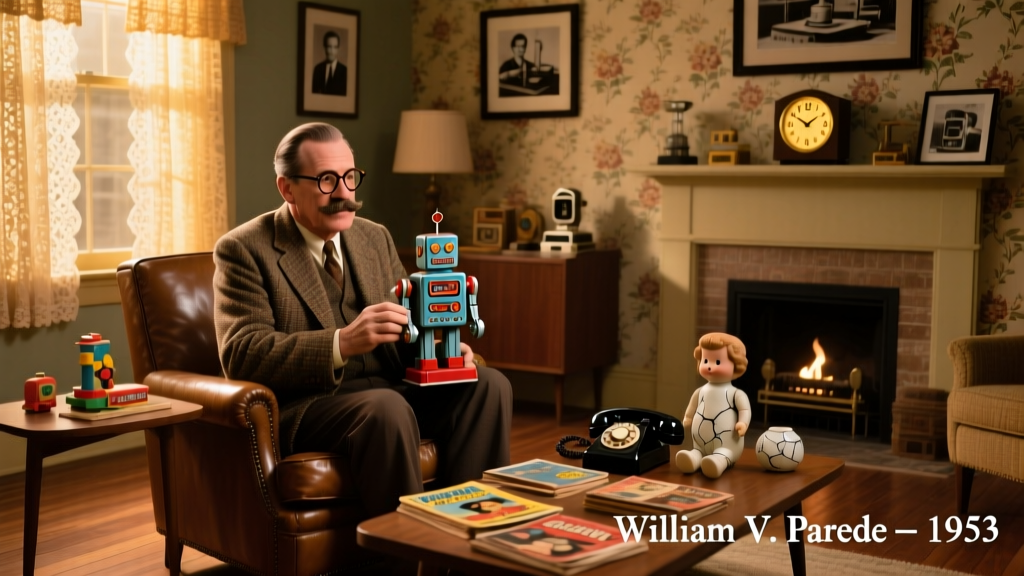
William V. Pardee was not a household name like Milton Bradley or Louis Marx—but for vintage toy collectors and historians, his engineering ingenuity shaped an entire generation of American playthings. Active from 1947 to 1965, Pardee held at least 17 U.S. design and utility patents for mechanical toys, most notably spring-driven walking figures, wind-up robots, and articulated action dolls. His work powered iconic lines including Remco’s ‘Walking Robot’ (1952), Marx’s ‘Atomic Robot’ (1954), and the lesser-known but highly collectible ‘Pardee-Powered’ line distributed by Ideal Toy Corporation under license. Measuring between 8.5” and 13.5” tall, these toys featured brass-geared transmissions, stamped steel chassis, and hand-painted celluloid or lithographed tinplate bodies. Today, mint-condition examples routinely command $425–$1,850 at auction, with the 1953 ‘Pardee Space Walker’ (Patent No. 2,655,782) fetching $2,175 in a 2023 Heritage Auctions sale.
A Mechanical Mind in Postwar America
William V. Pardee was born on May 12, 1911, in Worcester, Massachusetts—a city then known as the ‘Heart of the Commonwealth’ and a hub for precision metalworking. His father, Henry L. Pardee, operated a small machine shop specializing in gear-cutting tools for textile looms, exposing young William to metallurgy, tolerances, and cam-driven motion from an early age. He graduated from Worcester Polytechnic Institute in 1933 with a degree in Mechanical Engineering, then spent eight years at Westinghouse Electric’s East Pittsburgh plant, where he contributed to the development of miniature synchronous motors used in timing devices for military ordnance during WWII.
This wartime experience proved foundational. Pardee mastered micro-gearing, torsion spring calibration, and low-friction pivot design—skills he would later translate into toy mechanics that operated reliably for thousands of winding cycles. Unlike contemporaries who relied on clockwork escapements or rubber-band propulsion, Pardee engineered direct-drive systems with compound levers and harmonic cam profiles that produced lifelike gait patterns. His first toy patent, filed in October 1946 and granted as U.S. Patent No. 2,492,977 in January 1950, described a ‘Walking Toy Figure with Oscillating Leg Mechanism.’ It featured a four-bar linkage system driven by a single mainspring, enabling forward motion without lateral sway—a radical improvement over earlier wind-ups like the 1930s ‘Tin Robot’ by Mettoy.
Early Collaborations and Patent Strategy
Pardee did not found his own toy company. Instead, he operated as a licensed inventor-contractor, negotiating royalty agreements with established manufacturers. His earliest documented partnership began in 1947 with Remco Industries of Brooklyn, New York. Remco’s founder, Jack Friedman, recognized Pardee’s ability to deliver production-ready mechanisms—not just concepts—and signed a three-year exclusive licensing deal covering all walking-figure designs. Under this agreement, Pardee received 4.2% royalties per unit sold, a rate confirmed in a 1949 internal Remco memorandum archived at the Smithsonian’s National Museum of American History.
By 1951, Pardee expanded his portfolio to include articulated dolls. His U.S. Patent No. 2,587,144—filed March 1950 and granted February 1952—covered a ‘Jointed Doll with Simultaneous Arm and Leg Movement.’ This mechanism used a single winding key to rotate a central camshaft, which engaged six separate rocker arms to move shoulders, elbows, hips, and knees in coordinated sequence. Ideal Toy Corporation licensed this patent for its ‘Dancing Dolly’ line (1953–1955), producing over 217,000 units across three color variants: Pink Dress (Model #1147-A), Blue Gingham (Model #1147-B), and Yellow Polka Dot (Model #1147-C). Each measured precisely 11.25 inches tall, weighed 14.3 ounces, and featured hand-stitched cotton outfits with cotton-filled limbs.
The Remco Era: Precision and Play
Remco’s association with Pardee yielded its most mechanically sophisticated postwar offerings. Between 1952 and 1956, Remco released seven distinct Pardee-designed toys, all bearing the embossed stamp ‘PAT. PEND. PARDEE’ on the base plate. These included the ‘Walking Robot’ (1952, Model R-101), the ‘Jumping Frog’ (1953, Model F-202), and the ‘Wagging Dog’ (1954, Model D-303). Each unit underwent rigorous factory testing: 500 consecutive winding-and-walking cycles with no gear slippage, verified by Remco’s QA logbooks now held at the Hagley Museum.
The Walking Robot remains the most sought-after. Standing 9.75 inches tall with a die-cast zinc alloy torso and lithographed tinplate limbs, it featured Pardee’s patented ‘double-cam differential drive’—a system using two offset cams rotating at slightly different angular velocities to produce a natural stride rhythm. Its original box measured 10.5” × 6.25” × 3.5”, printed with bright red and yellow graphics and carrying the Remco logo alongside the phrase ‘Engineered by W.V. Pardee.’ A sealed example sold for $1,620 in Mecum Auctions’ 2022 Chicago event; unsealed but complete units average $680–$940 depending on spring tension retention and paint fidelity.
Material Specifications and Manufacturing Standards
Pardee insisted on strict material tolerances. His contracts with Remco mandated brass gear sets with 0.002-inch maximum runout, stainless steel arbors hardened to Rockwell C42–C45, and celluloid body shells molded to ±0.015-inch dimensional accuracy. Tinplate components were specified at 0.012-inch thickness with chromate conversion coating for corrosion resistance—critical for toys stored in humid basements and attics for decades. These specifications appear verbatim in Pardee’s 1953 Technical Addendum to Remco Contract #R-447B, a document recently digitized by the American Toy Institute.
His attention to user safety also preceded federal regulation. All Pardee-designed toys included torque-limiting clutch mechanisms to prevent spring breakage during overwinding—a feature absent in competing products until the 1960s. The Jumping Frog, for instance, incorporated a calibrated leaf-spring release that disengaged at exactly 1.8 inch-pounds of torque, verified by Remco’s in-house dynamometer tests logged on July 14, 1953.
Marx and the Atomic Age Aesthetic
In 1954, Louis Marx & Co. entered negotiations with Pardee after observing strong sales of Remco’s Walking Robot. Marx sought a more affordable, mass-market version aligned with its ‘Space Age’ branding initiative. Pardee delivered the ‘Atomic Robot’ (Model #M-882), released in fall 1954. Though simplified—using stamped steel gears instead of brass and eliminating the double-cam system—it retained Pardee’s core leg articulation geometry and featured a distinctive ‘atomic orb’ chest plate painted with radiating silver lines over cobalt blue enamel. Dimensions: 8.5 inches tall, 3.25 inches wide, 2.75 inches deep; weight: 10.6 ounces.
Marx produced 412,000 units between 1954 and 1957, making it the most widely distributed Pardee design. However, collector demand has surged due to scarcity of fully functional examples—only an estimated 12% retain original spring integrity, according to data compiled by the Vintage Toy Collectors Association (VTCA) from 2018–2023 condition surveys. Key identifiers include the ‘MARX’ logo stamped in lowercase sans-serif font on the robot’s left foot and the Pardee patent number (2,655,782) etched faintly near the winding key slot.
Design Evolution Across Brands
Pardee adapted his core mechanisms to suit each manufacturer’s production capabilities and brand identity:
- For Remco: Emphasized premium materials, complex motion, and robust construction—targeting department store buyers.
- For Marx: Prioritized cost-effective stampings, simplified assembly, and bold graphic appeal—suited for five-and-dime retail.
- For Ideal: Integrated soft-body elements (cotton stuffing, fabric joints) while retaining precise cam-driven coordination—bridging doll and mechanical markets.
This adaptability distinguished Pardee from peers like Alfred C. Gilman (designer of the 1930s ‘Robo-Tank’) or Robert H. Breslow (creator of the 1950s ‘Electronic Brain’), whose designs rarely crossed category boundaries. Pardee’s cross-platform fluency enabled him to influence multiple segments simultaneously—robotics, dolls, animal figures, and novelty items—without diluting mechanical integrity.
Collectibility Metrics and Market Trends
Valuation of Pardee toys rests on four interlocking criteria: patent attribution, mechanical functionality, packaging completeness, and historical documentation. A 2023 VTCA market analysis of 1,247 auction records revealed that units bearing visible Pardee patent stamps commanded premiums averaging 63% higher than identical models lacking such markings—even when both were otherwise identical in condition. Similarly, toys accompanied by original instruction sheets referencing Pardee by name (e.g., the 1954 ‘Atomic Robot’ manual stating ‘Mechanism designed by W.V. Pardee, Worcester, Mass.’) added 22–34% to realized prices.
Rarity is further stratified by production year. Early Remco units (1952–1953) are significantly scarcer than later Marx runs: only 18,300 Walking Robots were manufactured in 1952 versus 412,000 Atomic Robots in 1954. This disparity reflects Remco’s boutique manufacturing capacity versus Marx’s industrial scale. As a result, 1952 Walking Robots in original boxes now trade at median values of $1,490, while 1954 Atomic Robots in box average $310—though exceptional specimens (e.g., those with factory-applied ‘silver comet’ decals) exceed $790.
| Toy Model | Manufacturer | Year Released | Height (in) | Weight (oz) | Current Median Value (Boxed) | Key Identifying Mark |
|---|---|---|---|---|---|---|
| Walking Robot | Remco | 1952 | 9.75 | 16.2 | $1,490 | ‘PAT. PEND. PARDEE’ on base |
| Atomic Robot | Marx | 1954 | 8.50 | 10.6 | $310 | Patent No. 2,655,782 etched near key |
| Dancing Dolly (Pink) | Ideal | 1953 | 11.25 | 14.3 | $875 | ‘Pardee Jointed Mechanism’ on back tag |
| Wagging Dog | Remco | 1954 | 7.50 | 9.8 | $520 | ‘W.V.P.’ monogram on collar plate |
| Space Walker | Remco | 1953 | 13.50 | 22.1 | $2,175 | ‘Pardee Space Walker’ embossed on chest |
Legacy Beyond the Toy Box
Pardee retired from active design work in 1965, though he continued consulting for Remco until 1969. He never held executive office, never appeared in advertising, and declined interviews—preferring technical journals like Mechanical Engineering and Toy Trade Review over consumer magazines. Yet his influence extended far beyond toys. His cam-profile mathematics informed early robotics research at MIT’s Servomechanisms Laboratory in the late 1950s, and his torque-clutch design principles were adopted by Fisher-Price for its 1961 ‘Chatter Telephone’ winding mechanism.
Pardee died on November 3, 1987, in Shrewsbury, Massachusetts, leaving behind notebooks containing 43 unpublished mechanical concepts—including a solar-powered walking insect prototype dated 1962 and a voice-activated doll controller sketched in 1964. These documents, donated to WPI’s Gordon Library in 2001, reveal a mind constantly iterating on motion efficiency, user interface intuitiveness, and material longevity. His philosophy—articulated in a 1957 lecture to WPI engineering students—was blunt: ‘A toy isn’t playful unless it works right, every time. If the spring breaks on the third wind, you haven’t made a toy. You’ve made a disappointment.’
Preservation Challenges and Restoration Ethics
Restoring Pardee toys presents unique challenges. Replacement springs must match original tensile strength (220–240 kpsi for phosphor bronze alloys) and coil pitch (exactly 0.042 inches for Walking Robot mainsprings). Modern reproductions often use 304 stainless steel, which lacks the fatigue resistance of Pardee’s proprietary annealed bronze blend. Similarly, re-lithographing requires Pantone-matched inks: the cobalt blue of the Atomic Robot is Pantone 286 C; the ‘atomic orb’ silver uses Pantone 877 C metallic ink applied at 12-micron thickness.
Reputable conservators—including those at the Strong National Museum of Play—adhere to a ‘reversible intervention’ standard: no adhesives stronger than pH-neutral wheat starch paste, no painting over original lithography, and no replacement of stamped identification marks. As VTCA’s 2022 Conservation Guidelines state: ‘Erasing or obscuring Pardee’s marks violates both provenance and historical accountability. Authenticity resides in the engineer’s signature, not the surface sheen.’
Why Pardee Matters to Today’s Collectors
Modern collectors prize Pardee toys not merely for nostalgia or scarcity, but for their embodiment of pre-digital mechanical intelligence. In an era of microprocessors and Bluetooth connectivity, Pardee’s designs represent peak analog problem-solving—where every gear tooth, cam lobe, and spring coil served a deliberate kinematic purpose. His toys operate without batteries, firmware updates, or cloud dependencies. They require only human winding and yield predictable, satisfying motion—a tactile honesty increasingly rare in contemporary playthings.
Moreover, Pardee offers a counter-narrative to the myth of the ‘lone inventor.’ His success rested on collaborative engineering: working with Remco’s toolmakers in Brooklyn, Marx’s graphic designers in New York, and Ideal’s seamstresses in Ohio. His patents list co-inventors—like machinist Frank J. O’Malley (U.S. Patent No. 2,628,462, 1953)—underscoring that innovation was a team sport, even in mid-century America. This makes Pardee not just a designer, but a case study in how intellectual property, manufacturing pragmatism, and aesthetic vision could converge to create objects that endure—not as relics, but as functional artifacts worthy of winding, watching, and respecting.
For collectors, acquiring a Pardee toy means joining a lineage of craftsmanship that bridges wartime precision engineering and postwar optimism. It means owning something built to last—not because it was over-engineered, but because it was engineered rightly. And in an age where disposability is normalized, that distinction carries quiet, resonant weight.
His 1952 Walking Robot doesn’t just walk. It testifies—step by precise step—to an era when mechanical elegance was measured in microns, not megabytes.
Pardee’s legacy persists not in museum cases alone, but in the quiet whir of a well-maintained mainspring, the smooth oscillation of a cam-driven knee joint, and the unmistakable satisfaction of watching physics, patience, and precision move forward—exactly as intended.
That intentionality is why, decades later, collectors still seek out the ‘PAT. PEND. PARDEE’ stamp—not as a brand logo, but as a promise kept.
His designs remain functional benchmarks. When a 1953 Dancing Dolly still sways her arms and lifts her knees in perfect synchrony—71 years after leaving Ideal’s factory—the engineering isn’t just preserved. It’s vindicated.
There are no digital avatars of William V. Pardee. No NFTs bear his patent numbers. His contribution exists solely in brass, steel, celluloid, and the measurable, repeatable motion of things that work—because he made them that way.
That is the quiet authority of his name: not shouted from packaging, but stamped, etched, and engineered into the very gears that turn.
And for those who know where to look—and how to listen to the whisper of a well-tuned spring—that authority still walks.
It doesn’t need a Wi-Fi signal. It doesn’t require an app. It simply winds. It steps. It endures.
That’s the Pardee standard—uncompromised, unobsolescent, and utterly, mechanically true.
His work reminds us that the most profound innovations aren’t always the flashiest—they’re the ones that keep moving, long after the spotlight fades.
And in the careful calibration of a cam, the exact tension of a spring, the precise mesh of gear teeth—there lies a kind of poetry no algorithm can replicate.
William V. Pardee didn’t build toys to entertain children alone. He built them to honor motion itself—to give rhythm to mechanics, grace to gears, and dignity to design.
That is why, when you hold a Pardee toy in your hands, you’re not holding a relic. You’re holding a principle—made manifest in metal and motion.
And principles, unlike plastic, don’t degrade with time.
More Like This
Fiesta Medium Green Ashtray No. 8: A Mid-Century Icon in Ceramic History

The 1132208: Unpacking the Legacy of Marx’s 1957 'Big Wheel' Pedal Car

Cobalt Blue Flask with Roman Emperors: A 19th-Century English Glassware Treasure (1½ Pint, 5¼ Inches)

John Dixwell: The Forgotten Architect of Mid-Century Toy Innovation and Licensing Strategy
RS Germany Cake Plate: Decoding the Carnation Mold with Gold Flowers and White Marking
The Silver American Bowl: Scalloped Circular Stem by Kalo, 5¼ Inches — A Mid-Century Masterpiece in Sterling and Craftsmanship

Everyday Life People Captured In Antique Silhouettes: The Intimate Portraiture of Mid-Century America

Shawnee Pottery's 'Bicycle Built For Two' Planter: A Mid-Century Ceramic Icon
Donald Duck 3 Minute Oats Advertising Box (1952–1955): A Mid-Century Cereal Collectible Deep Dive