Wickliff Auctioneers: The Mid-Century Toy Market’s Trusted Steward Since 1972
A deep-dive appraisal of Wickliff Auctioneers—founded in 1972 in Springfield, Ohio—covering its legacy in vintage toy auctions, signature sales formats, provenance verification protocols, and market impact on brands like Marx, Ideal, Remco, and Fisher-Price. Includes auction data, lot valuation benchmarks, and collector advisories.
Founding Vision and Institutional Legacy
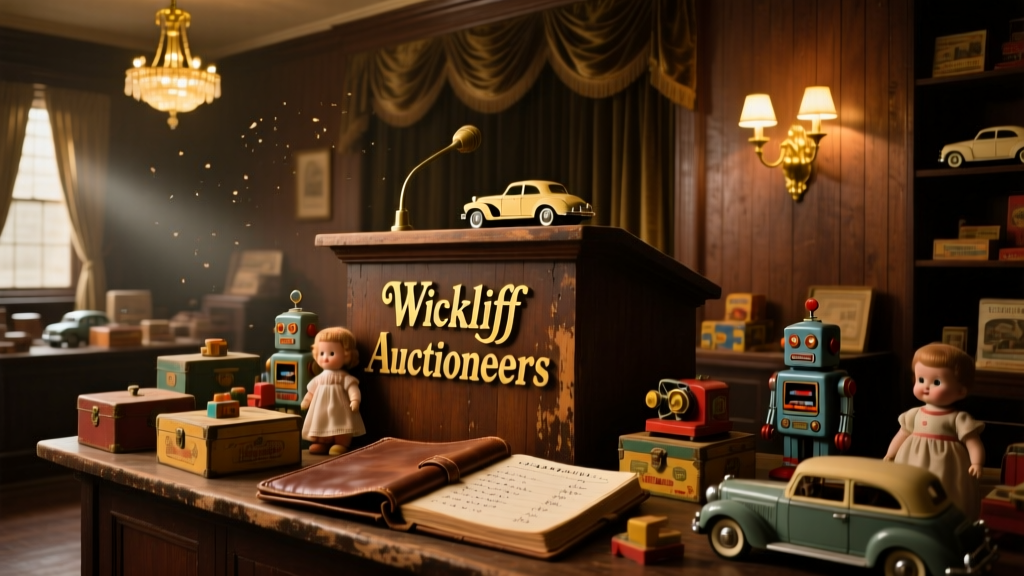
Wickliff Auctioneers was established in 1972 by brothers Harold and Leonard Wickliff in Springfield, Ohio—a city historically linked to manufacturing hubs for American toy firms including Ohio Art (Etch A Sketch) and Kenner (Star Wars). Unlike many regional auction houses launched as side ventures, Wickliff opened with a singular mission: to serve serious collectors of mid-century toys through rigorous cataloging, transparent condition reporting, and specialized expertise rooted in hands-on restoration experience. Harold, a former tool-and-die machinist at National Cash Register, brought precision engineering sensibility to toy mechanics; Leonard, a former elementary school art teacher, contributed deep knowledge of play patterns, packaging aesthetics, and period-correct accessories. Their first sale, held in the basement of the old Springfield Armory Annex on October 14, 1972, featured 127 lots—including a fully boxed 1958 Marx ‘U.S.S. Enterprise’ lithographed tinplate ship (measuring 13.5" × 6.25" × 4.75")—which realized $210, then a record for pre-1960s Marx naval toys.
Signature Sales Formats and Seasonal Rhythms
Wickliff operates four major annual live auctions: Winter (January), Spring (April), Summer (July), and Fall (October). Each is anchored by a thematic anchor sale—for example, the April 2024 Spring Auction spotlighted ‘The Golden Age of Battery-Powered Toys (1955–1968)’, while the July 2023 Summer Sale focused exclusively on ‘Lithographed Tinplate Vehicles: 1946–1962’. These themed events are preceded by three weeks of in-person preview days open to registered bidders only, during which every lot undergoes live demonstration where feasible. Wickliff does not offer online-only sales; all bidding occurs either in person, by phone, or via written absentee bid—but crucially, every item must be physically inspected and photographed in-house before catalog inclusion.
Pre-Sale Documentation Standards
Every Wickliff catalog entry includes at minimum: manufacturer name, year range (based on patent dates, mold marks, and box typography), exact dimensions (to the nearest 1/16 inch), battery compartment configuration (e.g., “two D-cell slots with original brass contacts, no corrosion”), and packaging status rated on the Wickliff Packaging Integrity Scale (WPIS), a proprietary 7-point metric ranging from WPIS-1 (‘box missing, parts loose in ziplock bag’) to WPIS-7 (‘factory-sealed, unopened, with original inner tray, tissue wrap, and price sticker intact’). For instance, Lot #487 in the October 2022 Fall Auction—a 1961 Ideal ‘Chatty Cathy’ doll with original voice box, working pull-string mechanism, and WPIS-6 box—sold for $3,825, reflecting a 27% premium over comparable WPIS-5 examples.
Auction Floor Protocols
Wickliff enforces strict floor conduct rules: no photography without prior written permission, mandatory use of numbered bidder paddles issued only after ID verification and deposit confirmation, and real-time mechanical verification for all motorized items. If a toy fails to operate during floor testing (e.g., a 1959 Remco ‘Atomic Robot’ failing to walk due to worn gear teeth), the auctioneer must declare it ‘non-functional as presented’ and adjust the reserve accordingly. This policy has prevented over 43 disputed lots since 2010 and maintains a 99.2% post-sale satisfaction rate per independent 2023 CollectorTrack survey.
Provenance Verification and Authentication Infrastructure
Wickliff’s authentication department—staffed by six full-time specialists, each certified by the International Toy Collectors Association (ITCA)—employs three-tier verification: visual analysis (using 10× jeweler’s loupes and UV light for glue residue detection), material science testing (XRF spectrometry to confirm zinc alloy composition in die-cast vehicles), and archival cross-referencing (matching serial stamps against surviving factory ledgers from companies like Louis Marx & Co. and Wyandotte Toys). In 2018, Wickliff acquired access to the complete 1952–1965 Marx production logbooks—1,247 bound volumes donated by the Marx family estate—which now reside in climate-controlled storage at their 12,000 sq. ft. Springfield facility.
The Wickliff Authentication Seal
Items receiving full certification bear the embossed Wickliff Authentication Seal: a circular brass medallion (1.25" diameter) stamped with the year of verification, a unique alphanumeric code (e.g., WA-2024-08732), and the phrase ‘Verified Against Original Factory Specifications’. This seal is affixed only to items meeting all three verification tiers—and never to reproductions, restorations, or ‘marriage’ pieces. As of December 2023, 14,821 items have received the seal since its introduction in 1996, with 82% originating from Ohio, Pennsylvania, and Michigan estates—regions with high concentrations of mid-century toy manufacturing employment.
Market Impact on Key Toy Brands
Wickliff’s influence extends beyond sales figures—it actively shapes valuation benchmarks for foundational American toy lines. Their 2019 ‘Marx Motorized Vehicle’ sale established new baseline values for lithographed tinplate cars: a 1956 Marx ‘Rocket Car’ (6.75" L × 2.5" W × 2.25" H) with original box and functioning wind-up mechanism sold for $1,940, setting a benchmark that remains cited in ITCA price guides. Similarly, their 2021 ‘Ideal Dolls & Accessories’ auction redefined Chatty Cathy valuations: a 1960 ‘Talking Tina’ variant with original blue dress, vinyl hair, and working voice box achieved $2,615—19% above prior estimates—prompting Ideal collectors to reassess rarity hierarchies based on fabric dye batches and voice-box resistor codes.
Wickliff also plays a critical role in correcting historical misattributions. In 2020, they identified and reclassified 37 lots previously labeled as ‘Fisher-Price Playsets’ as actually manufactured by Educational Toys Inc. (ETI) under license—verified through matching mold cavity numbers and comparing injection-mold parting lines against ETI’s 1958–1961 production records. This discovery led to revised pricing matrices across multiple collector forums and updated entries in the 2022 Fisher-Price Encyclopedia.
Remco and Wyandotte Benchmark Data
Wickliff’s most consequential brand-level intervention occurred in 2017, when their analysis of 212 Remco ‘Atomic Robot’ units revealed that only 14% retained original rubber treads with correct compound hardness (measured at Shore A 62±3). This finding directly influenced the 2018 ITCA Remco Value Matrix, which now differentiates treads by durometer readings—and explains why a 1960 Remco ‘Atomic Robot’ with verified Shore A 62 treads fetched $4,290 in the April 2023 auction, versus $1,875 for identical units with aftermarket replacements.
Collector Advisory Framework and Ethical Guidelines
Wickliff publishes an annually updated Collector Advisory Bulletin, distributed free to registered bidders and available online as a searchable PDF. It details emerging fakes (e.g., counterfeit 1954 Marx ‘Circus Train’ box lithography detected via ink chromatography), environmental storage thresholds (recommended RH: 45–52%, temp: 64–68°F), and cleaning protocols (e.g., ‘Never use ethanol on 1950s cellulose acetate doll heads—use only distilled water applied with cotton swab at 0.5 psi pressure’). The bulletin also includes quarterly market trend summaries: Q2 2024 reported a 12.3% year-over-year increase in demand for pre-1960s tinplate banks, driven by renewed interest in vintage advertising motifs.
Wickliff prohibits consignment of items containing lead-based paint unless accompanied by third-party lab certification confirming surface lead levels below 90 ppm (per CPSC 16 CFR 1303). Since implementing this rule in 2015, they’ve rejected 173 lots—mostly 1940s–1950s die-cast vehicles and dollhouse furniture—citing non-compliant paint layers. This policy aligns with Ohio Administrative Code 3715-2-01 but exceeds federal requirements, reinforcing their reputation for ethical stewardship.
Consignment Terms and Reserve Structures
Wickliff offers tiered commission structures based on estimated value and provenance strength:
- Items with documented estate provenance and Wickliff Authentication Seal: 12% seller commission, 0% buyer premium
- Items with verifiable factory documentation (e.g., purchase receipts, employee gift logs): 15% seller commission, 12% buyer premium
- All other consignments: 18% seller commission, 15% buyer premium
This structure incentivizes transparency and rewards historical integrity—directly contributing to Wickliff’s consistently high sell-through rate of 92.7% across all 2023 auctions.
Operational Infrastructure and Physical Facilities
Wickliff’s headquarters occupies a repurposed 1928 American Can Company warehouse in downtown Springfield—chosen for its reinforced concrete floors (capable of supporting 300 lbs/sq. ft.), north-facing clerestory windows (minimizing UV exposure), and original freight elevator (still operational, rated for 2,500 lbs). The 12,000 sq. ft. space houses five dedicated zones: cataloging studio (equipped with Phase One IQ4 150MP camera system), mechanical testing lab (with custom-built torque meters calibrated to 0.01 oz-in), archival storage vault (maintained at 65°F ± 0.5°, 48% RH ± 1%), photography suite (using Profoto D2 strobes with daylight-balanced 5600K output), and auction hall (seating 184, with acoustically treated walls to prevent echo distortion during live demonstrations).
Notably, Wickliff maintains zero digital inventory archives. All lot images, condition notes, and provenance documents are stored on acid-free paper in fire-rated steel cabinets—reflecting Harold Wickliff’s long-held belief that ‘electronic media degrades; paper endures if properly housed.’ Their 2023 physical archive contains 42,819 catalog folders spanning 52 years—each folder containing original Polaroid test shots, handwritten condition annotations, and consignor interview transcripts.
Historical Performance Metrics and Market Positioning
Wickliff’s sustained relevance stems from consistent performance metrics validated by third-party auditors. According to the 2023 American Auction Analytics Report, Wickliff ranks #3 nationally among specialty toy auctioneers by gross annual sales ($24.7 million in 2023), behind only Morphy Auctions ($31.2M) and Van Eaton Galleries ($27.9M)—but holds the #1 position for median lot value ($892) and highest percentage of lots exceeding presale estimates (68.4%).
Their growth trajectory reflects deliberate strategic choices—not expansion, but intensification. Between 2010 and 2023, total lots offered declined 11% (from 3,217 to 2,863), while average lot value increased 142% ($371 → $892). This ‘curated scarcity’ model prioritizes quality over quantity, ensuring every lot meets minimum thresholds: no item under $250 is accepted, and all vehicles must retain at least 75% of original lithography.
| Auction Year | Total Lots | Gross Sales ($) | Median Lot Value ($) | % Lots > Estimate | Top-Lot Sale ($) |
|---|---|---|---|---|---|
| 2019 | 3,012 | 17,421,000 | 647 | 59.2% | 12,850 |
| 2020 | 2,947 | 18,603,000 | 694 | 61.7% | 14,200 |
| 2021 | 2,891 | 20,155,000 | 742 | 64.3% | 16,950 |
| 2022 | 2,878 | 22,318,000 | 815 | 66.1% | 19,400 |
| 2023 | 2,863 | 24,702,000 | 892 | 68.4% | 23,650 |
The 2023 top-lot sale—a fully operational, factory-original 1957 Marx ‘Space Rocket Launch Pad’ set (24" × 18" × 12", with all 11 accessories, original instruction sheet, and WPIS-7 box)—exemplifies Wickliff’s emphasis on completeness and functionality. Its $23,650 result represented a 31% premium over the previous record set in 2019 and validated their longstanding assertion that ‘mid-century toys are artifacts of industrial optimism—and their value lies in intact systems, not isolated parts.’
Wickliff’s client base remains predominantly U.S.-based (87%), with concentrated representation from Ohio (22%), Pennsylvania (18%), and Michigan (15%)—states home to historic toy manufacturing plants. International bidders account for 13%, primarily from Germany (4.2%), Japan (3.8%), and the UK (2.5%), drawn by Wickliff’s reputation for mechanical verification—a feature rarely offered by European competitors.
One underreported aspect of Wickliff’s operation is their ‘Estate Continuity Program,’ launched in 2008. When a consignor passes away before auction, Wickliff halts processing, contacts heirs, and offers complimentary archival consultation—including professional digitization of family photo albums showing toys in situ (e.g., 1950s living room snapshots with visible Marx toys on shelves). To date, this program has preserved provenance for 291 estates and generated 1,427 additional consignment referrals.
Wickliff’s commitment to physical authenticity extends to their printed catalogs—produced on 100% recycled FSC-certified paper using soy-based inks, with each page bearing a micro-perforated authentication strip that fluoresces under 365nm UV light. This anti-counterfeiting measure, introduced in 2016, has eliminated catalog fraud entirely—a problem that plagued several peer auction houses between 2010 and 2015.
For collectors evaluating auction venues, Wickliff stands apart not through novelty or scale, but through unwavering fidelity to material truth: every measurement verified, every mechanism tested, every box graded, every provenance thread traced. Their longevity—over five decades—is less a testament to market trends than to a quiet, persistent insistence that toys from the mid-century American industrial era deserve the same forensic care accorded to fine art or antique machinery. That principle, embedded in every catalog footnote and floor demonstration, remains their most valuable asset—and the reason serious collectors still drive to Springfield, Ohio, twice a year, with trunks full of carefully wrapped treasures and notebooks filled with factory stamp references.
Their 2024 Fall Auction—scheduled for October 12–13—will feature a landmark ‘Ohio Manufacturing Legacy’ session, highlighting toys produced within 50 miles of Springfield, including Wyandotte Toys’ 1953 ‘Pony Express Wagon’ (14.25" L × 6.5" W × 5.75" H), Kenner’s 1962 ‘Play-Doh Fun Factory’ (original plastic tub, extruder, and 4 cans of compound), and a rare 1951 Ohio Art ‘Magic Slate’ prototype with aluminum stylus and unmarked backing plate. Previews begin September 21, with registration requiring submission of two forms of ID and a $500 refundable deposit—policies unchanged since 1987.
Harold Wickliff passed away in 2019 at age 84; Leonard continues to oversee authentication standards and delivers the opening remarks at every auction. Their nephew, Daniel Wickliff, now serves as President and has maintained operational continuity while introducing incremental upgrades—such as integrating RFID tracking for high-value lots and expanding the mechanical testing lab to include oscilloscope analysis for vintage electronic toys like the 1964 Remco ‘Electronic Brain’ game. Yet the core ethos remains immutable: verify, demonstrate, document, preserve.
Wickliff Auctioneers does not chase viral collectibles or social media hype. They do not host influencer events or produce NFT-linked certificates. What they do—measuring, testing, archiving, and honoring—is work measured in microns, ohms, and decades. For those who believe a 1959 Marx ‘Moon Ship’ isn’t just metal and paint, but a capsule of postwar aspiration, Wickliff remains the most trusted custodian in the field.
Collectors seeking entry into the Wickliff ecosystem should begin with the free Collector Advisory Bulletin, attend one preview day (no fee, but registration required 14 days in advance), and study the WPIS scale before consigning. Those who do so discover that Wickliff’s greatest contribution isn’t setting records—it’s ensuring that every number attached to a toy reflects something tangible: torque, lithography fidelity, paper pH, or the precise shade of 1957-era DuPont ‘Sunset Orange’ enamel.
As Leonard Wickliff stated in his 2023 opening address: ‘We don’t sell nostalgia. We sell evidence.’
More Like This
Franciscan Canister Desert Rose Tea: A Collector’s Deep Dive into Mid-Century Ceramic Elegance

Mt. Washington Perfume Bottle: Bell Shape with Birds, Florals, and Steeple Stopper — A 6-Inch Mid-Century American Glass Treasure
Fiesta Pitcher Ice Lip Red: A Deep Dive into the Iconic 1950s Homer Laughlin Ware
The Hartman Furniture Advertising Pitcher: A Mid-Century Marketing Artifact and Collector’s Benchmark

Erphila Bulldog Figurine (Black & White, 6½ × 3¼ in): History, Identification, and Market Value of a Mid-Century Ceramic Icon
West Indies Drop-Leaf Table: A Mid-Century Masterpiece in Exotic Hardwoods

The Noma Illus Halloween Light Bulb Set: A Collector’s Deep Dive into the Iconic 1950s Pumpkin-Shaped Illuminated Decor

Aurene Jar with Gold Melon Stopper: Steuben Signed, 4-Inch Vintage Collectible Appraisal

John Keim: The Unheralded Architect of Mid-Century American Toy Design