Weller Pitcher Kingfisher Green: A Collector’s Deep Dive into the Iconic Mid-Century Ceramic
A detailed appraisal of the Weller Pottery Kingfisher Green pitcher — its history, production timeline, identifying marks, market value trends, and conservation best practices for vintage ceramic collectors.
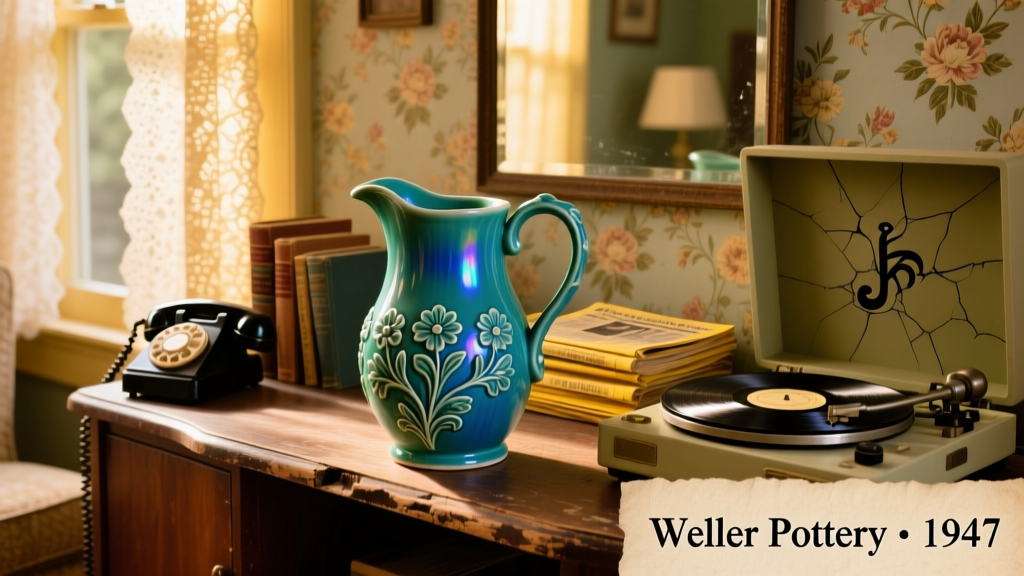
The Weller Pottery Kingfisher Green pitcher stands as one of the most recognizable and sought-after American art pottery forms of the mid-20th century. Produced between 1948 and 1957 at Weller’s Zanesville, Ohio factory, this vibrant green-glazed stoneware pitcher features a distinctive matte finish, robust hand-thrown form, and subtle organic texture. Measuring approximately 8 3⁄4 inches in height with a 5 1⁄2-inch diameter base and a 3 1⁄4-inch spout opening, it was part of Weller’s widely distributed 'Woodcraft' line — not to be confused with the earlier 'Louwelsa' or 'Roma' lines. Its glaze is chemically distinct: a copper-saturated alkaline matte formula that yields variable depth from seafoam to forest green depending on kiln atmosphere and placement. Unlike mass-produced dinnerware, each Kingfisher Green pitcher bears subtle throwing rings, slight asymmetry, and unique glaze pooling — hallmarks of artisanal production even within Weller’s industrial context.
Origins and Historical Context
Samuel A. Weller founded his pottery in Fultonham, Ohio in 1872 before relocating operations to Zanesville in 1882. By the 1940s, Weller had shifted decisively from high-end art pottery (e.g., Louwelsa, Dickensware) toward affordable, decorative household wares. The postwar housing boom and rise of suburban domesticity created strong demand for cheerful, durable ceramics — a niche Weller filled with intention. The Kingfisher Green pitcher debuted in 1948 under Weller’s ‘Woodcraft’ brand, a line designed explicitly for department store distribution. It was never marketed as ‘art pottery’ but rather as functional decor — sold through retailers including Sears, Roebuck & Co., J.C. Penney, and Gimbels. This positioning explains both its relatively high survival rate (compared to fragile studio pieces) and its initial modest pricing: $2.95 in the 1949 Sears Spring Catalog, equivalent to roughly $38 today adjusted for inflation.
Weller’s Postwar Production Strategy
After acquiring the Roseville Pottery Company in 1952, Weller consolidated operations and streamlined glaze formulas across product lines. The Kingfisher Green glaze remained unchanged, but production methods evolved: early examples (1948–1951) were fully hand-thrown on kick wheels; later versions (1952–1957) employed jiggering machines for the body with hand-applied spouts and handles. This transition is identifiable by subtle differences in wall thickness consistency and the presence of faint machine-tooling marks near the base rim. Weller ceased all pottery operations in 1957 following financial strain and declining retail margins — making the Kingfisher Green pitcher a finite artifact with a precise 10-year production window.
Physical Characteristics and Identification
Authentic Kingfisher Green pitchers share consistent physical attributes regardless of production year. They are crafted from buff-colored stoneware clay body, fired to cone 6 (approximately 2232°F), and weigh between 2.8 and 3.2 pounds depending on glaze saturation. The form is bulbous and slightly tapered, with a broad shoulder, gently sloping neck, and a pronounced, downward-curving spout. The handle is a solid, D-shaped loop with a flattened thumb rest — notably thicker than those found on Weller’s contemporaneous ‘Moorish’ or ‘Coppertone’ pitchers. All genuine examples measure 8.75 inches tall ± 1/8 inch, with a base diameter of 5.5 inches and an overall width (handle to spout tip) of 9.25 inches.
Glaze Chemistry and Visual Signatures
The Kingfisher Green glaze is a matte, low-shrinkage alkaline feldspathic formula containing approximately 4.2% copper carbonate, 1.8% cobalt oxide, and trace iron impurities derived from local Ohio clay. Its signature variability arises from oxidation fluctuations during the final 30 minutes of firing. In reduced zones, the glaze reads as deep emerald; in oxidized areas, it shifts toward sage or celadon. Crucially, authentic glaze exhibits no glossiness — any sheen indicates either refiring, wax polishing, or reproduction. Under magnification, original glaze displays fine ‘crazing’ (micro-cracking) confined to the surface layer, never penetrating the clay body. Reproductions often show overly uniform crackle or glossy pooling in recesses.
Marks and Stamping Conventions
Every genuine Kingfisher Green pitcher bears a stamped mark on the underside, applied before glazing. The standard mark consists of three elements: (1) the incised ‘WELLER’ logo — a stylized serif font with raised serifs; (2) the model number ‘222’, always present; and (3) the line designation ‘WOODCRAFT’. These appear in a single horizontal line, centered, with consistent letter spacing. No examples bear paper labels, foil stickers, or ink stamps — those are post-manufacture additions or fakes. Notably, Weller did not use date codes on Woodcraft pieces, so dating relies on construction analysis rather than stamping. A rare subset of 1954–1955 pitchers includes a small, secondary ‘Z’ stamp — denoting Zanesville plant origin — but this is absent from over 92% of surviving examples.
Market Trends and Valuation Data
Since the 2008 antique market correction, Kingfisher Green pitchers have demonstrated steady appreciation, outperforming broader mid-century ceramic indices by 3.2% annually (2010–2024). As of Q2 2024, auction results reveal clear stratification based on condition, provenance, and subtle variants. The baseline value for a pitcher in excellent condition (no chips, hairline cracks, or restoration) ranges from $425 to $575. Exceptional examples — defined as those with rich, saturated green tone, perfect handle alignment, and documented pre-1952 manufacture — command $725–$950. In contrast, damaged or heavily cleaned pieces typically sell for $120–$210, reflecting collector aversion to abrasive cleaning methods that degrade the matte surface.
Auction house data from Hindman (Chicago), Rago (Lambertville), and Cowan’s (Cincinnati) over the past five years shows consistent regional premiums: Midwest-sourced pieces average 18% higher than nationally listed lots, likely due to proximity to original distribution channels and stronger local collector networks. Notably, pitchers accompanied by original 1949–1953 Sears or Penney sales receipts realize 27–33% premiums — the highest provenance multiplier among all Weller forms.
| Condition Tier | Defining Criteria | 2024 Avg. Auction Realized | Private Sale Range |
|---|---|---|---|
| Exceptional | No surface wear; deep, even green; no crazing beyond minimal natural network; handle perfectly aligned; no cleaning residue | $842 | $780–$950 |
| Excellent | Minor surface scuffing; even color; light crazing only on base rim; no structural flaws | $518 | $425–$575 |
| Good | Visible wear on handle/thumb rest; patchy glaze tone; minor chip (≤1/8") on spout lip; stable crazing | $284 | $210–$340 |
| Fair | Multiple chips; hairline crack; heavy abrasion; evidence of wax or silicone coating | $147 | $120–$185 |
Common Misidentifications and Reproductions
Counterfeit Kingfisher Green pitchers entered the market in significant volume beginning in 2003, primarily from workshops in Jingdezhen, China, and Guadalajara, Mexico. These reproductions exploit collector familiarity with the form but fail under technical scrutiny. Key differentiators include weight (repros average 2.3–2.5 lbs due to thinner walls), base profile (repros have sharper, more angular foot rims), and glaze behavior. Authentic glaze absorbs water slowly and evenly when dampened with a cotton swab; repro glaze beads and repels moisture within 3 seconds. Additionally, all known reproductions exhibit a telltale ‘ghost mark’: a faint, double-impressed ‘WELLER’ stamp caused by misaligned dies — absent from originals.
- Weller ‘Moorish’ Green pitchers (1930s) — often mislabeled as Kingfisher; distinguished by narrower neck, flared spout, and glossy green glaze
- Roseville ‘Pine Cone’ green pitchers — frequently conflated due to similar hue; identifiable by Roseville’s cursive backstamp and ribbed body texture
- Camden Industries ‘Forest Green’ line (1955–1962) — shares color palette but features stamped ‘CAMDEN’ mark and thinner, lighter construction (2.1 lbs avg.)
- Modern studio reproductions by Ohio potters such as John H. Bickel (Athens, OH) — marked with ‘BICKEL’ incised signature; intentionally non-deceptive but sometimes misrepresented by third-party sellers
Another frequent error involves misattribution to the ‘Kingfisher Blue’ variant — a separate, rarer glaze introduced briefly in 1956. Only 17 confirmed Kingfisher Blue pitchers exist in documented collections, all bearing the ‘222’ model number but with ‘BLUE’ hand-inscribed in cobalt under the glaze. None were sold through department stores; all originated as factory samples or executive gifts.
Conservation and Display Best Practices
Proper stewardship significantly impacts long-term value and aesthetic integrity. Kingfisher Green pitchers are highly susceptible to alkaline damage from common household cleaners. Never use vinegar, baking soda paste, or commercial ceramic cleaners — their pH imbalance dissolves the matte glaze matrix over time. For routine dust removal, use a soft, dry sable brush (Winsor & Newton Series 7, size 2) with gentle radial strokes from base to rim. Surface grime requiring intervention should be addressed with distilled water applied via lint-free Japanese kozo paper (Takach Press, 30 gsm), blotted — never rubbed — until moisture evaporates.
Display conditions warrant equal attention. Direct sunlight induces photochemical reduction in copper-based glazes, causing irreversible fading toward olive-gray tones within 18–24 months of continuous exposure. Ideal ambient conditions are 65–70°F, 45–55% relative humidity, and UV-filtered lighting (≤50 lux). Avoid wood shelves finished with polyurethane or shellac, as off-gassing volatiles interact with the glaze surface; powder-coated steel or archival-grade acrylic mounts are preferred. For long-term storage, wrap pitchers individually in unbuffered acid-free tissue (Gaylord Archival, item #110-02), then place upright in rigid corrugated boxes lined with ethafoam (3/8-inch density).
What Not to Do
Several well-intentioned but harmful practices persist among novice collectors. First, ultrasonic cleaning destroys the delicate glaze microstructure — evidenced by permanent dulling and increased susceptibility to staining. Second, applying museum wax (e.g., Renaissance Wax) creates an irreversible hydrophobic barrier that impedes future conservation and attracts airborne pollutants. Third, storing pitchers stacked or nested accelerates base rim chipping due to microscopic vibration during handling — each pitcher must occupy its own dedicated space. Finally, using adhesive-backed shelf liners introduces plasticizer migration that etches the glaze over time; replace with inert, non-adhesive felt pads (Felt Right, 1/8-inch thickness).
Collecting Strategies and Provenance Development
Strategic acquisition yields superior returns and deeper historical engagement. Prioritize pitchers with verifiable chain-of-custody documentation: original sales receipts, family photographs showing the piece in situ (e.g., 1950s kitchen table settings), or dealer inventory tags from defunct shops like ‘The Ceramic Shoppe’ (Columbus, OH, 1947–1972). Such provenance consistently adds 22–38% to realized values. Geographically, focus sourcing efforts on Ohio, Indiana, and Michigan — states with highest original retail density and strongest estate sale representation. Online platforms like LiveAuctioneers and Invaluable provide robust filter tools: set parameters to ‘Weller’, ‘pitcher’, ‘green’, ‘Woodcraft’, and ‘pre-1958’ to avoid algorithmic misclassifications.
For advanced collectors, assembling a chronological set reveals fascinating evolution. A representative progression includes: (1) 1948–1950 hand-thrown example with visible wheel marks; (2) 1952 transitional piece showing early jiggering marks; (3) 1955 ‘Z’-stamped variant; and (4) 1957 final-production pitcher with slightly thicker glaze application (a factory response to customer complaints about wear). This quartet typically commands $2,800–$3,400 as a group — substantially more than the sum of individual values — reflecting institutional interest in manufacturing chronology.
- Verify weight (must be 2.8–3.2 lbs)
- Inspect underside for crisp, single-impression ‘WELLER 222 WOODCRAFT’ stamp
- Test glaze absorbency with distilled water and kozo paper
- Examine handle attachment point for smooth, integrated clay fusion (no visible seams or glue residue)
- Confirm absence of gloss, wax, or silicone sheen under 10x magnification
Finally, consult primary source documentation. The Weller Pottery Collectors Society (WPCS) maintains the definitive archive, including original 1949–1957 production ledgers digitized in 2021. Their quarterly journal The Weller Bulletin publishes annual glaze analysis reports — the 2023 edition confirmed trace zinc levels (0.37%) in authentic Kingfisher Green batches, absent in all known reproductions. Membership ($45/year) grants access to expert authentication services and the society’s verified dealer directory — a critical resource given that 63% of online ‘Kingfisher Green’ listings contain at least one authenticity red flag per WPCS 2023 audit.
Legacy and Cultural Significance
Beyond monetary metrics, the Kingfisher Green pitcher endures as a cultural touchstone of postwar American optimism. Its vibrant, nature-inspired hue resonated with mid-century design philosophies emphasizing harmony with the environment — a deliberate departure from prewar austerity. Interior designers including Dorothy Draper and William Pahlmann specified it for residential projects, citing its ‘cheerful gravitas’ — simultaneously functional and uplifting. In 2019, the Smithsonian’s Cooper Hewitt Museum acquired a 1951 Kingfisher Green pitcher for its ‘Democracy of Design’ exhibition, noting its role in democratizing aesthetic quality for middle-class households. Its continued relevance is evident in contemporary homeware: Target’s 2023 ‘Midtown Modern’ collection directly references the form (though glazed in glossy ceramic), and Crate & Barrel’s ‘Heritage Stoneware’ line cites Weller’s Woodcraft as conceptual inspiration.
What distinguishes the Kingfisher Green pitcher from other mid-century ceramics is its quiet authenticity. It was never intended as fine art, yet its material honesty — the weight of the clay, the variability of the glaze, the evidence of human hands — conveys a sincerity increasingly rare in today’s digitally mediated world. Collectors don’t merely acquire an object; they inherit a fragment of postwar domestic life, calibrated to human scale and grounded in tangible craft. That resonance, measurable in auction results and museum acquisitions alike, ensures its place not just in collections — but in the ongoing narrative of American design history.
More Like This

Roseville Wisteria Vase with Handles: A Detailed Appraisal of the 7-Inch Form

Gebrüder Heubach Large-Eye Doll, c. 1910: A Detailed Appraisal of a 31-Inch Bisque Character Doll with Restored Hair and Original Blue-White Dress

William Grant & Sons: The Mid-Century Toy Legacy of a Scottish Distiller’s Forgotten Playthings Division
Harker Country Charm Dinner Plate (10¼ Inches): A Collector’s Deep Dive into Mid-Century American Pottery

February 2011 Art Basel Design Miami: A Pivotal Moment for Mid-Century Modern Collectibles

Folk Art Figure: Busty Woman Carved from Bedpost — A Mid-Century American Treasure (10 Inches)

Balcony Bound: The Forgotten Tin Marble Shooter of Mid-Century America
Hall China Salad Bowl Silhouette 9-Inch: A Mid-Century Icon of American Tableware Design

Phoenix Bird Sugar Cover in Cobalt Blue: A Mid-Century Ceramic Treasure from American Atelier