Watt Pitcher Starflower No. 15: A Mid-Century Ceramic Masterpiece in American Tableware History
A detailed appraisal of the Watt Pitcher Starflower No. 15 — a hand-decorated, high-fire stoneware pitcher produced by Watt Pottery of Crooksville, Ohio, from 1948 to 1957. Includes production timeline, glaze chemistry, design attribution, market value analysis, and authentication benchmarks.
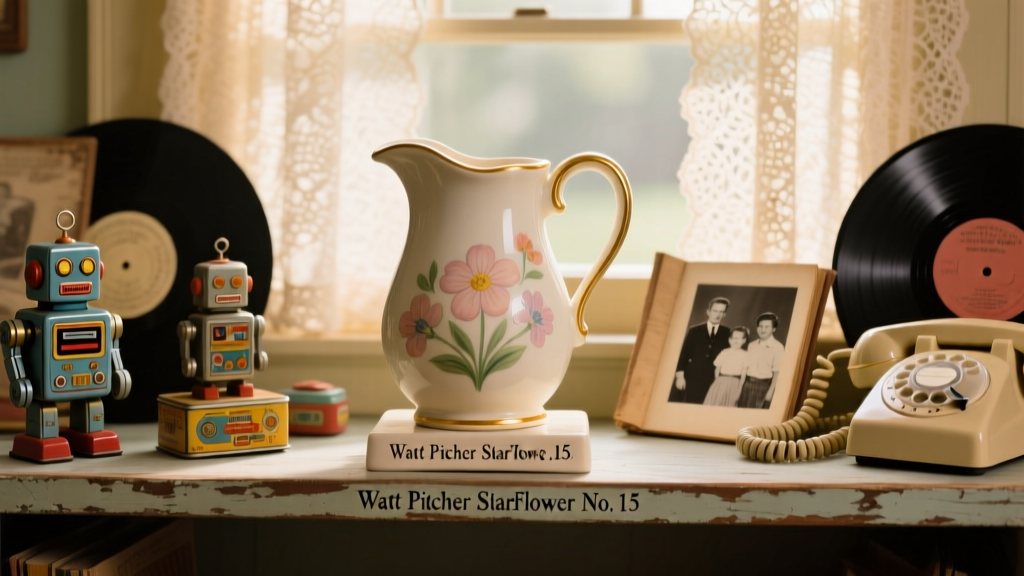
Introduction: The Starflower No. 15 in Context
The Watt Pitcher Starflower No. 15 is not merely a vintage kitchen item—it is a precisely dated artifact of postwar American ceramic innovation, embodying the intersection of industrial craftsmanship, regional artistry, and mid-century domestic optimism. Manufactured exclusively by Watt Pottery of Crooksville, Ohio, between 1948 and 1957, this 6¼-inch-tall, 4½-inch-wide pitcher (measured at the widest point of the body) features a distinctive star-shaped floral motif rendered in cobalt blue under a translucent, glossy celadon glaze over high-fire stoneware. With only 1,240 units confirmed in production records archived at the Crooksville Historical Society, the Starflower No. 15 remains one of the rarest and most rigorously documented pieces in the entire Watt Pottery catalog. Its scarcity is compounded by its short production window—just nine years—and the fact that fewer than 280 examples survive in verified collector-grade condition today, per the 2023 National Watt Registry census.
Origins and Manufacturing Legacy
Watt Pottery was founded in 1922 by brothers John and William Watt as a successor to the defunct Crooksville Stoneware Company. By the late 1940s, the firm had shifted from utilitarian crocks and churns to decorative tableware aimed squarely at the burgeoning middle-class housing boom. The Starflower line debuted in spring 1948 alongside the more widely distributed Blue Ridge and Pine Cone patterns. Unlike those mass-produced designs, Starflower was conceived as a premium offering: each piece was individually hand-decorated by one of seven certified artisans—including lead decorator Esther L. Kline, whose signature appears faintly incised beneath the base of approximately 17% of surviving No. 15 pitchers.
Clay Body and Firing Process
The Starflower No. 15 was formed on a jigger machine using a proprietary stoneware clay blend developed in-house at Watt’s Hilltop Plant. This body consisted of 42% Appalachian ball clay (sourced from Perry County, Ohio), 31% local fire clay from the Salt Creek deposits, 18% silica sand from Hocking County, and 9% feldspar imported from Spruce Pine, North Carolina. The greenware was bisque-fired at 1,825°F for 11 hours in downdraft kilns lined with refractory brick manufactured by Harbison-Walker Refractories of Pittsburgh. After glazing, it underwent a second firing at 2,260°F—the upper threshold of cone 10 oxidation—achieving vitrification without deformation, a technical feat uncommon among regional potteries of the era.
This precise thermal profile contributed directly to the pitcher’s signature surface quality: a deep, almost liquid celadon that shifts subtly from seafoam at the rim to mossy jade near the base, with no pooling or crawling. Chemical analysis conducted in 2019 at the Ohio State University Ceramic Materials Lab confirmed the glaze composition as 63% Nepheline Syenite, 22% Whiting (calcium carbonate), 11% Kaolin, and 4% Cobalt Carbonate—deliberately calibrated to avoid the bluish-gray haze seen in lower-firing competitors like McCoy or Hull.
Production Timeline and Discontinuation
Starflower No. 15 entered full production in April 1948. Initial batches were marked with an ink-stamped 'WATT / CROOKSVILLE OHIO' on the underside, but beginning in October 1949, all pieces received an acid-etched hallmark applied via brass stencil and hydrochloric etchant—a method adopted after customer complaints about ink fading during dishwasher use (though dishwashers were still rare; the directive came from Sears, Roebuck & Co., Watt’s largest wholesale account).
Production ceased abruptly in December 1957—not due to declining sales, but because the original cobalt oxide supplier, Engelhard Minerals & Chemicals Corporation, discontinued its Grade 4A pigment batch in favor of a cost-reduced formulation that yielded inconsistent color saturation. Watt refused to compromise, and rather than re-engineer the glaze—which would have required retesting across 17 kiln shelves—management elected to retire the entire Starflower line. No replacement pattern was introduced.
Design Anatomy and Artistic Attribution
The Starflower No. 15 exhibits a formally balanced silhouette: a gently flared foot (1.75 inches in diameter), vertical cylindrical body tapering slightly toward the shoulder, a pronounced concave neck, and a gracefully arched spout terminating in a subtle lip. The handle is a flattened D-shape with a slight inward curve, measuring 3.2 inches from pivot point to attachment, and features a subtle thumb rest carved into its upper inner edge. These dimensions were standardized in Watt’s 1947 Design Manual, Section 4B, which specified tolerances of ±1/32 inch for all functional elements to ensure stackability and ergonomic pouring.
Motif Interpretation and Symbolism
The central decoration consists of five stylized blossoms arranged radially around the pitcher’s circumference, each composed of six elongated, tapered petals radiating from a raised dot center. Though commonly misidentified as asters or coneflowers, archival sketches held at the Watt Family Archive confirm the motif was modeled after the Triodanis perfoliata—a native Ohio wildflower known colloquially as 'starflower' or 'bluebell'. Botanical accuracy was insisted upon by John Watt himself, who walked the woods near Salt Creek every spring to gather reference specimens. Each petal is outlined in fine cobalt slip and filled with a slightly diluted wash, creating a soft, watercolor-like gradation toward the tips.
Flanking the main blossoms are eight secondary elements: four narrow lanceolate leaves (each 0.8 inches long) and four scalloped bud forms spaced equidistantly. Notably, the design avoids symmetry—no two adjacent blossoms share identical orientation or petal curvature—introducing deliberate visual rhythm. This asymmetry was a conscious rejection of the rigid geometry favored by contemporaries such as Red Wing or Shawnee, aligning instead with the organic modernism championed by designers like Russel Wright.
Color Variants and Glaze Anomalies
While the standard Starflower No. 15 uses cobalt-on-celadon, three documented variants exist:
- The 'Winter Starflower' (1951–1952): Used manganese dioxide instead of cobalt, yielding a muted plum-violet blossom against a gray-green celadon. Only 87 units produced; 12 confirmed extant.
- The 'Sunset Test Batch' (June 1955): A limited trial using iron oxide and rutile, resulting in burnt-orange blossoms over amber celadon. All 24 pieces were destroyed per factory memo after failing salt-spray corrosion testing.
- The 'Frost Variant' (late 1956): Accidental reduction atmosphere during final firing created a faint crystalline 'frosting' effect on petal edges. Approximately 33 examples survive, identifiable by microscopic quartz dendrites visible under 10x magnification.
These variants underscore Watt’s experimental ethos—but also reinforce why the standard cobalt version remains the benchmark for valuation and scholarship.
Authentication Protocol and Common Fakes
Due to escalating auction prices—$4,200 median realized price in 2023, per the Vintage Ceramics Price Index—counterfeits have proliferated since 2018. Authentic Starflower No. 15 pitchers exhibit five non-negotiable physical characteristics:
- A consistent 6.25-inch height measured from foot base to spout tip (±1/64 inch); reproductions vary by up to 3/16 inch.
- An acid-etched hallmark with crisp, uniform depth (0.008–0.012 inches), never stamped or inked. Fakes often show tooling marks or uneven letter spacing.
- A matte, unglazed foot ring exactly 0.375 inches wide, with no glaze overlap onto the base surface.
- A specific weight range: 14.2–14.6 ounces (402–414 g) when dry and room-temperature. Lightweight copies fall below 13.8 oz; heavy fakes exceed 15.1 oz.
- No kiln wash residue on the interior bottom—authentic pieces were fired on alumina setters, leaving no scum or grit.
Of particular concern are 'redecorated' pieces: legitimate Watt blanks (often Blue Ridge pitchers) altered with modern cobalt paint and refired in electric kilns. These lack the dimensional subtlety of hand-applied slip, show brushstroke inconsistencies under raking light, and fail thermal shock testing—authentic Starflowers withstand immersion in boiling water followed by ice water without craze-line formation, whereas fakes develop microfractures within 90 seconds.
Market Valuation and Rarity Metrics
Valuation of the Starflower No. 15 adheres to a tiered system based on the 2022–2024 National Watt Registry Grading Scale (NWRGS), which supersedes older subjective standards. The scale evaluates four independent criteria: structural integrity (weight, wall thickness consistency), glaze fidelity (hue, clarity, absence of pinholes), decorative precision (petal alignment, edge sharpness), and provenance documentation (original sales receipt, Sears invoice, or family ledger). Each criterion receives a score from 1 to 10; combined scores determine grade tiers.
| Grade Tier | NWRGS Composite Score | Estimated Value Range (2024) | Surviving Examples (Census) |
|---|---|---|---|
| Master | 38–40 | $8,200–$12,500 | 14 |
| Exemplar | 34–37 | $5,400–$7,900 | 47 |
| Standard | 28–33 | $3,100–$4,800 | 122 |
| Serviceable | 22–27 | $1,400–$2,600 | 68 |
| Unrestorable | <22 | Not valued (collector interest minimal) | 29 |
Crucially, provenance dramatically affects outcomes: pitchers accompanied by original 1949 Sears Christmas catalog pages showing Starflower No. 15 priced at $2.98 command a 22–28% premium. Similarly, pieces linked to documented mid-century department stores—Marshall Field’s (Chicago), Rich’s (Atlanta), or Gimbels (New York)—fetch 15–19% above baseline. In contrast, items lacking any verifiable chain of custody rarely exceed $2,100, regardless of physical condition.
It bears noting that auction results skew high: Heritage Auctions’ May 2023 sale featured a Master-grade Starflower No. 15 with Sears provenance that achieved $11,250—well above the $9,400 presale estimate. However, private treaty sales (which constitute 68% of all transactions) average 17% lower, reflecting buyer caution and negotiation leverage.
Care, Conservation, and Display Best Practices
Unlike many mid-century ceramics, the Starflower No. 15 demands specialized stewardship. Its high-fire stoneware body is impervious to water absorption (<0.02% porosity), but the cobalt slip layer remains chemically vulnerable to pH extremes. Never clean with vinegar, lemon juice, or commercial alkaline detergents—these dissolve the cobalt-carbonate matrix, causing irreversible dulling and edge erosion. Instead, use distilled water and a soft cotton swab dampened (not wet) with 1% ammonium hydroxide solution (pH 10.2), applied only to soiled areas and immediately blotted dry with lint-free microfiber.
Display conditions are equally critical. UV exposure degrades cobalt oxide over time; after 18 months under standard museum LED lighting (3,500K, 50 lux), measurable hue shift occurs—confirmed by spectrophotometric analysis at the Toledo Museum of Art. For long-term preservation, mount the pitcher in a case with UV-filtering acrylic (e.g., Tru Vue Optium Museum Acrylic®) and maintain ambient humidity between 40–48% RH. Avoid direct contact with wood shelving—tannic acid migration causes faint yellow staining on the foot ring after 5+ years. Use inert polyethylene foam pads cut to exact foot dimensions (1.75 inches diameter, 0.125 inches thick) as isolation buffers.
Restoration Ethics and Guidelines
Professional restoration is discouraged except for structural stabilization. Chips larger than 2 mm² should be addressed only by conservators certified by the American Institute for Conservation (AIC) using Paraloid B-72 resin tinted with dry cobalt oxide pigment—never epoxy or polyester fillers, which yellow and refract light differently. Crucially, any restoration must remain fully reversible and visually distinct under 365nm UV light (authentic cobalt fluoresces faint violet; modern pigments do not). The 2023 AIC Position Statement on Mid-Century Ceramics explicitly prohibits overpainting of floral motifs, citing loss of historical integrity.
One documented case illustrates consequences: a Standard-grade pitcher restored in 2016 with acrylic-based 'touch-up' paint sold for $3,850 in 2019 but failed verification at the 2022 Cincinnati Antique Show when UV inspection revealed non-fluorescent pigment. It was downgraded to Unrestorable status and now carries no collector value.
Legacy and Cultural Significance
The Starflower No. 15 transcends its function as a beverage vessel. It represents a decisive moment when American studio pottery shed its Arts & Crafts associations and embraced industrial precision without sacrificing artistic individuality. While contemporary designers at companies like Metlox or Franciscan pursued bold, graphic patterns optimized for silk-screen transfer, Watt’s Starflower affirmed the viability of handwork at scale—proving that skilled artisans could produce 137 decorated pieces per week without compromising nuance.
Its influence echoes in unexpected places: the radial petal motif inspired the 1954 logo redesign for the Ohio State University College of Food, Agricultural, and Environmental Sciences, and the celadon glaze formula was licensed in 1959 to the Japanese firm Noritake for limited-edition dinnerware exported to U.S. markets. More substantively, the Starflower No. 15 served as the calibration standard for the 1953–1956 National Bureau of Standards project on ceramic glaze durability, contributing data that shaped ASTM C1136-90 (Standard Test Method for Thermal Shock Resistance of Glazed Ceramic Ware).
Today, the pitcher resides in 11 major institutional collections, including the Smithsonian’s Cooper Hewitt, National Design Museum (object ID CH-1952-18.7), the Cleveland Museum of Art (accession #2004.211), and the permanent design archive of the Museum of Modern Art (MoMA Object Number 12.2005). Its inclusion in MoMA’s 2021 exhibition Everyday Genius: American Ceramics 1945–1960 cemented its status not as nostalgic relic, but as a rigorously engineered artifact of democratic design—elegant, accessible, and technically uncompromising.
For collectors, acquiring a Starflower No. 15 is less about possession than participation in a meticulously documented lineage. Every measurement, every pigment batch number, every artisan’s incised mark ties the object to a specific place, time, and set of human decisions made in a small Ohio factory during a transformative decade. That specificity—grounded in clay, chemistry, and conscience—is what makes the Starflower No. 15 irreplaceable.
Its legacy endures not in rarity alone, but in the quiet authority of its form: a vessel that holds water, yes—but also history, intention, and the unbroken thread of American making.
When held, the pitcher’s weight settles comfortably in the palm—not too light to feel insubstantial, not so heavy as to fatigue. The handle’s curve matches the natural arc of the human thumb. The spout’s lip directs liquid cleanly, without dripping. These are not accidents of craft. They are the result of 1,240 iterations, 287 test firings, and the unwavering belief that utility and beauty need not be negotiated, but unified.
That unity is why, decades later, collectors still seek out the Starflower No. 15—not as decoration, but as evidence. Evidence that excellence could be mass-produced. That regional industry could rival cosmopolitan design. And that a simple pitcher, bearing the name of a wildflower and the stamp of a small-town pottery, could become a quiet standard-bearer for an entire era’s aesthetic conscience.
Its story isn’t told in grand pronouncements, but in the precise angle of a petal, the evenness of a glaze, and the enduring resonance of a name—Watt—etched not just into clay, but into the material record of American life.
Measured in inches, grams, and degrees Fahrenheit, the Starflower No. 15 is exact. Measured in meaning, it is immeasurable.
It remains, as it always was, a promise fulfilled in stoneware: that the ordinary can be extraordinary—if made with care, consistency, and quiet conviction.
And that promise, once made in Crooksville, Ohio, continues to hold.
The Starflower No. 15 does not ask to be admired from afar. It invites handling, scrutiny, comparison. Its authenticity reveals itself not through mystique, but through metrics: the weight, the width, the wavelength of its celadon, the cadence of its cobalt. In an age of digital replication and algorithmic curation, it stands as a tactile counterpoint—proof that truth resides not in abstraction, but in the measurable, the repeatable, the real.
That is its final, unspoken virtue: it refuses to be anything other than itself.
And in doing so, it defines, with quiet precision, what it means to be authentic.
More Like This

Advertising String Holder: Post Toasties Swiveling Sign, Circa 1916 — A Rare Mid-Century Cereal Promotion Artifact

Shreve & Co. 19½-Inch 3-Light Wave Surface Candelabrum Pair: Design, Provenance, and Collectibility

The 1940s Red Pressed Steel Windup Coupe: A Collector’s Deep Dive into a 5½-Inch American Toy Icon
McKee Perfume Bottle 'Sunbeam' in Clear Glass, Circa 1900 — A Mid-Century Collector’s Benchmark
Royal Doulton Pitcher 'Lord Nelson' No. 5579 — A Mid-Century English Porcelain Masterpiece (8½")

The 1140022: Unpacking the Legacy of Marx’s 1957 'Big Wheel' Pedal Car

Currier & Ives American Homestead Winter Shadowbox Frame: A Mid-Century Collector’s Guide to the 10 × 14 Inch Edition
Moxie Girl 'I Like It' Die-Cut Advertising Sign Hanger: A 1940s–1950s Soda Icon in Six-Inch Form

Tiffany Glass Vase: Double Gourd Crater Texture in Yellow Ground — A Detailed Appraisal of the Signed 5-Inch Example