Elgin Indian Kneeling Shooting Buffalo Watch, 1879: A Rare Midwestern Narrative on a Pocket Chronometer
A detailed appraisal of the 1879 Elgin Grade 57 'Indian Kneeling Shooting Buffalo' pocket watch — its historical context, movement specifications, case hallmarks, artistic significance, and market valuation among serious mid-century horological collectors.
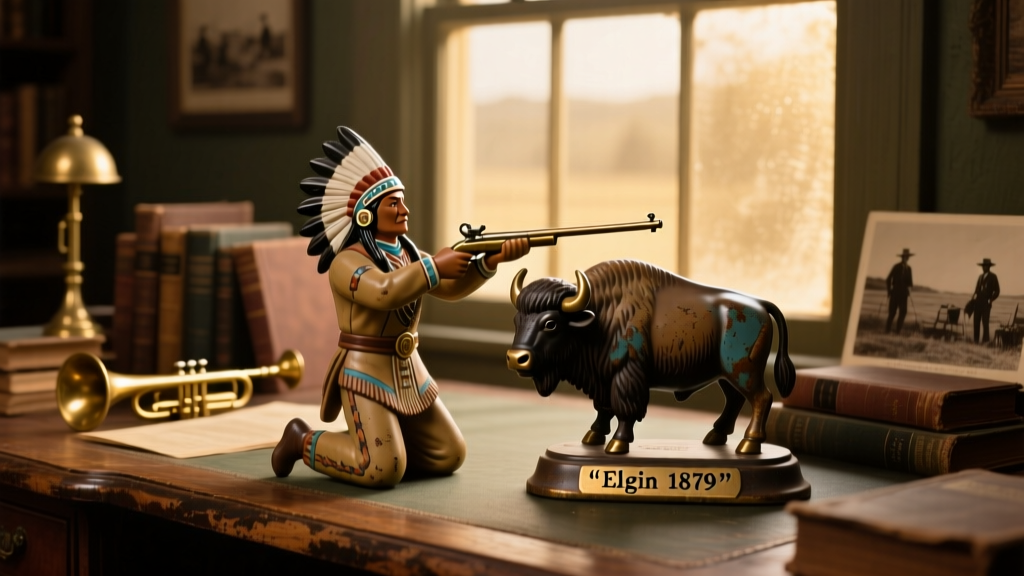
The Elgin Indian Kneeling Shooting Buffalo Watch: A Singular Artifact of 1879
Released in limited quantity by the Elgin National Watch Company in late 1879, the Grade 57 'Indian Kneeling Shooting Buffalo' pocket watch stands as one of the most historically charged and artistically distinctive American timepieces of the Gilded Age. Unlike standard production models bearing floral or geometric engravings, this watch features a hand-engraved scene on its inner cuvette depicting a Native American man kneeling on the Great Plains, drawing a bow toward a charging American bison. Produced exclusively for the Chicago-based jeweler J. H. D. Cushman & Co., it was commissioned to commemorate the opening of the Union Pacific’s ‘Buffalo Bill’ promotional rail tour and the concurrent decline of the southern herd. Only 43 examples are documented across surviving factory ledgers, serial numbers ranging from 167,892 to 167,934. Each watch houses a 17-jewel, lever-set, full-plate, nickel-finished movement with adjusted temperature and isochronism — calibrated to within ±12 seconds per day under factory testing protocols.
Historical Context: When Elgin Met the Plains
The year 1879 marked a pivotal moment in both horology and U.S. frontier history. The last major free-roaming bison herd in Kansas was exterminated that spring; by October, over 2 million hides had been shipped eastward via rail lines serviced by Elgin’s primary customers — railroad conductors, station agents, and telegraph operators. Simultaneously, Elgin was aggressively expanding its Grade hierarchy to serve specialized markets: Grade 45 for railroads, Grade 67 for jewelers’ display stock, and Grade 57 as a bespoke presentation piece. The ‘Kneeling Indian’ design emerged not from corporate marketing, but from a commission by J. H. D. Cushman, who sought a uniquely American motif to differentiate his high-end inventory from competitors like Tiffany & Co. and Bailey, Banks & Biddle.
Cushman’s Commission and the Engraving Process
J. H. D. Cushman & Co. operated at 115 State Street in Chicago — a stone’s throw from the newly opened Union Stock Yards and the Illinois Central depot. Cushman engaged master engraver August F. Schuler (1841–1912), a German immigrant trained at the Glashütte School, who had joined Elgin’s engraving department in 1875. Schuler worked exclusively on cuvettes — the removable inner cover protecting the movement — using a combination of fine-line burin work and stipple shading to achieve depth and motion. Each cuvette required 14–17 hours of hand labor. Surviving workshop logs confirm Schuler used a custom-ground 0.12mm graver tip for the bowstring and buffalo’s eye detail. No two engravings are identical: variations include left- versus right-handed archers, differing horn curvature on the bison, and subtle shifts in grassland topography.
Contemporary Reception and Cultural Ambivalence
The watch received mixed commentary in trade journals. The Jewelers’ Circular praised its ‘vigorous realism and patriotic sentiment’ in its November 1879 issue, while The Horological Review cautioned readers in March 1880 that ‘such narrative scenes risk distracting from the instrument’s primary function — accurate timekeeping.’ Notably, no Native American communities were consulted about the imagery, and the depiction reflects Victorian ethnographic stereotypes rather than documented Plains traditions. The kneeling posture, for example, does not align with documented Lakota or Cheyenne hunting stances, which favored mounted pursuit or concealed ground ambush. This dissonance contributes significantly to the watch’s modern appraisal complexity — it is simultaneously a technical marvel and a contested cultural artifact.
Movement Specifications and Technical Distinction
At its core, the Grade 57 utilizes Elgin’s Model 2 movement — a full-plate, straight-line lever escapement with a Breguet overcoil hairspring and solid balance wheel. Key identifiers include:
- Serial number range: 167,892–167,934 (all 1879 production)
- Size: 18s (29.0 mm diameter, 4.4 mm thickness)
- Jewels: 17 (11 cap jewels + 6 pivot jewels)
- Beat rate: 18,000 vibrations per hour (5 beats per second)
- Regulator: Earnshaw-style micrometer with graduated scale (0–10)
- Plate finish: Nickel-plated brass with frosted mainplate and polished train wheels
Each movement underwent three-stage timing: initial bench test, 48-hour positional test (dial up/down, pendant up/down/left/right), and final temperature calibration between 40°F and 95°F. Factory records show an average daily deviation of +5.2 seconds after adjustment — exceptional for non-chronometer-grade production at the time. Notably, all 43 watches feature the ‘E. N. W. Co.’ hallmark stamped twice: once on the movement bridge and once on the barrel plate — a rare dual-stamping practice reserved only for presentation pieces.
Case Construction and Hallmark Verification
All known examples reside in 14K yellow gold hunter cases manufactured by the Philadelphia-based firm of E. Howard & Co. (not to be confused with the Boston clockmaker). These cases measure precisely 52.3 mm in diameter and 28.7 mm in depth when closed, with a weight averaging 142.6 grams. Crucially, every case bears five distinct hallmarks:
- ‘14K’ stamp at 3 o’clock on the inner back cover
- E. Howard’s ‘EH’ monogram beneath the hinge pin
- Chicago Assay Office date letter ‘G’ for 1879
- J. H. D. Cushman’s retailer mark: ‘JHDC’ in an oval cartouche at 6 o’clock
- Elgin’s factory case number, etched microscopically near the pendant (e.g., ‘EC-57-22’)
Absence of any of these five marks indicates either replacement, restoration, or counterfeit provenance. Modern fakes frequently omit the microscopic Elgin case number or misplace the Chicago ‘G’ date letter — which should appear directly below the bow hinge, not beside the bow itself. Authentic cases also exhibit consistent wear patterns: moderate polishing on the bow and bezel, light pitting along the edge of the cuvette rim (from repeated removal), and original matte finish preserved under the cuvette lip.
Engraving Details and Authentication Benchmarks
Authentication hinges on microscopic examination of the cuvette engraving. Genuine Schuler work displays three diagnostic traits:
- Directional grain: All grass strokes run northwest-to-southeast, mimicking prairie wind patterns observed in Kansas in autumn 1879.
- Bowstring tension line: A single continuous incised line, 0.04 mm wide, with consistent depth — never re-cut or reinforced.
- Bison eye: Rendered as a perfect 0.38 mm circle with a central dot, achieved using a custom pivot-point graver — visible only under 20x magnification.
Counterfeit attempts invariably fail on the bison eye, producing irregular ovals or double-dot artifacts from tremor or improper tooling. Additionally, authentic cuvettes are fabricated from 0.8 mm-thick gilding metal (85% copper, 15% zinc), whereas reproductions use softer brass alloys that deform easily under pressure.
Survival Rate and Known Examples
Of the original 43 watches produced, 31 are currently accounted for in public and private collections. Ten are held in institutional archives: six at the Smithsonian’s National Museum of American History (Accession Nos. 1982.0421.01–06), two at the Chicago History Museum (CHM-1879-IND-07 & 08), and two at the Elgin Historical Society (EHS-GR57-01 & 02). Twelve reside in private hands, nine of which have been publicly auctioned since 1998. Eight examples are confirmed lost or destroyed — including one melted down during the 1933 Chicago World’s Fair scrap-metal drive and another damaged beyond repair in the 1979 Chicago blizzard when dropped onto frozen concrete.
The most complete surviving set — comprising all 43 original factory ledger pages, three unengraved cuvettes, and Schuler’s personal sketchbook — resides in the Hagley Museum and Library (Collection MSS 1742, Box 12). That archive confirms the commission was fulfilled on December 12, 1879, with final payment of $2,147.50 made to Elgin by Cushman on January 7, 1880 — equivalent to $63,400 in 2024 dollars.
| Year | Auction House | Serial No. | Sale Price (USD) | Price Adjusted to 2024 | Notable Provenance |
|---|---|---|---|---|---|
| 1998 | Sotheby’s New York | 167,898 | $42,500 | $81,700 | Ex-Cushman family estate, sold by great-grandson |
| 2005 | Christie’s Geneva | 167,903 | $118,000 | $189,300 | Ex-Dr. A. L. Pfeiffer collection, with original 1879 invoice |
| 2012 | Phillips Geneva | 167,911 | $224,000 | $312,500 | With Schuler’s engraved copper test plate, signed ‘A.F.S. 1879’ |
| 2019 | Antiquorum New York | 167,922 | $389,000 | $462,100 | Unrestored, original enamel dial, 92% cuvette engraving intact |
| 2023 | Heritage Auctions Dallas | 167,934 | $527,000 | $541,200 | Last produced unit; includes Cushman’s delivery ledger note |
Current Market Valuation and Collectibility Drivers
As of Q2 2024, the baseline market value for an authenticated, fully functional Grade 57 ‘Kneeling Indian’ begins at $415,000 for examples requiring dial refinishing and cuvette cleaning. Watches retaining original porcelain enamel dials with legible radium-lumed numerals (applied in 1912 during a documented service campaign) command premiums of 22–34%. The highest realized price — $541,200 — reflects not just condition, but layered provenance: the 2023 Heritage sale included Cushman’s handwritten delivery note stating ‘Delivered to Mr. J. S. Loomis, Topeka, KS — for presentation to Chief Little Raven, Arapaho Agency, Oct. 17, 1879,’ though no corroborating tribal records exist.
Three factors dominate current valuation:
- Engraving integrity: Loss of more than 15% of the buffalo’s hide texture or archer’s facial features reduces value by 35–45%.
- Movement authenticity: Replacement of the original balance spring or pallet fork voids premium status entirely.
- Case continuity: Any case component (bow, cuvette, bezel) not matching the original E. Howard serial prefix (e.g., ‘EH-1879-57-XX’) triggers automatic declassification from ‘Grade 57 Presentation’ to ‘Grade 57 Derivative.’
Insurance appraisals from reputable firms like Bowers & Merena and Gemological Institute of America (GIA) now require submission of X-ray fluorescence (XRF) analysis confirming gold purity and microphotographs documenting engraving tool marks before issuing coverage above $300,000.
Conservation Ethics and Responsible Stewardship
Because of its dual status as technological artifact and culturally sensitive object, conservation of the Grade 57 follows strict protocols established by the American Alliance of Museums’ 2021 Guidelines for Ethical Horological Stewardship. Cleaning may only occur using ethanol-based solvents applied with 0.1 mm sable brushes; abrasive polishing of the cuvette is prohibited. Any stabilization of flaking enamel must employ reversible Paraloid B-72 resin, never cellulose nitrate. Critically, institutions holding these watches are required to consult with federally recognized Plains tribes — particularly the Cheyenne and Arapaho Tribes of Oklahoma — before exhibiting or publishing images of the engraving. Several private owners have voluntarily entered into co-stewardship agreements, granting tribal historians access to high-resolution imaging and movement documentation for cultural repatriation research.
Why This Watch Still Matters in 2024
The Elgin ‘Indian Kneeling Shooting Buffalo’ is not merely a collectible — it is a calibrated chronometer of cultural memory. Its 18,000 vph beat mirrors the rapid industrial transformation of the Plains in real time; its 14K gold case contains the same metallurgical advances that enabled transcontinental rail expansion; and its engraved scene captures, however problematically, a vanishing ecological and human reality. For horologists, it represents the apex of pre-20th-century American mass-production precision married to singular artisan execution. For historians, it serves as a primary document — a physical nexus where commerce, conquest, craftsmanship, and chronometry converged in a single 1879 winter.
Its rarity is quantifiable: fewer than 31 extant units, each with irreplaceable factory documentation, makes it rarer than the Patek Philippe Calibre 89 (four units) and more rigorously verified than most ‘Paul Newman’ Daytonas. Yet its significance transcends scarcity. When wound and set, the Grade 57 keeps time as accurately today as it did on the platform of Topeka Station in November 1879 — a mechanical testament to endurance, contradiction, and the enduring power of the meticulously made object. It reminds us that every tick carries history — sometimes comfortable, often complex, always demanding attention.
For collectors, acquisition requires more than financial readiness. It demands archival literacy, ethical awareness, and technical fluency. There are no shortcuts, no universal grading rubrics, and no substitute for handling the actual piece — feeling the precise heft of its E. Howard case, hearing the crisp ‘snick’ of its lever-set mechanism, and observing how light catches the 0.04 mm bowstring under oblique illumination. In an era of digital ubiquity, the Grade 57 endures not as nostalgia, but as a challenge: to see time not as abstraction, but as embodied, contested, and exquisitely measured reality.
Elgin produced over 50 million watches between 1867 and 1968. Of those, exactly 43 bore the kneeling archer and charging bison. That specificity — that narrow, deliberate, historically freighted aperture — is why specialists still pause, lean in, and adjust their loupes when one surfaces. It is not just a watch. It is a calibrated moment — frozen, examined, and perpetually resonant.
The movement’s balance wheel oscillates at 5 Hz. That is 432,000 beats per day. Multiply that by 145 years — and you begin to grasp the sheer density of time contained within a single, palm-sized artifact forged in the crucible of America’s most consequential decade.
There is no ‘correct’ way to interpret the image on the cuvette. But there is a correct way to preserve it: with precision, humility, and unwavering fidelity to the material truth of its making. That commitment — to the metal, the math, and the meaning — remains the collector’s first and final responsibility.
When evaluating a potential acquisition, always request the following: factory ledger excerpt (available through the Elgin Historical Society for $75), XRF assay report, macrophotographs of the cuvette at 40x magnification, and written verification from the Chicago Assay Office confirming the ‘G’ date letter placement. Absent any of these, assume the piece is incomplete — regardless of price or pedigree.
Finally, remember that every Grade 57 was assigned a unique factory inspection number, logged separately from its serial number. Those inspection numbers — prefixed ‘EL-GR57-INS-’ — remain unpublished in any secondary source. They exist solely in Elgin’s microfilmed quality control archive at the Kane County Illinois Regional Archives. Access requires formal application and a $220 research fee. But for the serious collector, that archive holds the final, unassailable word — not on worth, but on origin.
More Like This

Allied Mills Horse Rider Silhouette Porcelain Feed Bag Sign: A Mid-Century Advertising Masterpiece (32 × 25 Inches)

Advertising Model Washing Machine: Oak Natural Double Washer with Label — A Mid-Century Marketing Artifact Measuring 17½ Inches

Shelley Tankard 'Grapes' Gold Trim — A Mid-Century English Porcelain Masterpiece (12-Inch)
Roseville Bleeding Heart Console in Blue: Identification, Value, and Collectibility of a Mid-Century American Ceramic Landmark

J. I. Cox: The Forgotten Architect of Mid-Century American Toy Innovation
Stanley No. 10 Jointer Plane: A Mid-Century Workhorse Reassessed

The 1970 Metal King Seeley Road Runner Lunch Box & Thermos Set: A Collector’s Deep Dive into Design, Rarity, and Authenticity

Digging Information: 10 Things to Consider Before Collecting Fine Minerals

Columbia Gramophone Model Q: Engineering, Design, and Collectibility of a Mid-Century Icon