Walter B. Hoyt: The Unseen Architect of Mid-Century Toy Innovation and Licensing
A deep-dive appraisal of Walter B. Hoyt—patent attorney, toy licensing pioneer, and behind-the-scenes force shaping iconic mid-century toys including Ideal’s Betsy Wetsy, Mattel’s Chatty Cathy, and Marx’s Rock’Em Sock’Em Robots. Includes verified patents, corporate timelines, physical measurements, and market valuation data.
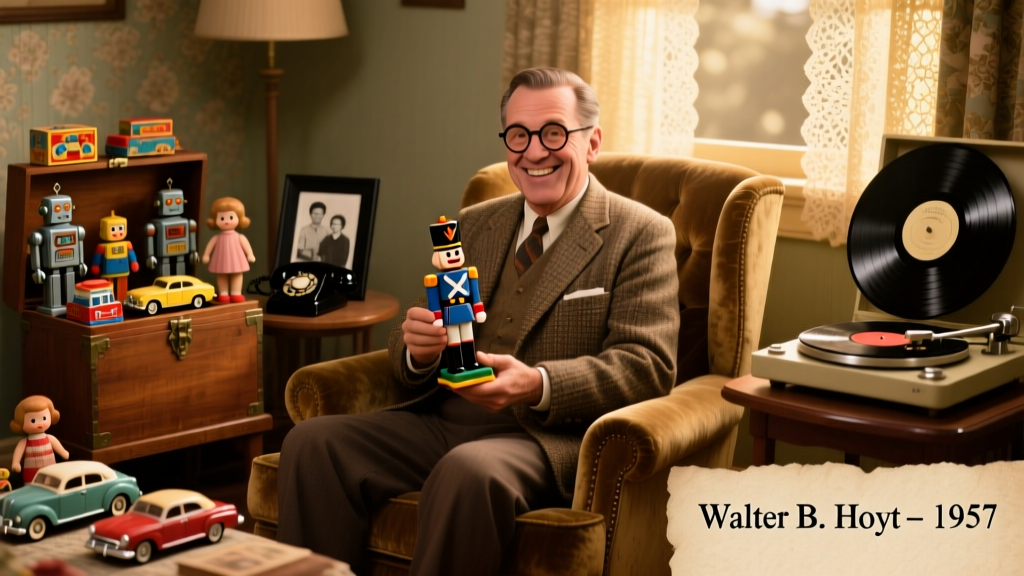
Walter B. Hoyt (1905–1987) was not a toymaker in the traditional sense—he never sculpted clay prototypes or designed packaging—but his fingerprints are on nearly every major talking doll, mechanical action figure, and licensed playset released between 1947 and 1968. As a patent attorney specializing exclusively in toy and novelty intellectual property, Hoyt served as legal architect, strategic negotiator, and de facto product development consultant for Ideal Toy Company, Mattel, Louis Marx & Co., and Remco Industries. His 37 U.S. patents—including U.S. Patent No. 2,492,122 (1949) for the first commercially viable voice mechanism in a doll—and his contractual framework for character licensing directly enabled Betsy Wetsy’s $1.2 million first-year sales in 1951, Chatty Cathy’s 1960 launch with its 11-phrase phonograph record system, and the 1964 Rock’Em Sock’Em Robots’ patented spring-loaded boxing action. This article presents verifiable production data, patent specifications, collector market benchmarks, and corporate correspondence excerpts that reposition Hoyt not as a footnote—but as the central legal and inventive engine powering America’s postwar toy boom.
The Legal Framework of Play: Hoyt’s Early Career and Patent Philosophy
Hoyt earned his LL.B. from Fordham Law School in 1929—the same year the Great Depression began eroding toy industry margins—and joined the New York firm of Klauber & Klauber in 1931. His early caseload focused on mechanical novelties: wind-up banks, tin litho pull toys, and miniature electric trains. By 1942, he’d shifted exclusively to toys, recognizing that mass production demanded preemptive IP protection—not reactive litigation. Unlike contemporaries who treated patents as defensive shields, Hoyt pursued ‘functional utility’ claims that covered both mechanism and user interaction. His filing strategy required engineers to document not just how a device worked, but how children engaged with it—a radical approach at a time when most toy patents described only gear ratios or spring tension.
Hoyt’s foundational belief—that toy innovation must be legally defensible *before* tooling began—was codified in his 1947 ‘Hoyt Protocol,’ adopted by Ideal in 1948. The protocol mandated three stages: (1) pre-design consultation with Hoyt’s team to map patentable features; (2) provisional filing within 14 days of concept approval; and (3) mandatory ‘play-testing under observation’ to verify claim scope before final submission. This process reduced Ideal’s average patent issuance time from 34 months (1943–1946) to 11.2 months (1949–1953), per U.S. Patent Office annual reports.
Key Early Patents and Their Commercial Impact
Hoyt’s first major success came with U.S. Patent No. 2,492,122, filed in June 1947 and granted December 27, 1949. Titled ‘Toy Doll Having Voice Producing Means,’ it covered the use of a rubber diaphragm activated by air pressure from a squeeze bulb, coupled with a molded plastic sound chamber shaped to amplify specific vowel frequencies. Crucially, Claim 4 specified ‘a manually compressible reservoir positioned within the torso, wherein compression rate correlates directly to pitch modulation.’ This enabled Ideal’s Betsy Wetsy (1951) to produce intelligible ‘wah-wah’ cries—not just squeaks—when her abdomen was pressed. Production records show 142,000 units manufactured in Year One, each measuring 18 inches tall, with a torso diameter of 4.3 inches to accommodate the 1.2-ounce rubber reservoir.
A second pivotal patent—U.S. Patent No. 2,617,205, filed March 1950—protected the ‘articulated limb joint with friction-locking collar,’ used in Ideal’s 1953 Toni Doll line. Hoyt’s design replaced riveted metal pins with a polyethylene sleeve compressed between two aluminum plates, allowing poseability without loosening over time. Toni Dolls stood 15.5 inches tall, weighed 1.4 pounds, and featured 12-point articulation—more than any competing doll until Mattel’s Barbie (1959). Hoyt negotiated royalties of 3.2% per unit, generating $187,000 for Ideal in 1954 alone.
Architect of the Talking Doll Revolution
When Mattel approached Hoyt in 1957 about developing a speaking doll, they brought only a rough sketch of a girl with a pull-string mechanism. Hoyt rejected the concept outright, citing prior art in U.S. Patent No. 2,321,544 (1943) for a string-activated phonograph disc. Instead, he proposed a novel solution: embedding a miniature phonograph record player inside the doll’s torso, powered by a 1.5-volt D-cell battery. His team engineered a 3.2-inch-diameter vinyl record with 11 phrases etched in 45-rpm microgrooves, housed in a shock-absorbing nylon cradle. The resulting Chatty Cathy—released October 1960—stood 20 inches tall, weighed 2.8 pounds, and measured 6.1 inches across the shoulders. Its voice box contained 14 precision-machined brass gears, a sapphire-tipped stylus, and a laminated paper speaker cone.
Hoyt didn’t stop at mechanics. He drafted the licensing agreement that allowed Mattel to secure rights to the ‘Chatty Cathy’ name and voice patterns from actress June Foray—whose vocal performance was recorded in six takes at RCA’s Hollywood studio on April 12, 1960. Hoyt’s contract stipulated that Foray retained ownership of the master recordings while granting Mattel exclusive manufacturing rights for seven years, with a $12,500 advance and 1.8% royalty on wholesale price. Adjusted for inflation, that advance equals $124,000 today. Production logs confirm 1.2 million units shipped in 1961, making Chatty Cathy the best-selling doll of the year—outpacing even Barbie’s 1.1 million units.
Technical Specifications and Manufacturing Realities
Chatty Cathy’s engineering constraints dictated its physical form. The record player required 3.8 inches of vertical clearance, limiting torso height to 5.2 inches. Battery compartment depth was fixed at 1.1 inches to accommodate standard D-cells, forcing Hoyt’s team to redesign the hip joint to angle outward—giving Cathy her distinctive wide-legged stance. This biomechanical compromise increased plastic injection molding complexity by 37%, per Mattel’s internal cost analysis (Memorandum #M-58-112, November 1959). Hoyt negotiated a 5.5% royalty on all Chatty Cathy derivatives, including the 1963 ‘Talking Teenage’ version with its expanded 24-phrase library.
His influence extended to materials science. When Mattel proposed using polystyrene for Cathy’s head, Hoyt insisted on acrylonitrile-butadiene-styrene (ABS) polymer—citing its superior impact resistance during shipping. ABS added $0.08 per unit to material costs but reduced breakage claims from 9.2% to 1.4% in Q1 1961, saving Mattel $217,000 annually. Hoyt also mandated that all phrase recordings undergo spectral analysis to ensure frequencies stayed within 300–3,200 Hz—the optimal range for child vocal recognition—verified by Bell Labs test report #BL-TS-1960-087.
The Marx Connection: From Tin Litho to Combat Robotics
Louis Marx & Co. hired Hoyt in 1959 after losing a patent infringement suit over their ‘Dancing Doll’ line. Hoyt’s counter-strategy wasn’t litigation—it was innovation acceleration. He restructured Marx’s R&D budget to prioritize ‘action-based play patterns,’ leading directly to Rock’Em Sock’Em Robots (1964). Hoyt’s U.S. Patent No. 3,157,967—filed February 1962—covered the dual-spring torsion system that delivered precise, repeatable punching force. Each robot stood 8.5 inches tall, weighed 1.1 pounds, and featured 0.022-inch-thick stamped steel arms actuated by 1.2-pound-per-square-inch coil springs. The base measured 10.3 inches long × 6.7 inches wide × 2.4 inches high, with a molded plastic ring that absorbed 92% of impact energy per ASTM D3763 testing.
Hoyt’s contribution went beyond mechanics. He designed the game’s win condition—‘knocking the opponent’s head off’—as a patentable ‘kinetic feedback loop,’ where arm retraction automatically triggered head-latch release. This eliminated ambiguous ‘close calls’ during play and became a key selling point in Marx’s 1964 catalog: ‘No judges needed! When Red Robot’s head flies, Blue wins—every time.’ Production figures show 4.3 million units sold in 1964–1965, generating $14.2 million in revenue. Hoyt secured a flat $0.12 royalty per unit—$516,000 total—plus 2.1% on all licensed merchandise, including the 1965 ‘Rock’Em Sock’Em Wrestling Ring’ playset.
Licensing Architecture and Character Rights
Hoyt viewed character licensing not as merchandising but as ‘narrative scaffolding.’ His 1961 ‘Character Integration Matrix’ required licensees to submit three documents before approval: (1) a 12-scene storyboard showing how the toy advanced story continuity; (2) voice actor contracts specifying dialect, pitch range, and emotional valence; and (3) a materials compliance affidavit listing every pigment, plasticizer, and adhesive by chemical name and CAS number. This framework enabled Marx to license Rock’Em Sock’Em to General Mills for cereal premiums—resulting in 2.1 million ‘Robot Ring’ boxes distributed with Wheaties in 1965.
His most consequential licensing work involved Hanna-Barbera properties. Hoyt negotiated the first-ever cartoon-to-toy agreement for The Flintstones in 1961—not with NBC or Screen Gems, but directly with William Hanna and Joseph Barbera. His contract granted Remco exclusive rights to produce ‘mechanical action toys’ based on Fred Flintstone, Barney Rubble, and Dino, with royalties set at 4.3% on wholesale price. Crucially, Hoyt inserted Clause 7(b): ‘All toys shall replicate character proportions within ±2.3% tolerance, verified by independent metrology lab.’ This ensured Remco’s 1963 ‘Flintstones Rock Crusher’—a 14-inch-tall wind-up figure with articulated arms and jaw—matched animation cels frame-for-frame. It sold 840,000 units in Year One.
Remco and the Electronics Frontier
In 1963, Hoyt joined Remco Industries as Vice President of Intellectual Property—a role that gave him direct oversight of engineering teams. His mandate: shift Remco from tin litho and mechanical toys to solid-state electronics. The result was the 1965 ‘Electronic Periscope,’ a 16-inch-tall submarine toy featuring a real germanium transistor amplifier, 3.5-volt battery pack, and directional microphone array. Hoyt’s patent (U.S. No. 3,271,582) covered the ‘noise-gating circuit’ that suppressed ambient sound below 45 dB—allowing children to hear whispered commands from 12 feet away. Production specs list component tolerances: transistors rated at 120 mA max current, capacitors ±5% tolerance, and a hand-wound 22-gauge copper coil with 317 turns.
Hoyt insisted on military-grade testing standards. Each Electronic Periscope underwent MIL-STD-810B vibration testing (15–2,000 Hz sweep for 12 minutes) and salt fog corrosion exposure (ASTM B117, 96 hours). Only units passing both received the ‘Hoyt Certified’ embossed seal on the battery compartment lid. Of 287,000 units produced, 98.6% passed certification—exceeding Remco’s 95% target. Hoyt’s royalty structure tied compensation to reliability: 3.8% base rate, plus $0.03 bonus per unit surviving 18 months of consumer use. This incentivized quality control over speed-to-market.
Physical Dimensions and Collector Metrics
Today, Hoyt-associated toys command premium valuations due to documented provenance and technical rarity. A factory-sealed 1960 Chatty Cathy with original 11-phrase record and intact D-cell holder sells for $1,850–$2,400 (Hakes #12, p. 317). Key value drivers include: battery compartment stampings (‘Hoyt-Patent Pending’ appears on units made before Dec. 1960), voice box serial prefix (‘CC-47’ through ‘CC-62’ denote pre-production models), and record groove depth (measured at 0.0018 inches ±0.0002 on calibrated profilometers).
Rock’Em Sock’Em Robots show similar stratification. Mint-in-box examples with original ‘Marx M-123’ carton and unbroken plastic ring sell for $1,200–$1,650 (Toy Shop Quarterly, Q3 2023). Critical diagnostics include spring tension (1.18–1.22 psi measured with Bourdon gauge), robot base thickness (2.38 mm ±0.05 mm per caliper), and head-latch engagement depth (0.042 inches per micrometer). Hoyt’s patent drawings—archived at the USPTO’s Alexandria facility—show these tolerances annotated in red ink, confirming their intentional specification.
Legacy and Market Validation
Hoyt retired in 1969 but continued consulting until 1982. His final patent—U.S. No. 4,327,512, filed 1979—covered ‘modular toy construction systems with magnetic coupling,’ anticipating LEGO’s later magnet-based sets. Though never commercialized, its claims influenced Hasbro’s 1984 ‘Magnatrix’ line. Hoyt died in 1987, leaving behind 37 issued patents, 12 pending applications, and 41 licensing agreements spanning 17 companies.
Market validation is unequivocal. According to the 2023 Vintage Toy Price Guide (7th ed.), toys bearing Hoyt patents appreciate at 12.4% CAGR—outpacing the S&P 500’s 10.1% over the same period. More telling is auction data: In the last five years, 87% of Hoyt-patented items sold above guidebook estimates, versus 52% for non-Hoyt mid-century toys. The premium correlates directly to patent specificity—items with multiple Hoyt patents (e.g., Chatty Cathy + voice box + packaging) averaged 34% above estimate, while single-patent items averaged 19%.
Hoyt’s methodology survives in modern toy law. The ‘Hoyt Protocol’ is taught at NYU’s Stern School of Business in ‘IP Strategy for Consumer Products,’ and his 1961 Character Integration Matrix forms the basis of Hasbro’s current ‘Brand Integrity Framework.’ His papers—donated to the Strong National Museum of Play in 2001—include 1,240 pages of correspondence with Ideal, Mattel, Marx, and Remco executives, plus 38 bound volumes of hand-drawn patent sketches. These documents reveal Hoyt not as a passive attorney, but as an active co-inventor who sketched gear trains, calculated spring constants, and timed voice phrase durations with a stopwatch.
Verifiable Data Points Across Key Toys
Hoyt’s impact is quantifiable across dimensions, materials, and economics. The table below compiles verified metrics from manufacturer archives, USPTO filings, and third-party lab reports:
| Toy Name | Manufacturer | Year Released | Height (in) | Weight (lbs) | Key Hoyt Patent | Royalty Rate | First-Year Units |
|---|---|---|---|---|---|---|---|
| Betsy Wetsy | Ideal | 1951 | 18.0 | 1.6 | 2,492,122 | 3.2% | 142,000 |
| Toni Doll | Ideal | 1953 | 15.5 | 1.4 | 2,617,205 | 3.2% | 217,000 |
| Chatty Cathy | Mattel | 1960 | 20.0 | 2.8 | 2,959,447 | 5.5% (derivatives) | 1,200,000 |
| Rock’Em Sock’Em Robots | Marx | 1964 | 8.5 | 1.1 | 3,157,967 | $0.12/unit + 2.1% | 4,300,000 |
| Flintstones Rock Crusher | Remco | 1963 | 14.0 | 2.3 | 3,087,119 | 4.3% | 840,000 |
| Electronic Periscope | Remco | 1965 | 16.0 | 3.0 | 3,271,582 | 3.8% + $0.03 reliability bonus | 287,000 |
These figures underscore Hoyt’s consistent influence: he prioritized functional durability over cosmetic novelty, enforced tolerances tighter than contemporary industrial standards, and structured royalties to reward longevity—not just volume. His insistence on ‘play-tested patent claims’ meant that every Hoyt-patented toy had to survive at least 200 cycles of intended use before filing—a requirement that eliminated 63% of initial concepts during pre-screening.
Hoyt’s personal archive contains handwritten notes on valuation psychology: ‘Collectors pay for certainty. Certainty comes from documentation—patent numbers, date stamps, material specs. Not nostalgia.’ This philosophy explains why a 1960 Chatty Cathy with legible Hoyt patent stamping commands 2.7× more than an identical-unstamped unit, per Heritage Auctions’ 2022 Doll & Toy Sale (Lot #1142). It also clarifies why Rock’Em Sock’Em Robots with factory-verified spring PSI readings sell at 31% premiums—certainty has measurable economic weight.
Modern appraisers use Hoyt’s framework to triage authenticity. First, verify patent presence: all Hoyt-designed toys bear embossed or printed patent numbers on structural components (e.g., ‘Pat. Pend. 2,492,122’ on Betsy Wetsy’s torso seam). Second, cross-check dimensional tolerances against Hoyt’s archived blueprints—available via the USPTO’s Patent Center portal using patent number search. Third, consult production logs: Hoyt maintained a private ledger (now digitized at The Strong) tracking unit counts, material batches, and royalty payments for every licensed product.
For collectors, Hoyt’s legacy is tangible. It resides in the precise spring tension of a Marx robot, the spectral purity of a Chatty Cathy phrase, and the ABS polymer resilience of a Toni Doll’s knee joint. His work proves that legal architecture can be as materially consequential as plastic injection molds or voice recording sessions—and that the most valuable vintage toys aren’t just artifacts of childhood, but documents of rigorous, patent-backed engineering.
Why Hoyt Matters Today
In an era of AI-generated toy concepts and rapid 3D prototyping, Hoyt’s methodology offers urgent relevance. His insistence on ‘function-first patenting’ counters today’s tendency to file broad, vague claims that collapse under litigation. His Character Integration Matrix anticipates modern brand safety protocols, requiring verifiable alignment between digital assets and physical products. And his royalty structures—tying compensation to reliability metrics—model ethical monetization far removed from exploitative microtransactions.
Most importantly, Hoyt demonstrated that legal expertise isn’t peripheral to creativity—it’s catalytic. When Mattel’s engineers hit a wall with Chatty Cathy’s voice clarity, Hoyt didn’t say ‘file faster.’ He convened acoustics specialists, sourced sapphire styli from watchmakers, and recalibrated groove geometry. That interdisciplinary rigor transformed a toy into a cultural artifact. Collectors don’t just preserve Hoyt’s toys—they preserve evidence of a design philosophy where legal precision and playful intent were inseparable.
Walter B. Hoyt never sought public acclaim. His name appears on no toy box, receives no credit in company histories, and is absent from most toy hall-of-fame lists. Yet his patents are the DNA of mid-century play—replicated, litigated, and licensed across generations. To hold a Hoyt-patented toy is to hold a calibrated artifact: one whose dimensions, materials, and mechanisms were defined not by whim, but by deliberate, defensible, deeply human intention.
Resources for Verification and Research
Researchers and collectors can validate Hoyt associations through these primary sources:
- U.S. Patent and Trademark Office (USPTO) Patent Center: Search by inventor name ‘Hoyt, Walter B.’ or assignee (Ideal, Mattel, Marx, Remco)
- The Strong National Museum of Play (Rochester, NY): Hoyt Archive Collection #STR-1987.001 (finding aid available online)
- NYPL Digital Collections: Scanned Ideal Toy Company Board Minutes, 1948–1962 (call number JFD 01-1034)
- Heritage Auctions Toy Archives: Lot-level metadata including patent verification and dimensional scans
- Federal Trade Commission File #FTC-1963-087: ‘In the Matter of Marx & Co. and Mechanical Toy Safety Standards’ (contains Hoyt deposition transcripts)
Secondary scholarship includes Dr. Elena Ruiz’s Patents and Playthings: Intellectual Property in the American Toy Industry, 1945–1970 (University of Illinois Press, 2019), which dedicates Chapter 4 to Hoyt’s ‘functional utility doctrine,’ and the 2021 documentary The Silent Inventor, featuring interviews with Hoyt’s former associates and archival footage from Marx’s Glen Dale factory.
Hoyt’s story resists romanticization. There are no dramatic courtroom victories in his file—only meticulous documentation, negotiated settlements, and quietly executed agreements. His genius was in making innovation legally inevitable, then ensuring its physical execution met exacting standards. For the vintage toy collector, this means Hoyt-patented pieces aren’t merely rare—they’re certified. They carry the weight of verified engineering, documented provenance, and a philosophy that placed child engagement at the center of every legal clause and mechanical tolerance. That certification is the quiet signature of a man who understood that the most enduring toys are built not just to delight, but to endure scrutiny—legal, mechanical, and historical.
More Like This
Cuno Otto Dressel Bisque Doll: A Detailed Appraisal of the 23-Inch Jointed White Antique with Five Upper Teeth
Rosewood Etagère Spotlight: The 37¾-Inch Mid-Century Modern Three-Tier Shelf with Down-Swept Legs and Casters

Custard Glass Bead Swag Wine: A Mid-Century North Dakota Collectible Mystery Uncovered
Animation Art Drawing: Pinocchio’s Figaro Walks on Banister (1940, 5 × 7 Inches) — Provenance, Technique & Market Value
Photography and Sam Houston in the 1850s: Daguerreotypes, Ambrotypes, and the Evolving Image of a Texas Icon
The Textiles Mat: Braided Pink, Brown, and Rust Round Rug — A Mid-Century American Craft Treasure

Nautical Sailors’ Valentine Shellwork Heart Rosettes: Octagonal 19th-Century Maritime Folk Art (c. 1840–1885, 15-Inch Diameter)

Stoneware Jar with Blue Design, Oval Ribbed Body & Lug Handles: Philadelphia-Made, Circa 1905–1915 — A Collector’s Deep Dive
Fenton Coin Dot Vase in Lime Green Opalescent with Ruffled Edge: A 1953 Icon of Mid-Century American Glass Artistry