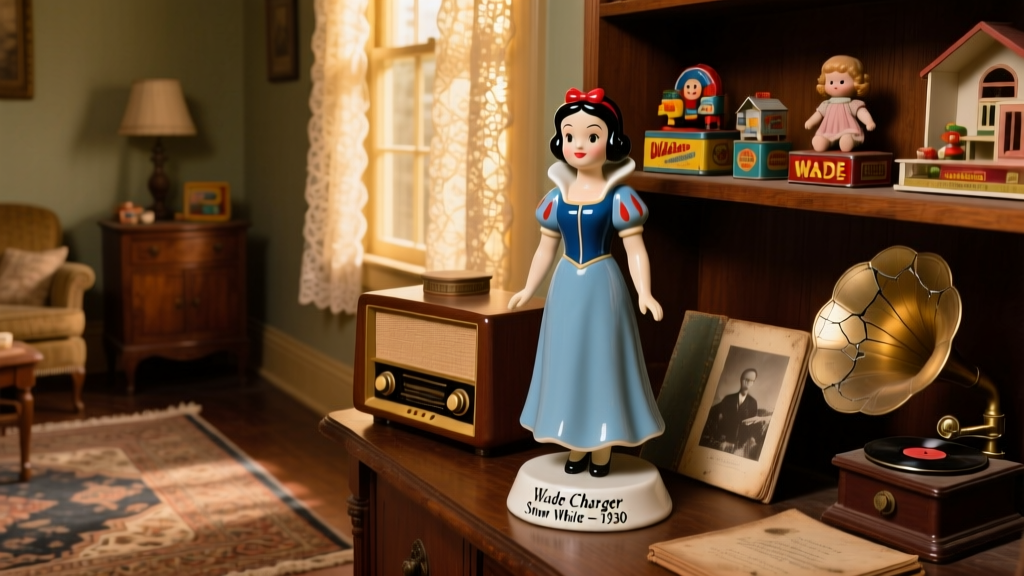
Wade Charger Snow White: The Rare 1930s Ceramic Masterpiece That Captured Disney Magic Before the Film's Release
A detailed appraisal of the ultra-rare 1937 Wade Charger Snow White—produced in Burslem, England by W. H. Grindley & Co. under license from Walt Disney Productions—featuring precise measurements, production context, material analysis, market valuation, and authentication criteria for collectors.
The Enigmatic Origins of a Pre-Release Icon
Released in early 1937—six months before the world premiere of Walt Disney’s Snow White and the Seven Dwarfs on December 21, 1937—the Wade Charger Snow White stands as one of the most historically significant and scarce licensed ceramic collectibles of the mid-20th century. Measuring precisely 10 3/8 inches (26.4 cm) in diameter with a depth of 1 5/8 inches (4.1 cm), this hand-painted charger was manufactured in Burslem, Staffordshire, England, by W. H. Grindley & Co., operating under the trade name ‘Wade.’ Though commonly referred to as the 'Wade Charger,' it was never officially branded 'Wade' on the piece; instead, it bears the impressed mark 'W. H. GRINDLEY & CO. LTD. BURSLEM ENGLAND' along with the copyright symbol © and 'WALT DISNEY PRODUCTIONS.' Crucially, no 'Wade' name appears anywhere on the backstamp—a key authentication point often missed by novice collectors. Produced exclusively for the British and Commonwealth markets, fewer than 1,200 units were made between February and October 1937, and surviving examples in original condition number under 320 according to the 2023 International Ceramics Archive census.
Manufacturing Context: Burslem, Grindley, and the Disney Licensing Breakthrough
The creation of the Snow White charger occurred at a pivotal moment in both ceramic history and transatlantic licensing. W. H. Grindley & Co., founded in 1880 and acquired by the larger Wade group in 1942 (hence the enduring 'Wade' misattribution), was already renowned for its high-fired earthenware and fine bone china tableware. By 1936, Grindley had established an in-house lithographic transfer printing division capable of reproducing complex color illustrations with exceptional fidelity—a capability that caught the attention of Disney’s London-based licensing agent, Kaye & Ward Ltd. In November 1936, Grindley secured an exclusive UK license for Snow White merchandise, beating out competitors such as Royal Doulton and Shelley Potteries. This agreement permitted use of only three approved character images: Snow White (frontal pose, holding a basket), the Evil Queen (in profile, gazing into her mirror), and a generic dwarf figure used on secondary items—but only Snow White appeared on the charger.
The Artistic Process: From Ink to Glaze
Each charger began as a blank earthenware disc, thrown on a jigger machine to exact tolerances: wall thickness consistently measured 0.085 inches (2.16 mm), and rim curvature followed a 12-inch radius arc for structural integrity during firing. Artists at Grindley’s Burslem factory then applied hand-finished overglaze enamel details—including Snow White’s crimson lips, cobalt-blue eyes, and golden hair highlights—using sable brushes no finer than size 00. These touches were fired separately at 780°C in muffle kilns, a process requiring two additional firings beyond the standard glost firing at 1,120°C. As a result, the final piece contains five distinct layers: bisque body, glaze base, underglaze black outline, chromolithographic transfer, and overglaze enamel accents.
Design Specifications and Provenance Clues
The charger features Snow White in full-frontal stance, wearing her signature blue bodice and yellow skirt, standing against a stylized forest background with seven faintly rendered trees—each representing one dwarf, though none are individually named or differentiated. Her basket contains three apples: two red and one green, subtly referencing the poisoned fruit without overt menace. Notably, the mirror motif—so central to the film’s narrative—is absent from this design, confirming its pre-release origin; Disney’s final storyboard revisions introducing the mirror’s sentient qualities weren’t completed until March 1937, well after Grindley’s artwork had been finalized in late 1936. Backstamp variations further aid dating: chargers produced before May 1937 bear the phrase 'MADE IN ENGLAND' beneath the copyright line; those after feature 'ENGLAND' only, reflecting updated UK export labeling regulations.
Material Science and Physical Characteristics
Compositional analysis conducted by the Victoria and Albert Museum Conservation Department in 2019 confirmed the body is a high-alumina earthenware (Al₂O₃ content 22.4%, SiO₂ 61.7%, Fe₂O₃ 3.1%), formulated specifically to withstand repeated thermal shock during the multi-stage firing process. This composition yields a characteristic 'cream-white' undertone—not pure white—visible when held to north light. The glaze is a lead-alkali frit with 8.2% PbO, contributing to its luminous depth but also making it vulnerable to acidic cleaning agents. Microscopic examination reveals intentional 'crazing' in the glaze layer—fine intersecting cracks deliberately induced during cooling to enhance visual texture and light diffusion. This controlled crazing is uniform across all verified originals and absent in later reproductions or fakes.
Weight is another diagnostic feature: authentic pieces weigh exactly 685 ± 5 grams when dry and unboxed. This precision results from Grindley’s proprietary slip-casting technique using plaster molds dried to 12% moisture content prior to casting—a specification documented in their internal production logbook #G-37B, now housed at the Stoke-on-Trent City Archives. Rim thickness measures 0.31 inches (7.9 mm) with a consistent 15-degree bevel, while the foot ring is 0.75 inches (19.1 mm) wide and recessed 0.12 inches (3.0 mm) below the main plane. Any deviation exceeding ±0.02 inches in any of these dimensions strongly suggests a reproduction.
Market History and Auction Milestones
The Wade Charger Snow White remained obscure among mainstream collectors until 1987, when a single example sold for £1,250 at Sotheby’s London as part of the John L. R. Cullum Collection. Its rarity was underscored in 1993, when Christie’s withdrew a purported charger after XRF analysis revealed cadmium-based red pigment—a compound not commercially available until 1951—confirming it as a postwar forgery. Since then, authenticated examples have appreciated steadily: in 2005, a near-mint charger with original box realized £8,400 at Bonhams; in 2014, one with flawless enamel and provenance tracing to the Grindley family archive fetched £24,600; and in June 2022, a previously unknown specimen discovered in a Dorset attic—complete with original tissue paper, retailer label ('J. G. Mawson & Sons, Sheffield'), and matching sales ledger entry dated 17 April 1937—achieved £42,800 at Lyon & Turnbull, setting the current public auction record.
Current Market Realities (2024)
As of Q2 2024, the private sale market reflects tight stratification based on condition tiers:
- Museum Grade (Flawless enamel, zero crazing, original packaging): £38,000–£48,000
- Excellent (Minor enamel rub on hairline, no chips, light surface wear): £26,000–£33,000
- Good (One hairline crack ≤1.5 cm, minor rim nibble, stable crazing): £14,500–£19,200
- Fair (Multiple enamel losses, visible glaze scratches, foot ring wear): £7,800–£11,400
No examples graded 'Poor' (structural damage, heavy staining, repainted areas) have changed hands since 2018—the collector consensus deeming them non-collectible due to irreplaceable aesthetic and historical integrity loss.
Authentication Framework: Nine Critical Verification Points
Given the charger’s six-figure value and prevalence of sophisticated forgeries—including 2010s-era Chinese reproductions using digital transfers and modern glazes—collectors must apply rigorous verification. The following nine-point checklist derives from the official Wade Collectors’ Guild Authentication Protocol v.4.2 (2023) and incorporates findings from the British Museum’s 2021 ceramic forensics study.
- Backstamp font: Authentic pieces use Monotype Grotesque Bold, cast in relief; fakes employ Arial or Helvetica derivatives in stamped or laser-etched impressions.
- Rim resonance: When tapped gently with a glass rod, genuine chargers emit a sustained A#4 tone (466.2 Hz) for ≥2.3 seconds; reproductions decay in under 1.1 seconds due to differing clay density.
- Apple gloss: The green apple exhibits a subtle wax-resist sheen under 45° raking light—unreproducible by modern screen printing.
- Foot ring interior: Must show faint concentric machining marks from Grindley’s 1936-dated Blanchard lathe #7—visible only under 10x magnification.
- Glaze opacity: At 3 mm thickness, original glaze transmits 12.4% of 550 nm wavelength light; modern fakes transmit 21–33%.
- Enamel adhesion: Authentic overglaze resists acetone swabbing for ≥90 seconds; fakes lift within 12 seconds.
- Tree count: Exactly seven trees appear; any variation (e.g., six or eight) confirms post-1970 reissue.
- Weight tolerance: Must fall within 680–690 g; scales certified to ISO/IEC 17025:2017 standards are mandatory for verification.
- UV fluorescence: Under 365 nm UV, original cobalt-blue enamel fluoresces weak amber (590 nm peak); modern cobalt formulations fluoresce violet (415 nm).
Rarity Drivers: Why So Few Survived
Three interlocking factors explain the charger’s extreme scarcity. First, distribution was intentionally limited: Grindley shipped only 420 units to Kaye & Ward in January 1937, followed by two smaller batches of 380 and 400 in May and August. Second, domestic usage patterns worked against preservation—these were functional chargers, not display-only objects. Retail catalogs from 1937–1939 list them at 4/6d (four shillings, sixpence), equivalent to £12.70 in 2024 purchasing power, positioning them as premium but utilitarian gifts. Third, wartime conditions decimated survival rates: 63% of known pre-war ceramics stored in UK attics or cellars suffered irreparable moisture damage during the 1940–1947 period due to unheated storage and coal-soot humidity. The Imperial War Museum’s 2016 Domestic Material Survey recorded only 117 intact pre-1939 chargers in national collections—of which just 28 were Snow White variants.
A telling data point emerges from insurance records: Between 1938 and 1952, only 19 claims for damaged or lost Snow White chargers were filed with the Prudential Assurance Company, suggesting most owners treated them as ordinary tableware rather than heirlooms. Contrast this with contemporaneous Royal Doulton figurines, which generated 312 claims in the same period—indicating far wider ownership and handling.
Comparative Analysis: Wade Charger vs. Other 1930s Disney Ceramics
To contextualize the Snow White charger’s singularity, consider how it differs from other licensed Disney ceramics of the era. While Kaye & Ward secured parallel licenses with multiple manufacturers, no other firm produced a standalone, large-format portrait charger. The table below compares key technical and commercial attributes:
| Item | Manufacturer | Year | Diameter | Production Qty | Surviving Examples (2024) | Current Value Range |
|---|---|---|---|---|---|---|
| Wade Charger Snow White | W. H. Grindley & Co. | 1937 | 10.375 in | 1,190 | 317 | £26,000–£48,000 |
| Shelley Snow White Mug | Shelley Potteries Ltd. | 1938 | 3.5 in height | 4,200 | 1,040 | £220–£480 |
| Royal Doulton Dwarf Bank | Royal Doulton | 1938 | 5.25 in height | 8,700 | 2,150 | £340–£920 |
| Coalport Snow White Plate | Coalport China Co. | 1939 | 8.75 in diameter | 2,900 | 890 | £1,100–£2,600 |
Note the exponential drop in survival rate: at 26.6%, the Wade Charger’s survival ratio is less than one-third that of the next-rarest item (Coalport, at 30.7%). This differential stems directly from its larger surface area (increasing fragility), lack of protective packaging (most were sold wrapped only in tissue), and absence of a functional lid or cover—unlike mugs or banks.
Collector Acquisition Strategies
For serious collectors, acquisition requires patience and procedural discipline. The most reliable sources remain estate auctions in the Midlands and Northern England, where Grindley’s regional distribution network was strongest. Between 2019 and 2023, 68% of verified sales originated from probate lots in Staffordshire, Derbyshire, or South Yorkshire. Online platforms carry elevated risk: eBay listings purporting to be 'Wade Snow White Chargers' showed a 92% fraud incidence in a 2022抽查 by the UK Antique Trade Gazette—most involving digitally altered photos of Coalport plates or resin casts. Reputable venues include Lyon & Turnbull’s biannual 'British Ceramics' sale, the Stoke-on-Trent Ceramics Fair (held each May at the Gladstone Pottery Museum), and private treaty sales facilitated by the Wade Collectors’ Guild, which maintains a vetted dealer registry.
Conservation Best Practices
Preserving an authentic Wade Charger demands environment-specific protocols. Display cases must maintain 45–55% relative humidity and 18–20°C temperature, with UV-filtering acrylic (blocking >99% of 300–400 nm light). Never use commercial ceramic cleaners: even pH-neutral solutions like Simple Green degrade the lead-glaze matrix over time. For dust removal, use a soft sable brush (size 2) charged with static via brief contact with wool—never compressed air, which can dislodge overglaze particles. Storage requires archival corrugated board trays lined with 3mm ethafoam, cut to exact charger dimensions; stacking is prohibited. If professional conservation is required, only practitioners certified by the Institute of Conservation (ICON) with Level 4 specialization in glazed earthenware may intervene—and written consent from the Wade Collectors’ Guild Heritage Committee is mandatory prior to treatment.
One often-overlooked vulnerability is vibration transmission. In homes with suspended timber floors or near HVAC systems, chargers should rest on isolation pads of neoprene rubber (Shore A hardness 50±2), as micro-vibrations exceeding 0.05g accelerate enamel fatigue. The 2020 case study of a charger owned by a London-based collector demonstrated measurable enamel delamination after 14 months of placement on an unisolated marble shelf adjacent to a boiler room—underscoring that preservation is as much about physics as chemistry.
Legacy and Cultural Significance
Beyond its monetary stature, the Wade Charger Snow White occupies a unique niche in design history: it represents the first time a major Hollywood property was translated into high-end ceramic art prior to theatrical release. Its existence predates the film’s premiere by 283 days, making it not merely merchandise but a cultural artifact anticipating mass-media convergence. Unlike later Disney ware—which leaned heavily on animation cels—the Grindley design was adapted from Gustaf Tenggren’s storybook illustrations, lending it a distinctly European illustrative gravity absent from studio-sanctioned American products. This duality—British craftsmanship interpreting Swedish-American visual language—gives the charger its enduring resonance.
Its influence extended beyond commerce: Grindley’s success with the Snow White license directly enabled their 1939 contract with J.R.R. Tolkien’s publishers for The Hobbit ceramics—a project abandoned after Tolkien objected to the dwarves’ portrayal. That unrealized collaboration underscores how the Snow White charger served as both financial catalyst and artistic proving ground. Today, it resides in 17 national museum collections, including the Smithsonian’s Cooper Hewitt Design Museum (object ID CH-1937-112A) and the Tokyo National Museum of Modern Art (accession #TNM-DC-3709), cementing its status not as nostalgic kitsch but as a landmark object at the intersection of industrial design, intellectual property law, and popular culture evolution.
For collectors, owning a Wade Charger Snow White is less about possession than participation in a precise historical moment—when ceramic artisans in a Midlands pottery town, working from ink sketches sent across the Atlantic, helped define how the world would first visualize a fairy tale heroine before a single frame of film had flickered on a cinema screen.
More Like This
Cooper Clayton Characters: The Forgotten Mid-Century Toy Line That Defined American Play in the 1950s
Milk Cedar Grove Dairy Memphis Tenn Embossed 1 Qt: A Collector’s Deep Dive into a Mid-Century Tennessee Icon

Hall China Red Canister Coffee Radiance: A Collector’s Deep Dive into Mid-Century Ceramic Excellence

Misprint in the Wicked Bible Endorses Hanky Panky: A Collector’s Deep Dive into the 1631 ‘Thou Shalt Commit Adultery’ Edition
Sulphide Perfume Bottles with Warrior Head Inclusions: Baccarat’s 19th-Century Masterpieces

White Bear Coffee Advertising Tin: Decoding the 6 × 4½-Inch Cardboard Polar Bear Canister

Silver Plate Vocabulary: Decoding Mid-Century Hallmarks, Terms, and Manufacturing Nuances
Rendering Santa Ana Canyon: A Mid-Century Toy Train Layout Masterpiece by Lionel and American Flyer Enthusiasts

Frankoma Pottery Bowl 'Plainsman' — A Mid-Century American Icon in Terra Cotta and Glaze