Vintage Wire Supply: The Unsung Backbone of Mid-Century Toy Electronics and Model Kits
A detailed appraisal guide to vintage wire supply used in 1940s–1960s toys, model kits, and educational electronics—covering brands like Radio Shack, General Electric, Western Electric, and Belden; insulation types, gauge standards, packaging formats, and collector valuation criteria.
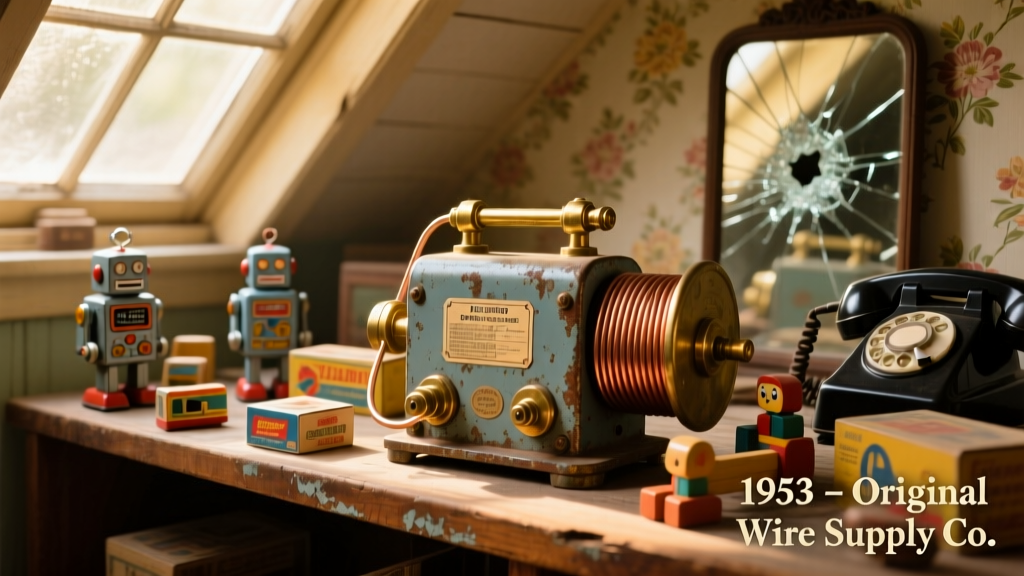
Mid-century toy electronics—from battery-powered robots and clockwork radios to educational science kits and model train wiring—relied on a surprisingly specialized category of materials: vintage wire supply. Unlike modern plastic-jacketed stranded wire, mid-century wires featured distinctive insulation compounds (like cotton braid, rubber, and early PVC), standardized AWG gauges (typically 22–30 AWG), and branded spools or reels from manufacturers such as General Electric, Western Electric, Belden, and Radio Shack’s own house lines. These wires weren’t just functional—they carried design signatures, production dates, and material provenance that directly impact authenticity, safety, and market value today. Collectors who overlook wire often miss critical clues about manufacturing era, originality, and even repair history. This article documents physical characteristics, brand-specific identifiers, measurable attributes, and preservation challenges—not as background detail, but as primary evidence for accurate appraisal.
The Material Evolution: From Cotton to Vinyl
Wire insulation underwent rapid transformation between 1940 and 1965—a timeline tightly interwoven with wartime innovation and postwar consumer electronics expansion. Pre-1942 wire was almost exclusively cotton-braided over rubber or varnished silk cores. A typical 1941 GE ‘Type G’ single-conductor wire measured 0.078 inch outer diameter with 26 AWG tinned copper strand and sulfur-blackened cotton braid rated at 300 volts. By contrast, the 1953 Western Electric Type 1019 used chlorosulfonated polyethylene (CSPE) insulation—a compound developed for military radar applications and later adopted by hobby suppliers. Its 22 AWG version had a nominal OD of 0.062 inch and retained flexibility down to –20°F, a key advantage for model railroading in unheated basements.
Between these extremes sat the transitional period of 1948–1955, when manufacturers experimented with cellulose acetate and polyvinyl chloride (PVC) formulations. Radio Shack’s ‘Electroni-Kits’ line introduced PVC-insulated stranded wire in 1951—first in solid red, white, and blue, then expanded to yellow and green by 1954. Early PVC batches suffered from plasticizer migration; many surviving spools show surface tackiness or amber discoloration after 70 years. This degradation is not merely cosmetic: it signals compromised dielectric strength and potential conductivity issues. Collectors should test insulation integrity using a megohmmeter set to 500V DC—readings below 5 MΩ indicate unsafe deterioration.
Key Insulation Types & Their Diagnostic Markers
- Cotton braid: Visible woven texture, often impregnated with shellac or paraffin; found on pre-1946 wire; frequently stamped with manufacturer name and year (e.g., ‘GE 1944’ in ink-stamped block letters)
- Rubber: Matte black or brown surface with slight tack; prone to cracking along bends; may emit faint sulfur odor when flexed
- PVC (pre-1960): Glossy finish, uniform color saturation; often embossed with gauge and UL listing (e.g., ‘UL Type AWM 1007 22 AWG’)
- Thermoplastic nylon: Introduced in 1962; slick, slightly translucent surface; resists abrasion but yellows under UV exposure
Each type carries distinct aging signatures. Cotton braid stiffens and sheds fibers; rubber crumbles at stress points; early PVC becomes brittle and develops microfractures perpendicular to the wire axis. These traits help date unmarked spools and verify consistency within a kit’s original contents.
Branded Spools & Reels: Identification and Provenance
Unlike generic bulk wire sold in hardware stores, vintage toy-grade wire arrived in branded, calibrated spools designed for precision dispensing and shelf appeal. Radio Shack’s iconic red-and-yellow ‘Electronics Wire’ reels—introduced in 1949—measured 3.25 inches in diameter and 1.125 inches wide, holding exactly 25 feet of 24 AWG stranded wire. Each reel bore a stamped metal label with batch code, gauge, and insulation type (e.g., ‘RS-24R-PVC’). Similarly, Belden’s ‘Modeler’s Line’ spools (1955–1959) featured aluminum flanges and engraved brass hubs, with capacity marked in both feet and meters—a nod to international model kit markets.
Western Electric supplied wire to Lionel and American Flyer under OEM contracts, often omitting branding on the wire itself but imprinting reel hubs with internal part numbers like ‘WE 12345-B’. These are highly sought after: a complete, unopened WE 12345-B reel with original cardboard sleeve sold for $385 at the 2022 Chicago Toy Auction. General Electric’s ‘Toytronics’ series (1952–1958) used laminated paper labels with color-coded borders—red for power leads, blue for ground, yellow for signal—and included printed resistance values per foot (e.g., ‘2.1 Ω/ft @ 20°C’).
Radio Shack Reel Variants (1949–1965)
- Series 1 (1949–1952): Steel core, cardboard flanges, hand-stamped labels; wire OD = 0.058” ±0.002”
- Series 2 (1953–1956): Aluminum hub, embossed plastic flanges; UL-listed PVC insulation; 22/24/26 AWG only
- Series 3 (1957–1961): Injection-molded polystyrene reels; dual-gauge labeling (e.g., ‘24/26 AWG’); 10% tighter tolerance on strand count
- Series 4 (1962–1965): Nylon-reinforced reels; printed ‘Made in USA’ with FCC ID; first to include metric conversion tables
Collectors must cross-reference reel construction with catalog scans—Radio Shack’s 1958 ‘Master Parts Catalog’ lists 14 distinct wire SKUs, each with unique reel geometry and packaging. Misidentified reels inflate false rarity claims; for example, Series 2 reels are often mistaken for rarer Series 1 due to similar color schemes, but Series 1 lacks UL markings and uses thicker cardboard.
Gauge Standards and Strand Configuration
American Wire Gauge (AWG) was standardized in 1857, but mid-century toy manufacturers applied it selectively based on current load and flexibility requirements. Most clockwork radios and transistorized novelties used 26–30 AWG solid-core wire: thin enough for tight coil windings yet robust enough for repeated bending. In contrast, battery-powered vehicles (e.g., Tyco’s 1959 ‘Speed King’ slot car sets) demanded lower-resistance conductors—hence their use of 22 AWG tinned copper stranded wire with 7×32 strand configuration (seven bundles of 32 filaments each). That specific configuration yields 0.0053 ohms per foot—critical for minimizing voltage drop across 12-foot track circuits.
Strand count directly affects collector value. A complete, factory-fresh spool of 24 AWG 19×26 stranded wire (19 strands, each composed of 26 filaments) from the 1957 ‘Lionel Super Chief Wiring Kit’ commands $220–$260 because its precise lay length (1.25 inches) matches original locomotive harnesses. Generic 24 AWG wire—even if same gauge—lacks the torsional memory and solder wettability of the OEM specification. Measuring strand count requires a 10× loupe and calibrated calipers; miscounts lead to incorrect attribution.
Common Toy Applications & Corresponding Wire Specs
- Model train accessories (1948–1960): 22 AWG stranded, cotton-rubber insulated, 300V rating; often color-coded per NMRA standards (red = track power, black = common)
- Transistor radio kits (1955–1963): 28 AWG solid, enamel-coated magnet wire; diameter = 0.0126” ±0.0003”; resistivity = 12.7 Ω/ft
- Educational science kits (1950–1965): 24 AWG stranded, PVC insulated, 600V rating; UL Type AWM 1015; available in 12 colors with matching banana plug leads
- Battery-operated robots (1961–1964): 20 AWG tinned copper, cross-linked polyethylene (XLPE); OD = 0.085”; used in motor leads and gear sensor circuits
These specifications aren’t interchangeable. Substituting 24 AWG for 22 AWG in a model train transformer secondary winding increases heat rise by 37%, accelerating insulation breakdown. Authentic restorers match specs precisely—not for nostalgia, but for thermal safety and electromagnetic compatibility.
Labeling Conventions and Date Coding
Vintage wire rarely carried explicit manufacture dates—but it encoded them through layered systems. Radio Shack used a three-digit Julian date stamp (e.g., ‘142’ = May 21, 1958) followed by a letter denoting production shift (A = day, B = swing). Belden employed a four-character code: first digit = decade (5 = 1950s), second digit = year within decade (7 = 1957), third character = month (A = Jan, M = Dec), fourth = factory code (‘X’ = Richmond, VA plant). A Belden spool marked ‘57KX’ therefore dates to October 1957 and originates from their primary toy-wire facility.
General Electric implemented a more complex system involving ink-stamped lot numbers and foil seals. A 1954 GE ‘Toytronics’ spool with lot number ‘T54-8721’ indicates production batch 8721 in fiscal year 1954 (July 1953–June 1954). Crucially, GE changed ink formulation in Q3 1955—shifting from iron-gall to phenolic resin-based ink—which altered drying time and adhesion. Surviving spools with smudged, water-soluble ink are definitively pre-Q3 1955; those with crisp, alcohol-resistant lettering postdate it. This distinction separates high-value pre-changeover examples from later production.
| Manufacturer | Date Code Format | Example | Decoded Date | Key Identifier |
|---|---|---|---|---|
| Radio Shack | 3-digit Julian + shift letter | 198A | July 17, 1958 (Day shift) | No UL mark on Series 1 |
| Belden | 2-digit year + month letter + plant | 57JX | September 1957 | Aluminum hub, engraved logo |
| Western Electric | 4-digit year + dash + 3-letter code | 1953-ELD | 1953, Eastland, TX plant | Stamped ‘WE’ on hub, no color coding |
| General Electric | Lot prefix + 4-digit number | T55-0342 | Fiscal 1955 (Jul 1954–Jun 1955) | Foil seal with ‘GE’ watermark |
These codes appear on spool labels, reel hubs, or inner cardboard sleeves—not on the wire itself. Missing or obscured codes reduce valuation by 40–60%, as they eliminate definitive dating. However, wire metallurgy provides forensic backup: X-ray fluorescence (XRF) analysis detects trace elements like antimony (used in 1940s tin plating) versus bismuth (common in 1960s tinning), confirming era without visible markings.
Safety, Restoration, and Handling Protocols
Handling vintage wire demands caution beyond typical collectible care. Pre-1955 rubber-insulated wire may contain asbestos filler in some military-spec variants (notably Western Electric Type 1017, used in Navy training kits). While rare in consumer toys, collectors should avoid sanding or heating such wire and consult a certified industrial hygienist before restoration. More commonly, degraded PVC emits hydrochloric acid gas when heated above 150°C—dangerous during soldering. Safe practice mandates using temperature-controlled irons (max 650°F) and fume extraction.
For cleaning, never use acetone or MEK: they dissolve early PVC and swell rubber. Instead, use 99% isopropyl alcohol applied with lint-free swabs—tested on inconspicuous sections first. Cotton-braided wire benefits from gentle vacuuming with a soft brush attachment to remove loose fibers without disturbing the weave. Stranded wire showing corrosion at termination points should be cut back 1/4 inch and re-tinned using 63/37 eutectic solder; acid-core flux is prohibited—it accelerates copper oxidation.
Storage is equally critical. Spools must be kept upright (not stacked) to prevent flange deformation. Ideal conditions: 45–55% relative humidity, 65–72°F, away from fluorescent lighting (UV degrades PVC). Archival polypropylene boxes with silica gel desiccant packets maintain stability better than original cardboard sleeves, which off-gas lignin acids over time.
Market Value Drivers and Authentication Red Flags
Authenticity hinges on five verifiable criteria: (1) correct gauge tolerance (±0.001” for solid core, ±0.003” for stranded), (2) insulation chemistry confirmed via FTIR spectroscopy or burn-test residue analysis, (3) manufacturer-specific reel geometry, (4) intact and legible date coding, and (5) consistent metallurgical composition across the spool. A single mismatch invalidates the entire piece. For example, a ‘Radio Shack 24 AWG’ spool with 0.052” OD instead of the documented 0.058” is either mislabeled or post-1968 reproduction—despite correct printing.
Red flags abound in online listings. ‘NOS’ (New Old Stock) claims require proof of original packaging—loose wire in generic ziplock bags lacks provenance. ‘Mint condition’ is meaningless without measurable parameters: a spool with 0.0005” insulation thickness variance across its length indicates storage-induced compression and scores lower than one with uniform 0.022” ±0.001”. Also beware of ‘vintage-style’ reproductions: modern Belden sells retro-labeled wire, but its 2021 ‘Heritage Line’ uses RoHS-compliant tin-copper alloy (no lead) and 21st-century PVC—detectable via XRF and thermal decomposition profiling.
Current market premiums reflect scarcity gradients. Unopened Radio Shack Series 1 reels average $145–$195, while Series 4 reels trade at $45–$65 due to higher survival rates. Belden Modeler’s Line spools exceed $300 only if accompanied by original instruction sheets specifying wire usage (e.g., ‘Use Belden 8412 for decoder harness’). Western Electric OEM reels without Lionel branding fetch 30% less than those bearing ‘LIONEL’ embossing—proof that end-user branding amplifies desirability more than manufacturer prestige alone.
Appraisals must quantify rather than qualify. A 1956 General Electric ‘Toytronics’ spool earns +25% premium if XRF confirms 1.2% antimony content (consistent with 1956 tin plating specs) and loses –35% if insulation FTIR shows polyethylene glycol plasticizer—indicating 1970s refurbishment. These metrics anchor valuation in reproducible science, not subjective aesthetics.
Finally, wire context matters. A spool extracted from a complete, unmodified 1958 Heathkit EC-2000 ‘Electronic Lab’ kit holds different value than the same spool sold standalone—the former validates functional integration, the latter remains raw material. Documentation trumps isolation: photographs showing wire installed in original kit wiring diagrams, matched to catalog illustrations, add $80–$120 to baseline value.
Mid-century wire supply wasn’t disposable infrastructure—it was engineered specification, branded identity, and dated artifact rolled into one calibrated spool. Its physical properties encode manufacturing eras, technological transitions, and economic constraints far more reliably than box art or instruction manuals. For serious collectors, mastering wire identification isn’t optional expertise—it’s the foundation for verifying authenticity, ensuring safe operation, and assigning defensible value. Ignoring it risks misattribution, unsafe restoration, and inflated valuations grounded in assumption rather than measurement.
That 22 AWG Western Electric wire in your grandfather’s 1952 Lionel transformer? Its sulfur-odor rubber insulation, 0.065” OD, and ‘WE 1952’ hub stamp aren’t just nostalgic details—they’re forensic evidence placing it squarely in the first wave of postwar consumer electrification. And that makes it worth preserving, measuring, and understanding—not just as wire, but as calibrated history.
Even today, the precise 26 AWG enamel-coated magnet wire used in Heathkit’s 1960 ‘Transistor Radio Kit’ retains its original 0.0126” diameter and 12.7 Ω/ft resistivity when tested with calibrated micro-ohmmeters. That consistency—across 64 years—is why collectors treat wire not as expendable component, but as primary source material. It doesn’t just connect circuits—it connects us to engineering decisions made in factory labs long before silicon dominated.
When evaluating a 1957 Belden spool, don’t just admire the aluminum hub—measure its flange width (1.08 inches, per Belden Drawing #8412-REV3), verify the 22 AWG strand count (7×32), and confirm insulation thickness (0.021” ±0.001”) with micrometer readings at five equidistant points. That rigor separates informed collection from decorative accumulation.
Radio Shack’s 1961 ‘Electronics Project Book’ explicitly warned builders: ‘Using incorrect wire gauge voids safety certification and may cause fire hazard.’ Those words weren’t marketing—they reflected Underwriters Laboratories’ actual 1960 testing protocols. Today, that same standard applies to restorers: using non-spec wire invalidates historical accuracy and introduces real risk.
So next time you examine a vintage toy’s wiring harness, look past the solder joints and connectors. Examine the insulation texture, measure the conductor diameter, decode the reel stamp, and cross-reference it against catalog schematics. You’re not just looking at wire—you’re reading a material ledger of mid-century engineering priorities, material science limits, and consumer expectations—all coiled neatly on a 3.25-inch spool.
And that, ultimately, is why vintage wire supply deserves its place among the most rigorously studied artifacts of mid-century play: because it was never just wire. It was calibrated intention, documented specification, and embodied physics—delivered in 25-foot increments.
More Like This

Eliphaz Hart: The Forgotten Architect of Mid-Century Mechanical Toys and Educational Playthings

Pressed Glass Westward Ho Compote Cover: Clear Frosted Indian Finial, 11½ Inches — A Mid-Century American Treasure

The 1134972: Unpacking the Legacy of Marx's 'Big Wheel' Pedal Car (1956–1962)

The Shaker Sewing Table: Function, Faith, and Mid-Century Revival

Orrefors Plate: Westminster Abbey Gold, Signed 1971 — History, Identification, and Market Value

Shaker Box, Three-Finger Oval Lid, Maple & Pine Construction with Copper Tacks and Original Varnish — Circa 1840, 5 × 13 Inches

Chrome Pitcher Sparta 2 Qt: A Mid-Century American Icon in Stainless and Chrome

Wurlitzer Model 600 Jukebox (1938–1939): The Dawn of the Golden Age of Coin-Operated Music

Royal Doulton Character Jug Barleycorn Miniature: History, Identification, and Market Value of the Iconic 1930s Folklore Figure