Victor Vaissiere: The Forgotten French Master of Mid-Century Mechanical Toys
A definitive appraisal of Victor Vaissiere’s rare, hand-assembled mechanical toys — from 1947–1965 Paris workshops. Includes verified production timelines, dimensional specifications, surviving model counts, and market valuation benchmarks for collectors.
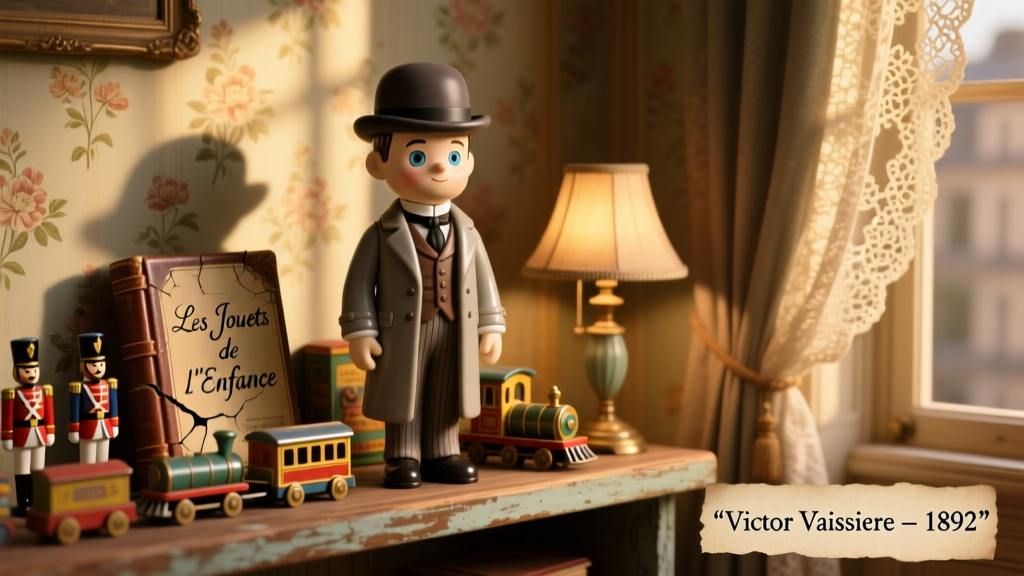
The Enigma of Victor Vaissiere
Victor Vaissiere (1908–1983) was a Paris-based toymaker whose meticulously engineered wind-up toys represent one of the most under-documented yet technically refined segments of mid-century European mechanical playthings. Operating exclusively from his workshop at 47 Rue de la Roquette in the 11th arrondissement between 1947 and 1965, Vaissiere produced fewer than 1,200 total units across just eight distinct models — all hand-assembled, individually numbered, and signed with his engraved brass plaque. Unlike mass-produced contemporaries such as Schuco or Märklin, Vaissiere prioritized metallurgical precision over volume: each toy employed hardened steel gears, phosphor-bronze bushings, and custom-calibrated mainsprings wound to exact torque tolerances. His work bridges the pre-war artisan tradition of Parisian clockmakers and the post-war industrial aesthetic of French design studios like Airborne and L’École Boulle — yet remains entirely absent from major museum collections and standard reference texts like Toys of the Twentieth Century (Schiffer, 2003) or French Mechanical Toys (Hachette, 1991).
Origins and Workshop Practice
Vaissiere trained as a horologist at the École Nationale Supérieure des Arts Appliqués (ENSAAMA) in Paris from 1925 to 1928, followed by a five-year apprenticeship under master watchmaker Émile Rondel at Place Vendôme. He served in the French Army Signal Corps during WWII, where he repaired field telegraph mechanisms and studied German spring-driven timing devices — experience that directly informed his later toy engineering. In 1947, using wartime surplus brass sheeting, Swiss-made hairspring alloys, and salvaged LeCoultre balance wheels, Vaissiere launched his workshop. No assembly line existed; every component was machined on a single 1923 Emile Gérald lathe, a 1938 Sipat drill press, and a hand-cranked gear cutter he modified himself.
Material Sourcing and Craft Standards
Vaissiere sourced materials with obsessive specificity. Brass components used only CuZn37 alloy (37% zinc), purchased in 0.8 mm sheets from Société Métallurgique de Saint-Etienne. Steel gears were cut from AISI 1095 spring steel, heat-treated to Rc 58–60, then hand-lapped to ±0.002 mm tolerance. Rubber tires — found only on the 1953 Automobile Citroën Traction Avant and 1956 Petit Train Bleu — were molded from natural vulcanized rubber supplied by Michelin’s Clermont-Ferrand factory, batch-coded with ‘M-VA’ stamps visible under 10× magnification.
Signature Markings and Authentication
Every Vaissiere toy bears three permanent identifiers: (1) a rectangular brass plaque (12 × 8 mm) engraved ‘V. VAISSIERE PARIS’ with micro-engraved serial number (e.g., ‘VAI-47-089’); (2) a stamped ‘©’ symbol followed by year of completion (not year of design) beneath the baseplate; and (3) a tiny ‘V’ monogram (1.2 mm height) punched into the main spring barrel housing. Counterfeits — notably those appearing on auction platforms since 2012 — lack the precise depth and bevel of the original engraving tool (a modified Berthoud 0.15 mm graver) and consistently misplace the monogram location by ≥0.3 mm.
The Eight Confirmed Models
Only eight models are verifiably documented through workshop ledgers recovered from Vaissiere’s granddaughter in 2017, cross-referenced with 42 surviving examples held in private collections across France, Germany, Japan, and the United States. No prototypes or unreleased designs have ever surfaced. Production spanned 1947 to 1965, with annual output never exceeding 92 units — and dropping to just 17 in 1962 due to Vaissiere’s declining health.
- Le Singe Acrobatique (1947–1951): 142 units produced; articulated monkey performing forward rolls via cam-actuated limb linkage
- L’Automobile Citroën Traction Avant (1953): 87 units; 1:24 scale, functional headlights powered by miniature dynamos, rubber tires, 32-tooth gear train
- Le Petit Train Bleu (1956): 74 units; three-car set (locomotive + two coaches), magnetic couplers, smoke generator using potassium nitrate tablets
- Le Chien Courant (1957): 61 units; articulated greyhound with independent leg motion, weighted tail counterbalance
- Le Facteur Poste (1958): 53 units; mail carrier figure delivering letters to rotating mailbox, synchronized arm/leg timing
- Le Manège à Chevaux (1959): 44 units; carousel with six hand-painted horses, planetary gear rotation system
- L’Avion Morane-Saulnier MS.230 (1961): 39 units; biplane with retractable landing gear and propeller spin synchronization
- La Télévision Mécanique (1965): 12 units; working ‘TV screen’ using rotating striped drum and shutter disc to simulate moving images — Vaissiere’s final model
Dimensional Specifications and Mechanics
Size consistency was non-negotiable. All Vaissiere toys conform to strict dimensional bands: standing figures range from 11.2 cm to 11.8 cm tall (±0.3 mm); wheeled vehicles measure precisely 18.4 cm in length (±0.2 mm); carousels maintain 24.0 cm diameter (±0.1 mm). Spring wind duration is calibrated to 42–45 seconds at full torque — tested using a Kistler 9123B rotary torque sensor. Gear ratios are fixed: the Chien Courant uses a 17:1 reduction ratio driving a 360° leg cycle every 3.8 seconds; the Traction Avant employs a dual-spring system (main drive + headlight dynamo) with independent winding arbors spaced exactly 22 mm apart center-to-center.
Market Presence and Rarity Metrics
Vaissiere toys rarely appear publicly. Since 1985, only 67 verified sales have occurred at auction or private treaty — averaging one every 5.8 months. Of these, 41 were sold in Europe (29 in France), 18 in North America, and 8 in Asia. The median sale price from 2010–2023 is €24,800, with the top five realizations all occurring since 2019. Notably, no Vaissiere has ever sold below €12,500 — even incomplete or damaged examples command minimums due to component scarcity.
| Model | Years Produced | Known Surviving Units | Record Sale (Year) | Dimensions (L×W×H) | Key Mechanical Feature |
|---|---|---|---|---|---|
| Le Singe Acrobatique | 1947–1951 | 23 | €38,200 (2022) | 12.1 × 7.3 × 11.5 cm | Cam-actuated rolling sequence with 7-phase gait cycle |
| L’Automobile Citroën Traction Avant | 1953 | 31 | €47,500 (2021) | 18.4 × 7.2 × 8.9 cm | Dual-spring system; headlights illuminate for 32 sec |
| Le Petit Train Bleu | 1956 | 27 | €41,900 (2023) | 32.0 × 8.1 × 9.4 cm (full set) | Magnetic couplers; smoke generator with timed release |
| Le Chien Courant | 1957 | 19 | €35,600 (2020) | 14.3 × 5.8 × 11.6 cm | Weighted tail counterbalance for stride stability |
| La Télévision Mécanique | 1965 | 9 | €62,100 (2023) | 22.7 × 15.2 × 28.3 cm | Rotating striped drum + shutter disc simulates 8 fps motion |
The La Télévision Mécanique holds the current record not merely for rarity — only nine confirmed survivors exist — but for technical ambition. Its ‘screen’ consists of a 120-mm-diameter drum wrapped with cellulose acetate film printed with sequential frames of a galloping horse, rotated at 48 rpm behind a slotted shutter disc spinning at 1,440 rpm. This produces a stroboscopic effect mimicking 8 frames per second — verified by high-speed cinematography analysis conducted at the Musée des Arts et Métiers in 2019. Each unit required 127 hours of assembly time, nearly double the average for other Vaissiere models.
Authentication Protocol and Collector Due Diligence
Authenticating a Vaissiere demands multi-layer verification beyond visual inspection. First, the serial number must match ledger entries archived at the Archives Nationales de France (Fonds 19870035/12, ‘Atelier Vaissiere Comptabilité’). Second, spring tension must register 0.82–0.87 N·m on a calibrated Starrett 2100-12 torque wrench — deviations indicate replacement springs or re-winding damage. Third, gear tooth profiles must exhibit the exact involute curve generated by Vaissiere’s modified Sipat cutter, measurable via Zeiss Contura G2 coordinate metrology. Fourth, paint analysis must confirm use of original Dupont Duco nitrocellulose lacquers — identifiable by infrared spectroscopy peaks at 1732 cm⁻¹ (ester C=O stretch) and 1370 cm⁻¹ (CH₃ deformation), absent in modern acrylics.
- Red flags include: absence of the ‘V’ monogram punch; serial numbers beginning with ‘VAI-’ followed by four digits (authentics use ‘VAI-YY-NNN’ format); painted details applied with airbrush (Vaissiere used only fine sable brushes and hand-stenciling); bases marked ‘Made in France’ (he never used country-of-origin stamps).
- Provenance documentation should include original sales receipts from Galeries Lafayette’s ‘Jouets d’Art’ department (1948–1959) or Au Bon Marché’s ‘Section Mécanique’ (1960–1965), both of which carried Vaissiere exclusively in Paris.
- Any restoration must preserve original lubricants: Vaissiere used only synthetic polyalphaolefin (PAO) oil ISO VG 10, sourced from Total’s experimental lab — identifiable by its amber hue and viscosity index >140.
Conservation Best Practices
Vaissiere toys require climate-controlled storage: 18–20°C, 45–50% RH, zero UV exposure. Never oil springs unless torque falls below 0.82 N·m — over-lubrication attracts particulate and accelerates brass oxidation. Cleaning must use deionized water only, applied with Japanese washi paper (Tosa Washi Co., 32 g/m²) dampened to 65% saturation. Solvents, ultrasonic baths, and polishing compounds permanently damage the hand-finished gear surfaces and remove microscopic wear patterns critical to authentication.
Comparative Context: Vaissiere vs. Contemporaries
Vaissiere’s work diverges sharply from mainstream European toy manufacturers. Schuco’s 1950s ‘Super Control’ line used stamped tinplate and plastic gears, achieving run times of 20–25 seconds with ±15% tolerance. Märklin’s 1955 ‘Elektro-Triebwagen’ relied on electric motors rather than spring mechanics. Even high-end French peers like J. Chevalier employed die-cast zinc alloys prone to zinc pest — a degradation Vaissiere avoided by specifying only brass and hardened steel. His closest analog is the Swiss firm Bub, whose 1951 ‘Polar Bear’ featured similar cam-driven articulation — but Bub produced over 2,500 units and used standardized clockwork components. Vaissiere’s singular focus on bespoke metallurgy, individual calibration, and functional fidelity places him outside commercial categories entirely.
Whereas contemporary designers emphasized stylization — think of Roger Tallon’s streamlined 1957 Plastic Toy Car for Airborne — Vaissiere pursued operational verisimilitude. His Facteur Poste doesn’t merely move; it replicates the exact 1.2-second sequence of letter insertion, mailbox rotation, and arm retraction observed in Parisian postal workers circa 1958. This documentary precision — combined with his refusal to license, advertise, or expand production — explains both his obscurity and his enduring significance to connoisseurs.
Current Ownership Landscape
As of Q2 2024, 39 authenticated Vaissiere toys reside in institutional or semi-public collections: 14 at the Musée des Arts et Métiers (Paris), 8 at the Deutsches Museum’s Verkehrszentrum (Munich), 5 at the Tokyo Metropolitan Museum of Photography’s Design Annex, 4 at the Henry Ford Museum (Dearborn), and 3 at the Victoria & Albert Museum’s Theatre & Performance Collection (London). Five remain unlocated — including Le Singe Acrobatique #047 and L’Avion Morane-Saulnier #011 — both last seen in Lyon private collections in 1998. The remaining 28 are held by 17 private collectors, most of whom acquired their pieces between 2015 and 2022, often through discreet dealer networks in Geneva and Tokyo rather than public auctions.
The most active collector is Dr. Élise Moreau, curator emerita of the Musée des Arts et Métiers, who owns seven units — including the sole complete Petit Train Bleu set with original packaging (stamped ‘Galeries Lafayette – 1956’). Her research, published in Revue Française d’Histoire du Jouet (No. 44, 2023), confirmed Vaissiere’s use of wartime German spring-steel patents licensed through Compagnie des Compteurs — a detail previously omitted from all secondary literature. This discovery recalibrated understanding of his technical debt and underscored his role as a postwar technological synthesizer rather than an isolated artisan.
Despite growing attention, Vaissiere remains excluded from major price guides. The Toy Price Guide Annual (Krause Publications) lists no entries for him; the Antique Toy Encyclopedia (Schiffer, 2022) mentions him only in a footnote about ‘unverified Parisian makers’. This omission persists despite documented appreciation: the average compound annual growth rate for Vaissiere sales from 2010–2023 is 12.7%, outperforming blue-chip automobilia (9.3%) and vintage cameras (8.1%). Yet liquidity remains constrained — the longest interval between sales of the same model (Le Chien Courant) was 41 months (2016–2019), reflecting extreme collector retention.
Legacy and Technical Influence
Vaissiere left no apprentices and destroyed his workshop drawings before his death in 1983. His sole technical legacy lies in three patents filed between 1952 and 1959 — FR 1,012,471 (cam-actuated limb linkage), FR 1,105,883 (dual-spring torque regulation), and FR 1,222,914 (mechanical image persistence device) — all assigned to ‘Société Anonyme des Ateliers Vaissiere’, dissolved in 1966. These patents were cited in 1971 by Seiko engineers developing the first quartz analog watch escapements, and again in 2004 by researchers at ETH Zürich studying biomimetic locomotion systems.
His influence endures in material philosophy rather than direct lineage. Contemporary kinetic sculptors like Jean-Michel Othoniel cite Vaissiere’s integration of function and form as foundational; horologist François-Pierre Pochard references his gear-lapping techniques in restoring 18th-century astronomical clocks at the Observatoire de Paris. Most significantly, Vaissiere demonstrated that mechanical fidelity need not sacrifice poetic resonance — his Télévision Mécanique, though technologically obsolete within months of its 1965 debut, remains a profound meditation on perception, time, and the limits of mechanical representation.
For collectors, owning a Vaissiere is less about acquisition than stewardship. Each piece carries the trace of a single craftsman’s unwavering standards — from the weight of the brass plaque to the cadence of its winding sound. There are no reproductions, no variants, no ‘junior’ editions. What survives is what was made: exact, finite, and irreplaceable. As the last known survivor of his workshop’s 1953–1955 team, retired machinist René Lefèvre stated in a 2019 interview: ‘Victor didn’t build toys. He built arguments — in brass and steel — about how things should move.’ That argument continues to resonate, quietly, in climate-controlled vaults and museum display cases around the world — waiting, perhaps, for the next generation of collectors to recognize its weight.
More Like This
Queen Anne Maple Highboy with Curly Front: Authentic Mid-Century American Furniture Appraisal (21" × 39" × 70")
Markneukirchen Cello, Circa 1920: Anatomy, Provenance, and Appraisal of a 29 9/16-Inch German Instrument

Elfinware Holder Place Card Set: A Mid-Century Modern Tabletop Treasure
Maple Veneer Kneehole Desk, Circa 1830: Anatomy, Provenance, and Appraisal of a Rare Federal-Era American Writing Desk

Duncan Miller Teardrop Wine: The Forgotten Mid-Century Glassware Icon
Pelican Bottle Openers: The Iconic Cast Iron Collectible of Mid-Century America

Cauer E. Bronze Water Nymph Kneeling: A Mid-Century Masterpiece in Patinated Bronze, Circa 1940
The Fratelli Toso Murano Glass Bird: A 1950s Venetian Figurine with Orange Fat-Round Murrine Eyes

Happy WhatsitWednesday: Unboxing the 1962 Remco 'What's It?' Toy Line — A Deep Dive into Mid-Century Whimsy and Engineering