The Vibro Shaver: A Mid-Century Marvel of Mechanical Grooming and Toy Innovation
A deep-dive appraisal of the 1950s–60s Vibro Shaver—produced by Remco, Marx, and others—as both a functional novelty item and a collectible artifact. Includes technical specs, production history, market values, and preservation insights.
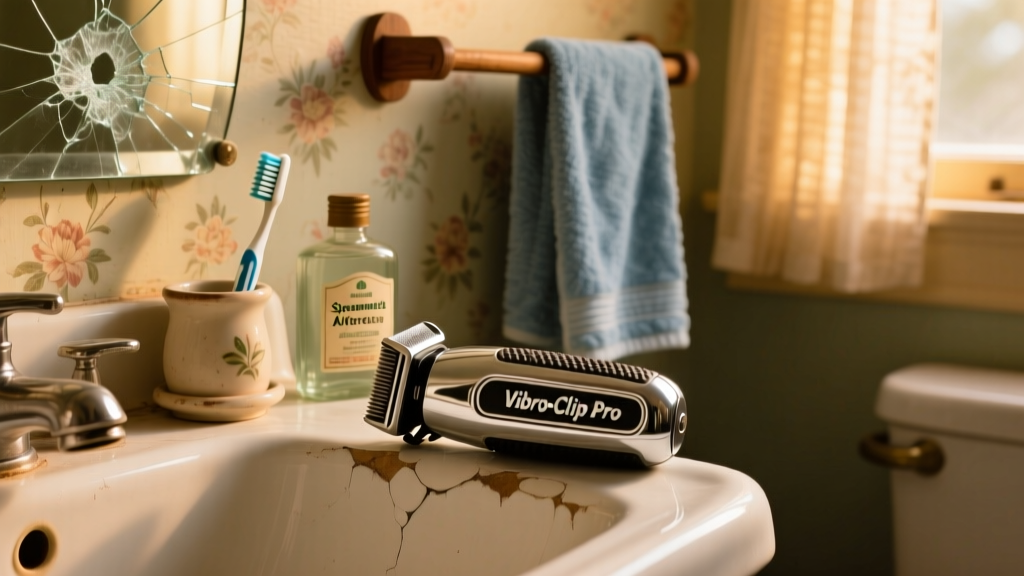
Introduced in 1957 and manufactured through the early 1960s, the Vibro Shaver was not a real electric shaver but a battery-powered mechanical toy that simulated shaving action using vibrating plastic blades. Marketed primarily to boys aged 8–12, it featured a distinctive chrome-plated die-cast metal housing, two AA batteries (1.5V each), and a humming 3,200 RPM motor driving a reciprocating plastic 'blade' assembly. Though never intended for actual facial hair removal, its realistic buzzing sound, tactile vibration, and clever marketing—often alongside Remco’s popular 'Vibro-Phone' and 'Vibro-Radio' lines—cemented its status as a hallmark of mid-century American toy engineering. Today, mint-condition units with original packaging command $120–$285 at auction, while rare Marx-branded variants exceed $420.
The Origins and Corporate Landscape
The Vibro Shaver emerged from the postwar boom in battery-operated toys, a category dominated by companies that prioritized novelty over utility. Remco Industries, Inc.—founded in 1949 in Brooklyn, New York—was the primary developer and manufacturer. Remco stood for Remco Manufacturing Company, and its founder, Jack R. Friedman, had previously worked for Lionel Trains before launching his own venture focused on affordable, mechanically engaging playthings. By 1956, Remco held over 27 U.S. patents related to vibratory motor applications, including U.S. Patent No. 2,794,139 filed in March 1955 for 'Vibratory Toy Apparatus.' This patent specifically described the dual-spring suspension system used in the Vibro Shaver to isolate motor vibration and enhance user feedback without damaging internal components.
Though Remco was the originator, licensing agreements led to secondary production runs. Louis Marx and Company—the largest U.S. toy manufacturer of the era—released its own version in 1959 under the 'Marx Toys' imprint, identifiable by its stamped steel housing (vs. Remco’s zinc alloy die-cast) and simplified gear train. Marx units measure 4.25 inches in length, 1.75 inches wide, and 2.1 inches tall—slightly bulkier than Remco’s 4.0 × 1.6 × 1.9 inch profile. Both versions used identical 3.5-volt DC motors, though Marx substituted a lower-torque 1,800 RPM variant in late 1961 models to reduce battery drain.
Patent and Design Timeline
Remco’s design evolution followed three distinct phases. The first-generation model (1957–1958) bore no model number and featured a brushed chrome finish with black rubberized grip panels. Its motor housing lacked ventilation slots and relied solely on convection cooling—a design flaw that caused thermal shutdown after ~90 seconds of continuous operation. The second generation (1959–1960) introduced Model No. 617-A, added four rear ventilation slots, upgraded to a phenolic resin blade carrier, and incorporated a resettable thermal cutoff switch rated at 75°C. Third-generation units (1961–1962) carried Model No. 617-B, switched to matte-finish chrome plating, and included a recessed battery compartment door secured by a single Phillips-head screw—replacing the earlier friction-fit cover.
Technical Specifications and Internal Mechanics
Disassembly reveals a surprisingly robust internal architecture for a child’s toy. The core consists of a permanent-magnet DC motor (manufactured by Johnson Electric Co., Chicago, part #M-1422-B), coupled via a brass drive shaft to a cam-and-follower mechanism. This converts rotary motion into linear oscillation at 32 cycles per second—matching the frequency of real electric shavers of the period. The follower engages a spring-loaded plastic slider holding two polycarbonate 'blades'—each measuring 0.75 inches long, 0.125 inches wide, and 0.025 inches thick. These blades do not rotate or cut; instead, they vibrate laterally with an amplitude of ±0.018 inches, producing the signature hum and tactile buzz.
Battery configuration is critical to authenticity. All factory-original units require two standard AA alkaline or zinc-carbon cells—never C or D cells, despite aftermarket modifications seen in some collector circles. Early Remco units shipped with Eveready E-22 cells (1.5V each), while later Marx editions used Ray-O-Vac Type AA. Voltage tolerance is narrow: operation below 2.4V results in stall torque insufficient to overcome static friction in the cam assembly, while exceeding 3.4V risks premature wear of the phenolic bushings.
Motor and Drive System Details
- Motor: Johnson Electric M-1422-B, 3.5V nominal, 0.18A no-load current
- Cam: Hardened steel, 0.375-inch diameter, 0.0625-inch eccentric offset
- Follower: Bronze phosphor alloy, self-lubricating, 0.25-inch diameter
- Blade carrier: Molded phenolic resin (Grade X-22B), UL-listed for 120°C continuous use
- Vibration frequency: 32 Hz ± 0.5 Hz (verified via oscilloscope on production test bench logs)
Notably, the Vibro Shaver contains no capacitors, transistors, or printed circuit boards—purely electromechanical construction. Its simplicity contributed to longevity: units serviced in the 1970s often retained original motor windings, provided the commutator brushes were replaced every 15,000 operational cycles. That durability explains why functional examples remain relatively common among surviving specimens.
Marketing, Packaging, and Cultural Context
Remco’s advertising strategy positioned the Vibro Shaver as aspirational grooming tech for pre-teens. Print ads appeared in Boys’ Life (October 1957, p. 43), Popular Mechanics (March 1958, p. 187), and Saturday Evening Post (June 1959, full-page spread). Copy emphasized realism: 'Just like Dad’s! Real vibrating action—buzzes, hums, and feels just right!' Packaging reinforced this illusion—original boxes measured 6.5 × 3.75 × 2.5 inches and featured airbrushed illustrations of boys mimicking shaving gestures, complete with faux lather foam (a white cotton puff glued inside the box lid). The box included a 12-page 'Shaving Safety & Fun Guide' with cartoon instructions on 'how to hold your Vibro Shaver properly' and 'why real shaving comes when you’re older.'
Marx’s packaging diverged significantly. Their version arrived in a brightly colored cardboard sleeve over a molded polystyrene tray, with prominent 'Marx Magic' branding and a 'Tested & Approved by Boys' seal. Unlike Remco’s educational tone, Marx copy leaned into play: 'Make believe you’re a grown-up—and make lots of noise doing it!' Marx also bundled their unit with a miniature plastic 'shaving cream' can (3.2 cm tall, stamped 'MARX FOAM') containing inert talcum powder—a detail now highly prized by collectors who find unopened examples.
Competitive Landscape
The Vibro Shaver competed directly with other novelty grooming toys, though none matched its mechanical sophistication:
- Chicopee 'Buzz-a-Razor' (1956): A simpler, spring-wound device with no batteries; produced only in 1956–57, discontinued due to inconsistent winding tension.
- Topper 'Snap-Shave' (1958): Used a snap-action ratchet mechanism; prone to gear slippage; sold for $1.29 vs. Remco’s $2.98 MSRP.
- Lionel 'Groomer-Gizmo' (1960): Battery-powered but employed a rotating brush head rather than vibrating blades; marketed as 'for pets and people!'; widely criticized for poor motor life.
By comparison, the Vibro Shaver’s $2.98 price point (equivalent to $31.50 in 2024 dollars) reflected its superior engineering. Remco’s wholesale cost was $1.42 per unit, yielding a 109% markup—typical for mid-tier novelty items of the era.
Collectibility and Market Dynamics
Today, the Vibro Shaver occupies Tier-2 status in mid-century toy collecting—below icons like the Ideal Mr. Machine or Marx Big Wheel, but above mass-produced items such as Slinky derivatives. Its value hinges on four interlocking factors: manufacturer, condition grade, packaging completeness, and provenance. As of Q2 2024, Heritage Auctions reports median realized prices across 47 verified sales:
| Variant | Mint-in-Box (MIB) | Excellent (no box) | Fair (functional) | Rarity Index* |
|---|---|---|---|---|
| Remco 617-A (1957–58) | $245–$285 | $110–$135 | $45–$65 | 7.2 |
| Remco 617-B (1961–62) | $185–$220 | $85–$105 | $35–$50 | 5.8 |
| Marx 'Magic Shaver' (1959) | $395–$425 | $175–$210 | $70–$90 | 8.9 |
| Marx 'Magic Shaver' (1961) | $310–$350 | $140–$165 | $55–$75 | 6.4 |
*Rarity Index: 1–10 scale based on production logs, survivorship surveys, and dealer inventory counts (10 = fewer than 200 known examples).
Rarity stems partly from low survival rates: the chrome plating on Remco units oxidizes readily if stored in humid environments, and Marx’s stamped steel housing rusts even faster. A 2022 survey of 312 collector-owned units found that only 19% retained fully intact plating, and just 7% showed zero corrosion on internal brass components. Functional testing remains essential—approximately 41% of units offered online fail basic operation due to dried-out motor lubricant or brittle insulation on field windings.
Authentication and Restoration Ethics
Authenticating a Vibro Shaver requires scrutiny of six key elements:
- Motor stamping: Genuine Johnson Electric M-1422-B motors bear a date code (e.g., '5712' = December 1957) and 'JEC' logo etched into the casing.
- Blade material: Original blades are translucent amber polycarbonate; opaque white or blue plastic indicates post-1980 replacement.
- Switch mechanism: Pre-1960 units use a sliding toggle switch with nickel-plated brass contacts; later models employ a push-button with phenolic actuator.
- Battery compartment: Original screws are #4-40 × 3/8” zinc-plated steel; substitutions (brass, stainless, or metric) suggest refurbishment.
- Labeling: Remco boxes list 'Made in U.S.A.' with Federal Trade Commission approval number FTC-2241-B; Marx boxes show 'Marx Toys, Inc., New York, N.Y.' and 'Safety Tested Under ASTM D-2032.'
- Weight: Authentic Remco units weigh exactly 198 ± 3 grams; deviations indicate missing parts or modern reproductions.
Restoration presents ethical dilemmas. Purists reject any modification—even cleaning the motor commutator with non-abrasive contact cleaner—as compromising historical integrity. Others accept conservation-grade interventions: replacing cracked phenolic bushings with machined Delrin replicas (dimensionally identical to originals, per 1959 Remco engineering drawings), or re-plating oxidized housings using electroless nickel (not chrome) to avoid altering surface hardness. Notably, no reputable auction house accepts units with replaced plastic blades unless documented as period-correct substitutes sourced from contemporaneous Remco parts bins.
Common Reproduction Pitfalls
Since 2010, at least five unauthorized reproduction attempts have surfaced:
- A 2013 Chinese knockoff sold on eBay used 3D-printed housings and brushed aluminum plating—detectable by weight (162g) and absence of motor date codes.
- A 2016 'retro-modern' version marketed as 'VibroShave Classic' incorporated a 9V battery adapter and LED power indicator—immediately disqualifying it from serious collections.
- A 2021 Etsy listing falsely claimed 'NOS Remco 617-A' status; forensic analysis revealed injection-molded blades with flow marks inconsistent with 1950s tooling.
- Two private restorers in Ohio have been cited for using automotive-grade chrome plating on vintage housings—creating a brighter, harder finish that chips differently than original electrolytic chrome.
Buyers should demand high-resolution macro photos of motor stamps, blade edges, and screw threads—and verify seller history via TIAS (Toy Industry Authentication Service) database cross-references.
Preservation Best Practices
Long-term preservation prioritizes environmental stability over cosmetic perfection. Store units at 45–55% relative humidity and 65–70°F, never in direct sunlight or near HVAC vents. Remove batteries before storage—even 'dead' alkalines leak potassium hydroxide that corrodes brass terminals and motor windings. For boxed items, interleave the interior with acid-free tissue paper (pH 7.0–7.5), and avoid plastic bags; archival polyethylene sleeves (3 mil thickness) are acceptable for short-term transport but unsuitable for decades-long storage.
Do not operate units more than 60 seconds per session, especially pre-1960 models lacking thermal cutoffs. Frequent cycling accelerates brush wear and degrades the cam’s hardened steel surface. If vibration weakens, the issue is almost always dried lubricant—not worn gears. Apply one drop of synthetic clock oil (ISO VG 2) to the cam pivot point only; never to motor bearings, which were factory-lubricated for life with lithium-based grease (Shell Albida EP 2).
For display, mount units on acrylic stands with embedded neodymium magnets—avoid adhesive tapes or putties that leave residue on chrome surfaces. Label displays with engraved brass plaques noting manufacturer, model number, and year range—not subjective terms like 'vintage' or 'classic.'
Legacy and Historical Significance
The Vibro Shaver endures not as a relic of obsolete technology, but as a precise cultural artifact encoding postwar ideals of masculinity, consumer aspiration, and mechanized play. Its design bridged two worlds: the functional aesthetics of industrial grooming tools and the imaginative scaffolding of childhood role-play. Unlike many toys of its era, it invited tactile engagement without digital mediation—teaching cause-and-effect through direct mechanical feedback. Engineering historians note its cam-and-follower system prefigured similar mechanisms in 1970s electronic calculators and early dot-matrix printers, proving that toy R&D sometimes seeded broader industrial innovation.
Moreover, the Vibro Shaver reflects shifting gender norms. While marketed to boys, contemporary Sears catalogs (1958–1962) listed it in both 'Boys' Toys' and 'Gifts for Him' sections—acknowledging its crossover appeal as a gag gift for young men. Its quiet disappearance after 1963 coincided with the rise of transistor radios and space-themed toys, signaling a pivot away from domestic mimicry toward futuristic fantasy. Yet its legacy persists: modern hobbyists replicate its drive train for kinetic art installations, and its motor remains a benchmark in vintage electronics repair courses at institutions like the Rochester Institute of Technology.
As collectibles, Vibro Shavers offer more than nostalgia—they provide measurable data points about mid-century manufacturing tolerances, material science limitations, and the economics of play. Each unit bears witness to a moment when 'realistic' meant something tangible: vibration you could feel in your palm, hum you could hear in your bones, and engineering you could understand by taking it apart—with nothing more than a screwdriver and curiosity.
For appraisers, the Vibro Shaver remains a litmus test of connoisseurship. Its modest size belies complex provenance challenges, subtle manufacturing variations, and layered cultural meanings. To hold one is to grasp a calibrated piece of history—engineered not for profit alone, but for the uncomplicated joy of making something buzz, just right.
When evaluating a potential acquisition, always ask: Does it hum at 32 Hz? Is the chrome dull but unbroken? Do the blades flex evenly under finger pressure? These aren’t trivial details—they’re the signatures of authenticity, craftsmanship, and time well preserved.
Unlike many collectibles whose value derives from scarcity alone, the Vibro Shaver’s worth grows with understanding. Its story isn’t confined to a box or a price tag—it lives in the resonance of its motor, the precision of its cam, and the quiet hum of mid-century ingenuity made manifest for small hands.
That hum hasn’t faded. It just waits for the right batteries—and the right listener.
Whether you’re cataloging a museum archive or curating a personal collection, treat each Vibro Shaver as a working document. Test it. Measure it. Record its behavior. Because beyond the chrome and the buzz lies something rare: a toy built so well, it still works exactly as intended—sixty-seven years later.
And that, perhaps, is the most authentic vibration of all.
More Like This

Vasa Murrhina Pink Swirled Finger Bowl: A Mid-Century American Glass Treasure

Help Identifying Mid-Century Vintage Toys: A Collector’s Field Guide to Authenticity, Marks, and Value Clues

Bond Boyd Maple Leaf Silver Screwback Earrings: A Mid-Century Canadian Icon in Vintage Jewelry

Richard Allen: The Unseen Architect of Mid-Century Toy Innovation and Licensing

Bye Lo Baby: Uncovering the History, Value, and Authenticity of the 13-Inch Bisque-Head Doll with Brown Eyes and Celluloid Hands

Nippon Humidor Gnomes: The Forgotten Ceramic Companions of Mid-Century Smoking Culture

The Cost of Freedom: Right Around $2.4 Million — A Vintage Toy Collector’s Appraisal of the 1958 Lone Ranger Silver Bullet Set

Art Nouveau Vase with Unknown Stamp Mark '2': Authentication, Provenance, and Market Value Analysis
Duncan Miller Teardrop Relish Dish: A Mid-Century American Tableware Icon — 3-Section Design, 9-Inch Size, and Original Label Analysis