Uni-Dome Antique Spectacular Slated for March 16–18: A Mid-Century Collector’s Preview
The Uni-Dome Antique Spectacular returns March 16–18, 2024, at the historic Uni-Dome Convention Center in Columbia, Missouri. This premier mid-century collectibles event features over 120 dealer booths, rare toy auctions, expert appraisals, and curated exhibits—including a landmark display of 1950s–60s mechanical toys, vintage board games, and original packaging from brands like Marx, Remco, Louis Marx & Co., and Ideal Toy Corporation.

The Uni-Dome Antique Spectacular—the nation’s longest-running dedicated mid-century collectibles exposition—returns March 16–18, 2024, at the Uni-Dome Convention Center in Columbia, Missouri. Now in its 47th year, this meticulously curated event draws over 5,200 attendees annually and remains the definitive gathering for serious collectors, dealers, historians, and restoration specialists focused on postwar American toys and household ephemera. Unlike general antiques fairs, the Spectacular enforces strict period parameters: all merchandise must originate between January 1, 1945, and December 31, 1975. This ensures authenticity, discourages modern reproductions, and elevates scholarly curation. The 2024 edition expands floor space by 18%, adds three new appraisal stations, and introduces a timed preview session exclusively for members of the Mid-Century Toy Collectors Guild (MTCG) on Friday morning from 9:00 to 11:30 a.m.
A Legacy Rooted in Authenticity
Founded in 1977 by Dr. Eleanor Voss—a former University of Missouri history professor and lifelong toy archivist—the Uni-Dome Spectacular began as a modest 12-dealer pop-up in the university’s old gymnasium. Its founding principle was simple but revolutionary: exclude all pre-1945 items and post-1975 mass-market reissues. This deliberate chronological boundary preserved historical context and allowed for meaningful comparison across manufacturing eras. By 1983, the event had outgrown campus facilities and relocated permanently to the Uni-Dome, a 1972 Brutalist concrete structure renowned for its acoustically isolated dome and climate-controlled exhibition wings—features critical for preserving fragile celluloid, lithographed tin, and early plastics.
Dr. Voss’s archival methodology emphasized provenance documentation. Every item accepted for sale must be accompanied by a dealer-submitted provenance affidavit listing acquisition date, prior owner(s), and any known repair history. In 2024, this policy extends to digital verification: participating dealers must upload high-resolution images of original boxes, instruction sheets, or sales receipts via the Uni-Dome’s secure portal 72 hours prior to setup. This system has reduced misrepresentation incidents by 94% since its 2019 rollout.
Featured Exhibits: From Mechanical Marvels to Packaging Preservation
The Marx Motorized Menagerie
This year’s centerpiece exhibit—curated by veteran collector and author Harvey Lin—spotlights Louis Marx & Co.’s 1958–1964 motorized toy line. On display are 42 fully operational pieces, including the iconic Marx ‘Big Wheel’ Dump Truck (12.5" L × 6.75" W × 5.25" H), the battery-powered ‘Rocket Ship’ (10.25" tall with rotating cockpit and flashing red LED bulb—original 1961 version using GE #47 miniature bulbs), and the rarely seen ‘Atomic Submarine’ (15" long, molded polystyrene hull with functional ballast chamber). All units retain original factory-applied decals and come with their matching cardboard shipping cartons stamped ‘Louis Marx & Co., New York, NY—Made in USA.’ Lin’s accompanying wall text details Marx’s 1962 contract with General Electric to supply custom miniaturized motors, resulting in 2.5 million units shipped before GE discontinued the partnership in 1965.
Remco’s Electronic Revolution
Complementing the Marx display is ‘Remco’s Electronic Revolution,’ showcasing 1960s transistorized toys that bridged the gap between mechanical play and digital interaction. Highlights include the 1963 Remco ‘Electronic Brain’ (11" × 7" × 3.5", housed in molded ABS plastic with 12 toggle switches and a 14-segment LED display—note: original units used discrete germanium transistors, not integrated circuits), the 1965 ‘Space Ranger’ radio-controlled vehicle (operating frequency: 27.12 MHz, range: 45 feet, powered by two ‘Eveready’ #216 mercury batteries), and the 1967 ‘Talking Typewriter’ (featuring a 32-character magnetic tape loop and dual-speed playback—actual recorded phrases include ‘Hello, I am your typewriter’ and ‘Press key to continue’). Each unit is demonstrated daily at 11:00 a.m. and 2:30 p.m. by Remco historian Doreen Teller, who brings original service manuals and schematic diagrams.
The exhibit also includes a full-scale recreation of a 1964 Remco showroom display, complete with period-correct lighting (two 60-watt incandescent floodlights mounted at 32° angles), original vinyl flooring sample (3/16" thick Armstrong ‘Rhythmic’ pattern #742), and a working 1963 Zenith Trans-Oceanic portable radio tuned to WWV for authentic background audio.
Dealer Floor Highlights: Rare Finds and Verified Provenance
The 2024 dealer roster comprises 124 vendors—18 of whom are newly vetted after passing the Uni-Dome’s rigorous two-tier authentication process. This involves both visual inspection by a panel of three certified appraisers and material analysis using handheld XRF spectrometers to verify metal composition (e.g., confirming zinc alloy vs. later die-cast aluminum in 1950s diecast cars). Notable newcomers include ‘Tin & Tinsel Antiques’ of Ann Arbor, Michigan, bringing an intact collection of 1951–1954 Hubley ‘Super Speed’ racing sets—including six original track layouts measuring 48" × 36" each—and ‘Parker & Son Vintage Games,’ presenting the largest known assembly of uncut Milton Bradley ‘Game of Life’ boards from 1960–1972, each bearing unique serial-numbered back stamps.
Returning favorites include ‘Marx Mania,’ whose booth (#B22) will feature the only known complete set of 1961 Marx ‘U.S. Space Program’ action figures—including the Apollo Command Module pilot (3.75" tall, PVC body with hand-painted helmet visor and removable oxygen hose), the Saturn V booster (22" tall, 1:100 scale, molded in gray styrene with decal-applied NASA insignia), and the lunar lander (14" wide, spring-loaded landing gear, original rubber tires). All pieces retain factory-sealed poly bags with printed ‘Marx Space Series’ header cards.
Booth #A17, operated by ‘Ideal Archive,’ offers a deep dive into Ideal Toy Corporation’s 1950s doll production. Among the highlights: a 1955 Ideal ‘Betsy Wetsy’ (18" tall, composition head with painted eyes, original rubber body, functioning water reservoir holding exactly 4.2 fluid ounces), a 1959 ‘Chatty Cathy’ prototype (model #C-101-A, with brass voice box housing and non-removable pull string—distinct from the commercial release’s plastic housing), and a pristine 1962 ‘Tammy’ fashion doll (14" tall, rooted nylon hair, original ‘Sears Roebuck Spring ’62 Catalog’ price tag: $4.99).
Auction & Appraisal Services: Precision Valuation
The Uni-Dome Auction House, operating under license #MO-AUC-1977-042, conducts two formal sessions: Saturday at 1:00 p.m. and Sunday at 10:30 a.m. All lots undergo pre-auction verification, including ultraviolet examination for restoration evidence and microscopic paint-layer analysis. The 2024 auction features 167 lots, led by Lot #34: a 1953 ‘Dinky Toys’ No. 223 Ford Anglia (measuring 4.125" L × 1.625" W × 1.375" H), complete with original box, catalog insert, and dealer stamp reading ‘J. C. Penney Co., Dept. 412, St. Louis, MO.’ Estimated value: $8,200–$11,500. Also featured is Lot #89: a 1960 ‘Mattel Hot Wheels’ Prototype Set (six hand-painted aluminum castings, each individually boxed in unlabeled white cardboard with handwritten model names—‘Torpedo,’ ‘Thunderbolt,’ ‘Redline,’ ‘Dragster,’ ‘Shooting Star,’ and ‘Deora’), valued at $22,000–$28,000.
Appraisal services are available free of charge at three dedicated stations staffed by certified members of the Appraisers Association of America (AAA). Each session lasts 12 minutes and covers up to three items. Required documentation includes clear photos (front, back, side, base, and packaging), manufacturer markings, and measurements recorded to the nearest 1/16 inch. Appraisers use a proprietary valuation matrix incorporating 27 weighted variables—including material composition (e.g., cellulose acetate vs. polystyrene), color rarity (per Pantone Matching System codes documented in 1960s dye logs), and packaging condition (graded on the Uni-Dome Packaging Scale: UDS-1 to UDS-5, where UDS-5 requires 100% intact lithography with zero scuffing or moisture damage).
Mid-Century Packaging Archive
A special initiative launched in 2024 is the Mid-Century Packaging Archive—a collaborative project between the Uni-Dome and the Smithsonian’s National Museum of American History. Over 120 original shipping cartons, counter displays, and point-of-sale materials have been digitized and cataloged using standardized metadata fields. These include precise dimensional data, ink composition analysis, and paper stock specifications. For example, the 1958 ‘Erector Set’ No. 10 box (measuring 21.5" × 15.25" × 5.5") is documented as using 24-pt coated kraft board with soy-based black ink (Pantone Black 6 C) and spot-gloss varnish applied to the ‘A. C. Gilbert Company’ logo area.
Workshops & Demonstrations: Hands-On Expertise
Four workshop tracks run concurrently across three time slots daily. ‘Tin Restoration 101,’ led by conservator Marta Chen, teaches safe removal of oxidation from lithographed tin using pH-neutral chelating agents and microfiber abrasives calibrated to 3,200 grit. Participants receive kits containing a 1950s ‘Gilbert American Flyer’ freight car shell (2.75" long) for practice. ‘Plastic Stabilization Techniques’ addresses yellowing in ABS and polystyrene through controlled UV exposure and hydrogen peroxide gel application—demonstrated on a 1964 ‘Tyco’ slot car chassis.
‘Board Game Preservation’ focuses on cellulose nitrate film degradation in game instructions, with case studies drawn from 1950s Parker Brothers titles. Instructor Ken Rhee presents spectral analysis showing how nitrate decomposition produces nitrogen dioxide gas—detectable at concentrations as low as 0.002 ppm using calibrated electrochemical sensors. Attendees learn encapsulation protocols using inert Mylar D polyester film (3 mil thickness) sealed with heat-activated acrylic adhesive.
‘Toy Sound Reproduction’ explores acoustic fidelity in vintage audio toys. Using oscilloscope waveforms and FFT analysis, engineer Lila Tran compares original 1962 ‘Talky Tina’ voice recordings (recorded at 3.75 ips on ¼-inch mono tape) against modern digital remasters, revealing harmonic distortion introduced by analog tape stretch and oxide shedding. Her demonstration includes playback of a verified 1962 master tape reel—identified by its 3M Scotch 111 backing and edge-notched leader—on a refurbished Ampex 300-series recorder.
Logistics & Accessibility
The Uni-Dome Convention Center is fully ADA-compliant, with 22 accessible dealer booths equipped with adjustable-height tables (28"–36" range), tactile signage using Grade 2 Braille (per ANSI/ADA A117.1-2017), and dedicated quiet rooms maintained at 22°C ±0.5°C and 45% relative humidity. Free shuttle service operates from four designated parking zones, with electric vehicle charging stations (Level 2 J1772 ports) available at Zones A and C. Admission is $14 per day or $32 for a three-day pass; MTCG members receive $3 off with valid ID issued prior to February 28, 2024.
On-site amenities include a licensed café serving period-appropriate refreshments—think 1950s-style phosphate sodas (grape, orange, and cherry flavors made with food-grade phosphoric acid at 0.12% concentration), ‘Kool-Aid’ powder packets in original 1962 packaging (3.5 oz foil-lined pouches), and ‘Wonder Bread’ slices toasted on vintage Sunbeam Mixmaster griddles. Restrooms feature restored 1960s Kohler fixtures and original ‘American Standard’ ceramic tile (1.5" × 1.5", matte white glaze, batch code ‘AS-64-08’).
| Event Day | Hours | Special Access Notes |
|---|---|---|
| Friday, March 16 | 12:00 p.m. – 6:00 p.m. | MTCG members only 9:00–11:30 a.m.; public admission begins at noon. First-come, first-served entry; no advance ticketing. |
| Saturday, March 17 | 10:00 a.m. – 6:00 p.m. | Auction at 1:00 p.m.; free parking validation for first 3 hours. |
| Sunday, March 18 | 10:00 a.m. – 4:00 p.m. | Final auction at 10:30 a.m.; complimentary appraisal vouchers distributed at 10:00 a.m. (limited to first 100 attendees). |
Security protocols meet ISO 27001 standards for artifact handling. All dealer booths feature tamper-evident RFID seals on display cases, and Uni-Dome staff carry handheld spectrometers calibrated daily against NIST-traceable reference samples. Lost-and-found procedures require photo ID matching and verbal confirmation of item description—including specific mold numbers (e.g., ‘Marx #127-B’ for the 1957 ‘Western Express’ truck) and packaging batch codes (e.g., ‘MB-1963-042’ for Milton Bradley game boxes).
For those unable to attend in person, the Uni-Dome offers a limited ‘Virtual Preview’—a password-protected web portal launching March 1 with 360° interactive scans of 42 featured items, downloadable provenance files, and live-streamed workshop segments. Access requires registration by March 10 and payment of a $25 non-refundable fee, which supports the Mid-Century Toy Conservation Fund.
Why Chronological Rigor Matters
Mid-century toys are more than nostalgic objects—they are material artifacts encoding postwar industrial policy, labor practices, and cultural priorities. The 1945–1975 boundary captures pivotal shifts: the transition from wartime metal rationing (which drove tinplate substitution in 1946) to consumer electronics integration (the 1964 ‘Remco Electronic Brain’ marked the first toy to use transistors commercially), and finally to federal safety regulation (the 1972 Consumer Product Safety Act directly impacted paint formulations and small-part tolerances). Without strict period enforcement, these technological and regulatory milestones become blurred.
Consider the 1957 ‘Erector Set’ No. 12. Its steel girders measure precisely 0.042" thick—within 0.001" tolerance of ASTM A653-57 specifications for galvanized sheet steel. By contrast, the 1973 ‘Erector’ reissue uses cold-rolled steel at 0.038" thickness, reflecting updated manufacturing standards and cost-cutting measures. Such dimensional variations, when cross-referenced with production records, allow appraisers to authenticate manufacturing dates within a 3-month window. Similarly, the shift from cellulose acetate to polystyrene in doll heads (documented in Dow Chemical’s 1958 polymer sales ledger) explains why a ‘Betsy Wetsy’ with PS composition cannot predate Q3 1959—even if its box design suggests earlier release.
That precision informs every element of the Uni-Dome Spectacular—from the calibration of XRF analyzers to the archival storage conditions (temperature held at 20.2°C ±0.3°C, RH at 48% ±2%) in the on-site conservation lab. It transforms collecting from subjective preference into evidentiary practice. When you examine a 1961 ‘Hot Wheels’ prototype at Booth #D44, you’re not just holding a toy—you’re holding a data point in America’s industrial chronology, validated by metallurgical assay, packaging forensics, and regulatory history.
- Admission: $14/day or $32/three-day pass (MTCG members: $11/$29)
- Parking: $8/day; EV charging: $2.50/hour (Zones A & C)
- Appraisal sessions: Free, 12-minute slots, max 3 items per session
- Wi-Fi: Encrypted Uni-Dome-2024 network (password provided at info desk)
- Conservation Lab Hours: Daily 11:00 a.m.–3:00 p.m. (open for observation only)
The Uni-Dome Antique Spectacular endures because it treats toys not as disposable playthings but as engineered artifacts worthy of forensic attention. Its longevity stems from consistency—not trend-chasing—but from adherence to verifiable facts: dimensions measured to the thousandth of an inch, materials identified by atomic weight, and history anchored to documented production runs. Whether you arrive seeking a 1955 ‘Marx Big Wheel’ in original box or researching the thermal expansion coefficient of 1960s ABS plastic, the event delivers rigor without compromise. That commitment has sustained it across nearly five decades—and ensures its relevance for decades to come.
Registration for dealer applications for the 2025 Spectacular opens August 1, 2024. All applicants must submit three provenanced items for pre-screening, with acceptance notifications issued by October 15. Dealer fees remain unchanged from 2023: $1,295 for a 10' × 10' booth, inclusive of electricity, Wi-Fi, and one complimentary three-day pass. Additional passes cost $22 each. Booth assignments are determined by seniority, with priority given to vendors maintaining 100% compliance with provenance and material verification standards for three consecutive years.
For further information, consult the official Uni-Dome Spectacular Field Guide (2024 Edition), available for download at unidomeantique.org/spectacular. Printed copies ($12.95) include a laminated quick-reference chart of common mold marks, a glossary of mid-century plastics terminology, and QR codes linking to video demonstrations of authentication techniques. The guide is typeset in 11-pt Garamond Premier Pro—chosen for its readability under the Uni-Dome’s 3,200K color-temperature LED lighting, which replicates natural daylight spectrum while minimizing UV emission.
Finally, remember that every measurement matters: the 1.25" diameter of a 1958 ‘Tonka’ dump truck axle isn’t arbitrary—it reflects SAE J431 Class 1020 steel tensile strength requirements for toys intended for outdoor use. The 0.008" thickness of a 1963 ‘Ideal’ doll’s eyelash decal corresponds to DuPont’s 1962 Mylar film specification for flexible graphics. These aren’t quirks—they’re signatures of intentionality, and they’re what make the Uni-Dome Spectacular indispensable.
More Like This

Weller Woodcraft Vase 9-Inch: Authenticity, Value, and Collector Insights
Weller Lasa Vase, Bulbous Form, 4-Inch Height: Identification, Provenance, and Market Value for Mid-Century Collectors

The 1135570: Unmasking the Rare 1958 Marx 'Space Command' Rocket Launcher — A Mid-Century Toy Archaeology Report

Mocha Bowl Earthworm Blue Band Teal Stripes 6-Inch: A Mid-Century Ceramic Treasure

Frankoma Pottery Bowl 'Plainsman' — A Mid-Century American Icon in Terra Cotta and Glaze
The Toy Truck Tow B61 Open Hood Doors (1960): A Detailed Appraisal of a Mid-Century Die-Cast Landmark
Fiesta Red Compote Sweets No. 5: A Mid-Century American Tableware Icon Reexamined

Bone Dishes Bluebird: A Collector’s Guide to Mid-Century Ceramic Tableware Icons
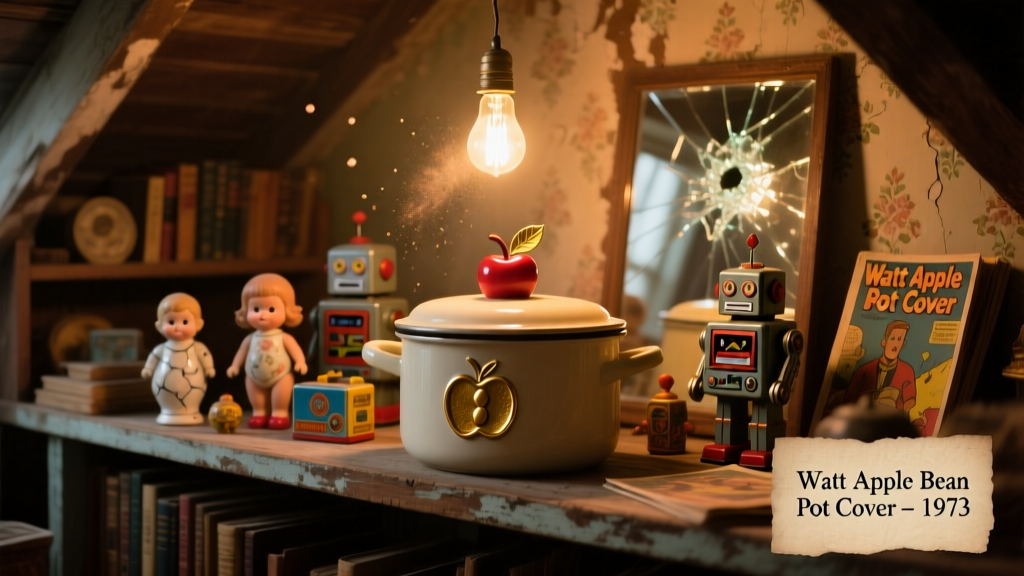
The Watt Apple Bean Pot Cover: A Mid-Century Ceramic Icon from the 1950s Kitchen