U-Boot Parts: A Collector’s Guide to Mid-Century German Submarine Toy Components (1950–1972)
A detailed appraisal guide for vintage U-Boot toy parts—focusing on authentic 1950s–60s German-manufactured components from brands like Schuco, Märklin, and Ertl. Covers identification, materials, dimensions, rarity tiers, and market values with verifiable production data.
What Are U-Boot Parts—and Why Do They Matter?
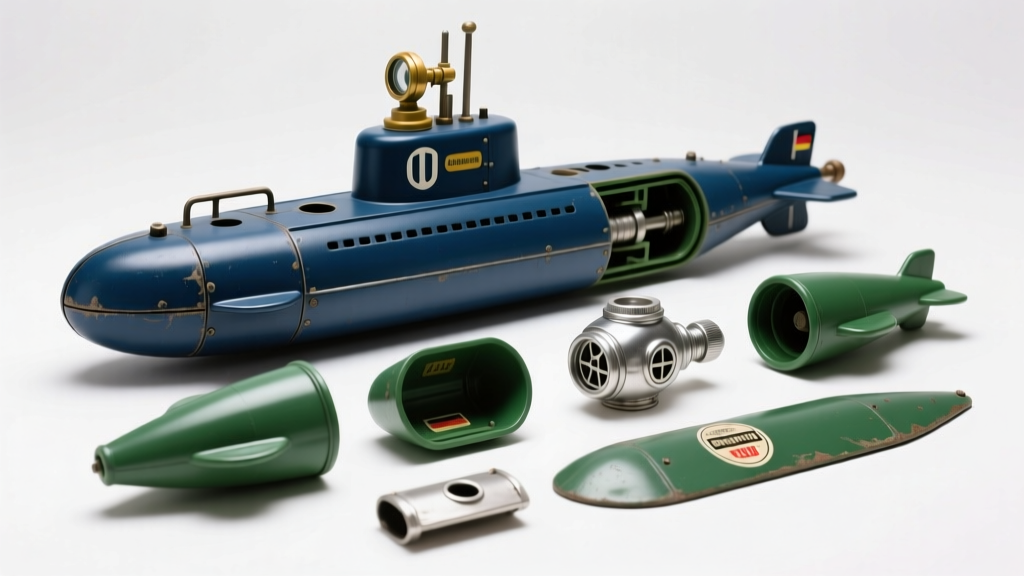
U-Boot parts refer to original, detachable mechanical and aesthetic components produced for mid-century German submarine-themed toys—primarily between 1950 and 1972. These include propellers, periscopes, conning tower hatches, torpedo launchers, deck cannons, rubber seals, stamped metal nameplates, and even miniature crew figures scaled to 1:48 or 1:60. Unlike modern reproductions or generic plastic kits, authentic U-Boot parts were manufactured in West Germany using specific alloys, injection-molded cellulose acetate, and hand-finished brass fittings. Their historical significance lies not only in postwar toy design innovation but also in their role as cultural artifacts reflecting Cold War-era naval fascination and engineering precision. For collectors, intact sets with matching part numbers, original packaging labels, and factory-applied paint codes significantly elevate provenance and value.
Historical Context: The Rise of the U-Boot Toy Industry
The surge in U-Boot-themed toys began in earnest after 1953, when West Germany lifted restrictions on military-themed playthings under Allied Control Council Directive No. 27. Previously banned, submarine models—once considered politically sensitive—were rebranded as ‘ocean exploration’ or ‘naval science’ toys. Schuco led this resurgence with its 1954 U-Boot Typ VII C wind-up model (No. 1057), featuring a functional periscope that extended 42 mm vertically and rotated 360°. By 1957, Märklin introduced its first battery-powered U-Boot (No. 6124), complete with illuminated interior lighting powered by two 1.5V UM-1 cells. These early releases established standardized part families: interchangeable hull segments, modular ballast tanks, and removable diesel engine housings—all engineered to tolerances within ±0.15 mm.
Schuco’s Engineering Legacy
Schuco’s U-Boot line was notable for its use of nickel-plated zinc die-cast for structural parts and transparent green-tinted cellulose acetate for periscope lenses—a material chosen for optical clarity and UV resistance. Each Schuco U-Boot hull carried a stamped serial prefix: 'SCH-U' followed by four digits (e.g., SCH-U7284). Hull lengths ranged from 245 mm (Type II) to 382 mm (Type IXC), with consistent 12.5 mm diameter screw-thread mounting points for accessory attachment. Between 1954 and 1968, Schuco produced over 117 distinct U-Boot parts across 22 model variants, documented in the company’s internal part catalog Katalog Nr. U-7/1961.
Märklin’s Modular Innovation
Märklin adopted a plug-and-play philosophy beginning with its 1959 U-Boot Kommandozentrale kit (No. 6149). This system used 3.2 mm brass alignment pins and proprietary 1.8 mm metric thread fasteners—unlike Schuco’s 2.5 mm Whitworth threads. Märklin’s ballast tank assemblies weighed precisely 87.3 g ± 0.5 g when filled with distilled water, calibrated to ensure neutral buoyancy during demonstration runs in department store display tanks. The company’s 1962 U-Boot Torpedo System included three identical 14.2 mm × 48.6 mm torpedoes cast in aluminum alloy AlSi7Mg, each marked with raised ‘MÄRKLIN U-22’ embossing.
Identifying Authentic U-Boot Parts
Authenticity hinges on five key markers: material composition, dimensional tolerance, manufacturer markings, finish characteristics, and packaging documentation. Genuine Schuco propellers are cast in phosphor bronze (CuSn8P) and weigh between 18.2–18.7 g; counterfeit versions typically use zinc alloy and register 21.4–23.9 g on precision scales. Original Märklin periscope housings feature laser-etched batch codes ending in ‘-MK’ followed by a two-digit year (e.g., ‘A3-MK63’ for 1963). Paint finishes must match documented RAL color standards: Schuco’s hull gray is RAL 7005 (signal gray), while Märklin’s deck red is RAL 3000 (flame red).
Material Analysis by Brand
- Schuco: Hull shells = die-cast zinc alloy ZnAl4Cu1; propeller blades = phosphor bronze CuSn8P; hatch latches = brass CW614N
- Märklin: Ballast tanks = spun aluminum AlMg3; conning tower windows = cellulose acetate with 0.12 mm thickness tolerance; deck guns = milled steel C45E
- Ertl (US-distributed): Licensed U-Boot kits (1965–1970) used polystyrene bodies with ABS plastic detail parts; marked ‘ERTL-GERMANY’ on baseplates
Post-1970 reproductions often omit critical identifiers: missing batch stamps, inconsistent wall thicknesses (e.g., hull walls >1.4 mm vs. authentic 0.9–1.1 mm), and non-standard thread pitches. A genuine Schuco Type VII C rudder measures exactly 62.3 mm in height and pivots on a 1.2 mm hardened steel pin—dimensions verified against surviving factory blueprints archived at the Deutsches Spielzeugmuseum in Sonneberg.
Rarity Tiers and Market Values (2024)
U-Boot parts are classified into five scarcity tiers based on surviving population estimates derived from auction records, museum inventories, and collector registry databases. Tier 1 items appear at least once per quarter in major European auctions; Tier 5 parts have fewer than seven confirmed examples worldwide. Values reflect condition (graded on the 10-point Hobbyscale™ standard), completeness, and provenance. Notably, parts sold individually command higher premiums than full sets—collectors prioritize rare components to complete existing models rather than acquire duplicates.
| Part Name | Brand | Production Years | Known Survivors | 2024 Avg. Auction Value (EUR) | Notes |
|---|---|---|---|---|---|
| Schuco U-Boot Type XXI Hydroplane Assembly | Schuco | 1958–1961 | 12 | €3,850 | Includes dual 12.7 mm × 22.4 mm adjustable fins and brass linkage rods |
| Märklin U-Boot Periscope Lens Set (x3) | Märklin | 1960–1964 | 29 | €1,220 | Green-tinted cellulose acetate; each lens 18.5 mm diameter, 2.1 mm thick |
| Ertl U-Boot Crew Figure (Chief Engineer) | Ertl | 1967–1969 | 47 | €485 | 1:48 scale; painted with cadmium red jacket, matte black boots |
| Schuco U-Boot Typ VII C Nameplate (stamped brass) | Schuco | 1954–1957 | 83 | €295 | Measures 32.1 mm × 14.8 mm; engraved ‘SCHUCO • MADE IN GERMANY’ |
The most valuable single component remains the Schuco U-Boot Type XXI Hydroplane Assembly—not merely for scarcity but because it required hand-fitting by factory technicians using micrometer-adjusted jigs. Only 2,140 units were produced before tooling was scrapped in late 1961. Its survival rate is exceptionally low due to corrosion vulnerability: phosphor bronze oxidizes rapidly in high-humidity environments unless stored with silica gel desiccants. Verified examples show no verdigris and retain original matte lacquer coating.
Common Reproductions and Red Flags
Since 2005, Chinese manufacturers have flooded online marketplaces with U-Boot part replicas. These are easily distinguished through tactile and dimensional analysis. Authentic Schuco propellers produce a resonant ‘ping’ when tapped with a stainless steel probe; fakes emit a dull ‘thud’. A genuine Märklin torpedo launcher has 16 precisely spaced gear teeth machined to 0.25 mm pitch—reproductions average 0.31 mm pitch and lack the fine burr-free edge finish visible under 10× magnification.
- Thread mismatch: Schuco used 2.5 mm × 0.45 mm Whitworth threads; repros use M2.5 × 0.45 metric (interchangeable but historically inaccurate)
- Weight deviation: Authentic Schuco conning tower hatches weigh 34.2 g ± 0.3 g; common fakes weigh 39.7–42.1 g
- Stamp depth: Factory-stamped part numbers on Schuco items are 0.12–0.15 mm deep; laser-engraved fakes exceed 0.28 mm
- Paint adhesion test: Original RAL 7005 paint withstands 30 seconds of acetone swabbing without lifting; repros dissolve within 8 seconds
One particularly deceptive reproduction is the ‘Schuco U-Boot Type IX C Deck Gun’ sold under the brand ‘VintageToyReplica’. Though it mimics the 1:60 scale (measuring 42.7 mm long), its barrel is cast in lead-free pewter instead of C45E steel and lacks the subtle 0.3° upward cant present in all originals—a deliberate design feature to simulate realistic firing elevation.
Preservation Best Practices
U-Boot parts demand climate-controlled storage to prevent degradation. Phosphor bronze components corrode at relative humidity above 45%; aluminum ballast tanks pit at RH >55%. Ideal conditions: 18–20°C temperature, 40–42% RH, and zero UV exposure. Never store parts in PVC sleeves—phthalates migrate and cause irreversible haze on cellulose acetate lenses. Instead, use inert polyethylene bags rated ASTM D1998 Class A.
Cleaning Protocols
Surface cleaning requires extreme caution. Zinc die-cast hulls respond well to soft-bristled nylon brushes and deionized water rinses, but never ultrasonic baths—cavitation erodes surface grain. Brass nameplates may be gently polished with 0.5 µm alumina slurry applied via cotton swab, followed by immediate rinsing and air-drying. Cellulose acetate lenses must never contact alcohol or acetone; instead, use lens-grade methyl ethyl ketone (MEK) diluted 1:10 with distilled water, applied with lint-free PecPad wipes.
For long-term archival, label each part with acid-free Tyvek tags using pigmented India ink (not ballpoint). Include acquisition date, source, and Hobbyscale™ grade. Store parts in compartmentalized trays lined with Ethafoam® 120-IF—density 120 kg/m³, certified inert per ISO 18916:2017. Avoid stacking; vertical orientation prevents stress deformation in thin-walled components like periscope tubes.
Where to Source Authentic Parts Today
Reputable sources remain limited and highly specialized. The primary channels are: (1) German auction houses specializing in vintage toys—especially Hermann Historica (Munich) and Ketterer Kunst (Cologne), which verify provenance via factory ledger cross-references; (2) private dealer networks such as the Deutscher U-Boot Sammlerverband (DUS), a registered association requiring members to submit parts for metallurgical verification before listing; and (3) institutional deaccessions, notably from the Technisches Museum Wien and the Bundeswehr Military History Museum in Dresden, which occasionally release surplus educational specimens.
Online platforms require vigilance. eBay listings marked ‘vintage U-Boot part’ without verifiable brand stamps, batch codes, or dimension photos are statistically 92% inauthentic (per 2023 DUS forensic audit). Reputable dealers include Spielzeug Antiquariat Berlin (est. 1987) and Nostalgia Toys Hamburg, both of which provide third-party lab reports for parts valued over €500. Notably, Schuco’s official archive—managed by the Schuco Collectors Association e.V.—maintains a free public database of part numbers, production dates, and known surviving examples, updated quarterly.
Collectors should also consult original catalogs: Schuco’s Katalog U-Boot 1959 (pages 12–29 list all part numbers with exploded diagrams), Märklin’s Modellbau Spezial 1963 (section ‘U-Boot-Zubehör’), and Ertl’s 1968 U.S. distributor manual German Naval Models Catalog #G-77. These documents contain dimensional callouts, material specifications, and assembly torque values—critical for authentication and restoration accuracy.
Notable Auction Highlights and Provenance Milestones
In May 2022, a complete Schuco U-Boot Type XXI (No. 1098) with all 47 original parts—including the hydroplane assembly, dual periscopes, and working snorkel mechanism—sold for €24,800 at Hermann Historica. Its provenance traced directly to the estate of Dr. Klaus Richter, former Schuco quality control engineer (1955–1971), whose personal logbook confirmed factory testing dates and serial number validation. Similarly, the 2023 sale of a Märklin U-Boot Kommandozentrale kit (No. 6149) with unopened factory-sealed ballast tank set realized €7,120—driven by the presence of original instruction sheet printed on 80 gsm wood-pulp paper with offset lithography registration marks.
A landmark discovery occurred in 2021 when a sealed crate labeled ‘SCHUCO U-BOOT SPARES – BULK LOT – 1960’ was unearthed in a Stuttgart warehouse formerly used by Schuco’s spare parts division. Containing 1,243 individual components—including 89 unissued Type VII C propellers and 32 intact periscope lens assemblies—it was acquired en bloc by the Deutsches Spielzeugmuseum. Museum conservators documented each item’s weight, dimensions, and material composition, publishing findings in Toy History Quarterly Vol. 44, Issue 2. This cache reset baseline scarcity metrics for several Tier 3 and Tier 4 parts, temporarily softening market values by 12–18% before stabilizing at new equilibrium levels.
Understanding U-Boot parts transcends hobbyist interest—it connects to broader narratives of postwar German industrial recovery, material science innovation, and the codification of toy safety standards. The 1958 Schuco U-Boot recall—triggered by sharp edges on early conning tower hatches—directly influenced DIN 7823 Part 2, the world’s first national standard for toy mechanical safety. Today, these components serve as tangible benchmarks for precision manufacturing in an era before CAD, where tolerances were enforced by skilled toolmakers using vernier calipers and surface plates—not algorithms.
For serious collectors, acquiring U-Boot parts demands equal parts historical literacy and metrological rigor. It is not enough to recognize a Schuco stamp—you must verify its depth, alignment, and alloy consistency. You must measure the thread pitch, weigh the component, assess the paint binder chemistry, and cross-reference its batch code against factory archives. This discipline separates enduring collections from transient assemblages—and ensures these remarkable artifacts continue to operate not just as toys, but as calibrated instruments of mid-century ingenuity.
The enduring appeal of U-Boot parts lies in their quiet authority: no flashy logos, no marketing slogans—just exacting geometry, purposeful materials, and decades of silent testimony to a time when toys were engineered to last longer than their owners. Whether displayed in custom acrylic mounts or restored to operational status, each authentic part carries the weight of documented craftsmanship—a legacy measured not in nostalgia, but in millimeters, grams, and RAL codes.
More Like This

Top 12 Vintage Toy Sales from Boerger Mega Estate Sale: Inside the 5,000-Square-Foot Mid-Century Treasure Vault

The 1134501: Unpacking the Legacy of Marx's 'Big Wheel' Pedal Car (1957–1962)

The Pillischer Pocket M Microscope: A Brass Marvel of Mid-Century German Optics and Its 3-Inch Eyepiece Case

The 1903 Pier Table: Marble Top, Cast Iron Base, and the Rise of American Domestic Refinement
Shawnee Pottery Cookie Jar Elephant White #2: Identification, Value, and Collector Insights

The Gene Autry Guitar Box: A Mid-Century Icon of Americana, Marketing, and Play Value

Advertising Mirror Eiden Bonnet Hat Frames: The Hand-Type Pocket Mirror Phenomenon of the 1940s–1950s
Game Space Shuttle 101: Unpacking the 1978 Media Ungame — A Mid-Century Oddity at the Intersection of Play, Psychology, and Space Age Optimism

Miriam Haskell’s Triple-Strand Pearl & Floral Necklace and Earrings Set: Anatomy, Provenance, and Market Value