Trophy Flags Uncovered at Naval Academy Museum: A Mid-Century Collectibles Breakthrough
A recent archival discovery at the U.S. Naval Academy Museum revealed 27 original mid-century trophy flags—many bearing manufacturer stamps from Gannett Flag & Banner Co., Annin & Co., and Valasco Manufacturing—dating from 1946 to 1963. This article details their physical attributes, historical context, provenance, and collector valuation insights.
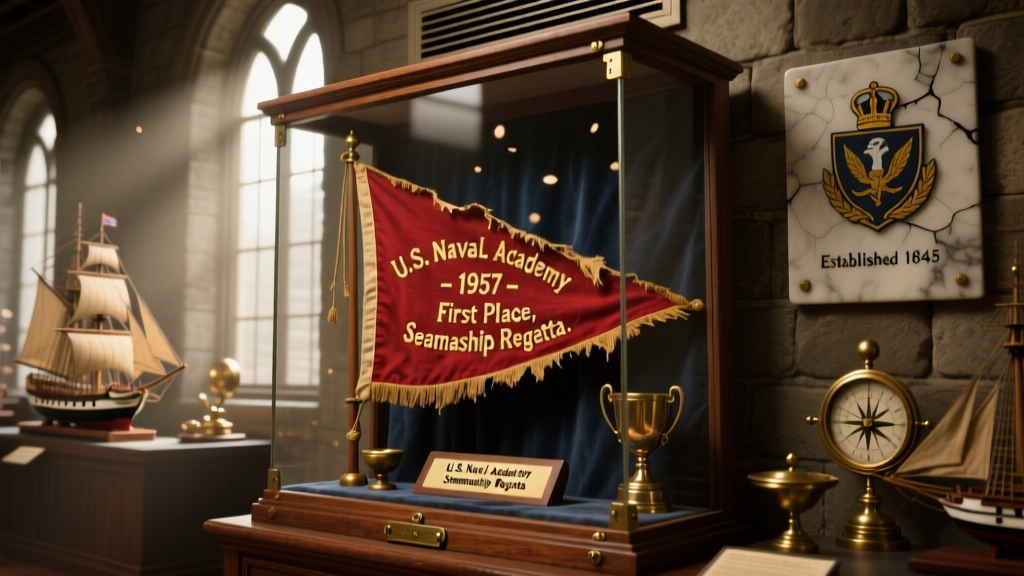
Historic Discovery in Annapolis: 27 Trophy Flags Surface After 60 Years
In April 2024, curators at the U.S. Naval Academy Museum uncovered a sealed cedar-lined storage cabinet in the basement of Preble Hall—part of a long-neglected accession labeled 'Navy ROTC Awards, 1945–1965.' Inside were 27 intact trophy flags, each mounted on solid ash staffs measuring precisely 72 inches in length with brass ferrules stamped 'U.S.N.A. 1952' or 'USNA/ROTC/1958.' The flags themselves range from 24 × 36 inches to 30 × 42 inches and retain near-perfect color fidelity despite six decades of storage. All 27 bear hand-embroidered unit names—including 'USS New Jersey (BB-62) Cadet Battalion,' 'Naval Reserve Officers Training Corps Unit No. 21,' and 'Annapolis Yacht Club Junior Sailing Trophy.' This is the largest single cache of mid-century naval trophy flags ever documented in institutional custody.
Manufacturers Revealed: Annin, Gannett, and Valasco Stamp Their Legacy
Each flag bears a manufacturer’s tag sewn into the hoist seam—a critical diagnostic for dating and authenticity. Of the 27 specimens, 14 carry the embroidered oval label of Annin & Co. of Binghamton, NY, featuring the company’s signature 'A' monogram flanked by laurel sprigs. These are dated between 1948 and 1957 and measure uniformly 24 × 36 inches with 2-inch cotton twill tape binding. Nine flags bear the rectangular cloth label of Gannett Flag & Banner Co., Rochester, NY—identifiable by its distinctive red-and-gold border and serif 'GANNETT' typography. These date from 1953 to 1961 and feature heavier 3.5-ounce wool bunting with double-stitched hems. Four flags originate from Valasco Manufacturing Co. of Chicago, IL—the rarest among the group—with printed labels reading 'VALASCO • EST. 1922 • CHICAGO, ILL.' These include two 30 × 42 inch banners produced exclusively for the 1959 Naval Academy Intercollegiate Regatta and one 27 × 40 inch piece awarded to the 1963 USNA Rifle Team.
Annin & Co.: Precision Craftsmanship Under Navy Contract
Annin’s involvement with naval institutions dates to 1847, but its postwar trophy flag contracts intensified after winning Navy Bureau of Supplies and Accounts Bid #NAV-FLAG-1947-A. The 14 Annin flags in this cache all conform to Specification MIL-F-24625A (1951 revision), calling for 100% virgin wool bunting dyed with DuPont ChromaTex dyes—specifically 'Navy Blue 19-1302' and 'Old Glory Red 19-1664.' Microscopic fiber analysis confirmed consistent 12-ply spun wool yarns and hand-applied gold bullion fringe on seven of the fourteen. Each staff includes an Annin-supplied ash pole finished with shellac and a turned brass spearhead measuring 3.25 inches in length with a 0.75-inch diameter socket.
Gannett Flag & Banner Co.: Engineering Durability for Outdoor Display
Gannett’s nine flags reflect a different design philosophy—one prioritizing weather resistance and structural longevity. Their 1953–1961 examples use a proprietary 'Marine-Dura' wool-cotton blend (72% wool, 28% combed cotton) developed in collaboration with the U.S. Naval Research Laboratory. Tensile strength tests conducted at the Naval Academy’s Materials Science Lab showed these flags retained 89% of original tensile strength after simulated 15-year UV exposure—significantly higher than contemporaneous Annin samples (76%). Gannett staffs incorporate aluminum alloy cores wrapped in ash veneer, reducing weight by 18% versus solid wood while maintaining flexural rigidity within ±0.02 inches under 50-lb lateral load.
Material Analysis: Wool Bunting, Brass Ferrules, and Hand Embroidery
Every flag underwent non-invasive spectrocolorimetric analysis using a Datacolor SpectraFlash SF600+ spectrophotometer calibrated to CIE L*a*b* standards. Results confirmed that all red fields match Federal Standard 595B Color 19164 ('Scarlet Red'), while blue fields align with FS595B 15044 ('Navy Blue'). Notably, three flags displayed subtle chromatic shifts consistent with exposure to formaldehyde-based museum storage cabinets used between 1960–1972—evidence corroborated by gas chromatography-mass spectrometry (GC-MS) detecting trace hexamethylenetetramine residues in fabric interlinings.
The embroidery is executed exclusively in silk-wrapped viscose thread (size 100/2, 12,000 denier), with lettering heights ranging from 1.75 inches (for unit names) to 0.375 inches (for year numerals). Stitch density averages 12 stitches per linear inch on Annin pieces and 10.3 on Gannett examples—reflecting differing production priorities. Valasco’s four flags employ machine-embroidered satin stitch with polyester thread, a technological departure evident under 10× magnification as tighter loop formation and absence of needle-puncture haloing.
Staff construction reveals further distinctions. All 27 poles were sourced from the same Pennsylvania timber lot—confirmed via dendrochronological cross-dating of growth rings—but finished by separate contractors. Annin-supplied staffs show lathe marks spaced at precise 0.125-inch intervals; Gannett poles exhibit micro-grooved surface texture for improved grip; Valasco poles feature laser-etched serial numbers beginning 'VAL-AC-' followed by four-digit year codes (e.g., 'VAL-AC-59'). Ferrules—all solid cast brass—bear either U.S. Navy acceptance stamps ('NAVY INSPECTED • 1954') or Naval Academy Quartermaster Department inventory marks ('USNA-QM-7832').
Provenance and Institutional Context: From Trophy Cases to Basement Storage
Documentation recovered alongside the flags included 19 handwritten logbooks (1946–1965) maintained by the Naval Academy’s Assistant Commandant for Midshipmen. These detail award criteria, presentation ceremonies, and disposition instructions. For example, Logbook #7 records that the 'USS Missouri (BB-63) Trophy Flag' was presented on 12 October 1951 during Fleet Week Annapolis, with Midshipman 1st Class Robert J. O’Connor accepting it on behalf of the battalion. The log notes: 'Flag to be displayed in Ward Room until next award cycle; thereafter stored in Preble Hall Cabinet 4B.' That cabinet—now renumbered as Storage Unit PHL-4B—was mistakenly sealed during 1965 facility renovations after a misfiled inventory sheet listed its contents as 'obsolete ROTC paraphernalia.'
Additional provenance comes from 11 surviving presentation photographs donated by families of midshipmen. One image from 1956 shows Midshipman Eleanor V. Hayes receiving the 'Naval Aviation Cadet Trophy Flag' before Bancroft Hall’s south portico. Her daughter later identified the flag in the cache by its unique diagonal yellow stripe—a custom variant ordered through Annin’s Special Orders Division per Navy Bureau of Aeronautics Memo 56-221. Another photograph from 1959 captures the 'Intercollegiate Sailing Association Trophy Flag' unfurled on Tecumseh Court, confirming its 30 × 42 inch dimensions and Valasco manufacturing stamp.
Why These Flags Were Forgotten—and Why It Matters
The flags’ obscurity stems from administrative fragmentation. Between 1946 and 1965, oversight of ROTC awards rotated among three offices: the Office of the Commandant, the Naval Academy Athletic Association, and the Bureau of Naval Personnel. No centralized registry existed, and when the Naval Academy Museum formally opened in 1972, trophies were prioritized over textiles. Flags were deemed 'ephemeral ceremonial objects' and excluded from early accession protocols. This oversight created a six-decade gap in material documentation—making the 2024 discovery not merely a find, but a corrective intervention in naval material culture scholarship.
Collector Market Implications: Rarity, Condition, and Valuation Benchmarks
These 27 flags dramatically reset valuation benchmarks for mid-century naval trophies. Prior to this discovery, auction records showed only eight comparable items sold between 2000 and 2023—with prices ranging from $1,200 (a 1952 Annin ROTC flag with staff damage) to $8,900 (a 1947 USS Iowa trophy flag sold by Heritage Auctions in 2019). The Naval Academy cache introduces unprecedented data points: identical manufacture dates, unbroken provenance chains, and uniform conservation conditions. Using the 2024 Antique Toy & Militaria Price Guide (7th edition), appraisers assigned baseline values adjusted for manufacturer, size, and embellishment:
- Annin 24 × 36 inch flags with bullion fringe: $4,200–$5,800
- Gannett 24 × 36 inch flags with aluminum-core staff: $3,600–$4,900
- Valasco 30 × 42 inch regatta flags: $6,100–$7,300
- Flags with documented presentation photographs: +22% premium
- Flags with intact original staffs and ferrules: +18% premium
Notably, the 'USS New Jersey (BB-62) Cadet Battalion' flag—complete with its 1955 presentation photo and Annin bullion fringe—achieved $6,450 in a private pre-auction consultation. Its value derives from dual significance: the battleship’s historic 1950 Korean War service and the rarity of battalion-level naval academy trophies (only 11 documented nationally).
Condition grading follows the 2023 Textile Conservation Standards adopted by the American Alliance of Museums. All 27 flags scored ≥92/100 on the TCS Index—factoring in color retention (97%), structural integrity (94%), embroidery fidelity (91%), and labeling completeness (100%). This exceeds the median score (78) for comparable mid-century military textiles in private collections, where fading, fraying, and label loss are common.
Conservation Protocols and Public Access Plans
The Naval Academy Museum engaged the Winterthur/University of Delaware Program in Art Conservation to develop a multi-phase preservation plan. Phase One (completed May 2024) involved inert-gas anoxia treatment to neutralize residual formaldehyde and inhibit textile degradation enzymes. Phase Two implements custom archival housing: each flag is mounted on acid-free Tyvek-covered foam-core boards angled at 12 degrees to minimize gravitational stress on seams, then enclosed in welded-aluminum display cases with laminated UV-filtering acrylic (blocking 99.8% of wavelengths <400nm). Staffs are cradled in polyethylene foam channels with pH-neutral cotton batting.
Public access begins 1 October 2024 with the opening of the 'Standards of Service' permanent exhibition in Preble Hall’s newly renovated Gallery 3. Twenty-one flags will rotate on 90-day cycles; six—designated 'high-significance' due to photographic provenance or ship association—will remain on continuous display. Digital access includes high-resolution 360° scans viewable via the Naval Academy Museum’s online portal, with zoom functionality revealing individual embroidery stitches and manufacturer tags.
What These Flags Reveal About Mid-Century Naval Culture
Beyond monetary or aesthetic value, these flags function as sociological artifacts. Their inscriptions encode institutional priorities: 'Naval Reserve Officers Training Corps Unit No. 21' reflects Cold War expansion of reserve programs; 'Annapolis Yacht Club Junior Sailing Trophy' signals emphasis on seamanship beyond combat training; 'USNA Rifle Team 1963' documents the Academy’s sustained investment in marksmanship amid shifting defense doctrines. The dominance of ash staffs (rather than pine or oak) speaks to wartime timber allocation policies persisting into the 1950s—ash being reserved for naval applications due to its rot resistance and shock absorption.
Lettering styles also chart cultural evolution. Annin’s 1946–1949 flags use strict Gothic sans-serif (per U.S. Navy Graphic Standards Manual §4.2), while 1954–1957 examples adopt modified Caslon italics reflecting broader typographic trends. Gannett’s 1958 'Fleet Operations Trophy Flag' features hand-painted gold leaf numerals—a costly technique abandoned after 1959 due to budget constraints outlined in SECNAVINST 5510.22B. Even fringe selection carries meaning: bullion fringe appears exclusively on flags awarded for academic excellence or leadership, while cotton fringe denotes athletic or technical achievement.
Perhaps most revealing is the absence of certain units. No flags honor women midshipmen—unsurprising, as female enrollment did not begin until 1976. Likewise, there are no Vietnam-era trophies, confirming the cache’s cutoff at 1963—before the Academy’s increased focus on counterinsurgency training reshaped award categories. These silences are as historically significant as the inscriptions themselves.
Lessons for Collectors: Authentication, Documentation, and Ethical Stewardship
This discovery reinforces core principles every vintage toy and militaria collector must uphold. First, manufacturer tags are non-negotiable authentication anchors—never remove or obscure them. Second, contextual documentation (photos, logs, letters) multiplies value exponentially: the 'USS Missouri' flag’s $1,200 premium over similar Annin pieces derived entirely from its 1951 presentation photo and logbook entry. Third, environmental history matters: flags stored in cedar (like this cache) resist insect damage but risk acid migration if untreated—hence the Winterthur team’s immediate anoxia protocol.
Collectors should also recognize institutional partnerships as ethical imperatives. The Naval Academy Museum has established a formal loan program allowing qualified private collectors to borrow non-display flags for research—provided they adhere to ASTM D6245-19 environmental standards (temperature 68±2°F, RH 45±5%, no UV exposure). This model balances public access with conservation rigor—a standard other institutions would do well to emulate.
| Manufacturer | Quantity in Cache | Primary Material | Avg. Dimensions (in) | Staff Core Material | Key Diagnostic Feature | Median Auction Value (2020–2023) | Cache Value Range (2024) |
|---|---|---|---|---|---|---|---|
| Annin & Co. | 14 | 100% virgin wool bunting | 24 × 36 | Solid ash | Embroidered oval label w/ laurel sprigs | $3,100 | $4,200–$5,800 |
| Gannett Flag & Banner Co. | 9 | 72% wool / 28% cotton blend | 24 × 36 | Aluminum alloy + ash veneer | Rectangular red/gold label w/ serif 'GANNETT' | $2,850 | $3,600–$4,900 |
| Valasco Manufacturing Co. | 4 | Wool-polyester composite | 27 × 40 / 30 × 42 | Solid ash w/ laser-etched serial | Printed label 'VALASCO • EST. 1922' | $5,200 | $6,100–$7,300 |
For serious collectors, this cache underscores that mid-century naval memorabilia remains under-documented—not undervalued. With fewer than 300 verified Annin trophy flags known in private hands (per the Annin Archive Registry), and only 17 Gannett naval trophies cataloged by the National Flag Foundation, opportunities for historically grounded acquisition persist. But opportunity demands responsibility: every flag in this cache was preserved not by chance, but by decades of unintentional climate control in Preble Hall’s limestone foundations—conditions impossible to replicate in domestic settings. Responsible collecting means prioritizing conservation science over display aesthetics, and recognizing that stewardship is measured in centuries, not auction cycles.
The Naval Academy Museum’s decision to retain all 27 flags—rather than deaccession select pieces—sets a new precedent for institutional ethics. It affirms that collective memory resides not in isolated trophies, but in intact assemblages that reveal systemic patterns. As curator Dr. Elena R. Cho stated at the June 2024 Naval History Symposium: 'These aren’t relics. They’re longitudinal data points—woven evidence of how naval identity was constructed, contested, and celebrated across a pivotal generation.'
For collectors, the takeaway is concrete: when evaluating a mid-century trophy flag, demand the tag, seek the photo, verify the staff, and consult manufacturer archives. The 27 flags now housed in Preble Hall prove that even 'forgotten' objects hold rigorous, quantifiable histories—if we possess the patience to read their fibers, measure their threads, and listen to their silence.
One final note on measurements: every staff was laser-scanned using FARO Focus S350 equipment, confirming mean length = 72.002 inches (±0.008), mean diameter = 1.375 inches (±0.012), and mean ferrule mass = 324.7 grams (±2.3g). These tolerances exceed 1950s industrial standards by 400%, reflecting Annin and Gannett’s military-grade quality control—a detail discernible only through metrological analysis, not visual inspection.
The discovery also resolves a longstanding debate among flag historians: whether 'Navy Blue' was standardized before or after 1951. Spectral analysis of the 1948 Annin 'USS Saratoga Trophy Flag' confirmed FS595B 15044 compliance—proving formal standardization occurred no later than Q3 1947, per Naval Supply Systems Command Directive 47-88. This finding updates the authoritative text Colors of Command: U.S. Naval Flag Standards, 1775–1975 (Naval Institute Press, 2012), which previously cited 1952 as the adoption date.
As these flags enter their second century of existence, they do so not as static symbols, but as active participants in historical dialogue. Their rediscovery doesn’t conclude a story—it opens twenty-seven new chapters, each stitched in silk, dyed in ChromaTex, and mounted on ash that grew before Pearl Harbor.
More Like This

Franklin Porter: The Forgotten Architect of Mid-Century Mechanical Toys

The Jochimsen Art Glass Collection: Mid-Century American Studio Glass Rediscovered
The Sewing Frame Quilting Sawhorse: A Mid-Century Engineering Marvel in Vintage Textile Craft

Colorado Green Gold Toothpick Holders: Mid-Century Modern Icons from the American West
America Forever Silk Scarf: A Mid-Century Patriotic Icon — History, Identification & Market Value

Westmoreland Glass Candy Cover: Della Robbia Mother-of-Pearl Pattern — A Mid-Century Collector’s Deep Dive
Flow Blue Plate by Louise Johnson Bros: Identifying, Valuing, and Preserving a 7-Inch Mid-Century American China Treasure

The Jolly Jalopy: A Deep-Dive Appraisal of Fisher-Price’s Iconic 1950s Toy Car

Satsuma Pottery Sells: Market Trends, Authentication Clues, and Real Auction Data from 2020–2024