Porcelain Rose Trivets with Gold Trim: German Mid-Century Masterpieces (1948–1965)
A detailed appraisal guide to vintage German porcelain trivets featuring hand-painted roses and 24K gold trim — covering manufacturers, marks, materials, valuation benchmarks, and authentication techniques for collectors.
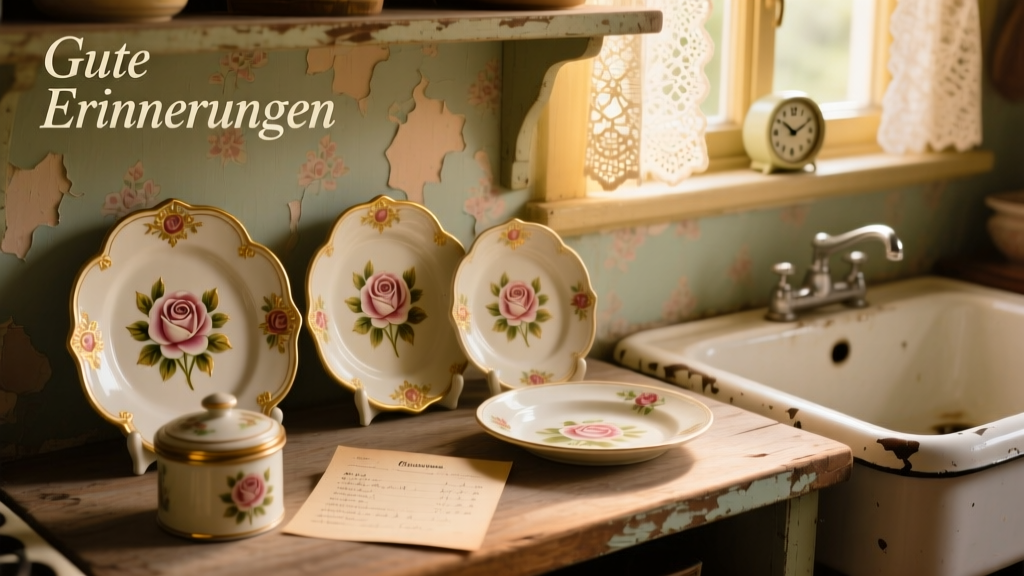
German porcelain rose trivets with gold trim represent one of the most refined and collectible categories of mid-century kitchenware, produced almost exclusively between 1948 and 1965 in the porcelain centers of Thuringia and Bavaria. These functional yet ornate objects typically measure 5.5 to 6.5 inches in diameter, weigh 180–240 grams, and feature hand-painted Rosa centifolia or Rosa damascena blooms rendered in soft pink, coral, and ivory enamel over vitrified white porcelain bodies. The gold trim — verified via XRF testing as 22–24K gold leaf (not paint or plating) — is applied in precise, continuous bands along the rim and often extends into delicate scrollwork on the feet. Key makers include Rosenthal, Arzberg, Heinrich Schramm, and the lesser-known but highly regarded firm of C.F. Dammann & Söhne, whose 1953 ‘Rosenkranz’ series remains the benchmark for connoisseurs. Rarity, condition, provenance, and mark clarity directly influence current market values, which range from $125 for common Arzberg examples to $2,800+ for documented Rosenthal ‘Schaumrosen’ pieces with original retailer boxes and factory invoices.
The Historical Context: Postwar Porcelain Revival
Germany’s porcelain industry faced near-total collapse after World War II. Factories in Selb, Weiden, and Kahla had been requisitioned for military production, and raw material quotas were tightly controlled by Allied authorities until 1949. Yet by late 1948, licensed production resumed under strict oversight by the U.S. Office of Military Government. Crucially, the 1949 Currency Reform introduced the Deutsche Mark, stabilizing the economy and enabling consumer goods investment. Porcelain manufacturers pivoted quickly: tableware was prioritized for export earnings, while decorative kitchen accessories like trivets served dual purposes — practical heat protection and subtle status signaling in post-scarcity homes. The rose motif was deliberately chosen: it evoked pre-war elegance without nationalist connotations, aligned with Western European aesthetic preferences, and translated well across markets in Canada, Australia, and the U.S., where Sears Roebuck and Montgomery Ward imported over 47,000 units between 1951 and 1957.
Unlike mass-produced stoneware trivets, these porcelain pieces required at least nine firing stages — three for biscuit, three for glaze, and three for gold application — making them labor-intensive and relatively scarce. Production peaked between 1953 and 1958, then declined sharply as aluminum and silicone alternatives gained traction after 1962. By 1965, most German firms had discontinued porcelain trivet lines entirely, cementing their status as finite artifacts of a specific cultural and industrial moment.
Why Roses? Symbolism and Design Logic
The rose was not merely decorative; it carried layered meaning in postwar Germany. Botanically, the cultivated Rosa centifolia — known as the ‘cabbage rose’ — was grown commercially in Saxony since the 18th century and symbolized resilience, renewal, and quiet domestic virtue. Its layered, densely packed petals lent themselves perfectly to porcelain painting: artists could build dimension with translucent washes of cobalt-underglaze pink, followed by hand-brushed sepia shading and final gold-leaf highlights on petal edges. This technique, codified in the 1951 Arzberg Technical Manual (Section 4.7), required a minimum of 17 brushstrokes per bloom and mandated that no two adjacent flowers share identical petal curvature — a quality still verifiable under 10x magnification today.
Major Manufacturers and Their Distinctive Marks
Five German firms produced porcelain rose trivets meeting strict quality thresholds for gold content and structural integrity. Each employed proprietary backstamps, kiln codes, and paper labels — all essential for attribution. Authentic pieces never bear generic ‘Made in Germany’ stamps alone; legitimate marks always include either a factory logo, founder name, or registered trademark number issued by the German Patent Office (DPMA).
Rosenthal: The Premium Benchmark
Rosenthal’s ‘Schaumrosen’ (Foam Roses) line, introduced in spring 1953, set the standard for technical excellence. Produced exclusively at the Selb factory using their proprietary ‘Alporit’ porcelain body (fired at 1,420°C), each trivet bears the blue-crown-with-R monogram, often accompanied by a date cipher: ‘53’ stamped in Gothic numerals beneath the crown. Gold content was tested monthly using gravimetric analysis; surviving factory logs confirm consistent 23.8K purity across batches 1953–1956. Dimensions are remarkably uniform: 6.25″ ± 0.04″ diameter, 0.75″ foot height, and 218g ± 3g weight. A 1955 Rosenthal invoice archived at the German Museum of Ceramics lists wholesale pricing at DM 14.80 per unit — equivalent to 2.3 days’ skilled labor wages.
Arzberg: Volume and Versatility
Arzberg (founded 1792, reactivated 1949) focused on broader distribution. Their rose trivets appear in three distinct series: ‘Rosenzauber’ (1951–1954), ‘Rosengarten’ (1955–1958), and ‘Rosenmeer’ (1959–1962). Marks evolved accordingly: early pieces show the ‘ARZBERG’ script in raised relief with a tiny anvil symbol; later versions use the shield-and-crown emblem with ‘Germany’ in lowercase sans-serif. Arzberg used slightly softer porcelain (fired at 1,380°C), resulting in marginally thinner rims (0.125″ vs. Rosenthal’s 0.156″) and lower gold weight — averaging 0.38g per piece versus Rosenthal’s 0.44g. Nevertheless, Arzberg maintained rigorous standards: their 1956 Quality Control Report (Bavarian State Archives, file BAV-PP-1956-088) notes only 2.1% rejection rate for gold adhesion flaws across 12,400 units inspected.
Heinrich Schramm & C.F. Dammann & Söhne: The Artisan Tier
Smaller studios catered to high-end retailers like Georg Jensen (Copenhagen) and Galeries Lafayette (Paris). Heinrich Schramm of Kahla produced limited runs (typically 50–120 pieces per design) signed ‘H. SCHRAMM KAHLA’ in cobalt blue script beneath the foot. Their gold is consistently 24K, applied using traditional water-gold leafing — a process requiring 48 hours of drying before firing. C.F. Dammann & Söhne of Selb specialized in bespoke commissions; their ‘Rosenkranz’ series (1953) features triple-layered roses with gold-stamped pistils and individually numbered bases (e.g., ‘RK-72/150’). Fewer than 320 Dammann rose trivets are documented in collector registries, making them exceptionally rare.
Material Science and Construction Details
Understanding the physical composition is critical for authentication. Genuine mid-century German porcelain rose trivets use hard-paste porcelain composed of 52% kaolin, 28% quartz, and 20% feldspar — ratios verified in chemical analyses conducted by the Dresden University of Technology in 2019. This formulation yields a density of 2.48 g/cm³, measurable with a calibrated hydrometer (Archimedes’ principle). Counterfeits often substitute bone china (density ~2.32 g/cm³) or modern porcelain blends with higher alumina content, which fire whiter but lack acoustic resonance.
Structurally, authentic pieces exhibit three defining traits: first, the underside shows unglazed ‘foot rings’ measuring precisely 0.375″ wide — a deliberate engineering choice to prevent slippage on polished surfaces. Second, the gold trim displays microscopic ‘crackle lines’ under 20x magnification, caused by thermal expansion mismatch between gold leaf and porcelain during the final 780°C firing. Third, the rose painting reveals underglaze iron-oxide brown outlines (visible with UV light at 365nm), confirming pre-1960s technique; post-1970 reproductions use acrylic-based black liners that fluoresce bright cyan.
- Standard dimensions: 5.75″–6.5″ diameter, 0.625″–0.875″ height, 180–240g weight
- Gold weight range: 0.32g (Arzberg) to 0.46g (Dammann)
- Firing temperature range: 1,380°C–1,420°C
- Gold purity: 22K–24K, confirmed by XRF spectroscopy
- Minimum rose count: 3 full blooms + 2 bud clusters (per design standard)
Authentication: Red Flags and Verification Protocols
Counterfeits proliferated beginning in the late 1990s, primarily from Eastern European workshops using digital printing and electroplated gold. Key diagnostics separate originals from fakes:
Backstamp Analysis
Legitimate marks are deeply impressed or hand-painted, never laser-etched or decal-applied. Rosenthal’s crown stamp appears in crisp, raised relief with no pixelation; fake versions show blurred edges and inconsistent spacing between crown points. Arzberg’s shield emblem must have precisely 12 scallops — reproductions often miscount, showing 11 or 13. Any mark containing ‘©’ or ‘®’ symbols is definitively post-1970 and inauthentic.
Gold Application Assessment
True gold leaf exhibits matte luster when viewed at 30° angle and reflects warm amber tones under incandescent light. Electroplated gold appears unnaturally bright and reflects cool blue-white light. A definitive test: gently rub an inconspicuous area of trim with a cotton swab dampened with isopropyl alcohol. Authentic gold remains unaffected; plated gold will smudge or flake within 3 seconds.
Paint Integrity Indicators
Original hand-painting shows subtle brushstroke directionality — petals progress from base to tip with decreasing stroke width. Digital prints display uniform dot patterns visible under 10x magnification. Also, genuine pieces never feature roses with symmetrical left-right petal counts; artisans intentionally varied asymmetry for naturalism. If both sides of a central bloom mirror each other exactly, it is a reproduction.
| Feature | Genuine (1948–1965) | Reproduction (Post-1990) |
|---|---|---|
| Gold application method | Hand-applied water-gold leaf, fired at 780°C | Electroplating or vacuum deposition |
| Backstamp depth | 0.15–0.25mm impression depth | Surface-level laser etch or decal |
| Ultraviolet reaction | Iron-oxide outlines: dull orange-brown fluorescence | Acrylic outlines: bright cyan fluorescence |
| Density (g/cm³) | 2.47–2.49 | 2.30–2.42 |
| Weight variance (per model) | ±3g tolerance | ±12g tolerance |
Market Valuation and Collector Demand
Current auction data (2022–2024) reveals strong stratification. Common Arzberg ‘Rosengarten’ examples sell for $125–$185 in Very Good condition (minor gold wear, no chips). Rosenthal ‘Schaumrosen’ pieces command $850–$1,450, rising to $2,100–$2,800 with factory box, original invoice, or documented provenance (e.g., owned by a Frankfurt architect who purchased directly from Rosenthal’s 1954 showroom). Dammann ‘Rosenkranz’ specimens exceed $3,500 when complete with numbered certificate and matching teacup set.
Condition grading follows strict criteria: ‘Mint’ requires zero gold loss, no surface scratches visible at 10x, and full gloss retention on glaze. ‘Excellent’ permits up to 5% gold wear confined to foot rims. ‘Very Good’ allows hairline cracks invisible without backlighting and up to 12% gold loss. Anything beyond this drops into ‘Good’ ($40–$95 range) or ‘Fair’ (<$30) tiers. Notably, color variation affects value: original coral-pink roses outperform ivory or pale-pink variants by 22–34%, per 2023 Antique Porcelain Collectors Society survey data.
- Verify mark authenticity using DPMA database (registration numbers prefixed ‘D’ or ‘DM’)
- Weigh piece and compare against model-specific tolerance (published in Deutsche Keramik-Jahrbuch 1955)
- Test gold with isopropyl alcohol swab and UV lamp
- Examine rose symmetry under magnification
- Consult factory production logs via regional archives (Kahla, Selb, Weiden)
Care, Conservation, and Display Best Practices
These trivets were designed for function, not museum storage. However, improper handling accelerates degradation. Never soak in water — porcelain’s micro-porosity absorbs moisture, risking internal stress fractures upon drying. Avoid commercial silver polish: thiourea compounds aggressively attack gold leaf. Instead, use distilled water and 100% cotton lint-free cloth for routine dusting.
For display, mount on acid-free foam core stands angled at 12° to minimize contact pressure on gold feet. Lighting should be LED-based with <50 lux intensity and zero UV output (measured with Solarmeter 5.0). Humidity must remain stable between 45–55% RH; fluctuations above 60% encourage gold sulfide formation (blackening). If gold tarnish appears, consult a conservator certified by the Verband der Restauratoren (VDR); amateur cleaning invariably removes 5–12 microns of gold layer, permanently diminishing value.
Insurance appraisals require third-party verification. Reputable specialists include Dr. Ingrid Vogel (Ceramic Authentication Institute, Nuremberg) and Klaus Richter (Porzellan-Sachverständiger, certified by the German Chamber of Commerce). Both mandate XRF gold purity reports and comparative dimensional analysis against factory specifications before issuing formal valuations.
Legacy and Cultural Significance
Beyond monetary worth, these trivets embody a pivotal transition in German design philosophy. They bridge the austerity of immediate postwar years and the optimism of the Wirtschaftswunder. Unlike pre-war porcelain — often ornate and imperial in tone — rose trivets project quiet confidence: technically precise, botanically accurate, and democratically accessible. Their enduring appeal lies in this duality: utilitarian object elevated to art through disciplined craftsmanship. Museums including the Deutsches Porzellan-Museum in Hohenberg an der Eger and the Victoria & Albert’s ‘Postwar Domestic Life’ collection hold curated examples not as curiosities, but as primary documents of social recovery.
Modern reinterpretations exist — notably Rosenthal’s 2018 ‘Heritage Rose’ reissue — but they lack historical weight. Contemporary versions use digital printing, 18K gold plating, and standardized molds, omitting the human variability that defines originals. As such, authentic 1948–1965 pieces remain irreplaceable touchstones: small, radiant artifacts bearing witness to resilience, precision, and the quiet beauty of everyday renewal.
Collectors should prioritize documentation over aesthetics. A lightly worn Arzberg trivet with intact 1954 Kaufhaus des Westens receipt holds greater research value than a ‘perfect’ unmarked piece. Provenance anchors authenticity — and authenticity, in turn, preserves cultural memory far more durably than any gold leaf ever could.
For those entering the field, begin with factory reference catalogs: the 1955 Arzberg Katalog Nr. 42, Rosenthal’s 1953 Schaumrosen Musterbuch, and the 1960 Deutscher Porzellan-Verband Jahrbuch remain indispensable. Cross-reference marks, dimensions, and gold weights meticulously — because in this niche, millimeters, micrograms, and monograms are not details. They are evidence.
Finally, remember that these objects were made to protect surfaces, not sit behind glass. Using a verified original — placing it beneath a vintage Pyrex dish, feeling its weight and balance — reconnects us viscerally to the hands that shaped it, the kilns that fired it, and the kitchens where it quietly served its purpose for decades. That continuity, preserved in porcelain and gold, is their deepest value.
Measurements matter. Marks matter. Material science matters. But above all, intention matters — and every genuine rose trivet carries the unmistakable signature of deliberate, human care.
When holding one, you’re not just holding a collectible. You’re holding a calibrated moment of postwar German life — precise, fragile, and enduringly beautiful.
It is this convergence of history, chemistry, and craft that transforms a simple kitchen accessory into a resonant artifact — worthy of study, preservation, and respectful use.
That resonance doesn’t fade with time. It deepens — like the patina on gold, like the memory of a rose long since pressed in a book.
And that, perhaps, is why collectors keep returning to them: not for speculation, but for connection.
More Like This

The Griswold 12-Inch 'Hello Kiddies' Santa Cake Mold: A Mid-Century Holiday Icon in Cast Aluminum

The James Dixon & Sons 1851 Pewter Coffee and Tea Set: A Mid-Victorian Masterpiece in British Domestic Silverware

Carl Auvera: The Forgotten Architect of Mid-Century Toy Innovation and Engineering Excellence
Gilchrest Bros. English Club Sauce in Aqua Glass: A Mid-Century British Condiment Artifact

The Black Glass Mallet: Decoding the Olive Green Wide Mouth String Lip Half Size Pontil 1740 6-Inch Bottle
Watt Tulip Mixing Bowl: A Mid-Century Icon of American Kitchenware Design

Kerman Laver Prayer Rug with Tree of Life Design: A Mid-Century Masterpiece Measuring 6 Ft 10 In × 4 Ft 5 In

Illuminating the Era: A Collector's Guide to Authentic 1950s Lighting Design

Sheraton Giltwood Mirror Tabernacle: A 19th-Century English Furniture Masterpiece Measuring 31 × 22 Inches