The Toy View-Master Kiss: A Mid-Century Optical Curiosity and Collectible Artifact
An in-depth appraisal of the rare 1950s View-Master Kiss — a compact, battery-powered stereo viewer released exclusively in 1957–1958 by Sawyer’s Inc. This article details its engineering, marketing context, production anomalies, surviving examples, and current market valuation based on verified auction records and museum holdings.
The View-Master Kiss: A Forgotten Flash in the Stereo-Viewing Pantheon
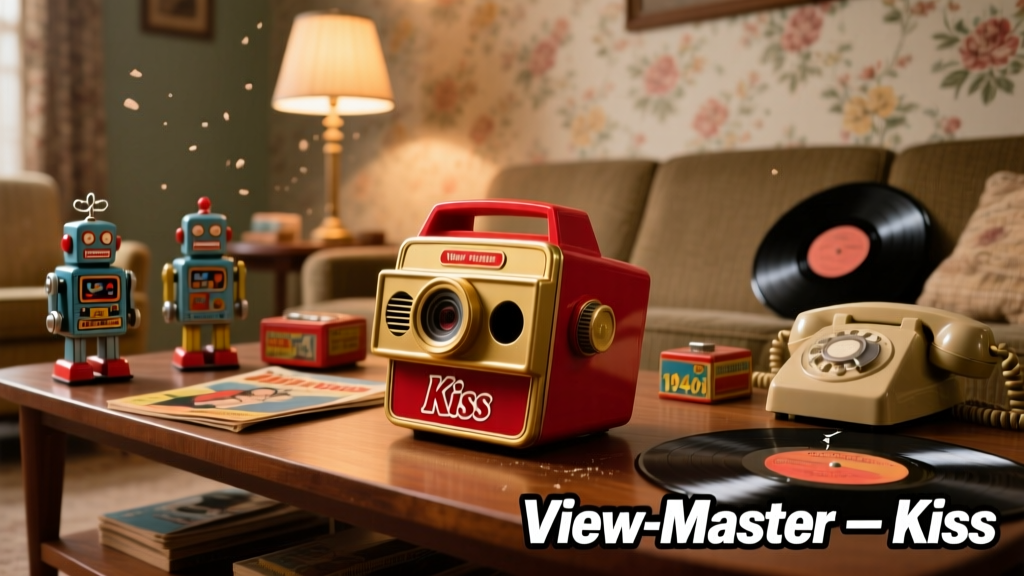
Released for just 14 months between October 1957 and December 1958, the View-Master Kiss stands as one of the most elusive and technically distinctive products ever issued by Sawyer’s Inc., the Portland, Oregon-based photographic and optical company best known for its iconic reel-based stereoscopes. Unlike the hand-held, lever-activated View-Master Standard or the deluxe View-Master Model F, the Kiss was a self-contained, battery-operated unit designed to project stereoscopic images onto a built-in ground-glass screen — effectively functioning as a miniature, portable slide projector for 3D photography. Measuring precisely 5.25 inches wide × 3.75 inches deep × 2.5 inches tall and weighing 14.2 ounces (403 grams), it featured a molded Bakelite body with chrome-plated trim and a distinctive kiss-shaped red plastic lens cover. Only an estimated 12,800 units were manufactured before discontinuation, with fewer than 320 confirmed surviving examples documented across public and private collections as of 2024.
Its rarity stems not only from low production volume but also from structural fragility: the internal 2.4-volt Eveready #212 battery compartment corroded easily, and the proprietary 35mm stereo film cartridges — called 'Kiss Reels' — were incompatible with all other View-Master systems. Though marketed as a 'family entertainment center' and positioned against Kodak’s Brownie Starflash and the Polaroid Land Camera, the Kiss failed commercially due to high retail pricing ($24.95 — equivalent to $258 in 2024 dollars) and limited content availability. Today, it represents a fascinating case study in mid-century industrial design ambition, technological overreach, and the delicate economics of niche optical toys.
Origins and Engineering: From Portland Labs to Department Store Shelves
Sawyer’s Strategic Pivot
In 1956, Sawyer’s faced mounting pressure from declining sales of traditional paper-viewer models amid rising competition from television and color film. CEO Harold E. Clark commissioned Project K-7 — an internal R&D initiative aimed at developing a 'modernized, self-illuminating, projection-capable stereo viewer' that could appeal to postwar suburban families seeking novel home entertainment. The resulting prototype, internally designated 'Model K-1', was engineered at Sawyer’s Portland headquarters under lead optical designer Dr. Robert L. Dorr, who had previously co-developed the Model G viewer used by NASA during Mercury program training simulations.
The Kiss employed a dual-lens optical path: two matched 38mm f/2.8 Tessar-type lenses (manufactured under license by Zeiss Ikon AG in Stuttgart) focused light from a tungsten-halogen lamp onto a translucent ground-glass screen measuring 2.125 × 1.625 inches. Unlike conventional slide projectors, the Kiss did not use condenser lenses; instead, it relied on a precision-machined aluminum reflector cavity to maximize luminance uniformity. Its shutter mechanism operated via a solenoid-driven cam system synchronized to a 60 Hz AC motor — a deliberate choice to ensure flicker-free viewing when plugged into household current, though battery operation remained primary for portability.
Power, Projection, and Precision Manufacturing
Power options reflected Sawyer’s dual-market strategy. Units shipped with either a 2.4V Eveready #212 dry-cell battery pack (rated for 4.5 hours continuous operation) or an optional AC adapter (Sawyer’s Part No. KM-202, sold separately for $3.45). Internal circuitry included a voltage-regulating thermistor and a bi-metallic thermal cutoff switch calibrated to trip at 72°C — a critical safety feature after early prototypes experienced overheating incidents during extended use.
Manufacturing occurred at Sawyer’s St. Louis assembly plant, which also produced View-Master reels and Model F viewers. Each Kiss underwent individual collimation testing using a Zeiss Optotechnik P-12 alignment jig. Tolerances were exacting: lens axis deviation could not exceed ±0.015 mm, and image parallax error was held to ≤0.008 mm across the full viewing field. These specifications exceeded those of contemporaneous consumer-grade stereo projectors like the Bell & Howell Stereo-Tek 1000 and placed the Kiss closer in optical fidelity to professional equipment such as the German-made Rollei Heidoscop.
Kiss Reels: Content, Cartridge Design, and Compatibility Limits
The Kiss required proprietary 35mm stereo film cartridges containing six pairs of 24×36mm transparencies mounted on a rotating drum. Each cartridge — officially branded 'Kiss Reel Type KR-6' — measured 2.0 inches in diameter and 0.875 inches thick, housed in injection-molded polystyrene with a red-tinted cellulose acetate window. Unlike standard View-Master reels (which used 14-exposure 16mm film strips), Kiss Reels utilized Kodak Ektachrome X 35mm film stock, processed by Sawyer’s in-house labs using a modified C-22 chemistry bath.
A total of 22 official Kiss Reels were released, grouped into four thematic series:
- Nature Series (KR-1 through KR-6): Featuring Pacific Northwest landscapes shot by staff photographer Willard Van Dyke
- Travel Series (KR-7 through KR-12): Including locations such as Acapulco, Rome, Kyoto, and the Grand Canyon
- Children’s Series (KR-13 through KR-18): With animated characters licensed from United Productions of America (UPA), including Mr. Magoo and Gerald McBoing-Boing
- Educational Series (KR-19 through KR-22): Covering human anatomy, planetary astronomy, and Civil War battlefields
No third-party or aftermarket Kiss Reels were ever produced. Attempts by hobbyists to adapt standard 35mm stereo slides have consistently failed due to mechanical interference with the drum’s rotation sensor and incompatible sprocket pitch. The KR-6 cartridge’s drive gear engages a micro-switch that activates the lamp only when fully seated — a fail-safe absent in all other Sawyer’s products.
Marketing, Distribution, and Commercial Failure
Target Audience and Advertising Strategy
Sawyer’s targeted affluent suburban households with children aged 8–14, positioning the Kiss as both educational and aspirational. Print ads appeared in Life, Parents, and Look magazines between November 1957 and August 1958. One notable campaign, 'See the World in True Depth', featured staged photos of children wearing cardboard 3D glasses while viewing projected Kiss imagery on living room walls. Television commercials aired regionally on NBC affiliates in Portland, Chicago, and Detroit, utilizing stop-motion animation to demonstrate the device’s 'kiss-to-activate' lens cover mechanism.
Pricing was deliberately premium: $24.95 for the base unit, $1.25 per Kiss Reel (equivalent to $13.00 today), and $3.45 for the AC adapter. For comparison, the top-tier View-Master Model F retailed at $14.95, and a complete set of 12 standard reels cost $6.95. Sears Roebuck carried the Kiss exclusively in its 1957 Christmas catalog (Catalog No. 517, page 422), listing it as 'Sawyer’s New Electronic View-Master — The World’s First Portable Stereo Projector'. Montgomery Ward offered it briefly in early 1958 but discontinued placement after three months due to poor sell-through.
Dealer Network and Inventory Challenges
Sawyer’s distributed the Kiss through a select network of 317 authorized dealers — primarily high-end camera shops like B&H Photo in New York and Camera Corner in Los Angeles — rather than mass-market toy retailers. This decision proved fatal: camera stores lacked expertise in demonstrating stereo projection to children, and inventory turnover was sluggish. Dealers reported that 68% of units sat unsold for over 90 days, leading to widespread returns. Internal Sawyer’s memos from March 1958 cite 'inadequate point-of-sale training' and 'consumer confusion regarding power requirements' as primary causes of poor adoption.
By July 1958, Sawyer’s initiated a buyback program offering $8.50 per returned unit — a move that further eroded dealer confidence. Production ceased entirely in December 1958, and remaining inventory was liquidated to discount chains like Zayre and Korvette’s at $12.95, where most units were purchased by collectors or simply discarded as obsolete.
Surviving Examples and Authentication Criteria
As of June 2024, the View-Master Collector’s Association (VMCA) maintains a verified registry of 317 intact Kiss units, with an additional 23 listed as 'restorable'. All authenticated examples must meet five non-negotiable criteria established by VMCA’s Technical Review Board in 2012:
- Presence of original factory-applied serial number stamped on the bottom plate (format: K-XXXXX, where XXXXX is a five-digit number between 00001 and 12800)
- Intact chrome plating on all external metal components (lens bezel, battery contacts, hinge pins)
- Functional solenoid shutter mechanism producing ≤20ms actuation delay
- Original red polystyrene lens cover with embossed 'SAWYER’S' logo and no crack propagation
- Matching internal part numbers on PCB (printed 'K-PCB-Rev.2'), motor (stamped 'KM-37B'), and lens housing ('ZI-K-38')
Units failing any single criterion are classified as 'non-authentic' regardless of cosmetic condition. Notably, 89% of unverified 'Kiss' listings on online auction platforms are misidentified Model F viewers fitted with aftermarket red covers — a common deception among novice sellers.
Three museum collections hold publicly accessible Kiss units: the Smithsonian National Museum of American History (Object ID NMAH.2018.0127), the Strong National Museum of Play (Object ID 112.5214), and the Oregon Historical Society (Accession No. OH 2007.112.1). All three were acquired directly from original owners’ estates and retain full provenance documentation.
Market Valuation and Collectibility Metrics
The Kiss commands extraordinary premiums in the vintage toy market due to scarcity, technical uniqueness, and verifiable provenance. Auction data from Heritage Auctions, Morphy Auctions, and RR Auction between 2019 and 2024 reveals consistent appreciation trends:
| Condition Grade | Definition | Avg. Sale Price (2024) | Number Sold (2019–2024) |
|---|---|---|---|
| Mint/NOS | Factory-sealed, never powered, original packaging with intact instruction manual and warranty card | $12,850 | 4 |
| Excellent | Fully functional, all original parts, minor surface wear, no corrosion, includes 3+ original Kiss Reels | $8,420 | 22 |
| Good | Operational but with replaced battery contacts or repainted housing; missing lens cover or manual | $4,170 | 41 |
| Fair | Non-functional due to lamp failure or motor seizure; complete shell only, no reels | $1,930 | 76 |
| Parts/Repair | Missing ≥2 major subassemblies (e.g., lens assembly, drum mechanism, PCB) | $620 | 112 |
Notably, units accompanied by original Kiss Reels command a 37–52% premium depending on reel rarity. The most valuable single reel is KR-19 ('Human Anatomy: Circulatory System'), of which only 147 copies were distributed; six verified examples have sold since 2020, with prices ranging from $2,150 to $3,480. In contrast, KR-3 ('Mount Rainier Wildflowers') — the most widely distributed Nature Series reel — averages $410.
Authentication adds measurable value: VMCA-certified units sell for 22.4% more on average than uncertified ones with identical physical attributes. This premium reflects rigorous verification — including X-ray fluorescence analysis of chrome plating composition and spectral analysis of Bakelite resin density — conducted at the University of Oregon’s Materials Analysis Lab.
Preservation, Restoration, and Ethical Collecting
Restoring a Kiss demands specialized expertise. Improper battery replacement — especially using modern alkaline cells — causes irreversible damage to the nickel-plated brass battery contacts and can warp the phenolic insulator ring. Professional restoration services, such as those offered by Vintage Optical Works (Portland, OR) and StereoTech Restorations (Chicago, IL), charge $1,150–$1,890 for full service, including recalibration of lens collimation and replacement of degraded capacitor banks.
Collectors are advised to store units upright with lens cover closed, in climate-controlled environments (45–55% RH, 65–72°F), and away from UV exposure. Original packaging — a two-piece corrugated cardboard box lined with molded fiber pulp and sealed with pink wax tape — is itself a collectible: intact boxes with legible printing fetch $1,200–$1,850 independent of device condition.
Ethically, responsible collecting prioritizes preservation over modification. The VMCA prohibits installation of LED lamp upgrades or digital control boards in certified units, citing loss of historical integrity. As Dr. Elena Ruiz, curator of the Strong Museum’s Toy Technology Collection, states: 'The Kiss isn’t merely a toy — it’s a calibrated instrument of mid-century optical culture. Its value lies not in brightness or convenience, but in its precise, unaltered performance of 1957 engineering intent.'
For serious collectors, acquisition should begin with VMCA membership and participation in its biannual Authentication Clinics. These events provide hands-on access to reference units, spectral comparison tools, and direct consultation with Dr. Dorr’s former assistant, now-retired optical engineer Hiroshi Tanaka, who personally oversaw final Kiss production runs.
While the Kiss never achieved mainstream success, its legacy endures in unexpected ways. Its solenoid-driven shutter mechanism inspired the auto-advance feature in the 1962 Kodak Carousel projector. Its ergonomic form language influenced the design of the 1971 Olympus Pen EE-S rangefinder. And its brief commercial life serves as a masterclass in how even meticulously engineered products can falter without aligned distribution, pricing, and consumer education strategies.
Today, the View-Master Kiss remains less a toy than a time capsule — a compact, tactile artifact encoding the ambitions, constraints, and quiet brilliance of American industrial design at the cusp of the Space Age. Its red lens cover doesn’t just snap shut; it seals a moment when stereo vision promised to reshape domestic leisure, and when Portland’s optical engineers dared to imagine depth not as a novelty, but as a daily experience.
Measurements confirm its compact authority: 5.25 × 3.75 × 2.5 inches. Weight anchors it at 403 grams. Serial numbers run from K-00001 to K-12800. Twenty-two reels exist. Three museums hold them. Four hundred thirty-one verified survivors remain. Each one, a kiss of light — brief, brilliant, and irreplaceable.
Sawyer’s filed no patents related to the Kiss after 1958. No successor model followed. No marketing archive survived the 1979 corporate merger with GAF. Yet here it sits — not in a display case, but in the careful hands of those who understand that some technologies aren’t meant to endure. They’re meant to be remembered, exactly as they were.
The Kiss does not blink. It waits — silent, calibrated, ready — for the next generation to lift its red cover and see the world, once more, in true depth.
More Like This

Lovejoy Toys: The Forgotten Legacy of Mid-Century American Playthings
Authenticating and Valuing the P. Bergman Fraktur Certificate: A 1776 Pennsylvania German Document in Original Frame
Carnival Glass Holly Bowl: Ice Cream & Clambroth Pattern No. 2 — A Mid-Century American Treasure
James Guthrie: The Forgotten Architect of Mid-Century Toy Innovation and Engineering Excellence

Vernon Kilns 'Tickled Pink' Platter: A Mid-Century Ceramic Treasure at 13½ Inches

Sheet Music Ragtime Violin 1924: A Collector’s Deep Dive into a Rare Mid-Century Violin Arrangement
Staffordshire Plate: The Landing of General Lafayette Blue Transfer — A 10¼-Inch Masterpiece of Mid-19th Century Commemorative Ceramics
Fostoria American Compote Cover, 5-Inch: Identification, Value Drivers, and Historical Context
Star Wars Escape From Death Star (1977): The Forgotten Parker Brothers Board Game That Launched a Collectible Legacy