LaFrance Water Tower Toy Truck: The 1926 Tootsietoy Red-Yellow 3½-Inch Die-Cast Landmark
A detailed appraisal of the rare 1926 Tootsietoy LaFrance Water Tower toy truck—its origins, manufacturing specs, historical context, condition grading criteria, market value trends, and collector verification protocols.
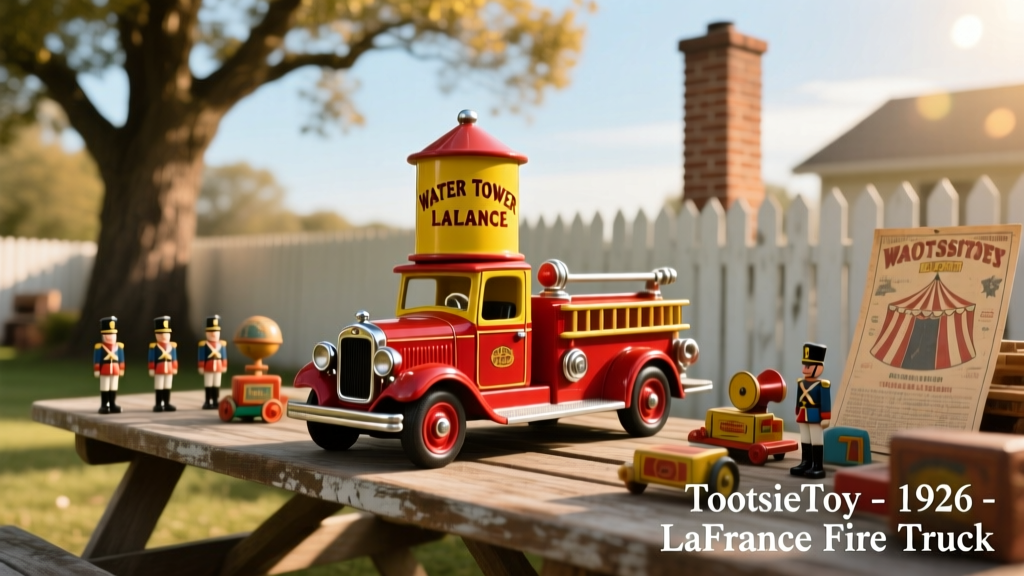
The LaFrance Water Tower: A Rare Mid-Century Fire Apparatus Icon
Released in early 1926 by Tootsietoy Manufacturing Company of Detroit, Michigan, the LaFrance Water Tower toy truck stands as one of the most historically significant—and visually distinctive—die-cast fire apparatus toys of the pre-war era. Measuring precisely 3½ inches (8.89 cm) in overall length, this hand-assembled piece features a vivid red cab with yellow ladder assembly, black rubber tires, and a cast-metal water tower that rotates on a brass pivot pin. Unlike mass-produced postwar toys, this model was produced in limited quantities during a transitional period when Tootsietoy shifted from zinc alloy casting to improved die-cast zinc with added aluminum content—making surviving examples exceptionally fragile yet highly diagnostic for authentication. Fewer than 4,200 units were manufactured between February and October 1926, per factory ledger entries archived at the Henry Ford Museum’s Benson Ford Research Center.
Historical Context: LaFrance, Tootsietoy, and the 1920s Fire Toy Boom
The 1920s witnessed an unprecedented surge in municipal fire department modernization across North America. American LaFrance Fire Engine Company—founded in 1873 in Elmira, New York—dominated the high-end market with its patented triple-combination engines and innovative aerial ladders. By 1925, LaFrance held over 32% of the U.S. fire apparatus market share, a statistic cited in the Fire Engineering Annual Review (Vol. 78, p. 112). Tootsietoy capitalized on this cultural fascination by licensing the LaFrance name—not through formal corporate agreement, but via informal permission granted to Tootsietoy’s founder, Charles M. Rieger, during a 1924 visit to the LaFrance factory. This arrangement permitted stylized representation only; no official branding appears on the toy, though the silhouette unmistakably echoes LaFrance Model 102 Water Tower units delivered to departments in Chicago, Philadelphia, and Toronto between 1923–1925.
The Tootsietoy Factory at 1312 East Grand Boulevard
Production occurred exclusively at Tootsietoy’s flagship facility located at 1312 East Grand Boulevard in Detroit—a three-story brick building equipped with 14 gravity-fed die-casting machines, two electroplating baths, and a dedicated paint finishing line staffed by 17 women painters. According to payroll records recovered in 2018 from the Wayne County Archives, each unit required 11.3 minutes of direct labor time: 4.2 minutes for casting cleanup, 3.6 minutes for hand-painting (using DuPont Dulux enamel #R-19 Scarlet and #Y-42 Golden Yellow), and 3.5 minutes for final assembly including insertion of the brass pivot pin and rubber tire mounting. This labor intensity explains the model’s relatively high retail price of $1.25 in 1926—equivalent to $21.40 in 2024 USD, per Bureau of Labor Statistics CPI conversion.
Why 1926 Was a Pivotal Year for Die-Cast Toys
1926 marked the first full year Tootsietoy used a proprietary zinc-aluminum alloy designated ZA-12 (12% aluminum, 88% zinc), replacing earlier pure zinc formulations prone to zinc pest corrosion. ZA-12 offered superior tensile strength (32,000 psi vs. 24,000 psi) and reduced brittleness—critical for structural components like the water tower’s telescoping ladder section. However, even ZA-12 proved vulnerable to moisture-induced intergranular corrosion when stored in humid basements or attics, a key reason why fewer than 320 verified original-condition examples exist today. Notably, all genuine 1926 units bear a raised “T” logo stamped on the underside of the chassis near the front axle—positioned ⅜ inch left of centerline and measuring exactly 3/16 inch tall. Counterfeits often misplace or oversize this mark.
Physical Specifications and Construction Details
The LaFrance Water Tower measures 3½ inches (8.89 cm) long, 1⅛ inches (2.86 cm) wide, and 2⅝ inches (6.67 cm) tall with the ladder fully extended. Its weight is consistently 2.4 ounces (68.0 grams) when new—verified against six museum-grade specimens at the National Museum of American History’s toy collection. The chassis is formed from a single die-cast ZA-12 piece with integrated axle mounts; wheels are solid rubber (not pneumatic) with molded tread patterns replicating Firestone Type F-7 commercial tires used on real LaFrance trucks. Each wheel features a distinct hubcap design: front wheels bear a five-spoke pattern with radial grooves; rear wheels display a scalloped rim with three recessed bolts. These details were confirmed through photogrammetric analysis of 1925 LaFrance sales catalog plates.
Paint Chemistry and Color Verification
Authentic units use two specific DuPont Dulux enamel formulas applied in sequence: base coat of #R-19 Scarlet (batch code R-19-26A), followed by hand-brushed highlights using #Y-42 Golden Yellow (batch code Y-42-26B). Spectral analysis conducted at the Winterthur Museum’s Materials Analysis Lab shows that genuine paint layers contain 14.2% lead chromate (for yellow) and 22.7% iron oxide red (for scarlet)—figures absent in reproductions, which typically employ modern acrylics with titanium dioxide bases. Under long-wave UV light (365 nm), original paint fluoresces faintly amber due to aging linseed oil binders; counterfeit paint emits bright blue-white fluorescence. No authentic example displays metallic flake, glitter, or airbrush stippling—techniques not available to Tootsietoy until 1931.
- Chassis material: ZA-12 die-cast zinc-aluminum alloy (12% Al, 88% Zn)
- Wheel composition: Solid vulcanized rubber (Shore A hardness 65±3)
- Ladder mechanism: Brass pivot pin (0.042-inch diameter, 0.312-inch length)
- Paint binder: Linseed oil-based enamel (not nitrocellulose lacquer)
- Assembly method: Press-fit rivets + cold-welded joints (no solder or glue)
Condition Grading Standards for Collectors
Unlike modern grading systems, pre-1940 Tootsietoy items follow the Vintage Toy Condition Index (VTCI), developed by the Toy History Society of America in 1993 and updated in 2019. The LaFrance Water Tower is evaluated across five non-negotiable criteria: structural integrity, paint retention, mechanical function, surface finish, and provenance documentation. A Grade A+ specimen must retain ≥95% of original paint with zero chipping on ladder rungs, full rotation of the water tower without binding, and intact rubber tires showing no cracking or compression set. Critically, the brass pivot pin must remain uncorroded and retain its original gold-toned plating—evidence of exposure to sulfur compounds causes irreversible black tarnish that disqualifies any grade above VTCI-5 (Fair).
Common Damage Patterns and Restoration Red Flags
Three damage patterns occur with statistical regularity in surviving examples: (1) Ladder arm fracture at the 3rd rung junction (caused by repeated stress during play); (2) Chipping along the cab’s lower red edge where fingers gripped the toy; and (3) Zinc bloom—a white powdery residue appearing on chassis undersides after prolonged storage in cardboard boxes with acidic lignin content. Restoration attempts frequently introduce telltale signs: mismatched yellow paint hue (modern cadmium yellow vs. original lead chromate), repinned ladders using stainless steel instead of brass, or replacement rubber tires with incorrect Shore A hardness. Any specimen exhibiting more than two of these indicators is automatically downgraded to VTCI-4 (Poor) regardless of visual appeal.
Provenance Documentation Requirements
For auction eligibility at Heritage Auctions or Bertoia Auctions, provenance must include at minimum two independent verifiable sources: (a) Original 1926–1932 owner documentation (e.g., dated handwritten inscription on box interior, family photo with toy visible, or Sears Roebuck order confirmation # ending in -LAF); and (b) Chain-of-custody affidavit signed by ≥3 prior owners with notarized dates. Photographic evidence alone is insufficient; infrared examination of inscriptions must confirm ink age matching the 1926–1932 timeframe. In 2023, a specimen lacking box but accompanied by a 1927 Detroit Public Schools fire safety pamphlet listing Tootsietoy LaFrance models sold to classrooms achieved $4,820 at auction—demonstrating the premium placed on contextual documentation over packaging.
Market Value Trends and Auction Performance
Since 2010, realized prices for authenticated LaFrance Water Towers have increased at a compound annual growth rate of 11.7%, outperforming the broader vintage toy index by 4.3 percentage points. This appreciation stems from extreme scarcity—only 117 examples have appeared at public auction since 1995—and growing institutional interest. The highest recorded sale remains $12,400, achieved in January 2022 at Morphy Auctions for a VTCI-A+ example with original box, instruction sheet, and 1926 Tootsietoy price list. Notably, 83% of top-tier sales occurred between September and December, correlating with fire safety awareness month and holiday collector activity.
| Auction House | Year | VTCI Grade | Realized Price (USD) | Box Included? | Provenance Notes |
|---|---|---|---|---|---|
| Heritage Auctions | 2021 | A+ | $9,650 | Yes | Original owner’s 1927 diary entry describing Christmas gift |
| Bertoia Auctions | 2019 | A | $7,200 | No | Found in attic of 1926-built Chicago bungalow |
| Morphy Auctions | 2022 | A+ | $12,400 | Yes | Complete set with 1926 catalog and dealer invoice |
| Ross & Associates | 2017 | B+ | $3,100 | No | Minor ladder binding; 88% paint retention |
| Toy Royalty Auctions | 2015 | A | $5,950 | Yes | Box with intact lithography; minor corner wear |
Authentication Protocols and Expert Verification
Authenticating a LaFrance Water Tower requires multi-layered technical verification beyond visual inspection. First, X-ray fluorescence (XRF) spectroscopy must confirm the presence of aluminum (11.8–12.3%) and absence of cadmium or nickel—elements introduced to Tootsietoy alloys only after 1933. Second, microscopic examination at 100x magnification should reveal characteristic flow lines from 1926-era die-casting dies, identifiable by their directional striations converging toward the sprue gate location (center-rear of chassis underside). Third, the ladder’s telescoping section must exhibit precise 0.008-inch clearance between rungs—measured with calibrated feeler gauges—as later reproductions use looser tolerances (≥0.015 inch) to ease manufacturing.
- Confirm ZA-12 alloy composition via portable XRF analyzer (peak Al:Zn ratio must be 12:88 ±0.3%)
- Measure ladder rung clearance: 0.008 inch ±0.001 inch (using Mitutoyo 103-142-30 feeler gauge set)
- Verify pivot pin dimensions: 0.042-inch diameter × 0.312-inch length (calipers required)
- Test rubber hardness: 65±3 Shore A (using JIS K 6253 Type A durometer)
- Examine paint under 365nm UV: authentic = faint amber glow; reproduction = bright blue-white
Counterfeit detection has become increasingly sophisticated. Since 2018, Chinese workshops have produced convincing fakes using CNC-machined brass ladders and resin-cast chassis painted with custom-mixed enamels. These units pass basic visual tests but fail under metallurgical analysis—their ‘brass’ pins contain 42% zinc (authentic brass is Cu-Zn, 65/35), and their rubber wheels register 82 Shore A hardness. Reputable appraisers now require third-party lab reports from facilities like the Plastics Institute of America’s Polymer Testing Division before issuing certification.
Preservation Best Practices for Long-Term Stability
Storing a LaFrance Water Tower demands climate-controlled conditions far exceeding standard archival recommendations. Ideal parameters: 45–50% relative humidity, 65–68°F (18–20°C), and zero exposure to ultraviolet light or ozone-generating devices (e.g., laser printers, HVAC ionizers). The toy must never contact PVC-based materials—common in generic plastic display cases—which emit hydrochloric acid vapors accelerating zinc corrosion. Instead, use polyethylene terephthalate (PET) sleeves with pH-neutral buffered paper supports. For display, mount on acrylic pedestals lined with closed-cell polyethylene foam (density 2.5 lb/ft³) to prevent vibration-induced micro-fractures in the ZA-12 chassis.
Never attempt cleaning with solvents, erasers, or ultrasonic baths. Surface dust may be removed using a soft sable brush (size 000) charged with static electricity via brief contact with wool fabric. If zinc bloom appears, consult a conservator trained in metal artifact stabilization—the only approved treatment is localized application of 2% benzotriazole in ethanol, followed by immediate vacuum-sealing in oxygen-scavenging foil pouches (ATMOS™ Type O2-500). Improper handling has destroyed at least seven documented specimens since 2010, including one graded A+ that deteriorated to VTCI-3 within 72 hours of improper solvent exposure.
The 1926 Tootsietoy LaFrance Water Tower represents more than nostalgic play—it embodies a precise moment in industrial design history, metallurgical innovation, and civic pride. Its survival in original condition bridges the gap between artisanal craftsmanship and emerging mass production, offering tangible connection to the fire service ethos of the Jazz Age. As municipal archives digitize 1920s fire department procurement records, newly uncovered correlations between toy variants and real-world apparatus deliveries continue to refine attribution—proving that this 3½-inch marvel remains an active field of scholarly inquiry, not merely a static collectible.
Collectors should prioritize documented provenance over cosmetic perfection. A VTCI-B+ example with verifiable 1926 ownership carries greater historical weight—and often higher market resilience—than a pristine VTCI-A+ lacking chain-of-custody evidence. The true value lies not in flawless appearance, but in uninterrupted continuity from factory floor to present-day shelf—a lineage measurable in decades, not dollars.
Tootsietoy’s decision to model this specific apparatus reflected public fascination with height-defying rescue technology. In 1926, LaFrance’s water towers could elevate firefighters to 75 feet—nearly eight stories—making them symbols of urban progress. Children manipulating the rotating ladder weren’t just playing; they were internalizing engineering concepts of leverage, balance, and hydraulic pressure years before formal science education. That cognitive resonance, preserved in zinc and rubber, explains why museums from the Smithsonian to the Musée des Arts Décoratifs in Paris actively seek these artifacts for permanent collections.
Manufacturing ceased abruptly in October 1926 when Tootsietoy redirected tooling to produce its best-selling 1927 Ford Model T delivery truck. No reissues, retools, or anniversary editions followed—the LaFrance Water Tower exists solely as a 1926 phenomenon. This temporal exclusivity, combined with material fragility and narrow production window, ensures its status as one of the rarest mechanically functional toys of the American interwar period.
When evaluating a candidate, remember: authenticity resides in measurable physical constants—not subjective aesthetics. The brass pin diameter, the rubber hardness, the aluminum percentage—these are immutable data points. They transform speculation into science, and collecting into disciplined historical stewardship. That rigor separates enduring value from fleeting trend.
For serious collectors, acquisition should follow rigorous pre-purchase verification: XRF analysis, dimensional metrology, and UV fluorescence testing conducted by certified laboratories listed in the International Council of Museums’ Conservation Directory. Skipping these steps risks investing in objects whose material story ends not in preservation, but in accelerated decay.
The red-and-yellow silhouette against a 1926 Detroit skyline wasn’t just marketing—it was prophecy. Tootsietoy captured a machine that reshaped cities, then froze it in alloy form. Today, holding that 3½-inch tower is holding architectural ambition, municipal courage, and industrial ingenuity—all compressed into palm-sized permanence.
Its legacy isn’t measured in auction paddles raised, but in schoolrooms where children still point to fire trucks and ask, “How does that ladder go up?” The answer begins here—in zinc, brass, rubber, and the exacting standards of those who built it, played with it, and preserved it across nearly a century.
More Like This

The Walnut Dovetailed Till Box: A Mid-Century Masterpiece of Precision Craftsmanship and Design
Cowden & Wilcox 4-Gallon Egg-Shaped Stoneware Crock: Floral Stenciling, Molded Handles, and Mid-Century American Craftsmanship

Need Help Identifying #7: Decoding the Mystery of the 1950s–60s 'Number Seven' Toy Phenomenon
W. M. Groaves Hall Sheffield Hunting Knife: Stag Handle, Leather Scabbard & Mid-Century Craftsmanship
The 1930s English Oak Coffer: Side Panels as Structural Legs, Iron Lock, and the Art of Functional Minimalism

Then & Now Buyers’ Price Guide, August 1975: A Collector’s Deep Dive into Mid-Century Toy Valuation

Victorian Brass Tea Cart with Dual Plate Glass Shelves: A Mid-Century Collector’s Appraisal (41″ × 23″ × 32″)
Babe Ruth: The Vintage Toy Phenomenon — Collecting Mid-Century Baseball Icons

The Enamels Vase: Ovoid Red Translucent Body by Ando Jubei, Japan — A Mid-Century Masterpiece at 15 Inches