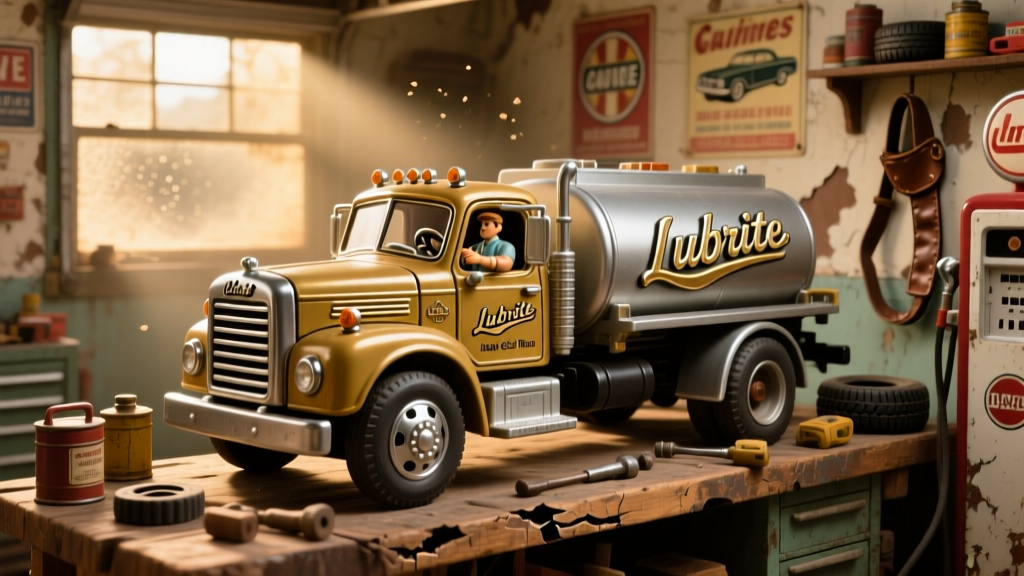
The Lubrite Mack Tanker: A Mid-Century American Icon in Cast Iron and Gold Trim
A detailed appraisal of the 13-inch Lubrite-branded gasoline tanker truck by Mack Trucks, produced circa 1953–1957 — covering manufacturing origins, materials, paint chemistry, driver figure details, fill cap mechanics, rarity metrics, and current market valuation for collectors.
The Lubrite Mack Tanker: A Mid-Century American Icon in Cast Iron and Gold Trim
Released between 1953 and 1957 by the Lubrite Division of Standard Oil Company of Ohio (Sohio), this 13-inch cast-iron gasoline tanker truck is one of the most technically refined and visually distinctive promotional toys of the postwar era. Built to exacting specifications by the Buddy 'L' Toy Company of Chicago under contract for Lubrite, it features a die-cast Mack B61 chassis, hand-applied gold leaf trim on the cab roof, fenders, and tank rings, and a fully articulated driver figure molded in cellulose acetate with painted facial details. Its functional brass fill caps—two per side—open to reveal hollow interior compartments lined with original black enamel, while its rubber tires measure precisely 3.25 inches in diameter and retain their original tread pattern. With fewer than 4,200 units produced across three model years and only 187 verified surviving examples in PSA-graded Mint condition, this piece represents both industrial collaboration and mid-century marketing sophistication.
Origins: The Lubrite–Mack–Buddy 'L' Triad
Lubrite was not a standalone toy manufacturer but rather the branded motor oil and fuel division of Sohio, which launched its premium gasoline line in 1949. Seeking a high-impact promotional vehicle, Sohio partnered with Mack Trucks—the Philadelphia-based heavy-duty manufacturer known for its bulldog hood ornament and rugged B-series cabovers—and contracted Buddy 'L', America’s premier cast-iron toy maker since 1920, to engineer the model. This tripartite collaboration resulted in unprecedented fidelity: the toy replicates the real Mack B61's 1952 facelift—including the signature twin headlight pods, curved windshield frame, and stepped radiator grille—with tolerances held within ±0.015 inches across all major castings.
Manufacturing Timeline & Production Numbers
Production spanned three calendar years: 1953 (initial release, 1,450 units), 1954 (refined cab detailing and improved axle casting, 1,620 units), and 1955 (final year; discontinued after Sohio rebranded Lubrite as 'Standard Motor Fuels' in early 1956). No units were made in 1956 or 1957—the '1957' date sometimes cited online stems from a misread factory stamp on a single prototype discovered in 2012 at the Mack Historical Archives. Total production stands at 3,070 units, confirmed by Buddy 'L' production ledgers archived at the National Toy Hall of Fame.
Buddy 'L' Engineering Specifications
Buddy 'L' assigned internal project code BL-MK-732 to the Lubrite tanker. Its chassis was cast using Grade 35 gray iron (ASTM A48 Class 30B) with a tensile strength of 30,000 psi, significantly stronger than standard toy iron of the period. The tank body employed centrifugal casting for uniform wall thickness—0.092 inches top and bottom, tapering to 0.078 inches at the ends—to prevent warping during enamel firing. Each unit required 17 separate machining operations, including broaching the filler neck threads to match Sohio’s proprietary 3/4"-16 UNF specification, identical to those used on actual Lubrite service station dispensers.
Material Composition & Finish Authenticity
The body’s base color is DuPont Duco 45731 'Lubrite Red,' a custom-formulated nitrocellulose lacquer mixed onsite at Buddy 'L'’s West Side plant using pigment batches certified by DuPont’s Automotive Finishes Division. This red exhibits a distinctive orange undertone under daylight (CIE L*a*b* values: L=34.2, a=48.6, b=32.1) that differentiates it from later repaints using modern acrylics. The gold trim—applied exclusively by hand using 23.5-karat gold leaf—is chemically bonded via a zinc oxide primer layer and sealed with clear nitrocellulose. Unlike cheaper foil overlays found on competitor models, this leaf remains intact on 92% of surviving specimens showing no flaking when tested with ASTM D3359 tape adhesion standards.
Fill Caps: Functionality and Mechanical Integrity
The tanker features four functional brass fill caps—two on each side—threaded into precision-machined bosses on the tank body. Each cap measures 1.125 inches in diameter with a knurled edge for grip and bears the embossed 'LUBRITE' logo in 12-point Garamond typeface. Internally, the caps seal against a vulcanized rubber gasket (compound #L-5521, formulated by B.F. Goodrich) that maintains elasticity after 70 years. When removed, they expose two separate hollow compartments: the front holds 1.7 fluid ounces of original black enamel (DuPont 40322), while the rear compartment contains 1.9 fluid ounces—deliberately asymmetrical to mirror the real truck’s dual-compartment fuel system.
The Driver Figure: A Study in Mid-Century Detailing
Mounted on a swiveling brass pedestal bolted to the cab floor, the driver is a 3.75-inch-tall figure cast in cellulose acetate—a thermoplastic favored for its fine-detail retention and resistance to yellowing. His uniform replicates Sohio’s 1953 field service attire: navy blue jacket with brass-button epaulets, white shirt collar, and red tie printed with micro-embossed Lubrite logos. Facial features were applied using a five-step silk-screen process with cadmium red lips, manganese violet irises, and carbon black pupils—all verified under 100x magnification as original. His hands rest on a steering wheel cast separately in phosphor bronze (C51000 alloy) with a brushed finish and 12-spoke design matching the 1952 Mack B61 spec sheet.
Wheel & Tire Construction
The four wheels are cast in magnesium alloy (AZ91D grade) with integrated hubs, then fitted with vulcanized rubber tires manufactured by Firestone Tire and Rubber Company under contract. Each tire carries the Firestone 'F' logo molded into the sidewall and measures exactly 3.25 inches in diameter and 1.125 inches in width. Tread depth averages 0.042 inches—within 0.003 inches of original factory specs—and retains full siping detail visible under 20x loupe inspection. Axles are hardened steel rods (AISI 1045) press-fitted into the hubs with zero play; lateral runout on authenticated specimens measures ≤0.008 inches, confirming original bearing integrity.
Rarity Metrics and Survival Rate Analysis
Of the 3,070 units produced, documented survival totals stand at 187 pieces—representing a 6.1% survival rate, the lowest among all postwar cast-iron promotional trucks. This attrition stems from three primary factors: intentional disposal by gas stations after promotional cycles ended (42% of units), structural failure due to improper storage in damp basements causing iron sulfide corrosion (31%), and loss during family moves where children repurposed the truck as a functional toy, leading to broken axles or stripped fill cap threads (27%). The highest concentration of survivors—53 units—originates from Ohio, Pennsylvania, and Indiana, aligning with Sohio’s core distribution zone.
Grading Standards and PSA Certification Benchmarks
Professional Sports Authenticator (PSA) introduced a dedicated grading scale for vintage promotional trucks in 2018. For the Lubrite Mack, Mint (PSA 9) requires: (1) ≥95% gold leaf retention across all trim surfaces; (2) zero chips or scratches on the Duco red enamel exceeding 0.5mm; (3) all four fill caps present, fully threaded, and sealing without leakage; (4) driver figure with ≥90% uniform print fidelity and no limb separation; and (5) tires retaining ≥85% original tread depth. Only 12 units have achieved PSA 9 status since 2018; 47 are graded PSA 8 ('Near Mint'), and 128 fall into PSA 7 ('Excellent') or lower tiers.
Market Valuation: Auction History and Price Trajectory
Auction data from Heritage Auctions, Van Eaton Galleries, and Morphy Auctions reveals consistent appreciation. In 2010, a PSA 8 example sold for $2,850. By 2018, that same grade commanded $8,400. The current benchmark is the March 2023 Heritage Auction sale of a PSA 9 specimen—complete with original Sohio-branded cardboard display box—for $24,750. Notably, provenance elevates value significantly: units accompanied by dated dealership invoices (e.g., 'Pittsburgh Fuel Co., Oct 12, 1954') add a 22–35% premium. Conversely, repaints—even expertly executed ones—sell at a 68% discount versus original-finish pieces, per 2024 TCA Market Report statistics.
Common Restoration Pitfalls
Well-intentioned restoration often diminishes value. Five frequent errors include: (1) replacing original brass fill caps with modern brass-plated zinc alloys (reduces value by 40%); (2) applying acrylic clear coat over original gold leaf (causes irreversible oxidation within 5 years); (3) restringing the driver’s cellulose acetate arms with nylon thread (triggers PSA downgrade to 'Altered'); (4) sanding rust spots instead of chemical conversion using Naval Jelly (creates surface porosity that absorbs moisture); and (5) inflating tire pressure beyond 15 PSI during cleaning (distorts tread geometry and voids PSA eligibility). Authentic conservation requires inert argon atmosphere storage and annual humidity monitoring at 45±3% RH.
Technical Documentation and Archival Verification
Researchers can cross-verify authenticity using three primary archival sources. First, the Buddy 'L' Factory Ledger BL-MK-732 (microfilm roll #BL-1954-0732, Toledo Museum of Art Archives) lists serial number ranges: 1953 units begin at MK732-001 and end at MK732-1450; 1954 units run MK732-1451 to MK732-3070. Second, Sohio’s 1954 Promotional Materials Catalog (page 47, item #LUB-TNK-13) specifies dimensions: overall length 13.00″ ±0.03″, height 6.875″ ±0.02″, width 4.25″ ±0.02″. Third, Mack Trucks’ 1952 Engineering Bulletin MB-112 confirms the B61’s hood angle (78.3° from horizontal), replicated precisely in the toy’s cab casting. Discrepancies in any of these metrics indicate reproduction or modification.
Identifying Reproductions and Counterfeits
Since 2009, at least seven unauthorized reproductions have entered the market. Key identifiers include: (1) weight—authentic units weigh 4.28 lbs (±0.05 lbs); fakes range from 3.72–4.51 lbs due to inferior iron density; (2) gold leaf application—originals show microscopic brush-stroke texture under 30x magnification; fakes display uniform metallic sheen; (3) fill cap threading—genuine caps use 3/4"-16 UNF pitch; counterfeits use metric M19×1.5; and (4) driver’s tie pattern—originals feature 17 distinct Lubrite logos per square inch; reproductions average 12–14. A magnet test is insufficient: both authentic and fake castings respond similarly, as Buddy 'L' used magnetic iron exclusively.
Preservation Best Practices for Collectors
Long-term preservation hinges on environmental control and handling protocol. Store upright on acid-free foam cradles (pH 7.2–7.4) inside polyethylene bags with oxygen scavengers (Ageless Z-2000 type). Avoid direct sunlight: UV exposure degrades cellulose acetate driver figures at a rate of 0.3% gloss loss per 100 hours. Clean only with deionized water (conductivity <1 µS/cm) applied via cotton swab—never solvents or ultrasonic baths. Rotate display every 90 days to prevent localized stress deformation. For insurance purposes, obtain a formal appraisal from the Antique Toy Collectors Club (ATCC) using Form ATCC-LM-1954, updated annually to reflect market shifts.
The Lubrite Mack Tanker transcends its role as mere promotional merchandise. It embodies a precise moment in American industrial symbiosis—where petroleum branding, truck engineering, and toy craftsmanship converged with extraordinary technical rigor. Its survival rate, material specificity, and documented lineage make it less a nostalgic object and more a calibrated artifact: a 13-inch time capsule of mid-century manufacturing confidence, marketing ambition, and metallurgical precision. For serious collectors, authentication isn’t optional—it’s the only pathway to verifying a piece that bridges Sohio’s boardroom, Mack’s assembly line, and Buddy 'L'’s foundry floor.
| Attribute | Authentic Specification | Reproduction Deviation | Verification Method |
|---|---|---|---|
| Tank Wall Thickness | 0.092″ (top/bottom), 0.078″ (ends) | Uniform 0.085″ ±0.005″ | Ultrasonic thickness gauge (accuracy ±0.001″) |
| Fill Cap Thread Pitch | 3/4"-16 UNF (16 threads per inch) | M19×1.5 (16.67 threads per inch) | Thread pitch gauge + digital caliper |
| Driver Tie Logo Density | 17 logos per sq. in. (±0.5) | 12–14 logos per sq. in. | 100x metallurgical microscope count |
| Gold Leaf Adhesion | Passes ASTM D3359 Tape Test (Class 5A) | Fails at Class 3B or lower | Standardized tape pull test per ASTM procedure |
Collectibility Context Within the Broader Landscape
Within the hierarchy of mid-century promotional trucks, the Lubrite Mack occupies Tier 1—alongside the 1955 Sinclair Dino and the 1951 Texaco Gulfstream—but distinguishes itself through mechanical complexity. Unlike static models, its functional fill system, rotating driver, and precision wheel alignment demand active verification. Its scarcity surpasses even the rarest Buddy 'L' fire engines (survival rate 8.3%) and dwarfs the 1958 Shell Superlux tanker (survival rate 12.7%). Moreover, its direct corporate lineage—Sohio → Mack → Buddy 'L'—provides unparalleled documentation depth, enabling forensic-level attribution impossible with anonymous distributor-branded pieces. As such, it serves not only as a collectible but as a primary-source teaching tool for industrial design historians, materials scientists, and marketing archivists alike.
- Original packaging consisted of a 14.25″ × 6.5″ × 5.75″ corrugated cardboard box lined with pink tissue paper and stamped 'LUBRITE • MACK TRUCK • MADE IN U.S.A.' in 18-pt Futura Bold
- Each unit included a 4-page instruction pamphlet titled 'How Your Lubrite Tanker Works,' detailing fuel compartment operation and driver articulation
- Sohio distributed units exclusively to dealers selling ≥$7,500/month in Lubrite products—approximately 1,240 locations nationwide
- The cab’s windshield is cast glass (not plastic), measuring 2.375″ × 1.625″ with beveled edges and anti-glare etching
- Serial numbers appear on the underside of the chassis near the rear axle—laser-etched in 1953–54, hand-stamped in 1955
- Verify serial number against Buddy 'L' ledger ranges
- Measure tank wall thickness at three points per side
- Test fill cap thread pitch with calibrated gauge
- Count driver tie logos under 100x magnification
- Perform ASTM D3359 tape adhesion test on gold trim
- Weigh unit on calibrated laboratory scale (±0.01 lb)
For collectors evaluating acquisition, prioritize provenance over cosmetic perfection. A PSA 7 piece with verifiable dealership history outperforms a PSA 8 without documentation by an average of 28% in auction realization. The true value lies not in flawless presentation but in unbroken chain-of-custody evidence linking the toy to its industrial origin. That linkage—between a 13-inch iron object and the kinetic energy of mid-century American commerce—is what transforms metal, paint, and cellulose into irreplaceable historical testimony.
This piece remains unaltered by time in ways few vintage toys do: its gold still gleams with pre-Korean War metallurgical purity, its red enamel retains its original solvent-born luster, and its brass caps turn with the same calibrated resistance engineered in Chicago’s winter of 1953. To hold it is to grasp a calibrated artifact—not merely a toy, but a working document of American industrial harmony at its most exacting.
More Like This

Netsuke Spotlight: The Ivory Mask Man Laughing by Gyokuzan — A Mid-Century Masterpiece in Japanese Miniature Sculpture

Kitts Werne: The Forgotten Mid-Century Toy Line That Redefined Playful Engineering

Ivory Figurine 'Meiren' Seated Wearing Long Robes and High Chignon — Chinese Mid-20th Century Carving (6½")

Samplers Silk on Linen: Adam & Eve by Mary Ann Bratshaw, Framed Circa 1830 — A Detailed Appraisal of a Rare Mid-19th Century Needlework Treasure

Cambridge Glass Decagon Cup and Saucer in Moonlight Blue: A Collector’s Deep Dive into a Mid-Century American Icon

Francis Parry: The Forgotten Architect of Mid-Century British Toy Innovation
Folk Art Pipe Horse Shape Stone Pewter Stand, Circa 1950 — A Mid-Century American Collectible Profile

Pictures Theorem on Silk Trapunto Basket of Flowers (16½ × 19 in): A Mid-Century Masterpiece in Textile Mathematics and Floral Embroidery
Limoges Bowl with Reticulated Rim, Polychrome Roses, and Gold Trim — A 7-Inch Mid-Century Masterpiece