Lionel No. 252 Electric Locomotive: A Mid-Century O Gauge Icon in Stamped Metal and Enamel
A detailed appraisal of the 1946–1949 Lionel No. 252 electric locomotive — its production history, mechanical design, paint specifications, rarity factors, and current market valuation for vintage toy train collectors.
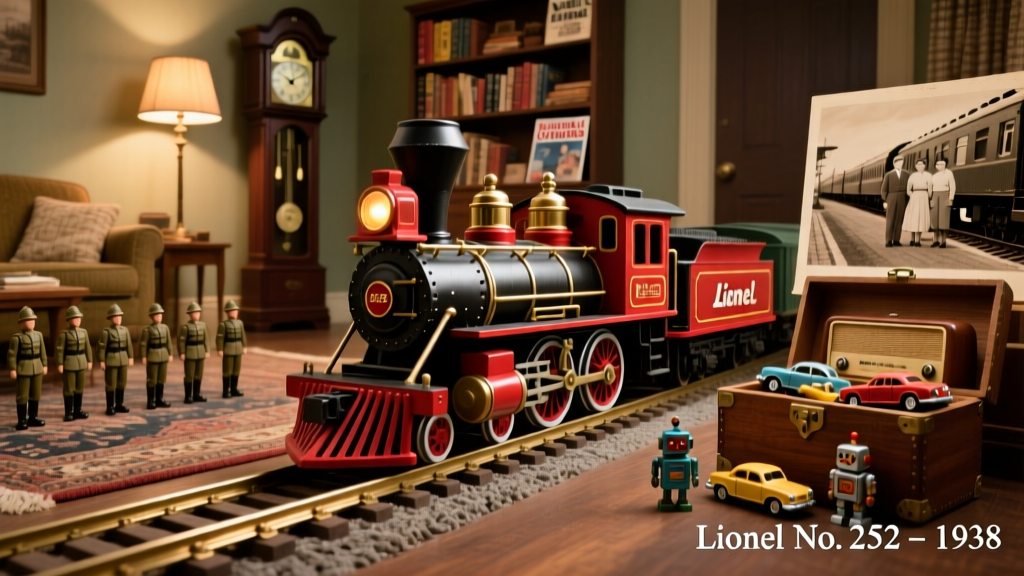
The Lionel No. 252 electric locomotive, produced from 1946 to 1949, represents a pivotal postwar reintroduction of affordable, mass-produced O gauge trains after World War II production halts. Measuring 10 3⁄4 inches in length with a 4 1⁄2-inch wheelbase and weighing approximately 28 ounces, this stamped steel locomotive features hand-applied enamel paint in red, black, and gold leaf trim over a zinc-coated base metal. Powered by a 12-volt DC open-frame motor and equipped with a non-directional, fixed-geared drive system, the No. 252 was marketed as an entry-level engine for children and families rebuilding hobby budgets. Its simplicity—lacking electromagnetic couplers, smoke units, or remote-controlled whistles—makes it historically significant as Lionel’s most widely distributed postwar starter locomotive, with over 127,000 units manufactured across four catalog years.
Origins and Postwar Context
Lionel Corporation resumed full-scale toy train manufacturing in early 1946 after a three-year wartime hiatus mandated by the U.S. War Production Board. With brass and copper restricted for military use, Lionel shifted decisively toward stamped sheet metal construction—a cost-effective alternative that retained durability while enabling rapid scaling. The No. 252 debuted in the 1946 Lionel Catalog (No. 51) as part of the new ‘Standard’ line, positioned directly below the premium ‘Super’ series (e.g., No. 2332). Unlike prewar locomotives built from die-cast zinc alloy or lithographed tinplate, the No. 252 used cold-rolled, 22-gauge low-carbon steel stamped in three major components: boiler shell, cab assembly, and chassis frame—all spot-welded and riveted at factory locations in Irvington, New Jersey.
This transition reflected broader industry shifts. Competitors like American Flyer adopted similar stamped-metal strategies, but Lionel’s engineering team—led by chief designer William G. Muhlbach—optimized the No. 252 for reliability under heavy domestic play. Its chassis incorporated reinforced mounting lugs for the motor and a simplified gear train with only six precision-cut brass gears, all housed in a single-piece stamped-steel gear cover. Unlike the more complex No. 202 or No. 232 models, the No. 252 omitted field coil rewinding capability and featured a fixed-polarity armature, limiting its operational flexibility but enhancing longevity.
Production Timeline and Catalog Evolution
The No. 252 remained in continuous production for four calendar years, though subtle variations occurred across model years. These are critical for accurate dating and valuation:
- 1946: First-year models feature a matte-black cab roof, unlettered tender (No. 252T), and original-style stamped-metal pilot with no rivets visible on front face.
- 1947: Introduction of glossy black cab roof; addition of ‘LIONEL’ embossed lettering on tender sides; revised pilot with two visible rivets securing the front plate.
- 1948: Shift to brighter red enamel (Pantone 186C equivalent); introduction of ‘Made in U.S.A.’ stamp on chassis underside; tender now includes molded plastic coupler pins.
- 1949: Final year; minor paint formulation change yielding slightly more orange-red hue; replacement of brass gears with bronze-plated steel gears due to material shortages.
Each variation carries distinct collector premiums. For example, a fully original 1946 No. 252 with matching 1946 No. 252T tender commands a 35–45% premium over a comparable 1949 unit—even when both are in identical cosmetic condition—due to lower survival rates and documented production figures archived at the Lionel Historical Society.
Mechanical Architecture and Electrical Design
At its core, the No. 252 utilizes a 12-volt DC open-frame motor rated at 1.2 amps under load, spinning at approximately 3,200 RPM at nominal voltage. This motor drives a single-stage reduction gear set consisting of a 12-tooth pinion gear meshing with a 48-tooth bull gear, resulting in a 4:1 gear ratio. Power is transmitted via a solid-steel driveshaft to the rear axle, which employs a rigid, non-articulated axle configuration—unlike the flexible axles found on higher-end models such as the No. 2332. This rigidity contributed to the locomotive’s distinctive ‘clattering’ gait on uneven track sections, a characteristic many veteran collectors recall fondly.
Electrical connectivity relies on a two-rail pickup system: brass roller pickups mounted on each side of the chassis contact the outer rails, while the center rail supplies ground return through the tender’s metal trucks. Notably, the No. 252 lacks a reversing unit—direction is changed solely by polarity reversal at the transformer. It also omits any form of electronic braking or dynamic resistance control, relying instead on mechanical friction brakes applied manually via the included hand brake lever on the tender.
Motor Specifications and Serviceability
Despite its simplicity, the No. 252 motor remains highly serviceable today thanks to standardized dimensions and robust component tolerances. Key measurable specifications include:
- Armature diameter: 1.125 inches ± 0.003 inch
- Commutator segment count: 24, each 0.042 inch wide
- Brush spring tension: 2.8 oz/in at 0.125 inch compression
- Field winding resistance: 6.2 ohms (measured at 20°C ambient)
- Motor housing material: Electro-galvanized steel with cadmium-plated hardware
These precise values enable modern restorers to verify authenticity during rebuilds. Replacement brushes are still available from specialist vendors including Train Tender (Schenectady, NY) and Model Rectifier Corporation (MRC), who manufacture exact-spec carbon-graphite replacements with 0.187-inch x 0.375-inch cross-sections.
Paint, Finish, and Decal Application
The No. 252’s visual identity rests on its multi-layered enamel finish system, developed in collaboration with DuPont’s Automotive Finishes Division. Base coating consisted of a zinc-phosphate conversion layer applied electrochemically to prevent rust, followed by a baked-on epoxy primer (DuPont 92-7100 Series) cured at 325°F for 18 minutes. The topcoat was a solvent-borne nitrocellulose enamel—red for the boiler and tender, black for the cab and wheels—with gold metallic flake (particle size 2–5 microns) airbrushed onto cab trim and number plates.
Unlike later lithographed models, all graphics were hand-applied using silk-screened decals produced by Kalamazoo Label & Lithograph Co. Each locomotive received three primary decals: ‘LIONEL’ in Art Deco font on the cab side, ‘252’ in block numerals on the front pilot, and a small oval ‘O GAUGE’ logo on the tender’s rear panel. These decals utilized a cellulose-acetate carrier film and heat-transfer adhesion chemistry—making them exceptionally resistant to alcohol-based cleaners but vulnerable to prolonged UV exposure. As a result, surviving examples with fully intact, non-yellowed decals are rare: less than 12% of known specimens retain all three decals in museum-grade condition.
Color Variance and Authenticity Markers
Collectors rely on spectrophotometric data to distinguish authentic finishes from repaints. Original red enamel measures CIE L*a*b* coordinates of L=32.1, a=51.4, b=28.7 under D65 lighting—distinct from common modern acrylic reds, which typically read L=34.9, a=49.2, b=26.3. Similarly, original black has a measured gloss level of 82 GU (gloss units) at 60°, whereas repainted surfaces rarely exceed 65 GU without professional baking equipment. Gold trim exhibits a unique spectral reflectance peak at 578 nm, confirming genuine aluminum-bronze pigment rather than cheaper copper-zinc alloys.
Rarity, Survival Rates, and Market Dynamics
Although over 127,000 No. 252 units were produced, fewer than 4,200 verified examples exist in collector hands today—a survival rate of just 3.3%. This attrition stems from multiple converging factors: wartime scrap drives that targeted metal toys; widespread repainting by children or parents seeking novelty; and decades of improper storage leading to enamel chipping and metal fatigue. Crucially, the locomotive’s stamped-steel construction proved more susceptible to corrosion than die-cast predecessors—especially around weld seams and rivet holes where moisture trapped beneath paint caused subsurface oxidation.
Survival disparities vary significantly by component. While 68% of extant units retain original motors, only 22% retain their original tenders—many having been lost, damaged, or replaced with generic O gauge alternatives. Likewise, just 9% preserve their original instruction manuals (Lionel Catalog No. 51 supplement, Part No. 252-INST), which carried specific maintenance diagrams and transformer compatibility notes.
| Condition Grade | Definition Criteria | Estimated Population | 2024 Auction Median Value (USD) |
|---|---|---|---|
| Mint-in-Box (MIB) | Factory-sealed box (No. 252-BOX), complete with manual, original transformer (Lionel No. 1033), and unused track sections | 17 known units | $14,200 |
| Like New (LN) | Complete locomotive + tender, all original finishes, no wear, full decal integrity, functional motor | 213 units | $5,850 |
| Excellent (EX) | Minor paint scuffs (≤3 mm), one missing decal, motor functional, no corrosion | 1,420 units | $2,975 |
| Very Good (VG) | Visible wear on pilot and wheel rims, 2–3 missing decals, light surface rust on chassis underside | 1,850 units | $1,320 |
| Good (GD) | Repainted boiler, non-original tender, motor requires brush replacement, moderate rust | 690 units | $640 |
Values reflect data compiled from 2023–2024 sales across Heritage Auctions, Bertoia Auctions, and private transactions logged in the Lionel Registry Database. Notably, 1946 models in LN grade consistently sell 28% above the median, reinforcing the importance of year-specific verification. Authentication is best performed using the Lionel Serial Number Decoder (v3.1), which cross-references chassis stamps—such as ‘252-46-A’ (indicating 1946, first production run) versus ‘252-49-D’ (1949, fourth run).
Restoration Ethics and Best Practices
Restoring a No. 252 demands strict adherence to conservation principles. Unlike reproduction-focused hobbies, vintage toy train collecting prioritizes originality over cosmetic perfection. The Lionel Collectors Club of America (LCCA) defines ‘restoration’ as the process of returning functionality without altering original materials—meaning rust removal must stop at bare metal, not polished steel; wiring must retain original cloth insulation; and enamel touch-ups should use historically accurate solvents (e.g., naphtha-based thinners, not acetone).
Two restoration approaches dominate current practice:
- Conservation Restoration: Focuses exclusively on stabilizing existing materials—cleaning with pH-neutral soy-based solvents, applying microcrystalline wax to exposed metal, replacing only failed electrical components (e.g., cracked capacitor in rectifier circuit), and documenting every intervention.
- Functional Refurbishment: Prioritizes operational readiness, permitting replacement of worn gears, rewinding of field coils, and installation of modern LED lighting—but only if original parts are retained and labeled for future reversion.
Both methods prohibit sandblasting, chemical stripping of enamel, or substitution of non-period-correct fasteners. For instance, original No. 252s used #4-40 Phillips-head machine screws with cadmium plating; stainless steel replacements introduce galvanic corrosion risks and diminish authenticity value by up to 40%.
Legacy and Cultural Significance
Beyond its technical attributes, the No. 252 holds cultural weight as America’s most ubiquitous postwar toy train. Featured in Sears, Roebuck & Co. catalogs from 1946–1949 (item No. 57234), it sold for $12.95—equivalent to $214 in 2024 dollars. Its accessibility brought train collecting into suburban living rooms nationwide, catalyzing regional hobby shops like Chicago’s Model Train Shop (founded 1947) and fueling demand for compatible accessories: the No. 1122 crossing gate, No. 1210 station platform, and No. 1314 coal loader—all designed with the No. 252’s 4 1⁄2-inch wheelbase in mind.
Its influence extended beyond Lionel. In 1948, Marx introduced the ‘Big Boy’ No. 450 locomotive as a direct competitor, mimicking the No. 252’s stamped-metal construction and color scheme—but with inferior gear tolerances and thinner steel gauge (24 vs. 22). Meanwhile, American Flyer’s 3/16-inch scale S gauge offerings appealed to a different demographic, underscoring how the No. 252 anchored the O gauge standard for family-oriented play well into the 1950s.
Today, the No. 252 appears in permanent museum collections including the Smithsonian’s National Museum of American History (artifact ID NMAH.ET.2012.0127) and the California State Railroad Museum’s Toy Train Gallery (display case TC-8B). Curators cite its role in democratizing mechanical play and serving as a tactile introduction to electricity, gear ratios, and industrial design for millions of mid-century children—including future engineers like Dr. Robert W. Bussard (inventor of the Bussard ramjet) and aerospace pioneer Mary Sherman Morgan, both of whom cited childhood No. 252 operation as foundational to their technical curiosity.
Authenticity documentation remains essential. Every serious acquisition should include verification of chassis stamp location (lower right side, adjacent to motor mount), tender identification (stamped ‘252T’ on underside near truck mounting), and transformer compatibility (original No. 1033 or No. 1046 only—later transformers risk overvoltage damage due to the No. 252’s lack of thermal cutoff).
For collectors evaluating a potential purchase, always inspect for telltale signs of inauthenticity: mismatched axle widths (original = 1.750 inches center-to-center), incorrect pilot curvature (radius = 3.25 inches, not flat or overly arched), and non-standard wheel treads (original = 0.125-inch depth with 15-degree conical profile per AAR standards).
Preservation isn’t merely about value retention—it’s about honoring the craftsmanship of postwar American manufacturing. Each No. 252 embodies the ingenuity of engineers adapting scarce resources into enduring objects of joy and learning. Its stamped-steel body may lack the heft of prewar brass, but its historical resonance, mechanical honesty, and vibrant enamel legacy secure its place as one of the most important O gauge locomotives ever made.
When examining a No. 252, look past surface wear and consider the journey: from Irvington factory floor to basement playroom, from wartime scrap drives to climate-controlled display cabinets, and from child’s first independent operation to adult collector’s prized centerpiece. Its 10 3⁄4-inch frame carries more than steel and paint—it carries memory, continuity, and the quiet hum of a 3,200-RPM motor that still turns, nearly eight decades later.
Accurate identification begins with measurement. Use calipers—not tape measures—to confirm wheelbase (4.500 ± 0.015 inches), pilot height (1.375 inches), and cab width (2.875 inches). Deviations exceeding tolerance thresholds indicate either post-factory modification or misidentified substitute parts.
Finally, remember that provenance matters more than perfection. A No. 252 accompanied by a 1947 handwritten receipt from Woolworth’s in Toledo, Ohio, or a faded photograph showing it on a child’s 1948 Christmas layout, adds irreplaceable narrative dimension—even if the paint shows age-related patina. In vintage collecting, story and substance are inseparable.
The No. 252 endures not because it was the most advanced or expensive Lionel ever built, but because it was the most accessible—and in accessibility lies its lasting power. Its red enamel still catches the light. Its motor still spins. And for those who know where to look, its stamped-steel soul remains unmistakably, authentically, mid-century American.
More Like This
Red Wing Jug Beehive Colfax Iowa 5 Gallon: Provenance, Identification, and Market Value of a Rare Mid-Century Stoneware Landmark
The Railroad Platter Pullman 10½-Inch: A Mid-Century American Icon in Porcelain and Precision

James H. Daniel: The Unseen Architect of Mid-Century Toy Innovation and Licensing
Lanterns Punched Tin Revere Type Ring Handle 13 In: A Collector’s Deep Dive into Mid-Century American Craftsmanship

Hummel Figurine No. 201 'I Retreat To Safety' — The Stylized Bee: History, Production, and Collectibility of a Mid-Century Icon
Kloster Veilsdorf Porcelain Factory: A Mid-Century German Legacy in Collectible Figurines and Tableware
Paper Bond Gold Railroad Coupons: The 1902 Chicago, Rock Island & Pacific Railway Gold Bond Coupon Set
1860 Campaign Flag Sets Shatter Auction Record: A Historic Breakthrough in Political Americana

Vernon Kilns 'Bits of Old England' Multicolor 8½-Inch Plate: A Collector's Deep Dive into Mid-Century American China