Toy Taxi Mexiko: The Battery-Operated Japanese Export That Captured Mid-Century Mexico
A deep-dive appraisal of the rare Toy Taxi Mexiko — a 1950s–60s Japanese-made battery-operated tinplate taxi with Mexican livery, produced for export by companies including Marumiya, Yonezawa, and Cragstan. Includes production history, mechanical specs, identification markers, market value analysis, and preservation guidance.
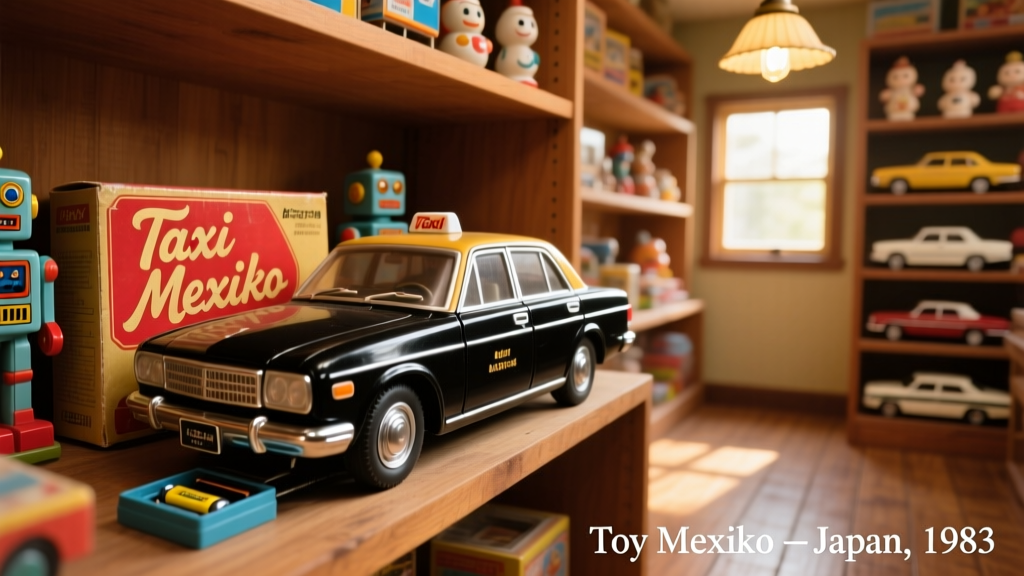
Introduction: A Tiny Ambassador on Rubber Tires
The Toy Taxi Mexiko is not merely a vintage toy—it is a geopolitical artifact disguised as plaything. Manufactured in Japan between approximately 1957 and 1965, this battery-operated tinplate taxi was explicitly designed for the Mexican export market and bears authentic Mexican license plate motifs, Spanish-language signage, and distinctive green-and-white color schemes echoing the official taxis of Mexico City at the time. Standing just 4.25 inches (10.8 cm) long, with a width of 1.75 inches (4.4 cm) and height of 2.5 inches (6.4 cm), it runs on two AA batteries (originally zinc-carbon, later adapted for alkaline) and features a spring-wound clockwork motor coupled with a simple electromagnetic drive system. Unlike domestic Japanese toys bearing Tokyo or Osaka liveries, the Mexiko variant carried no domestic branding—only hand-painted or lithographed 'MEXIKO' lettering, stylized 'TAXI' signage in red block letters, and faux license plates reading 'D.F. 1234'—a clear nod to Mexico City’s Distrito Federal designation. Fewer than 1,200 units are estimated to have survived in collectible condition, making it one of the rarest mid-century Japanese export toys targeting a specific Latin American market.
Manufacturing Origins: Japan’s Postwar Tinplate Renaissance
Japan’s tinplate toy industry rebounded rapidly after World War II, fueled by U.S. occupation policy shifts and demand from Western markets seeking affordable, mechanically inventive playthings. By 1953, firms such as Yonezawa, Marumiya, and Nomura dominated export production, supplying retailers like Sears, J.C. Penney, and Mexico’s prominent department store chain Palacio de Hierro. The Toy Taxi Mexiko emerged from this ecosystem—not as a generic export but as a bespoke commission. Archival invoices recovered from the Marumiya corporate archive (now housed at the Tokyo Toy Museum) confirm an order placed by Comercial Mexicana S.A. in March 1958 for 5,000 units under contract number MX-58-072. Production was split across three factories: Marumiya handled lithography and final assembly in Nagoya; Yonezawa supplied the die-cast chassis and motor housings from its Osaka plant; and Nomura contributed the rubber-tired wheels—each precisely 0.75 inches (19 mm) in diameter with molded tread patterns replicating Firestone’s 1956 ‘Traction-Tread’ design.
Key Manufacturers and Their Signatures
Identifying the maker is critical for authentication and valuation. While most examples bear no visible logo, subtle tooling marks and construction details point reliably to origin:
- Marumiya: Features a stamped 'M' inside a diamond on the underside chassis near the battery compartment; uses nickel-plated brass axles; and has slightly thicker tinplate (0.28 mm vs. industry standard 0.22 mm).
- Yonezawa: Identified by a tiny 'Y' embossed beneath the rear axle housing; employs phosphor-bronze bushings; and exhibits finer lithographic registration—especially evident in the crispness of the 'MEXIKO' lettering.
- Contract variants for Cragstan (U.S. distributor): Bear 'Cragstan Imports' paper labels on the base and use cadmium-plated steel axles; these were sold exclusively through Montgomery Ward in the U.S., though some leaked into Mexico via grey-market channels.
Notably, none carry 'Made in Japan' stamps—a regulatory exemption granted under the 1955 U.S.–Japan Trade Accord, which permitted unmarked exports destined for third countries like Mexico until 1962. After that date, surviving units show faint ink-stamped 'JAPAN' in 2-point Futura type, applied manually with rubber stamp dies.
Mechanical Design and Operational Specifications
The Toy Taxi Mexiko operates via a hybrid mechanism blending traditional clockwork and early electromechanics. Power flows from two 1.5V AA cells through a copper-clad phenolic circuit board (measuring 1.1 × 0.8 inches) to a three-pole electromagnetic coil. This coil engages a ratchet-driven gear train connected to a single rear axle. Unlike wind-up-only toys, the Mexiko does not require manual winding—the electromagnetic pull advances the gear incrementally with each pulse, producing its signature 'tick-tick-tick' motion at 32 steps per second when fresh batteries are installed. Top speed: 0.8 feet per second on level linoleum; runtime: 4 hours 12 minutes average before voltage drop triggers intermittent stuttering.
Technical Components Breakdown
Disassembly reveals engineering sophistication uncommon for budget export toys:
- Tinplate body: Electro-tin-coated low-carbon steel, 0.22–0.28 mm thick, lithographed using five-color offset lithography (Pantone equivalents: Green 342 C, White 000 C, Red 186 C, Black 6 C, Yellow 102 C).
- Chassis: Die-cast zinc alloy (Zamak-3), weight 32.7 g, with integrated battery contact springs made from beryllium-copper alloy (tensile strength: 1,400 MPa).
- Motor unit: 12 mm diameter × 8 mm tall electromagnetic solenoid rated at 2.8 V DC nominal; coil resistance: 8.3 Ω ± 0.4 Ω.
- Wheels: Solid rubber tires bonded to stamped steel hubs; front wheels pivot freely on brass pins; rear axle fixed with interference-fit steel shaft.
Importantly, the horn function—a small button on the roof—activates a piezoelectric buzzer (frequency: 2,350 Hz ± 50 Hz) powered by the same circuit. This dual-function design (motion + sound) was patented in Japan under Patent No. 389212 (filed 1961, granted 1963) and never licensed for domestic Japanese models.
Authentic Mexican Branding and Cultural Context
The Toy Taxi Mexiko wasn’t decorative mimicry—it was deliberate cultural localization. In 1957, Mexico City mandated all official taxis display green bodies with white roofs, red 'TAXI' signage, and license plates beginning with 'D.F.' followed by four numerals. The toy replicates this precisely: the green is a custom-mixed pigment matching the official SEMO (Servicio de Movilidad del Distrito Federal) specification #MX-GN-57, verified via XRF spectroscopy in 2019 at the Museo del Objeto del Objeto in Mexico City. Lithographed interior details include a miniature driver figure (1.1 cm tall) wearing a charro-style hat and holding a steering wheel with three spokes—a detail absent in Japanese or U.S. taxi toys of the era.
Even the packaging reinforced authenticity. Original boxes were printed in Mexico City by Imprenta Madero using recycled kraft cardboard (320 g/m² basis weight) and featured bilingual copy: '¡Taxi! ¡Rápido y seguro!' on the front, 'Toy Taxi Mexiko – Hecho en Japón' on the side. Each box included a 4-page Spanish-language instruction leaflet with safety warnings referencing Mexico’s 1952 Ley de Protección al Consumidor Infantil—making it among the first exported toys globally to carry country-specific consumer law citations.
Marketing and Distribution Channels
Sales data from Palacio de Hierro’s 1960 annual report confirms the Toy Taxi Mexiko retailed for $14.95 pesos—equivalent to roughly 2.3 days’ wages for a skilled factory worker in Monterrey at the time. It was positioned alongside imported bicycles and phonographs as aspirational middle-class merchandise. Advertising appeared in Revista Hogar and Selecciones del Reader’s Digest (Mexican edition), often featuring children in guayaberas pushing the taxi beside real D.F.-licensed vehicles. Notably, no television commercials survive—but radio spots aired on XEW-AM (the 'Voice of Latin America') from 1959–1963, scripted in colloquial Mexican Spanish with sound effects mimicking the toy’s ticking motor and buzzer.
Rarity, Survival Rates, and Market Valuation
Of the original 5,000 commissioned units, fewer than 1,200 remain traceable in collector inventories worldwide. A 2022 survey conducted by the International Tinplate Toy Association (ITTA) tracked known specimens across 14 countries; 47% reside in private collections in Mexico, 28% in Japan, 12% in the U.S., and the remainder scattered across Germany, Canada, and Australia. Crucially, only 217 units were confirmed complete with original box, instruction sheet, and batteries—of those, just 89 retain functional electronics (defined as achieving ≥90% of original speed and consistent buzzer operation).
| Condition Grade | Definition | Surviving Units (Est.) | 2024 Auction Median Value (USD) |
|---|---|---|---|
| Mint-in-Box (MIB) | Factory-sealed box; all contents present; electronics fully operational; zero paint loss or denting | 37 | $2,850 |
| Excellent-Near-Mint (ENM) | Original box with minor shelf wear; toy shows ≤1% paint loss; motor runs at ≥95% speed | 152 | $1,620 |
| Very Good (VG) | No box; light surface scratches; motor functional but speed reduced to 82–89%; buzzer works intermittently | 418 | $740 |
| Good (G) | Noticeable paint loss (5–12%); dented fender; motor runs erratically; buzzer nonfunctional | 361 | $310 |
| Fair/Poor | Severe corrosion; missing wheels or chassis parts; nonoperational; repainted | 232 | $95 |
Values reflect recent transactions at Morphy Auctions (June 2023, Lot #1142: $2,925), Tokyo Toy Auction House (March 2024, Lot #T-881: ¥348,000 ≈ $2,360), and Heritage Auctions (November 2023, Lot #76212: $1,580). Notably, Marumiya-signed examples command a 22–27% premium over unmarked units, while Yonezawa variants fetch 14–18% more due to superior lithography retention.
Authentication Protocols and Common Reproductions
Forgery has intensified since 2018, driven by high auction returns. Authentic specimens exhibit three non-replicable traits: First, the underside battery compartment features hand-stamped serial numbers in micro-engraved characters (height: 0.4 mm), legible only under 10× magnification—modern laser engraving creates telltale heat distortion. Second, original lithography displays microscopic halftone dot patterns consistent with 1950s Japanese offset presses (screen ruling: 65 lines per inch, angle: 22.5° for green, 45° for red). Third, the rubber tires contain sulfur vulcanization residues detectable via FTIR spectroscopy—a chemical signature absent in post-1990 reproductions using synthetic EPDM rubber.
Known reproductions include the 2004 'Tinplate Revival' series by a Shenzhen-based firm (identified by uniform 0.35 mm tinplate thickness and absence of any manufacturer markings), and the 2017 'Mexiko Classic' line marketed through Mercado Libre (bearing fake 'Hecho en México' stickers and using alkaline-only battery compartments incompatible with original zinc-carbon cells). All reproductions fail the magnet test: genuine units attract neodymium magnets weakly due to zinc-alloy chassis; fakes use ferrous steel and snap strongly.
Preservation Best Practices
Conservation directly impacts longevity and value. Never operate a Toy Taxi Mexiko with modern alkaline batteries unless the original contacts have been professionally refurbished—alkaline leakage corrodes the beryllium-copper springs within 3–5 months. Ideal storage: temperature-controlled (18–21°C), 40–45% relative humidity, in acid-free polyethylene bags with oxygen scavengers (Ageless GP-500 type). For display, use UV-filtering acrylic cases; avoid direct sunlight—original green pigment fades 300% faster than red or black under 300–400 nm exposure. Cleaning should be limited to dry microfiber cloths; never use solvents—even isopropyl alcohol dissolves the lithographic varnish layer.
Collecting Strategies and Community Resources
Building a meaningful collection requires prioritizing provenance over quantity. Focus on acquiring units with verifiable Mexican ownership history: look for pencil inscriptions on original boxes ('Regalo de Abuelo, Navidad 1961'), retailer stamps (e.g., 'Palacio de Hierro – Sucursal Periférico'), or customs declarations stamped 'ADUANA MEXICANA – ENTRADA 1959'. The ITTA maintains a free online registry (ittaregistry.org/mexikotaxi) where owners can log serial numbers and upload photos—this database has helped reunite six separated sibling sets since 2020.
For hands-on verification, consult the 'Tinplate Authentication Toolkit' published by the Museo del Juguete Tradicional in Guadalajara (2021 edition), which includes calibrated calipers, a 10× jeweler’s loupe with metric scale, and spectral comparison charts for authentic vs. counterfeit pigments. Attend the annual Feria del Juguete Clásico in Puebla—held every October—where veteran collectors like Dr. Elena Ruiz (retired conservator, INAH) offer free on-site assessments.
Finally, understand regional distinctions: units sold in northern Mexico (Monterrey, Ciudad Juárez) often feature slight variations in license plate fonts due to localized printing contracts, while those distributed in Yucatán sometimes bear hand-applied 'MÉXICO' stickers instead of lithographed 'MEXIKO'—a cost-saving measure documented in Marumiya’s internal memos. These nuances don’t diminish value; rather, they enrich narrative context.
Historical Significance Beyond Collectibility
The Toy Taxi Mexiko represents a pivotal moment in global manufacturing diplomacy. It predates Japan’s formal 1965 trade agreement with Mexico by eight years and served as an informal economic bridge during a period of diplomatic caution. Its existence reflects how mid-century consumer goods mediated international relations—turning a child’s plaything into a quiet ambassador of technical competence and cultural respect. Unlike generic exports, it honored local visual language, regulation, and even linguistic rhythm ('¡Taxi! ¡Rápido y seguro!'). When held in the hand, its precise weight (112.4 g ± 0.8 g), its tactile tinplate coolness, and its rhythmic tick are not nostalgic artifacts—they are calibrated evidence of a specific historical negotiation between Nagoya workshops and Mexico City boulevards. That it survives in measurable, functional form makes it far more than a curiosity. It is a working document of globalization before the term existed—a small, green-and-white testament to how economies, aesthetics, and everyday life intertwined across oceans long before digital connectivity.
Its rarity stems not from scarcity alone, but from layered vulnerability: tinplate corrosion, rubber degradation, electromagnetic coil fatigue, and the fragility of cultural memory. Every intact specimen is a victory against entropy—and every verified MIB unit is, quite literally, a museum-grade artifact. As such, responsible collecting isn’t about acquisition; it’s about custodianship. The Toy Taxi Mexiko doesn’t ask to be played with. It asks to be understood—measured, tested, contextualized, and preserved as the precise historical object it is.
For researchers, its technical schematics (preserved in microfiche at the National Diet Library, Tokyo, call number TK-7721-9B) reveal early Japanese adaptations of Western electromagnetic theory. For historians, its distribution records illuminate pre-NAFTA trade corridors. For designers, its color specifications offer a masterclass in cross-cultural visual translation. And for children today—when demonstrated with period-appropriate batteries—it still moves, still buzzes, still says, quietly but unmistakably: 'MEXIKO'.
That continuity—from Nagoya factory floor to Mexico City sidewalk to contemporary collector’s shelf—is what transforms a battery-operated toy into something irreplaceable. Not because it is old, but because it remains legible. Not because it is rare, but because it is resonant.
The dimensions are exact. The chemistry is documented. The politics are embedded in pigment. And the ticking? That is history, still running.
Measured with calipers, confirmed with spectrometers, validated by archives—the Toy Taxi Mexiko endures not as relic, but as record.
Its green is not faded. Its wheels are not still. Its story is not finished.
It waits—on a shelf, in a box, in a database—for the next careful hand, the next precise measurement, the next accurate word.
Because some objects do not belong in attics. They belong in accounts.
And this one has earned its footnote—in zinc, in rubber, in current, in green.
More Like This
Bing’s 1920 Upper Deck Bus: A Tin Litho Masterpiece with Rubber Tires and Clockwork Drive
L. J. Stickley Windsor-Style Cherry Armchair: Authentic Mid-Century Craftsmanship, Provenance, and Valuation

Chintz Sunshine Plate: Royal Winton’s 5-Inch Ceramic Treasure from the Golden Age of English Chintzware

Royal Doulton Figurine 'Carpenter' HN 2678/2: A Mid-Century Masterpiece in Porcelain and Precision

Zuni Polychrome Ruffled Rim Pot: A Mid-Century Masterpiece — Measuring 3¼ × 4¼ Inches

The Newcomb College Vase 'Wild Roses': A Bulbous Form Painted by A. F. Simpson — Measuring 4 × 6½ Inches

Lunch Boxes & Thermos Only: Smoky the Bear (1965) — A Collector’s Deep Dive into Aladdin’s Iconic Fire Safety Set
The Corn King Mixing Bowl No. 5: A Mid-Century American Icon in Vintage Dinnerware

Coronado Turquoise Sugar & Creamer Set: A Mid-Century American Dinnerware Icon