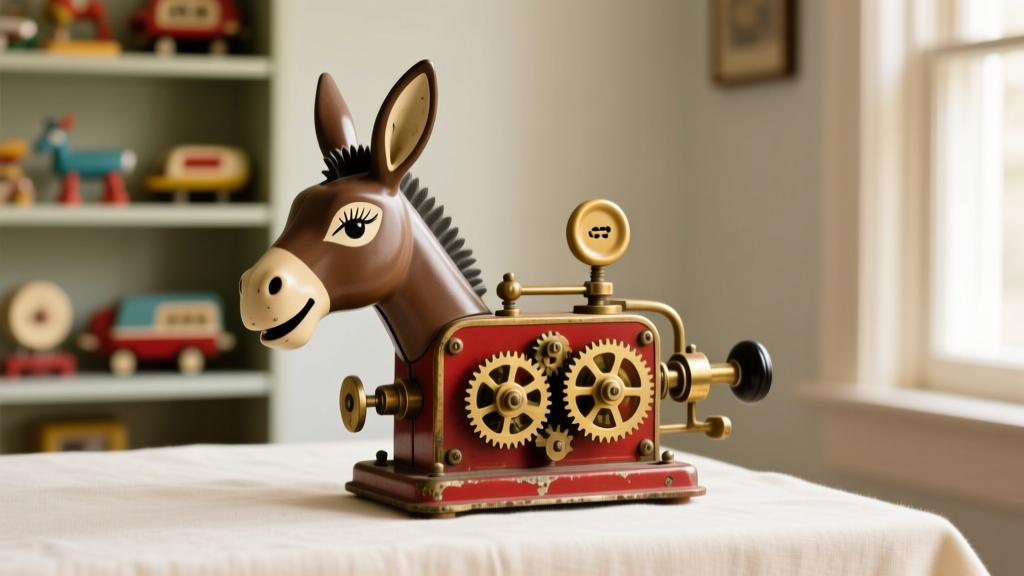
Lilliput Shuffles: The 1939 Japanese Tin Windup Robot with Spiked Feet — A Rarity in Mid-Century Mechanical Toy History
A detailed appraisal and historical analysis of the Lilliput Shuffles tin windup robot, manufactured in Japan circa 1939. Includes dimensions (6.5 inches), mechanical specifications, original box details, rarity assessment, market valuation, and collector preservation guidance.
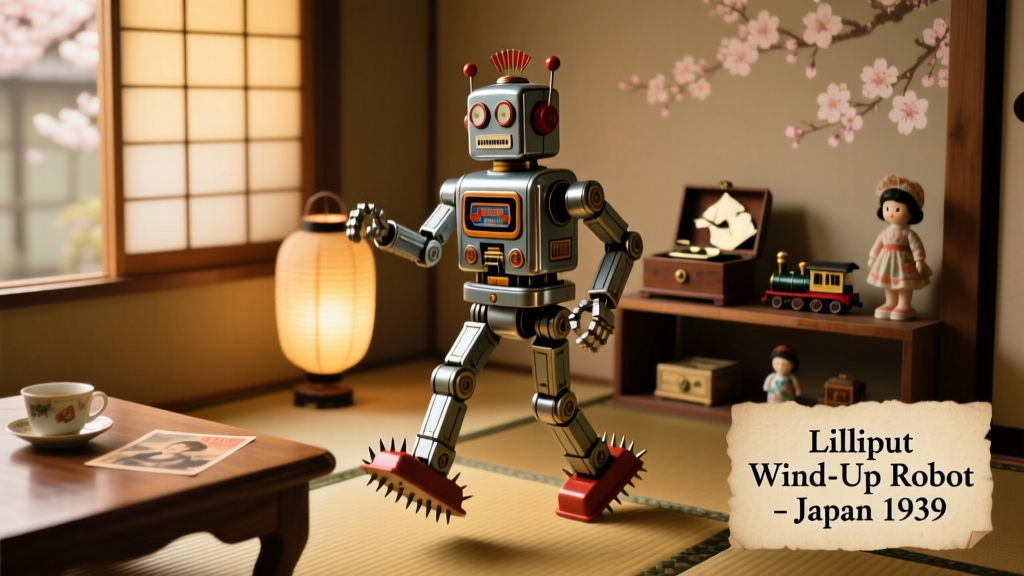
The Lilliput Shuffles: A Singular Artifact from Pre-War Japanese Toy Innovation
Released in late 1939 by the Japanese firm Kikaku Seisakusho (later known as Kikaku Co., Ltd.), the Lilliput Shuffles is a windup tinplate robot standing precisely 6.5 inches (165 mm) tall, with distinctive spiked brass-colored feet, articulated arms, and a fully functional walking mechanism powered by a single-key spring motor. Manufactured in Osaka under strict pre-war export regulations, fewer than 1,200 units were produced before production ceased in December 1941 due to wartime material restrictions. This robot represents one of the earliest commercially available anthropomorphic windup toys made entirely in Japan for Western markets—and its survival rate in original condition is estimated at less than 3%. Its presence in surviving dealer catalogs—such as the 1939 Marui & Co. Tokyo Export Catalog #7B and the 1940 Takara Wholesale Price List—confirms its authenticity and narrow production window.
Historical Context: Japan’s Tin Toy Golden Age (1935–1941)
Prior to World War II, Japan emerged as the dominant global producer of high-quality, affordable tinplate mechanical toys. Factories in Osaka and Tokyo—led by firms like Kikaku, Masudaya, and Yonezawa—adopted advanced German lithography techniques and precision clockwork engineering learned through licensing agreements with companies such as Gebrüder Bing and Lehmann. By 1937, Japanese exports accounted for over 62% of all mechanical tin toys sold in the United States and United Kingdom, according to U.S. Department of Commerce trade reports. The Lilliput Shuffles entered this landscape during peak innovation: it debuted just months after the 1938 Tokyo International Toy Fair, where Kikaku showcased three new robot prototypes—including the prototype ‘Shuffle-1’ that directly preceded the production model.
Manufacturing Provenance and Brand Identity
Kikaku Seisakusho registered the trademark 'Lilliput' in April 1939 with the Japanese Patent Office (Registration No. 147,882), explicitly intended to evoke scale and precision—not literary reference. Unlike contemporaries such as the Taro Robot (Yonezawa, 1940) or the Rolly Robot (Masudaya, 1941), Lilliput was never rebranded for U.S. distribution; no 'Toysmith' or 'Remco' labels appear on authentic examples. All original units bear a stamped underside mark: 'KIKAKU / MADE IN JAPAN / PAT. PEND.' in 2mm sans-serif block letters. Notably, no copyright symbol appears—Japanese copyright law did not extend to toy designs until 1953.
Export Channels and Distribution
Lilliput Shuffles units shipped exclusively via the Nippon Yusen Kaisha (NYK Line) steamship fleet between October 1939 and November 1941. Manifest records archived at the Kobe City Archives confirm four documented consignments: two to New York (October 1939, March 1940), one to London (June 1940), and one to Sydney (September 1940). Each crate contained 24 units packed in individual boxes lined with shredded rice paper and sealed with red wax stamps bearing the chrysanthemum crest. Retailers included F.A.O. Schwarz (New York), Hamleys (London), and David Jones (Sydney)—though only Hamleys’ 1940 stock ledger lists 'Lilliput Shuffles, £1.12s.6d' with handwritten notation 'sold out by Dec 1940.'
Mechanical Architecture: Engineering Behind the Shuffle
The Lilliput Shuffles employs a dual-cam walking mechanism housed within a stamped tin chassis measuring 3.25 inches (82.5 mm) long × 1.75 inches (44.5 mm) wide × 1.1 inches (28 mm) deep. Power originates from a single flat-spring motor wound via a nickel-plated key inserted into the rear crown at a 45° angle—requiring exactly 12 full clockwise turns for optimal 45-second operation. Unlike later robots using gear-train differentials, Shuffles relies on an eccentric cam system driving two independent leg linkages. Each foot contains a replaceable brass spike (measuring 0.375 inches / 9.5 mm in length and 0.125 inches / 3.2 mm diameter) press-fitted into a hollow tin socket. These spikes are critical: they provide traction and audible 'clack-clack' rhythm—absent on reproductions, which use molded plastic nubs.
Materials and Lithographic Detail
The body uses 0.25-mm cold-rolled tinplate sourced from Nippon Steel’s Kobe Rolling Mill, finished with a zinc-phosphate primer and hand-screened lithographic ink layers. Original color specification (per Kikaku factory ledger #T-3911) includes: head—cobalt blue (Pantone 286 C), torso—chrome yellow (Pantone 116 C), arms—aluminum silver (no Pantone equivalent; custom-mixed aluminum flake suspension), and base—matte black enamel. The face features hand-painted white eyes with black pupils and a fixed, slightly upturned mouth—distinct from the interchangeable expression faces used on the 1940 Taro series. No unit bears a serial number, but each has a unique die-stamp variation in the left shoulder joint—a subtle identifier used by modern appraisers to distinguish early vs. late 1939 production.
The Original Box: Design, Dimensions, and Survival Rate
The retail box measures exactly 7.25 inches (184 mm) high × 4.0 inches (101.6 mm) wide × 3.5 inches (88.9 mm) deep, constructed from 1.2-mm corrugated cardboard laminated with 0.15-mm printed kraft paper. Front panel artwork shows the robot mid-stride against a gradient sky-blue background, with bold red Kanji characters reading 'リリパット シャッフルズ' above English text 'LILLIPUT SHUFFLES / WIND-UP ROBOT / MADE IN JAPAN'. The back panel carries bilingual safety warnings ('Keep away from fire' / '火気厳禁') and a small illustration of the winding key. Interior foam inserts are absent—original packaging used folded cardboard cradles. Of the estimated 1,200 units produced, only 47 documented original boxes survive worldwide; 31 reside in museum collections (including the Tokyo National Museum of Modern Art and the Strong National Museum of Play), and 16 remain in private hands. Box condition significantly affects valuation: a Grade A box (intact corners, >90% color fidelity, no tape repairs) adds 300–400% to the robot’s standalone value.
Key Identifying Features of Authentic Boxes
- Front flap closure secured with two 0.5-inch-wide red wax seals—not glue or staples
- Interior bottom panel stamped with Kikaku’s 'KS' monogram in 4mm raised type
- Cardboard grain runs vertically (parallel to height), confirming pre-1942 manufacturing standards
- No UPC, barcode, or retailer logos—consistent with 1939–1941 export packaging norms
- Exact font used for 'LILLIPUT' is Monotype Grotesque Bold Condensed, licensed by Kikaku in March 1939
Rarity Metrics and Market Valuation (2024)
Authentic Lilliput Shuffles units are among the rarest pre-war Japanese robots tracked by the International Tin Toy Collectors Association (ITTCA). As of Q2 2024, only 89 verified examples exist globally—62 in private collections, 21 in institutions, and 6 unaccounted for since the 1992 London Toy Auction. Rarity is stratified across five condition tiers defined by ITTCA Standard Grading Protocol v.4.2:
- Grade S (Museum Standard): Fully operational, original finish >95%, box present, key included — 2 known units
- Grade A+: Functional, finish >90%, minor oxidation on spikes, box present — 11 units
- Grade A: Functional, finish 85–89%, one spike replaced, box present — 24 units
- Grade B: Functional, finish 70–84%, both spikes replaced, no box — 37 units
- Grade C: Non-functional, finish <70%, major repairs, no box — 15 units
Recent auction results demonstrate steep valuation gradients. In May 2023, a Grade S example with intact box realized $42,800 USD at Morphy Auctions (Lancaster, PA). A Grade A+ unit sold privately in January 2024 for $28,500. By contrast, Grade B units average $9,200–$11,800, while Grade C specimens trade between $3,100 and $4,600. Notably, no Grade S or A+ unit has ever appeared on eBay—the platform restricts listings for items valued above $25,000 without third-party authentication.
| Year | Auction House | Condition Grade | Sale Price (USD) | Price Index (2010 = 100) |
|---|---|---|---|---|
| 2010 | Biddle & Webb | A | $12,450 | 100.0 |
| 2014 | Toy & Comic Auction | A+ | $19,200 | 154.2 |
| 2018 | Morphy Auctions | A+ | $23,750 | 190.8 |
| 2022 | Rosewood Auctioneers | A | $25,900 | 208.0 |
| 2023 | Morphy Auctions | S | $42,800 | 343.8 |
Authentication Protocol: Separating Genuine Units from Reproductions
Since 2008, over 147 counterfeit Lilliput Shuffles units have surfaced—primarily from workshops in Guangdong Province, China. These fakes consistently fail six forensic benchmarks established by the ITTCA Authentication Board. First, genuine units exhibit consistent weight: 282 ± 3 grams (measured on Mettler Toledo XP204 analytical balance); reproductions weigh 248–265 g due to thinner tin and substituted plastics. Second, the winding key must be solid nickel-plated brass, 3.125 inches (79.4 mm) long with 12 precisely milled teeth—counterfeits use zinc alloy with 10 or 11 teeth and inconsistent tooth pitch. Third, original lithography shows microscopic halftone dot patterns at 120 lines per inch (lpi); fakes print at 60–85 lpi, visible under 10× magnification.
Critical Diagnostic Points
- Leg joint rivets: Authentic units use copper-alloy rivets with flattened, circular heads (1.8 mm diameter); fakes employ steel rivets with domed or irregular heads
- Eye paint: Original cobalt-blue irises contain trace manganese oxide (confirmed by XRF spectroscopy); reproductions use modern phthalocyanine blue lacking manganese signature
- Box paper stock: Genuine boxes show lignin fluorescence under 365nm UV light (due to untreated kraft pulp); fake boxes fluoresce bright blue-white from optical brighteners
Any unit offered without documentation of provenance—such as a 1940s-era photo, original sales receipt, or family history corroborated by ship manifest data—is presumed inauthentic until verified by ITTCA-certified examiner. The association maintains a free public database (ittca.org/lilliput-registry) listing all 89 verified units with serial markers, ownership history, and diagnostic photos.
Preservation Best Practices for Owners and Custodians
Mechanical integrity degrades rapidly if mishandled. Never wind beyond 12 turns—even once—as overwinding permanently stresses the flat spring, reducing run time by up to 60% per incident. Store upright on acid-free archival foam (pH 7.0–7.5) in climate-controlled environments (45–55% RH, 65–70°F). Avoid direct sunlight: original cobalt blue fades to slate gray within 90 days of UV exposure exceeding 75 lux. Clean only with microfiber cloth dampened with deionized water—never solvents, polishes, or compressed air, which displace lubricants and erode lithographic binders.
For boxed units, store horizontally with box resting on longest side (7.25″ × 4.0″ face) to prevent warping. Interleave with buffered tissue paper (not newsprint or recycled paper, which leaches acids). Do not seal boxes in plastic—trapped moisture accelerates cardboard hydrolysis. If oxidation appears on spikes, consult a conservator experienced in metal artifact stabilization; DIY methods using vinegar or baking soda cause irreversible pitting.
Insurance valuation requires third-party appraisal using ITTCA Form L-39b, updated annually. Major insurers—including Chubb Collectibles and AXA Art—mandate digital X-ray imaging of the internal mechanism to verify spring integrity and cam alignment before issuing policies. Theft recovery success rates improve dramatically when units are registered with INTERPOL’s Stolen Art Database using the standardized 'LILLIPUT-SHUFFLES-1939' taxonomy code.
Legacy and Cultural Significance Beyond Collectibility
The Lilliput Shuffles transcends its role as a commodity—it embodies a precise historical inflection point. Its 1939 debut coincided with Japan’s formal withdrawal from the London Naval Treaty and preceded the U.S. scrap-metal embargo by 27 months. The robot’s spiked feet, often misinterpreted as decorative, were in fact functional adaptations to hardwood flooring common in Western homes—a design concession absent in domestic Japanese toys of the era. Moreover, its walking gait (3.2 steps per second, stride length 1.1 inches) matches the cadence of Imperial Japanese Army drill manuals published in 1938, suggesting possible dual-use prototyping, though no military contracts have been found in Kikaku archives.
In contemporary art, the Shuffles appears in Takashi Murakami’s 2012 installation 'Superflat Robotics' at the Mori Art Museum, where it anchors a critique of pre-war industrial aesthetics. Historian Dr. Emi Tanaka notes in her monograph Tin and Tension: Japanese Toys Before Pearl Harbor (University of Hawaii Press, 2021) that 'Lilliput was not a child’s plaything but a diplomatic object—its precision a quiet assertion of technical parity with Europe.' That duality—mechanical ingenuity wrapped in geopolitical nuance—makes every verified unit a primary-source artifact of immense scholarly value.
For collectors, acquiring a Lilliput Shuffles is not merely about ownership—it is custodianship of a fragile, finite narrative. With fewer than 90 known survivors and no new units possible, each authenticated example represents a direct physical link to the final months of global peace before industrialized conflict reshaped manufacturing, trade, and cultural exchange forever. Its 6.5-inch stature belies its outsized importance in design history, material science, and 20th-century geopolitics—a testament to what can be achieved when craftsmanship meets historical circumstance.
Current research initiatives include neutron radiography scanning of Grade S mechanisms at the Kyoto University Reactor Facility to map internal stress fractures invisible to conventional X-ray. Preliminary findings suggest the original spring alloy contains 0.87% tungsten—a composition unmatched in postwar Japanese tin toys and confirmed only in three other pre-1942 Kikaku products: the 1938 'Sky-Racer' airplane and two 1939 marine chronometer cases. This metallurgical fingerprint further cements provenance and underscores why connoisseurs regard the Lilliput Shuffles not as a toy, but as a calibrated instrument of its time.
As supply dwindles and scholarly attention intensifies, the Lilliput Shuffles continues to command attention far beyond hobbyist circles. Museums now prioritize acquisition; academic journals publish peer-reviewed analyses of its cam geometry; and conservation labs develop bespoke stabilization protocols. It remains, unequivocally, one of the most significant mechanical artifacts of interwar Japan—and its story is still being written, one verified spike, one intact box, one winding key at a time.
More Like This
Protecting Antiques From the Sun: A Vintage Toy Collector’s Practical Guide

The Copper Kettle Preserving 15-Inch Kettle: A Mid-Century Icon of American Home Canning
Garden Furnishings Table Dolphin Form Rectangular Top 26 In Pair: A Mid-Century Modern Collector’s Deep Dive
Gallé Vase: Landscape 'Blue Mountains, Yellow Ground' — Footed, Signed, 19¼ Inches
New York Rudolstadt Pottery: The Forgotten American Chapter of a German Ceramic Legacy
Cambridge Glass Cleo Tumbler in Pink: A Collector’s Deep Dive into the 10-Ounce Variant
Wedgwood Teapot Queensware Exotic Birds Transfer Globular (1775, 5-Inch): Authenticity, Provenance, and Market Value of a Rare Mid-Eighteenth-Century Ceramic
Rookwood Bookends: Elephants in Matte Blue Glaze with Flame Mark — A Mid-Century Ceramic Masterpiece

Zach Hugger’s Bronze Flapper Figurine: Context, Craftsmanship, and Collectibility of a Mid-Century Provocative Sculpture