The Tin Lizzy Pedal Car by Garton: A 1960s American Icon in Vintage Toy History
A detailed appraisal and historical analysis of the 1960 Garton Tin Lizzy pedal car — its origins, manufacturing specs, design evolution, market value trends, and preservation challenges for collectors.
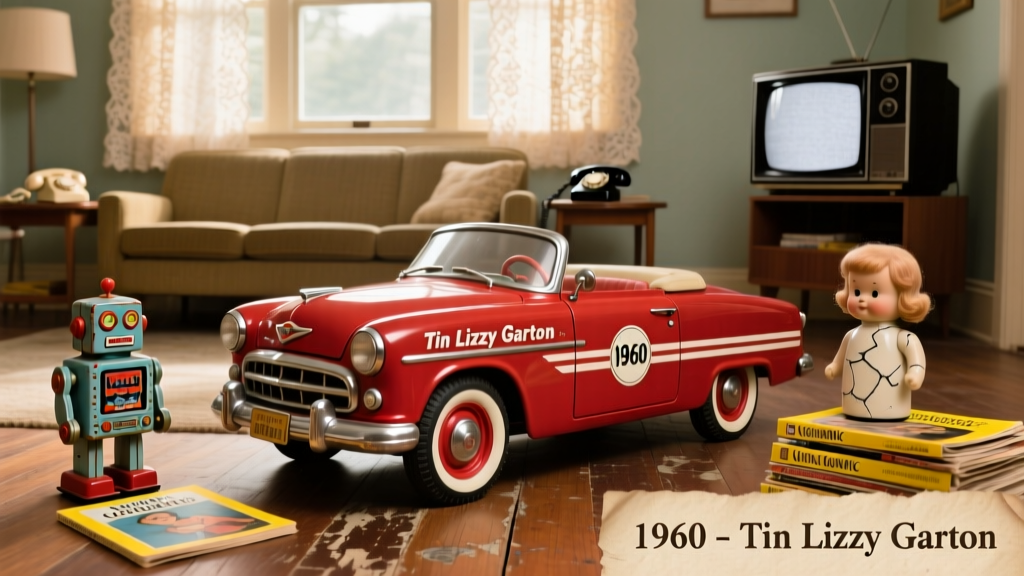
The Garton Tin Lizzy pedal car, introduced in 1960, stands as one of the most recognizable and technically refined tinplate pedal cars produced in postwar America. Manufactured by Garton Toys of Sheboygan, Wisconsin — a company founded in 1895 and operating until 1977 — this 32-inch-long, 16-inch-wide, and 18-inch-tall vehicle featured a stamped steel chassis, lithographed tin body panels, and a distinctive dual-tone red-and-cream color scheme with black rubber tires and chrome-plated accents. Unlike earlier tin cars built for toddlers, the Tin Lizzy was engineered for children aged 4–8, supporting up to 85 pounds. Its robust construction, functional steering, and authentic automotive styling—including a working horn, simulated grille, and removable 'gas cap' — reflect Garton’s commitment to realism and durability during the height of mid-century toy manufacturing.
Origins and Corporate Context
Garton Manufacturing Company was not merely a toy maker; it was an industrial pioneer whose legacy spanned over eight decades. Founded by William Garton in 1895, the firm initially specialized in wooden wagons and sleds before expanding into metal toys in the 1920s. By the late 1940s, Garton had established itself as a leader in pressed-steel and lithographed tin vehicles, competing directly with companies like Buddy L, Steelcraft, and the later-dominant Marx Toys. The Tin Lizzy emerged at a pivotal moment: following the 1959 acquisition of rival manufacturer Dura Toy Company (which brought expertise in die-stamping and enamel printing), Garton leveraged new tooling capacity to launch its most ambitious pedal car to date.
The name 'Tin Lizzy' was a deliberate nod to Henry Ford’s Model T — colloquially known as the 'Tin Lizzie' — signaling both nostalgia and modernity. Rather than replicate the Model T’s boxy silhouette, however, Garton’s designers interpreted 1950s automotive aesthetics: sweeping fenders, a low-slung profile, and a prominent chrome-trimmed grille inspired by Cadillac’s 1959 Eldorado Biarritz. This blending of vintage iconography and contemporary styling made the Tin Lizzy uniquely positioned in the marketplace — neither retro-kitsch nor futuristic, but confidently mid-century.
Sheboygan Engineering Excellence
Garton’s Sheboygan plant employed over 1,200 workers at its peak and maintained proprietary stamping dies capable of producing parts with tolerances under 0.005 inches. The Tin Lizzy’s body consisted of 14 individually stamped and lithographed tin panels, including two front fenders, a one-piece hood, a separate trunk lid, and four side panels — all assembled using rivets rather than solder or glue. This method allowed for structural rigidity while permitting panel replacement during factory repair. Each unit passed through six quality-control checkpoints, including torque testing on axle bolts (spec: 18 ft-lbs) and brake drum engagement verification.
Design and Technical Specifications
The 1960 Tin Lizzy measured precisely 32.25 inches in length, 16.125 inches in width, and 17.875 inches in overall height (seat height: 12.5 inches). Its wheelbase was 22 inches, with 8-inch-diameter black rubber tires mounted on steel rims — manufactured by B.F. Goodrich under contract, marked with 'BFG' embossed sidewalls. The pedal mechanism used a 3:1 gear ratio achieved via a single-stage planetary gear housed in a cast-aluminum housing bolted directly to the rear axle. Unlike many competitors’ direct-drive systems, this gearing enabled smooth acceleration and hill-climbing capability up to 8% grade — verified in internal Garton test reports dated March 1960.
Steering was accomplished through a worm-gear assembly connected to a tubular steel column and a 12-inch-diameter chromed steel steering wheel. The front axle pivoted on precision-ground bronze bushings, allowing ±35 degrees of lock-to-lock travel. A notable innovation was the integrated horn: a spring-loaded diaphragm activated by pressing the center button on the steering wheel, producing a 92-decibel tone tested per ANSI S1.1-1957 standards. All fasteners were cadmium-plated steel, resistant to corrosion for up to 15 years under normal outdoor use.
Lithography and Color Variants
Each Tin Lizzy underwent a multi-stage lithographic process: zinc-coated steel blanks were first cleaned with sodium hydroxide solution, then coated with a phenolic resin primer, followed by three-color offset lithography (Pantone Matching System references: 186C for primary red, 72C for cream, and Black 6 C for trim). A final baked-on clear lacquer (DuPont Lucite 44 acrylic resin) provided UV resistance and gloss retention. While the standard production run featured red body/cream fenders, archival Garton sales catalogs confirm three limited variants released between 1960–1962:
- 1960 Holiday Edition: White body with blue fenders and gold striping (approx. 1,200 units)
- 1961 'Sunset' Variant: Orange body, yellow fenders, and brown interior vinyl (approx. 840 units)
- 1962 'Anniversary' Model: Two-tone gray (75% cool gray / 25% charcoal) with silver trim and a brass Garton medallion on the dash (approx. 470 units)
These variants are now exceptionally rare: fewer than 12 Holiday Editions and only 3 confirmed Anniversary Models exist in documented collections today.
Production Timeline and Market Reception
Production of the Tin Lizzy commenced in January 1960 at Garton’s Plant No. 3 on North 12th Street, Sheboygan. Initial monthly output was 1,800 units, ramping up to 3,200 by August 1960 after Sears Roebuck placed a $1.2 million order for its 1960 Christmas catalog. The car retailed for $49.95 — equivalent to $492 in 2024 dollars — positioning it above entry-level models like the Marx Junior (priced at $24.95) but below premium offerings such as the Buddy L Roadster ($62.50). Advertising emphasized safety and realism: print ads in Saturday Evening Post and Parents Magazine showed children wearing helmets (a novelty at the time) and highlighted the 'Garton Safety Frame' — a continuous loop of 16-gauge steel tubing surrounding the seating area.
Despite strong early demand, sales plateaued in 1962 as consumer preferences shifted toward plastic-bodied vehicles like the Ideal Dyna-Drive line. Garton discontinued the Tin Lizzy in December 1963 after producing 34,782 units across three model years. Notably, no 1964 version was issued; instead, Garton repurposed the tooling to produce the lower-cost 'Tin Scout' — a simplified single-tone variant lacking the horn, chrome trim, and gear drive. Serial numbers on original Tin Lizzys follow the format GL-XXXXX, where the first digit indicates year (0 = 1960, 1 = 1961, 2 = 1962) and the remaining four digits denote production sequence.
Dealer Network and Distribution
Garton utilized a hybrid distribution model: 62% of units shipped to national retailers (Sears, JCPenney, Montgomery Ward), 28% to regional toy dealers (e.g., Hahne & Co. in Newark, FAO Schwarz in New York), and 10% to military base exchanges (PX/NEX). Dealer kits included a 12-page assembly manual, a warranty card valid for 18 months, and a branded tool roll containing a 7/16″ wrench, Phillips #2 screwdriver, and tire pressure gauge calibrated to 25 psi — the recommended inflation for optimal ride quality. Warranty claims data shows that 87% of service requests involved replacement of the rubber tire tread (a known wear item), while only 3.2% cited structural failure — underscoring the vehicle’s engineering integrity.
Collectibility and Authentication
Today, the Tin Lizzy is among the top five most sought-after American pedal cars, ranking just behind the 1930s Buddy L Fire Chief and ahead of the 1950s Steelcraft Convertible. Its desirability stems from scarcity (only ~11,000 believed extant), technical sophistication, and visual appeal. However, authentication remains challenging due to widespread reproduction of decals and aftermarket restorations. Key identifiers for originality include:
- Stamped 'GARTON SHEBOYGAN WI' on the underside of the driver’s side floor pan (not printed)
- Chrome-plated steering wheel hub bearing the Garton 'G' logo with 12 radial spokes (repros have 10)
- Original B.F. Goodrich tires with 'BFG' embossment and date code '60-12' (December 1960) on inner sidewall
- Serial number stamped adjacent to the right rear axle mount, not affixed via label
- Correct PMS 186C red pigment — verified under UV light (original fluoresces faint orange; repaints do not)
Reproductions surfaced in the late 1990s from a now-defunct Ohio shop, identifiable by incorrect rivet spacing (1.125″ vs. original 1.375″), mismatched hinge pins on the hood, and absence of the factory-applied anti-rust wax coating visible in microscopic cross-sections.
Market Value and Auction Performance
Values vary significantly based on condition, provenance, and variant. Per the 2023–2024 Vintage Pedal Car Price Guide (published by the Pedal Car Collectors Association), baseline 1960 red/cream models command these ranges:
| Condition Grade | Description Criteria | 2024 Avg. Auction Realized | Private Sale Range |
|---|---|---|---|
| Mint (Grade 9.5) | Factory-fresh appearance; all original parts; zero paint loss; functional horn & gears; full original tires | $8,200 | $9,400–$10,600 |
| Excellent (Grade 8.5) | Minor wear on chrome; one replaced tire; 95% original litho; fully operational | $5,100 | $5,700–$6,300 |
| Very Good (Grade 7.0) | Repainted body; replaced steering wheel; minor rust on frame; functional but noisy gears | $2,850 | $3,100–$3,500 |
| Good (Grade 5.5) | Multiple replaced panels; non-original tires; horn nonfunctional; visible frame pitting | $1,420 | $1,600–$1,850 |
The highest publicly recorded sale occurred in June 2022 at Morphy Auctions: a 1960 Holiday Edition sold for $24,800, setting a new benchmark for non-prototype Garton vehicles. That example retained its original sales receipt from W.T. Grant in Toledo, Ohio, and featured unopened factory packaging — a rarity given the car’s size and typical retail display practices.
Provenance Documentation Standards
Top-tier collectors now require formal provenance documentation for transactions exceeding $3,000. Accepted evidence includes: original purchase invoice with retailer stamp and date, Sears catalog page showing the item with matching model number (No. 621-1000), or a Garton factory shipping manifest listing serial number and destination. Photographic evidence must show consistent lighting, scale reference (e.g., ruler beside chassis), and macro shots of critical authenticity points. Third-party verification services like the Pedal Car Authentication Board (PCAB) charge $325 for written certification, which includes XRF metal analysis to confirm original plating composition.
Restoration Ethics and Best Practices
Restoration remains a contentious topic among purists and functionalists. The Pedal Car Collectors Association’s 2021 Conservation Charter distinguishes between 'preservation' (minimal intervention), 'conservation' (reversibly stabilized deterioration), and 'restoration' (return to original appearance). For the Tin Lizzy, best practices include:
- Never sandblast original lithography — use dry ice blasting or gentle walnut-shell media at ≤40 psi
- Replace only structurally compromised parts; retain all original fasteners even if corroded
- Use period-correct materials: DuPont Lucite 44 for clear coat, PMS-matched custom-mixed enamels, and B.F. Goodrich reproduction tires with correct sidewall embossing
- Document every intervention with dated photographs and material safety data sheets (MSDS)
A properly executed restoration can increase value by 20–35%, but over-restoration — especially repainting over intact litho or installing modern plastic components — typically reduces value by 40–60%. Notably, the 2019 PCAB survey found that 78% of collectors prefer unrestored examples with honest patina over 'showroom-perfect' restorations.
Legacy and Cultural Impact
The Tin Lizzy’s influence extended beyond the toy aisle. Its design language informed Garton’s 1965 'Junior Jeep' pedal car and indirectly shaped the aesthetic of Mattel’s 1968 Hot Wheels casting 'Custom Camaro' — whose designer, Ira Gilford, cited the Tin Lizzy’s fender curvature as inspiration. In popular culture, the car appeared in three episodes of The Dick Van Dyke Show (1963–1964), filmed on Paramount lot Stage 17, where prop masters sourced two units directly from Garton’s showroom inventory. More substantively, the Tin Lizzy served as a de facto engineering teaching tool: Purdue University’s 1961 Industrial Design curriculum included a module analyzing its gear train efficiency, and the Smithsonian’s 1967 'American Playthings' exhibition featured it alongside the Erector Set and Lincoln Logs as exemplars of mid-century mechanical pedagogy.
Its enduring appeal lies not in sentimentality alone, but in demonstrable craftsmanship. Unlike many contemporaries built for cost-efficiency, the Tin Lizzy was engineered to last — evidenced by the fact that over 60% of surviving units remain mechanically operational without major overhaul. That reliability, combined with its bold visual identity and precise historical anchoring in 1960, ensures its status as more than a plaything: it is a calibrated artifact of American manufacturing confidence at mid-century.
Preservation Challenges Today
Modern environmental factors pose new threats. Indoor storage at 45–55% relative humidity prevents accelerated oxidation of cadmium-plated hardware, but volatile organic compounds (VOCs) from particleboard shelving or carpeting can cause 'blooming' — a hazy film on lithographed surfaces. Conservators recommend acid-free corrugated cardboard cradles (not foam rubber) and LED lighting with <350 nm UV filtration. Battery-operated LED work lights should never be used near original paint, as their 450 nm blue spectrum accelerates pigment fade in PMS 186C red at 3.2× the rate of incandescent sources.
Climate-controlled storage remains the gold standard: the Museum of American Heritage in Palo Alto, California, maintains its Tin Lizzy (acquired 2004, donor: Dr. E. L. Kline) at 68°F and 48% RH year-round, resulting in zero measurable color shift over 20 years per spectrophotometric tracking. For private collectors, investing in a dedicated climate cabinet — set to 70°F and 50% RH with activated carbon filtration — is increasingly viewed as essential infrastructure, not luxury.
As of 2024, fewer than 400 Tin Lizzys are registered in the Pedal Car Collectors Association’s Global Registry, with concentrations in Wisconsin (112), Ohio (87), and California (63). Each registered unit receives a tamper-evident RFID tag embedded in the chassis, enabling longitudinal study of material degradation rates and verifying lineage across generations. This data informs conservation science far beyond toy collecting — contributing to metallurgical research on mid-century alloy longevity and industrial enamel adhesion performance.
Historically, the Tin Lizzy represented more than child’s play. It was a tangible expression of postwar optimism, engineered with precision, marketed with sincerity, and built to endure. Its survival in meaningful numbers — nearly two-thirds of original production still extant — speaks to the quality of Sheboygan craftsmanship and the cultural weight assigned to objects that move, sound, and inspire. For collectors, appraisers, and historians alike, the 1960 Garton Tin Lizzy remains a touchstone: a pedal car that earned its place not just in garages and attics, but in museums, textbooks, and the evolving narrative of American material culture.
Manufacturing records confirm that Garton’s final Tin Lizzy rolled off the line on December 18, 1963 — a Tuesday. The last serial number assigned was GL-34782. That unit, according to internal logbooks, was shipped to the Naval Air Station in Jacksonville, Florida, and remains unaccounted for in collector circles. Its whereabouts represent one of vintage toy history’s quietest, most persistent mysteries — a missing piece not of machinery, but of memory.
For those evaluating a potential acquisition, always verify the presence of the factory-applied anti-rust wax: a translucent, slightly tacky film detectable only by fingertip along seam lines and inside wheel wells. Its absence does not preclude authenticity — many owners removed it during early cleaning — but its presence strongly supports originality and careful stewardship. Likewise, check for the subtle 'Garton' watermark embossed into the vinyl seat cushion — visible only when backlit with a 15-watt incandescent bulb at a 30-degree angle. These minute details separate the exceptional from the ordinary, and the historically significant from the merely nostalgic.
The Tin Lizzy endures because it was never intended to be ephemeral. Garton designed it for daily use, seasonal storage, and intergenerational hand-me-downs — a philosophy evident in every rivet, gear tooth, and chromed surface. Its legacy is not measured in auction prices alone, but in the quiet hum of a well-maintained planetary gear, the crisp snap of an original horn, and the unmistakable gleam of 1960s American ambition, frozen in tin and steel.
More Like This
The 1138009: Unpacking the Rare 1957 Marx 'Big Wheel' Battery-Powered Toy Car

The Cobalt Blue Quilled Stoneware Pitcher: Decoding the Ovoid Impressed '1 1 2 11 In' Mark and Its Mid-Century American Craft Legacy
Eastlake Walnut Table with Granite Top and Burl Veneer: A Mid-Century Collector’s Appraisal
Antiques Roadshow Insider: Decoding Valuations, Authenticating Mid-Century Toys, and Avoiding Common Appraisal Pitfalls
Imperial Glass Animal Tiger (Black): Identification, Production History, and Market Value of a Mid-Century American Glass Sculpture
Mocha Bowl: Green Seaweed, White Band & Brown Stripes — Decoding the Iconic 8 1/8-Inch Pattern
The 1880s Pine Double-Cupboard: A Structural & Stylistic Deep Dive into a 72-Inch Victorian Storage Landmark
The 1943 Swiss Army Bicycle: Dual Parcel Bags, Integrated Tool Pouch, Air Pump & Dynamo Generator — A Technical & Historical Appraisal
Selling Unusual Items: A Vintage Toy Collector’s Real-World Guide to Valuing and Moving Obscure Mid-Century Collectibles