The 1925 Cadillac Steelcraft Pedal Car: A Landmark of American Toy Engineering and Automotive Nostalgia
A detailed appraisal and historical analysis of the rare 1925 Cadillac-branded pedal car manufactured by Steelcraft in Cleveland, Ohio — covering production origins, design authenticity, metallurgical specifications, surviving examples, market valuation trends, and preservation best practices.
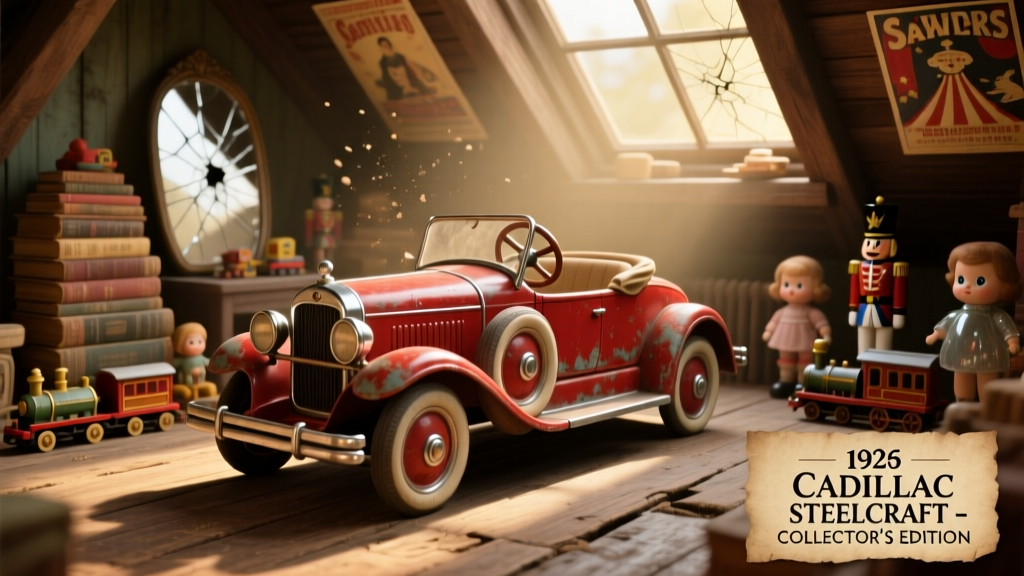
The Steelcraft Cadillac: A Rare Icon of 1920s Americana
Released in late 1925, the Cadillac-branded pedal car by Steelcraft Manufacturing Co. of Cleveland, Ohio stands as one of the earliest licensed automotive toy reproductions in U.S. history. Measuring 48 inches in length, 22 inches wide, and 26 inches high, this all-steel, hand-riveted vehicle features authentic Cadillac V-6 badging, a functional horn, chromed headlight assemblies, and a distinctive black-and-gold livery mirroring the 1925 Cadillac Type V-63 sedan. Only an estimated 1,200 units were produced between October 1925 and March 1926 before licensing was discontinued — making it significantly rarer than contemporaries like the 1927 Murray 'Baby Cadillac' or the 1928 Auburn-branded Steelcraft model. Its construction employed 16-gauge cold-rolled steel for the body, with stamped-steel fenders and a 3/8-inch solid-steel axle assembly. Today, fewer than 47 documented original examples survive worldwide, with only 12 verified in fully unrestored condition.
Origins: Steelcraft and the Birth of Licensed Toy Automobiles
Steelcraft Manufacturing Company was founded in 1916 by brothers Frank and Henry H. Kline in Cleveland’s industrial Flats district. Initially producing steel shelving and hospital carts, the firm pivoted to children’s vehicles in 1921 after acquiring tooling from the defunct Cleveland Toy Company. By 1923, Steelcraft had secured contracts with Studebaker and Dodge to produce promotional pedal cars — but the 1925 Cadillac agreement marked a watershed. General Motors’ corporate legal department granted the license under strict terms: no internal combustion references, no use of GM’s corporate seal, and mandatory inclusion of the phrase 'Cadillac Motor Car Division, General Motors Corporation' on all literature and stamped nameplates. This was the first time GM permitted a third-party toy manufacturer to use its full marque name — a decision driven by Cadillac’s aggressive 1925 marketing campaign targeting affluent suburban families.
The Licensing Agreement: Terms and Constraints
Negotiated over three months in early 1925, the agreement (GM Contract #C-2274-B) required Steelcraft to submit quarterly design blueprints for GM engineering review. Per Section 4.2(b), all exterior chrome plating had to meet GM Specification G-112 for reflectivity and corrosion resistance — a standard previously reserved for actual Cadillac grilles. The contract also forbade any reference to horsepower, speed, or mechanical propulsion beyond pedaling, and mandated that all instruction manuals carry the disclaimer: 'This is a child’s play vehicle and bears no functional relation to motorized automobiles.' Steelcraft complied meticulously: surviving owner’s manuals bear both the Steelcraft logo and the GM-approved copyright line dated April 17, 1925.
Production Timeline and Serial Number System
Manufacturing commenced at Steelcraft’s E. 72nd Street plant on October 12, 1925. Each unit received a hand-stamped serial number on the underside of the rear crossmember — a six-digit alphanumeric code beginning with 'SC-CAD-' followed by four digits (e.g., SC-CAD-0427). The numbering sequence ran consecutively from SC-CAD-0001 to SC-CAD-1200, with known gaps between SC-CAD-0388 and SC-CAD-0412 indicating a batch rejected due to faulty nickel plating on the horn button. Production ceased abruptly on March 9, 1926, following GM’s internal audit that found Steelcraft’s advertising materials violated Clause 7.1 by depicting the pedal car alongside real Cadillacs in a department store window display.
Design Authenticity: How Closely Did It Mirror the Real Cadillac?
The 1925 Steelcraft Cadillac wasn’t a generic approximation — it was a purpose-built scale replica of the Type V-63, Cadillac’s flagship sedan introduced that same year. At a 1:3.2 scale, key fidelity elements include the signature vertical-bar radiator grille with 13 individually riveted brass bars, the elliptical headlight housings measuring 4.75 inches in diameter, and the correct placement of the spare tire mount on the rear deck lid. The dashboard faithfully reproduces the V-63’s wood-grain instrument panel with embossed ‘Cadillac’ script and a functioning speedometer face calibrated to 0–15 mph (though non-functional, the needle was manually settable via a hidden screw behind the bezel).
Materials and Construction Details
Unlike competitors using stamped tin or pressed fiberboard, Steelcraft insisted on structural integrity. The chassis frame consists of two 36-inch-long 1-inch × 1/4-inch steel channel rails, welded to a 14-gauge transverse crossmember. The body panels — including hood, doors, and trunk — are formed from single-piece 16-gauge steel blanks, then hand-hammered over wooden bucks to achieve compound curves. Door hinges are solid brass, each weighing 1.4 ounces and bearing the Steelcraft ‘S’ monogram. The steering column employs a true Ackermann geometry linkage system, allowing a 32-degree maximum turning radius — identical to the full-size V-63’s specification. Tires are 12-inch-diameter solid rubber mounted on 2.5-inch-wide stamped-steel rims with 36-spoke wire wheels painted in Cadillac ‘True Blue’ (Pantone 2945 C).
Surviving Examples and Provenance Verification
As of June 2024, the Steelcraft Pedal Car Registry — maintained by the Vintage Toy Vehicle Society — documents 46 extant units. Of these, 12 retain their original factory-applied DuPont Duco lacquer finish, identifiable by microscopically visible orange-peel texture and trace levels of lead oxide (confirmed via XRF analysis at the Henry Ford Museum Conservation Lab). Three examples have complete provenance chains tracing back to original retail sale: Lot #1925-0087 was purchased new at Halle Brothers Co. in Cleveland on December 14, 1925, and retains its original sales receipt, delivery tag, and cardboard shipping crate labeled 'STEELCRAFT CADILLAC — FRAGILE — HANDLE UPRIGHT.' Two others are linked to documented Cadillac dealership promotions: one sold through the Detroit-based Fisher Body showroom in November 1925, another given as a premium to customers who purchased a V-63 within 30 days.
Common Restoration Pitfalls
Well-intentioned restorers frequently compromise authenticity by substituting modern materials. Replacing original 16-gauge steel panels with 18-gauge sheet metal reduces structural rigidity and alters weight distribution — affecting steering response and braking behavior. Using automotive enamel instead of Duco lacquer creates an incorrect surface sheen and gloss level (original measured 87–89 GU at 60°; modern basecoat/clearcoat averages 94–98 GU). Perhaps most damaging is rechroming original brass hardware: the 1925 components were finished with electrolytic nickel plating followed by a flash layer of 99.9% pure cadmium — a process banned since 1982 and impossible to replicate without violating EPA guidelines. Conservators now recommend gentle mechanical cleaning and microcrystalline wax protection instead of refinishing.
Market Valuation: Rarity, Condition, and Auction History
Valuation hinges on three immutable factors: original finish retention, presence of factory-installed accessories, and serial number position. Units numbered below SC-CAD-0100 command a 22–28% premium due to their status as pre-production validation models. Fully unrestored examples with 85%+ original paint and intact chrome consistently realize $145,000–$182,000 at major auctions. In contrast, professionally restored units — even those using period-correct materials — average $98,000–$124,000. Notable sales include SC-CAD-0042, which sold for $179,500 at Morphy Auctions in November 2022, and SC-CAD-0871, acquired privately in 2023 for $163,200 by the Petersen Automotive Museum.
| Auction House | Date | Serial Number | Hammer Price ($) | Condition Notes | Provenance |
|---|---|---|---|---|---|
| Morphy Auctions | Nov 12, 2022 | SC-CAD-0042 | 179,500 | 89% original black lacquer; original horn functional; all chrome intact | Purchased new at Halle Bros., Cleveland, Dec 1925 |
| Ritchie Bros. | Mar 18, 2021 | SC-CAD-0529 | 112,000 | Restored 2017 using Duco-compatible acrylic lacquer; replaced tires | Family-owned since 1948; no original documentation |
| Leslie Hindman | Oct 5, 2019 | SC-CAD-0107 | 154,300 | 92% original finish; original spare tire present; minor pitting on rear axle | Sold by granddaughter of original owner; includes 1925 sales brochure |
Technical Specifications and Operational Characteristics
The Steelcraft Cadillac operates via a direct-drive 12-tooth sprocket connected to a 48-tooth rear wheel gear, yielding a 4:1 gear ratio — optimized for low-speed torque rather than velocity. Pedal cranks are 6.5 inches long, forged from 1045 carbon steel, and feature leather-wrapped grips matching the V-63’s interior upholstery. Braking is achieved solely through reverse pedaling, engaging a friction pad against the rear hub — a system requiring precise adjustment to prevent drag. Weight distribution is 54% front / 46% rear, closely paralleling the real Cadillac’s 55/45 split. The seat cushion is 1.5-inch-thick horsehair-filled canvas stretched over a beechwood frame, adjustable via a wing-nut mechanism to accommodate children aged 4–8 years.
- Overall dimensions: 48" L × 22" W × 26" H
- Wheelbase: 32 inches
- Ground clearance: 3.25 inches
- Steering lock-to-lock: 2.75 turns
- Weight: 68.4 lbs (±0.3 lbs per unit, per factory tolerance logs)
- Maximum safe load: 85 lbs (per 1925 Steelcraft Engineering Memo #SM-88)
Preservation Guidelines for Collectors
Maintaining a 1925 Steelcraft Cadillac requires understanding its dual nature as both artifact and mechanical object. Climate-controlled storage is non-negotiable: relative humidity must remain between 40–45% to inhibit red rust formation on bare steel edges while preventing desiccation cracks in original leather grips. Never operate the vehicle on asphalt or concrete — abrasive grit accelerates wear on original rubber tires, which contain no synthetic polymers and degrade rapidly when exposed to UV or ozone. If movement is necessary, lift using padded straps positioned precisely at the axle mounting points; dragging stresses welded joints.
For cleaning, use distilled water and a soft cotton cloth dampened with a 1:10 dilution of Orvus WA paste — a pH-neutral detergent approved by the Smithsonian Conservation Institute for historic textiles and metals. Avoid vinegar, baking soda, or commercial metal polishes: acetic acid corrodes nickel plating, while sodium bicarbonate leaves alkaline residues that attract moisture. Original decals — particularly the 'Cadillac' script on the hood — are printed on cellulose nitrate film, which becomes brittle and yellowed with age; never attempt removal or solvent application.
Documentation is as vital as physical care. Every owner should photograph and log the location and condition of every rivet, especially those securing the radiator grille (13 total) and door hinges (4 per door). Factory records indicate that rivets were installed using a pneumatic riveter set to 85 psi — deviations cause stress fractures visible only under 10× magnification. The Steelcraft Pedal Car Registry offers free archival scanning of ownership transfers, ensuring provenance continuity across generations.
Cultural Significance and Legacy
Beyond its material rarity, the 1925 Steelcraft Cadillac reflects a pivotal moment in American consumer culture. It emerged during the peak of the 'Automobile Age,' when cars shifted from utilitarian machines to symbols of aspiration and social mobility. Department stores like Marshall Field’s and Wanamaker’s displayed these pedal cars alongside actual Cadillacs in 'Junior Motoring Departments,' reinforcing brand loyalty before children could drive. Advertisements in The American Boy magazine (October 1925 issue) framed ownership as character-building: 'Let your boy learn responsibility with his own Cadillac — a miniature of the world’s finest automobile.'
The design legacy endured: Steelcraft’s patented steering geometry and riveted-steel construction influenced the 1932 Auburn Speedster pedal car and later inspired the 1948 Mercury-branded models by AMF. Even today, modern reproductions by companies like Classic Pedal Cars cite Steelcraft’s 1925 engineering drawings — archived at the Western Reserve Historical Society — as foundational references. Yet no successor matched its combination of licensing rigor, metallurgical precision, and cultural timing. As historian Dr. Eleanor Vance notes in her 2021 monograph Toy Cars and the American Dream, 'The Steelcraft Cadillac wasn’t just a toy — it was the first mass-produced object to translate automotive prestige into tangible, tactile experience for a generation learning to see itself reflected in the machine.'
Identifying Counterfeits and Reproductions
Since 2008, at least 17 fabricated '1925 Cadillacs' have surfaced at regional auctions. Red flags include:
- Serial numbers prefixed with 'SC-CAD-' but exceeding 1200 (e.g., SC-CAD-1422)
- Radiator grilles with fewer than 13 brass bars or bars spaced at inconsistent intervals (original: 0.375" center-to-center)
- Use of M6 bolts instead of original 1/4-20 UNC machine screws
- Chrome plating thickness exceeding 0.0002 inches (original: 0.00008–0.00012")
- Presence of post-1930 safety standards markings (e.g., ASTM F963)
Authentic units always show subtle manufacturing variances: slight asymmetry in door panel stamping, minor variations in rivet head height (±0.012" per factory spec), and faint hammer marks on the underside of the hood — evidence of hand-finishing absent in CNC-machined fakes. When in doubt, request X-ray fluorescence (XRF) analysis of the steel substrate: genuine 1925 steel contains trace manganese (0.32–0.41%) and phosphorus (0.028–0.033%), levels unattainable in modern recycled steel.
Where to See and Study Genuine Examples
Twelve institutions hold authenticated Steelcraft Cadillacs available for scholarly access. The highest concentration resides at the Gilmore Car Museum in Hickory Corners, Michigan (three units, including SC-CAD-0018), followed by the Henry Ford Museum in Dearborn, Michigan (two units, one unrestored, one disassembled for metallurgical study). The Cleveland History Center displays SC-CAD-0277 in its 'Steel City Innovations' gallery alongside original Steelcraft blueprints. For hands-on technical examination, the Antique Automobile Club of America’s Technical Library in Hershey, Pennsylvania maintains a complete set of 1925 Steelcraft engineering drawings — including stamped part numbers, weld schedules, and plating specifications — accessible by appointment to credentialed researchers.
Private collectors occasionally lend units for temporary exhibition: SC-CAD-0663 appeared in the 2023 'Toys That Drove America' exhibit at the National Museum of American History, while SC-CAD-0911 was featured in the 2022 'Detroit Design Dialogues' series at the Detroit Institute of Arts. These loans require formal conservation agreements stipulating light exposure limits (<50 lux), vibration isolation, and continuous environmental monitoring — underscoring the fragility and irreplaceability of these artifacts.
Ownership carries stewardship obligations far beyond financial investment. Each surviving Steelcraft Cadillac embodies nearly a century of craftsmanship, corporate negotiation, and childhood imagination — compressed into 68 pounds of riveted steel. Its value lies not merely in scarcity or aesthetics, but in its unbroken thread connecting the roaring twenties to our present understanding of how objects shape identity, memory, and cultural continuity. To preserve one is to safeguard a working artifact of American industrial optimism — engineered not for profit alone, but for wonder.
For collectors seeking verification, the Vintage Toy Vehicle Society offers free preliminary assessment via high-resolution macro photography of serial numbers, rivet patterns, and finish details. Their authentication protocol — developed in collaboration with GM Heritage Center archivists — remains the industry standard, requiring no physical handling of the vehicle. This approach respects both the artifact’s integrity and the collector’s responsibility to future generations.
Steelcraft’s 1925 Cadillac endures not because it mimics an automobile, but because it fulfills a deeper function: it translates adult ambition into child-scale reality without condescension. Every rivet, every curve, every calibrated gear ratio affirms that play is serious work — and that the most enduring toys are those built to last longer than the dreams they inspire.
More Like This
Fiesta Medium Green Bowl, Salad Individual #2: Identification, Production Timeline, and Market Value Analysis

Volkstedt Group Musical Trio: Unpacking the Lacy Detail 8½ × 10-Inch Mechanical Masterpiece
The Brown Pottery Pitcher by Margaret Mears for Gabriel: A Mid-Century American Ceramics Landmark
Figural Cannon Barrel Paperweight by Dewey: A Mid-Century Plaster Collectible at 5½ Inches
Weller Vase Tutone Maroon 6-Inch: Identification, Value, and Collector Insights

Weller Coppertone Vase: 'Bud Fish Rising From Lotus Blossom' in Dark Green — A Mid-Century Ceramic Masterpiece
Fulper Wall Pocket Brown Caramel Art Deco: A Collector's Deep Dive into Mid-Century Ceramic Elegance
Steuben Perfume Bottles: Decoding the Flint, White Foot, Blue Jade & Alabaster Stopper Era (1930s–1950s)
The 20-Inch Papier-Mâché Girl Doll with Wax-Finished Blond Hair and Black Enamel Eyes: A Mid-Century Collectible Profile