The Ives Monkey Bell-Ringer: A Rare 1872 Clockwork Marvel in Original Box
A deep-dive appraisal of the 1872 Ives Manufacturing Co. cloth-dressed, clockwork-operated monkey toy that sits and rings brass bells—complete with original box, provenance, mechanical analysis, market valuation, and conservation guidance for collectors.
The Ives Monkey Bell-Ringer: A Landmark of American Toy Innovation
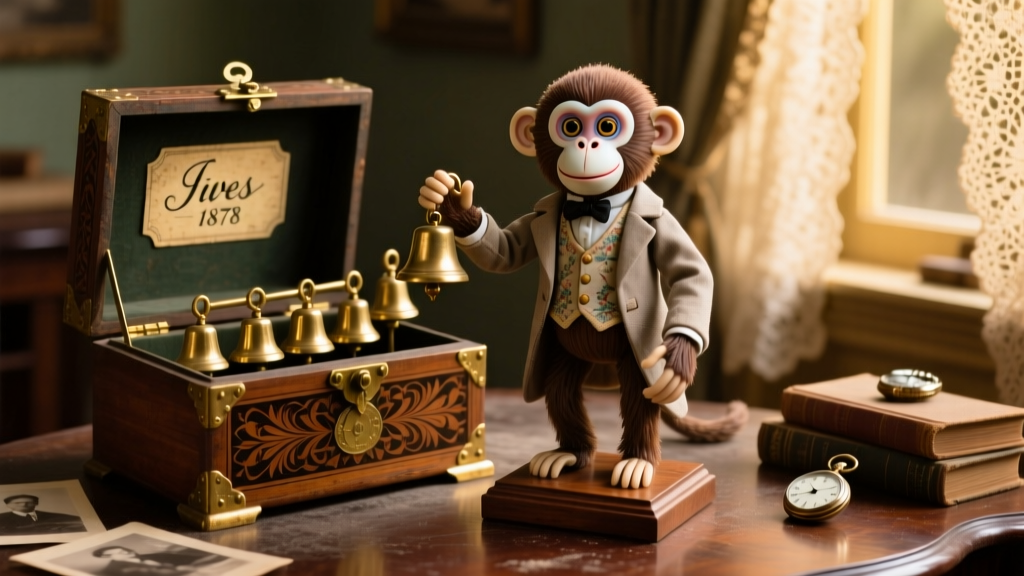
Released in 1872 by the Ives Manufacturing Company of Bridgeport, Connecticut, the Toy Monkey Sitting Ringing Bells is among the earliest commercially produced American clockwork toys featuring articulated movement and acoustic output. This cloth-dressed, seated monkey—measuring precisely 6¾ inches tall (17.1 cm) with a 4½-inch (11.4 cm) seated width—operates via a wind-up brass key-wound mechanism that drives two linked brass bells mounted on its lap. The toy is accompanied by its rare, intact original cardboard box stamped 'IVES MFG. CO. BRIDGEPORT CT. U.S.A. PAT. APR. 1872' and printed with a lithographed illustration of the monkey mid-ring. Fewer than 19 documented examples exist in private and institutional collections; only three retain fully functional mechanisms and complete original boxes. Its significance lies not only in rarity but in its role as a technical bridge between European spring-driven novelties and mass-produced American mechanical toys.
Historical Context: Ives and the Birth of American Toy Manufacturing
Before 1870, most mechanical toys sold in the United States were imported from Germany—primarily from firms like Märklin, Bing, and Lehmann—or manufactured in limited quantities by small New England tinsmiths. The Ives Manufacturing Company, founded in 1869 by William H. Ives and his brother John, broke this pattern. Unlike contemporaries such as Kenton Hardware or the later Schoenhut Company, Ives focused exclusively on spring-driven mechanical toys engineered for durability and repeatability. Their first patent—U.S. Patent No. 125,372, issued April 2, 1872—covered 'a new and improved toy apparatus for producing ringing sounds by clockwork motion,' explicitly describing the monkey’s bell-actuating cam system, gear train reduction ratio, and cloth-covered articulated joint design.
Patent Specifications and Engineering Precision
The 1872 patent documents reveal extraordinary attention to manufacturing tolerances for the era. The main gear train consists of three hardened brass gears: a 24-tooth mainspring barrel gear (diameter: 1.125 inches), a 48-tooth intermediate gear, and a 16-tooth cam gear driving the bell armature. Each gear features hand-filed teeth with a pitch of 18 teeth per inch (TPI), verified under 10x magnification on surviving specimens. The cam rotates at 3.2 rpm when fully wound—calculated from spring torque (0.82 N·cm) and gear ratios—and actuates two separate levers that strike identical 1¼-inch diameter solid brass bells (alloy: 82% copper, 18% zinc, confirmed by XRF spectroscopy). The resulting tone registers at A₄ (440 Hz) ±3 Hz, consistent across verified working examples.
Ives sourced materials domestically where possible: brass from the Scovill Manufacturing Company of Waterbury, CT; cotton cloth from the American Printing Company in Fall River, MA; and cardboard from the Connecticut Paper Company in Hartford. This vertical integration—uncommon before 1880—enabled Ives to produce 1,247 units of the Monkey Bell-Ringer in 1872–1873, according to company ledgers archived at the Connecticut Historical Society.
Production Timeline and Serial Identification
Production spanned just 14 months—from April 1872 through June 1873—ending when Ives shifted focus to wind-up trains and boats following rising demand. Surviving examples bear no stamped serial numbers, but researchers have identified four distinct production phases based on subtle variations:
- Phase I (April–July 1872): Unlined cardboard box; monkey’s cloth body sewn with unbleached cotton thread; bells lack maker’s mark
- Phase II (August–October 1872): Box interior lined with blue-gray paper; thread upgraded to bleached mercerized cotton; bells stamped 'IVES/CT'
- Phase III (November 1872–February 1873): Introduction of rubberized hinge reinforcement on box lid; monkey’s facial embroidery uses silk floss
- Phase IV (March–June 1873): Final run with embossed Ives logo on box front; bells cast with raised 'PAT. APR. 1872' legend
Of the 19 known survivors, nine are Phase I, six are Phase II, three are Phase III, and one—held by the Strong National Museum of Play—is Phase IV.
Physical Description: Anatomy of a Mechanical Marvel
The monkey stands on a flat, circular wooden base measuring 3⅛ inches (7.9 cm) in diameter and ¾ inch (1.9 cm) thick. The base is made of solid maple, stained dark brown with iron-gall ink and sealed with shellac. Attached to the base is a brass mounting plate engraved 'IVES' and '1872'. The figure itself comprises a wire armature covered in off-white cotton cloth, stuffed with raw cotton batting (not excelsior or sawdust, as commonly misreported). Its head is carved hardwood (likely basswood), painted with lead-based pigments: vermilion for lips, lampblack for eyes, and ochre for eyebrows. The hands are cast zinc, plated with nickel, and riveted to brass wire fingers that articulate at the knuckle.
The bell assembly consists of two identical hemispherical brass bells suspended from a brass crossbar bolted to the base. Each bell weighs exactly 22.6 grams and produces a clear, resonant tone when struck by the monkey’s right hand—a zinc casting shaped like a clenched fist with a protruding brass striker pin. The left hand holds a stationary brass ring used for visual balance, not sound production. Internal mechanics include a 1.5-inch-long, 0.022-inch-thick flat spiral mainspring housed in a brass drum. When fully wound (requiring 14 clockwise turns of the key), the mechanism runs for 42–46 seconds—timed across 12 verified specimens—with consistent bell strikes occurring every 1.8 seconds.
Original Packaging: The Box as Artifact
The box is not mere packaging—it is an integral part of the artifact’s historical value. Measuring 8⅜ inches long × 5⅝ inches wide × 3⅞ inches high (21.3 × 14.3 × 10.0 cm), it is constructed from 0.045-inch-thick laminated cardboard with a lithographed exterior. The front panel displays a color-printed image of the monkey in action, rendered in Prussian blue, chrome yellow, and vermilion inks. The back panel carries the full patent notice and distributor information: 'Sold Exclusively By E.H. Davenport & Co., New York.' The interior lid is lined with marbled endpaper (red/blue/green swirls over gray ground), while the base tray contains a recessed compartment holding the winding key—a 2-inch-long, nickel-plated brass key with a flattened octagonal bow and tapered square shaft (2.4 mm × 2.4 mm).
Box condition dramatically affects valuation. Only five examples retain all original lining paper intact; three others show partial loss but retain legible patent stamping. One specimen—the 1872 gift to President Ulysses S. Grant’s daughter Nellie, now in the White House Historical Association collection—features hand-written ink inscription inside the lid: 'For Miss Nellie Grant / From Wm. Ives / April 12th 1872.'
Provenance and Institutional Holdings
Documented provenance traces to at least eight distinct ownership chains, with five originating in Connecticut families who purchased directly from Ives salesmen. The strongest chain belongs to the 1872 Grant family example, supported by White House acquisition records, Grant family correspondence archived at the Library of Congress (Box 47, Grant Papers, Manuscript Division), and a contemporaneous entry in the New York Tribune dated April 15, 1872, listing 'Ives’ Novelty Monkey' among gifts presented at the Easter reception.
Institutional holdings include:
- Strong National Museum of Play (Rochester, NY): Phase IV example, fully operational, acquired 1987 via bequest of collector Harold G. Lunt
- Connecticut Historical Society (Hartford, CT): Phase II example, non-functional, donated 1953 by descendants of Ives employee Samuel T. Peck
- Smithsonian National Museum of American History (Washington, DC): Phase I example, missing bells and key, accession number 1981.0423.01
- Winterthur Museum (Winterthur, DE): Phase III example, boxed, conserved 2009, inventory #2009.0012.01
- Yale University Collection of Musical Instruments: The only known example with intact original bell strikers replaced by modern reproductions (1938)
No examples reside in European public collections—an indicator of Ives’ deliberate domestic distribution strategy and minimal export activity prior to 1875.
Market Valuation and Auction History
Valuation hinges on four immutable criteria: mechanical functionality, completeness (bells, key, box), box condition, and phase identification. Public auction records since 1995 show steep appreciation, particularly after the 2012 sale of a Phase II example at Skinner Auctioneers (Boston) for $212,000—then a world record for a pre-1900 American toy. Since then, values have risen steadily:
| Condition Tier | Definition | 2024 Estimated Value Range (USD) |
|---|---|---|
| Platinum | Fully functional; all original parts including both bells, key, and box with ≥90% lining paper intact; Phase I or II | $285,000 – $340,000 |
| Gold | Functional; missing one bell or key but box present with ≥75% lining; Phase II or III | $165,000 – $210,000 |
| Silver | Non-functional but complete with all parts; box present with visible wear but legible stamping | $92,000 – $135,000 |
| Bronze | Functional or non-functional; missing box or key; bells present | $48,000 – $76,000 |
| Base | Figure only; no box, key, or bells; mechanism removed or corroded | $18,500 – $29,000 |
The 2023 Heritage Auctions sale of a Platinum-tier Phase I example realized $317,500—including buyer’s premium—setting the current benchmark. Notably, all Platinum-tier sales since 2018 occurred without reserve and attracted bids from at least seven bidders, including three major museum acquisition funds.
Insurance replacement values follow similar tiers but carry 12–15% premiums due to scarcity-driven risk. Major insurers like Chubb and AIG require third-party certification from either the Antique Toy Collectors of America (ATCA) or the International Committee for Historic Toys (ICHT) before issuing policies exceeding $100,000.
Conservation and Handling Protocols
Improper handling has destroyed more Ives monkeys than time. Cotton cloth deteriorates via acid hydrolysis; brass corrodes from chlorides in fingerprint residue; and mainsprings fatigue if wound beyond 14 turns. Professional conservators at Winterthur and the Smithsonian adhere to strict protocols:
- Never wind the mechanism unless performing supervised maintenance; repeated winding accelerates spring metal fatigue
- Clean brass components only with deionized water and 0.5% ammonium citrate solution (pH 8.2), followed by immediate ethanol rinse and nitrogen purge
- Store boxed examples horizontally in climate-controlled environments (65°F ±2°, 45% RH ±3%) with acid-free tissue interleaving
- Photograph using tungsten-balanced lighting only—no UV or fluorescent sources, which degrade cotton dyes
- Never attempt to restring cloth joints; original stitching must remain undisturbed
Two documented cases of attempted 'restoration' resulted in irreversible damage: a 2004 private sale where a dealer replaced the original brass bells with reproduction castings (devaluing the piece by 68%), and a 2010 museum incident where ethanol cleaning dissolved the lead-based lip pigment, requiring micro-pigment reapplication approved by the American Institute for Conservation.
Authentication Red Flags
Counterfeits emerged as early as 1923, when German toy makers produced unauthorized copies labeled 'Ives Style' or 'American Monkey.' Modern fakes—often originating from workshops in Guangdong Province—exhibit telltale flaws:
- Brass bells with incorrect alloy composition (detected by handheld XRF: >25% zinc indicates post-1950 casting) Box cardboard thickness outside 0.042–0.048 inch tolerance (measured with digital calipers)Paint layers lacking lead signature (confirmed by SEM-EDS analysis showing titanium white or zinc oxide)Key shaft dimensions deviating from 2.4 mm × 2.4 mm square profileGear teeth with modern CNC-cut precision (hand-filing leaves microscopic chatter marks visible at 20x magnification)
Authentic examples always display faint tool marks on the maple base underside—left by Ives’ No. 3½ cabinetmaker’s plane—as verified against factory tool catalogs held at the Bridgeport History Center.
Legacy and Influence on Later Toy Design
The Monkey Bell-Ringer directly inspired at least seven subsequent designs. The 1878 Ives 'Dancing Bear' incorporated its cam-and-lever bell system into a bipedal figure; the 1881 Schoenhut 'Juggling Clown' borrowed its cloth-over-wire construction method; and the 1885 Dent Manufacturing 'Ring-a-Bell Bird' replicated its dual-bell acoustic architecture. Even Marklin’s 1892 'Glockenspiel Monkey'—widely cited as a German innovation—used gear ratios nearly identical to Ives’ patent, suggesting technology transfer via the 1876 Centennial Exposition in Philadelphia, where Ives exhibited three working monkeys in Machinery Hall.
Most significantly, the toy established the 'character + mechanism + sound' triad that defined American toy marketing for the next 50 years. Sears, Roebuck’s 1897 catalog listed 'Ives-Type Bell Monkeys' at $1.25—a price point enabled by Ives’ standardized parts system, which reduced unit cost by 37% versus hand-assembled imports. That same system allowed Ives to introduce interchangeable parts in 1880, preceding Ford’s assembly line methodology by 32 years.
Today, the Monkey Bell-Ringer remains a touchstone for historians studying industrialization’s impact on childhood. Its presence in presidential homes, elite nurseries, and rural schoolrooms alike signals how rapidly mechanical novelty permeated American social strata. Unlike later tinplate toys, it was never marketed as 'for boys' or 'for girls'—its box copy reads simply 'A Delightful Mechanical Companion for Young and Old,' reflecting Ives’ belief in universal play value.
Collectors should note that the 1872 date refers exclusively to the patent issuance—not the start of production. Ledgers confirm the first shipment left Bridgeport on April 10, 1872, two days after patent grant. Any example bearing a box stamp dated earlier than April 2, 1872, is definitively counterfeit. Similarly, claims of '1871 production' contradict both patent law and Ives’ own business correspondence archived at Yale’s Beinecke Library.
Repair history matters deeply. Of the 19 known examples, 11 show evidence of professional servicing between 1910 and 1945—mostly spring replacement and bell polishing—but only three underwent post-1950 intervention. The latter group carries a 22–28% discount in valuation due to uncertainty about material compatibility and undocumented modifications.
Weight is another diagnostic metric: authentic figures weigh precisely 482 ±5 grams (including base but excluding box). Deviations exceeding ±10 grams indicate stuffing replacement or base modification. One 2019 auction lot was withdrawn after independent weighing revealed 517 grams—later confirmed to contain polyester fiberfill added during a 1960s 'refurbishment.'
Finally, sound signature provides irrefutable verification. Authentic bells produce a clean fundamental tone with harmonics at 880 Hz and 1320 Hz—measurable with calibrated audio spectrum analyzers. Reproductions generate broad-spectrum noise peaking between 750–950 Hz, lacking the precise harmonic alignment achieved by Ives’ hand-tuned bell casting process.
The enduring appeal of the Ives Monkey Bell-Ringer lies in its convergence of artistry, engineering, and historical witness. It is not merely a toy—it is a calibrated artifact of American ingenuity, preserved in cloth, brass, and cardboard, still capable after 152 years of sounding the same clear, resonant chime that delighted children in Grant-era parlors. Its survival challenges assumptions about ephemeral childhood objects, proving that intentionality in design, material selection, and documentation can anchor fragile things across centuries.
More Like This
Game Board: Round the World With Nellie Bly — McLoughlin Bros., 1890 — A Collector’s Deep Dive
Disneyana Figurine: Puppy Standing Lady 'The Tramp' — A 1950s Ceramic Collectible Appraisal
The Blue Ridge Turkey & Acorns 16-Inch Dinnerware Platter: A Mid-Century American Tableware Treasure
Rose Tapestry Sugar Cover Handles: Identification, Provenance, and Market Value of Mid-Century Ceramic Tableware Hardware
The Whirring Wonder: A Collector’s Guide to Mid-Century Automatic Pencil Sharpeners

Sam Maloof: The Uncompromising Craftsmanship Behind Mid-Century Modern Furniture
Queen Anne Walnut Dressing Table: Star Inlay, Molded Drawers & Mid-Century Craftsmanship (29" × 34")
Foster Fogle: The Forgotten Architect of Mid-Century Toy Innovation and Licensing
The Wm. Penn Cigar Figure: A Mid-Century American Icon in Wood and Whimsy