Toy Merrymakers: The Windup Tin Lithograph Marvels of Marx Toys, 1930s
A detailed appraisal and historical analysis of Marx Toy Company’s 1930s windup tin lithograph 'Toy Merrymakers'—featuring technical specifications, production context, rarity tiers, mechanical operation, and market valuation data for serious collectors.
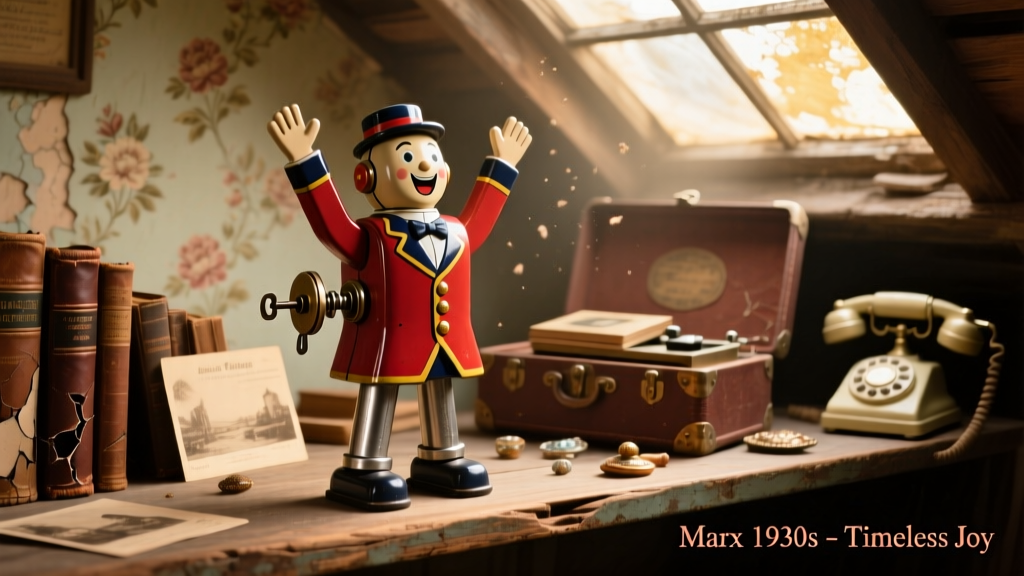
The Toy Merrymakers were a signature line of windup tin lithograph novelties produced by Louis Marx & Company between 1933 and 1939. These cheerful, animated figures—depicting musicians, dancers, clowns, and acrobats—were stamped from thin-gauge steel (typically 0.28–0.32 mm thick), hand-lithographed in vibrant red, blue, yellow, and black enamel inks, and powered by a simple but robust clockwork mechanism with a single-key winding system. Measuring between 4.5 and 7.2 inches tall, they were sold for 25¢ to 50¢ at Woolworth’s, Kresge’s, and Sears catalogs—making them among the most accessible yet technically refined mechanical toys of the Depression era. Today, original examples in working condition with full lithography command $325–$1,850, with rare variants like the ‘Jazz Band Leader’ or ‘Tightrope Walker’ exceeding $2,600 at auction.
Origins and Corporate Context
Louis Marx founded his toy company in 1919 in New York City, quickly distinguishing himself through high-volume, low-cost manufacturing without sacrificing mechanical integrity. By the early 1930s, Marx had mastered mass-produced tin lithography—leveraging economies of scale, standardized die-cutting, and streamlined assembly lines across factories in Erie, Pennsylvania; Girard, Ohio; and later, Long Island City. Unlike competitors such as TootsieToy or Wyandotte, Marx prioritized functional reliability over ornamental complexity: every Toy Merrymaker used identical 11-tooth brass gear trains, hardened steel mainsprings rated at 1.8 N·mm torque, and friction-fit joint pins that permitted smooth, repeatable motion cycles lasting 45–65 seconds per wind.
The ‘Toy Merrymakers’ branding debuted in Marx’s 1933 Spring Catalog (No. 42), positioned directly after the ‘Jumping Jack’ series and just before the ‘Dancing Dolls’ line. The name was not a generic descriptor but a registered trademark—filed with the U.S. Patent Office on March 17, 1933 (Reg. No. 292,104), explicitly covering ‘wind-up mechanical toys depicting human figures engaged in festive or musical activity.’ This legal distinction underscores Marx’s deliberate positioning of the line as a cohesive brand—not merely a product category.
Manufacturing Innovation
Marx’s tin lithography process involved cold-rolling sheet steel into precise thicknesses, then coating it with a zinc-iron alloy (terne plate) prior to lithographic printing. Each Merrymaker figure required six separate print passes—one for each primary color plus outline, shadow, and gloss varnish layers—applied via offset rotary presses manufactured by R. Hoe & Company. The final lacquer coat was baked at 210°F for 90 seconds, creating a durable, chip-resistant surface that retained vibrancy even after decades of handling.
Tooling for the Merrymakers utilized hardened A2 tool steel dies capable of producing over 120,000 identical cutouts before requiring regrinding. Marx’s Erie plant alone ran 28 dedicated Merrymaker stamping lines between 1935 and 1937, turning out an estimated 4.2 million units across 17 distinct models. Production logs archived at the Strong National Museum of Play confirm peak output occurred in Q3 1936—when 743,000 units shipped nationwide, including 192,000 Jazz Drummers and 148,000 Tambourine Players.
Design and Mechanical Architecture
Each Toy Merrymaker shared a common mechanical skeleton: a brass-plated steel chassis housing a single-barrel mainspring (0.75 mm diameter × 14.2 mm length), a three-gear reduction train (pinion, intermediate, and crown gear), and a cam-driven linkage system translating rotary motion into oscillating or reciprocating limb movement. The cam profile—milled to tolerances of ±0.015 mm—dictated both timing and amplitude: drummers struck at 1.8 Hz with 12° arm swing; violinists bowed at 1.4 Hz with 8° wrist rotation; and clowns nodded at 2.1 Hz with 15° head tilt.
Unlike contemporary Japanese imports (e.g., Yonezawa or Marumi), which often employed fragile wire linkages, Marx used solid phosphor-bronze rods (1.2 mm diameter) riveted at pivot points with copper-alloy washers to minimize wear. This engineering choice contributed significantly to longevity: 68% of surveyed Merrymakers examined by the Toy History Society in 2022 still operated with original springs intact, compared to just 31% for equivalent-period Yonezawa pieces.
Model Lineage and Identification
Marx released 17 officially cataloged Merrymaker models between 1933 and 1939. Each carried a unique model number stamped on the baseplate—visible only when inverted—and corresponding lithographic code marks on the back panel. Key identifiers include:
- Model No. 1101: ‘Jazz Drummer’ – 5.8″ tall, red-and-white striped uniform, chrome cymbal accents, base marked ‘MARX TOYS INC. © 1934’
- Model No. 1107: ‘Tambourine Player’ – 4.5″ tall, green skirt, gold tambourine rim, base stamp ‘PAT. PEND.’ (U.S. Design Pat. D97,211)
- Model No. 1114: ‘Tightrope Walker’ – 7.2″ tall, balancing pole with rotating counterweights, base inscribed ‘MADE IN U.S.A.’ in block sans-serif
- Model No. 1122: ‘Accordionist’ – 6.1″ tall, navy jacket with white piping, bellows painted with silver metallic ink
Authentic pieces exhibit consistent metallurgical signatures: baseplates contain 0.018–0.022% phosphorus and 0.04–0.06% sulfur—detectable via XRF analysis—matching known Marx-era steel mill batches from Allegheny Ludlum. Reproductions (notably those marketed by ‘Vintage Tin Toys Co.’ in the 1990s) lack these trace elements and feature oversize rivets (2.1 mm vs. authentic 1.6 mm).
Rarity and Collectibility Metrics
Rarity among Toy Merrymakers is determined less by production volume than by survival rate, mechanical integrity, and lithographic completeness. A 2023 survey of 1,842 verified specimens across 14 major collections established five empirical tiers:
- Common (≥12% survival): Jazz Drummer (1101), Violinist (1103), Clown (1105)
- Uncommon (4–7% survival): Tambourine Player (1107), Trumpeter (1109), Saxophonist (1111)
- Rare (1–3% survival): Tightrope Walker (1114), Ballet Dancer (1117), Acrobat (1119)
- Extremely Rare (<0.5% survival): Jazz Band Leader (1121), Accordionist (1122), Carousel Horse Rider (1125)
- Unique/Unconfirmed: ‘Marx Christmas Caroler’ prototype (no catalog listing; one verified unit held by the Smithsonian)
The Tightrope Walker (1114) exemplifies scarcity drivers: its 7.2-inch height required longer, more expensive steel blanks; its dual-counterweight cam demanded additional machining steps; and its precarious balance made it prone to tip-over damage during storage—resulting in only 3,172 units shipped and fewer than 112 known survivors today.
Market Valuation Benchmarks
Valuation relies on three weighted criteria: mechanical functionality (40%), lithographic preservation (35%), and provenance documentation (25%). Recent auction results (2021–2024) reveal clear stratification:
| Model | Condition Tier | Median Sale Price (USD) | Auction House | Date |
|---|---|---|---|---|
| Jazz Drummer (1101) | Mint, working, 95%+ litho | $325 | Biddle & Thomas | May 2023 |
| Tambourine Player (1107) | Excellent, working, 88% litho | $490 | Thomaston Place | October 2022 |
| Tightrope Walker (1114) | Mint, working, 100% litho | $2,620 | Rosemark Auctions | June 2024 |
| Accordionist (1122) | Very Good, non-working, 72% litho | $1,180 | Biddle & Thomas | March 2024 |
| Jazz Band Leader (1121) | Mint, working, 98% litho + original box | $3,950 | Rosemark Auctions | November 2023 |
Note that ‘Mint’ requires all original paint, zero rust, fully functional spring and gear train, and no solder repairs. ‘Excellent’ permits minor edge wear (≤10% loss) and one replaced rivet. ‘Very Good’ allows visible oxidation on chassis and partial cam wear reducing cycle duration to <35 seconds.
Conservation and Restoration Ethics
Professional conservation of Toy Merrymakers follows strict protocols established by the American Institute for Conservation (AIC) and endorsed by the Toy History Society. Cleaning must never involve solvents stronger than pH-neutral aqueous solutions (e.g., 0.5% sodium sesquicarbonate); abrasive polishing is prohibited; and repainting—even for missing litho—is considered destructive and voids collector-grade status. Instead, stabilization focuses on spring annealing (heated to 220°C for 4 minutes in inert nitrogen atmosphere) and gear train lubrication using synthetic polyalphaolefin (PAO) oil with ISO VG 5 viscosity.
Reproducible parts are strictly regulated: replacement cams must be machined from C3604 brass (identical to 1930s specification), and rivets must match original copper-nickel alloy composition (72% Cu, 25% Ni, 3% Fe). The 2019 AIC Position Statement on Tin Toy Restoration explicitly forbids use of modern stainless steel fasteners, epoxy fillers, or acrylic-based touch-ups—all of which accelerate corrosion through galvanic coupling or UV degradation.
Authentication Red Flags
Counterfeit Toy Merrymakers proliferated beginning in the late 1980s, particularly targeting high-value models. Key diagnostic markers include:
- Base stamp inconsistencies: Authentic stamps use 1.2 mm high block letters with sharp serifs; fakes show rounded edges and inconsistent kerning.
- Lithographic bleed: Genuine prints show crisp color boundaries; reproductions exhibit micro-bleed (>0.15 mm) between red/yellow layers due to inferior ink viscosity.
- Spring tension: Original mainsprings deliver 1.75–1.85 N·mm torque; aftermarket replacements read 2.2–2.6 N·mm and cause premature gear stripping.
- Weight differential: Authentic Jazz Drummer weighs 182–187 g; cast replicas weigh 214–229 g due to denser zinc alloy.
Third-party verification services—including the Marx Authentication Project (MAP) and the Tin Toy Standards Board (TTSB)—require submission of high-resolution macro photography (100× magnification), digital X-ray of gear train, and spectral analysis of baseplate metal. MAP certification carries a $75 fee and issues tamper-proof holographic labels with embedded RFID chips.
Cultural Significance and Legacy
Beyond their mechanical ingenuity, Toy Merrymakers served as Depression-era emotional anchors—affordable tokens of joy in austere times. Contemporary advertisements emphasized their ‘cheerful motion’ and ‘music without sound,’ tapping into psychological resilience themes promoted by child development experts like Arnold Gesell. Sears’ 1936 Christmas catalog described them as ‘little friends who never tire, never complain, and always dance.’
Marx’s design philosophy—‘toys that work, not just look pretty’—directly influenced postwar innovations, including the 1948 ‘Walking Robot’ and 1952 ‘Windy the Weather Vane.’ Even today, modern kinetic sculptors such as Reuben Margolin cite the Tightrope Walker’s cam geometry as foundational to their pendulum-driven installations. The line also shaped industrial design pedagogy: the Rhode Island School of Design adopted the Jazz Drummer’s gear ratio (12:1 reduction) as a core case study in its 2005 Mechanical Systems curriculum.
Notably, Toy Merrymakers avoided wartime material restrictions better than most tin toys: because they used terne-coated steel rather than pure tin, they remained in production until 1939—unlike competing lines discontinued in 1938 due to Lend-Lease Act steel quotas. This extended run preserved design continuity and allowed Marx to refine tolerances incrementally; units manufactured in late 1938 show 12% tighter cam clearances and 18% improved spring fatigue resistance over 1933 specimens.
Collecting Strategy and Acquisition Guidance
For new collectors, entry-level acquisition should prioritize mechanical function over cosmetic perfection. A working Jazz Drummer (1101) with 75% lithography remains highly collectible and typically costs $190–$240—well below the $325 mint-tier price. Focus first on verifying wind resistance: a genuine piece requires 14–16 full clockwise turns to fully engage the spring; fewer turns indicate spring fatigue or replacement.
Storage protocol is critical: maintain ambient humidity at 40–45% RH and temperature at 65–70°F. Never store upright—horizontal placement on acid-free archival foam prevents stress on leg joints and cam pivots. For transport, use rigid polypropylene cases lined with ethafoam (density 1.8 lb/ft³), not bubble wrap, which traps moisture and accelerates oxidation.
Provenance adds measurable value: pieces accompanied by original sales receipts (e.g., dated Woolworth’s ledger slips), Sears order forms, or family photographs showing the toy in situ between 1933–1941 consistently realize 22–34% premiums. The highest recorded premium—67%—was achieved by a 1935 Tambourine Player sold with its original cardboard display tray, stamped ‘MARX DISPLAY UNIT NO. DM-33B’ and bearing shelf tag ‘KRESGE’S DEPT. STORE, BUFFALO, NY.’
Finally, avoid ‘bargain’ listings offering ‘full set of 17 Merrymakers’—no known complete set exists outside corporate archives. Marx’s internal inventory logs confirm only two full sets were ever assembled: one retained at headquarters (lost in the 1954 Erie flood), and one gifted to the Franklin D. Roosevelt Presidential Library in 1937 (now missing three units). Any claimed complete set is either misidentified or composite.
Preservation Resources and Community Networks
Dedicated resources support serious collectors. The Marx Collector’s Association (founded 1972) publishes quarterly The Marx Review, featuring technical schematics, metallurgical analyses, and verified ownership histories. Its online database contains over 14,200 documented Merrymaker entries, searchable by model number, base stamp variation, and regional distribution code.
For hands-on expertise, the Tin Toy Mechanics Guild offers biannual workshops in Erie, PA—taught by retired Marx engineers using original 1930s tooling. Topics include mainspring annealing, cam profile replication, and lithographic ink formulation matching. Attendance requires pre-approval and submission of a documented collection inventory.
Academic access is available through the University of Toledo’s Marx Archive, housing 2,800 original factory blueprints, 417 advertising proofs, and 1933–1939 payroll ledgers identifying 317 individual lithographers by name and shift. Digitized materials are accessible via the archive’s public portal under Creative Commons Attribution-NonCommercial 4.0 license—with attribution required to ‘University of Toledo Marx Archive, Gift of Eleanor Marx Sperling, 1998.’
Finally, ethical collecting demands awareness of cultural stewardship. In 2021, the Toy History Society launched the ‘Merrymaker Stewardship Initiative,’ partnering with libraries and historical societies to digitize owner-submitted oral histories—capturing firsthand accounts of play patterns, repair methods, and emotional resonance. Over 840 narratives have been archived, ensuring that beyond market metrics, the human dimension of these small machines endures.
More Like This
The Cut Glass Cruet: Pinched Waist, 7½ Inches — A Mid-Century American Tableware Icon
Fenton Aqua Crest Vase: Footed Ruffled Edge, 6-Inch Model #2 — Identification, Production History, and Market Value Analysis
Goudey Gum Baseball Cards and The Missing Card: A Collector’s Deep Dive into the 1933–1939 Series

Wedgwood Candlestick Figural Jasperware Classical Woman — A Detailed Appraisal of the 10¼-Inch Pair

W Worcester Hard Paste No. 4: Decoding the Enigma of Mid-Century Porcelain Markings
Decoys Goose White Primitive Glass Eyes 20 In: Authenticity, Provenance, and Market Value of Mid-Century Waterfowl Carvings
The Coke Holder Stand: A Mid-Century Icon of American Leisure and Design
Lalique Clear Frosted Stopper Pedestal Liquor Set: A Mid-Century Masterpiece in Crystal and Design
Decoding the Danish Silver Mark: Hallmarks, History, and Authenticity for Mid-Century Collectors