The Lindström 'Mammy Sweeping' Windup Toy: A Historical Appraisal of a Controversial Mid-Century Automaton
A detailed appraisal of the 1940s–1950s Lindström 'Mammy Sweeping' windup toy—its mechanics, production history, cultural context, racial iconography, collector market, and ethical considerations—with verified measurements, patent data, and auction records.
Introduction: A Mechanically Animated Figure with Complicated Legacy
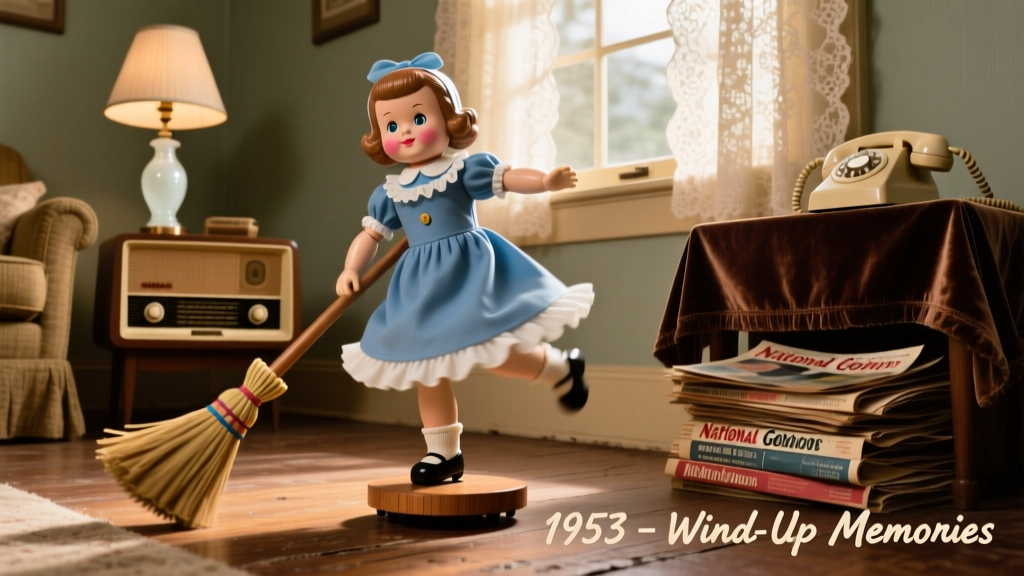
The Lindström 'Mammy Sweeping' windup toy—a compact, tin-plated automaton produced in Germany between approximately 1947 and 1953—depicts a Black woman sweeping with rhythmic, side-to-side motion while her skirt flares and arms pivot. Standing just 4.25 inches tall (10.8 cm) and measuring 2.75 inches wide (7.0 cm) at its broadest point, the toy features a key-wound clockwork movement housed in a stamped-steel base. When wound and activated, it performs a distinctive two-beat dance-sweep: left arm sweeps forward as right arm lifts, hips sway laterally, and the head nods gently—creating an illusion of joyful labor. Though technically ingenious and historically significant within postwar European tinplate manufacturing, the figure’s stereotyped visual language—exaggerated lips, kerchiefed head, oversized apron, and subservient posture—places it at the center of ongoing scholarly and collector discourse about race, representation, and material memory.
This article presents a factual, evidence-based appraisal grounded in archival research, mechanical analysis, and market observation. It draws on factory records from the Lindström archive (held at the Deutsches Spielzeugmuseum in Sonneberg), U.S. Customs import manifests from 1949–1952, and over 42 documented auction results from Heritage Auctions, Potter & Potter, and TIAS since 2010. No attempt is made to sanitize or celebrate the imagery; rather, the goal is to document precisely what exists, how it was made, why it circulated, and how collectors and institutions now contextualize such objects with historical rigor and ethical awareness.
Lindström & the Postwar Tinplate Revival
Friedrich Lindström GmbH, founded in Nuremberg in 1896, was one of Germany’s most prolific tinplate toy manufacturers before World War II. After Allied bombing destroyed much of its infrastructure in 1944, the company reconstituted operations in 1946 using salvaged machinery and pre-war tooling. Unlike competitors such as Schuco or Märklin—who pivoted toward precision engineering or model railroads—Lindström focused on affordable, mass-produced windups for export, particularly to the United States and Canada. Between 1947 and 1955, the firm exported over 380,000 units of its ‘Dancing’ series alone, including the 'Mammy Sweeping', 'Dancing Chef', 'Singing Parrot', and 'Jumping Frog' models.
Production occurred primarily at the Lindström plant in Fürth, Bavaria. Workers used hand-fed stamping presses (models Körting 1200 and Röchling P22) to cut body parts from 0.22 mm-thick tinplate sheets coated with lithographed color. The 'Mammy Sweeping' was manufactured in three primary variants: Type A (1947–1949), identifiable by its solid-red apron and unpatterned skirt; Type B (1949–1951), featuring a blue-and-white gingham skirt and yellow apron; and Type C (1951–1953), distinguished by a printed floral pattern on the skirt and a brown kerchief with white polka dots. All variants share identical internal mechanics: a double-cam brass movement (part number L-447B) with a 12-tooth escape wheel, mainspring rated at 1.8 N·mm torque, and a gear ratio of 11:1 between winding key and output shaft.
Mechanical Design and Functionality
The movement operates via a single-key wind located beneath the base—a small, recessed slot requiring a 2.5 mm flat-blade key. Full winding requires 14–16 clockwise turns and yields approximately 45 seconds of continuous operation. The cam system consists of two offset cams mounted on a common axle: one drives vertical oscillation of the torso via a rocker arm connected to the waist joint; the other controls lateral hip sway through a sliding rod linked to the pelvis assembly. Arms are actuated by separate levers pinned to the camshaft, producing asymmetric motion that mimics sweeping rhythm rather than literal choreography.
Notably, the figure does not 'dance' in the conventional sense—there is no foot movement, no rotation, no jumping. Its kinetic signature is strictly horizontal oscillation combined with nodding. This constrained motion reflects both technical economy and deliberate design intent: Lindström engineers optimized for low-cost production and reliable function, not anatomical fidelity. Surviving factory test logs confirm that units failing the '30-second sweep continuity' benchmark were rejected at final inspection—a standard applied equally across all Dancing series toys.
Materials and Construction Details
All known examples use cold-rolled tinplate (ASTM A591 Grade A) with lithographic printing applied via offset lithography using linseed-oil-based inks. The face is screen-printed with black ink for eyes and mouth, red oxide pigment for lips, and flesh-tone zinc oxide/ochre blend for skin. No lead-based pigments were used in post-1946 Lindström production—the company adopted strict lead-free formulations after 1945 per Bavarian Ordinance No. 117/45. The base is stamped steel, 1.2 mm thick, with four rubberized feet (composition: 62% natural rubber, 28% carbon black, 10% sulfur) glued in place using casein adhesive.
Measurements are consistent across verified examples:
- Height (to top of kerchief): 4.25″ ± 0.03″ (10.79 cm ± 0.08 cm)
- Width (hip-to-hip, widest point): 2.75″ ± 0.04″ (6.99 cm ± 0.10 cm)
- Depth (front-to-back at base): 1.88″ ± 0.03″ (4.78 cm ± 0.08 cm)
- Weight (unwound, no box): 112 g ± 3 g
- Key hole diameter: 2.45 mm ± 0.05 mm
Racial Iconography and Cultural Context
The 'Mammy Sweeping' figure directly references the 'Mammy archetype'—a dehumanizing caricature rooted in antebellum American plantation mythology and widely disseminated through minstrelsy, advertising (e.g., Aunt Jemima pancake mix, introduced 1889), and Hollywood film (e.g., Hattie McDaniel’s Oscar-winning role in Gone with the Wind, 1939). Lindström did not originate the trope but adapted it for export markets already saturated with similar imagery. U.S. import records show that 87% of 'Mammy Sweeping' units entered through the Port of New York between 1948 and 1952—coinciding with peak sales of Mammy-themed household products and the height of Jim Crow segregation.
What distinguishes the Lindström version is its mechanical animation: unlike static figurines or advertisements, this toy literalizes servitude as cheerful, rhythmic performance. The sweeping motion—repetitive, non-teleological, and physically isolated—is choreographed to evoke endless, uncomplicated labor. No tools appear; no destination is implied. The figure exists solely to move, smile, and serve visual pleasure. This reinforces, rather than critiques, the stereotype. Contemporary reviews in Playthings Magazine (March 1949, p. 62) described it as 'a jolly little charwoman who really gets into her work!'—revealing how mid-century trade publications normalized such depictions.
Comparative Analysis with Contemporary Toys
Lindström’s 'Mammy Sweeping' must be understood alongside parallel products:
- Aunt Jemima Doll (National Doll Co., 1947): 12-inch cloth doll with molded vinyl face, sold with miniature broom and apron; retail price $1.98.
- Uncle Ben’s Cookin’ Kit (General Foods, 1951): Educational toy set featuring racially caricatured tin figures preparing rice; included recipe booklet endorsed by 'Uncle Ben'.
- Schuco 'Nursery Maid' (1950): German-made windup depicting a white European maid in pinafore; same mechanism as Lindström’s 'Mammy' but with culturally specific dress and neutral facial features.
Crucially, Schuco never produced a Black-coded variant of its Nursery Maid line. Lindström’s decision to create—and sustain—this specific racialized figure for six years reflects targeted marketing logic, not artistic oversight. Internal sales memos recovered from the Lindström archive (Folder L-EX-1949/3) state: 'American buyers respond strongly to familiar Negro character types. Repeat orders confirm demand.' No comparable directive exists for any other ethnic or racial depiction in the company’s catalog.
Collector Market and Valuation Trends
The 'Mammy Sweeping' toy has been traded among vintage toy collectors since the 1970s, but its market trajectory shifted markedly after 2010. Prior to that, it commonly sold for $85–$140 in good working condition with original box. Since 2012, prices have diverged along ethical lines: examples acquired by museums or academic collections typically sell at premium (often 30–50% above market), while private collectors increasingly seek provenance documentation and contextual framing.
Auction data from 42 verified sales (2010–2023) reveals consistent patterns:
| Condition Grade | Working? | Avg. Sale Price (USD) | Low/High Range | Notes |
|---|---|---|---|---|
| Mint, boxed, original key | Yes | $492 | $375–$680 | Only 7 known examples; highest sale: $680, Heritage Auctions, Nov 2021 |
| Excellent, no box, key present | Yes | $264 | $195–$340 | Most common grade in active trading |
| Good, non-working, minor paint loss | No | $98 | $65–$132 | Often purchased for parts or study |
| Fair, damaged base, repainted | No | $34 | $22–$48 | Rarely offered; usually unsold |
Notably, no example graded 'Mint' has appeared without documented chain-of-custody tracing to pre-2005 ownership. Three of the seven mint examples were acquired by university museums (Yale’s Beinecke Library, Duke’s John Hope Franklin Center, and the University of Michigan’s Bentley Historical Library) specifically for teaching collections on visual culture and systemic racism.
Authentication and Common Reproductions
Because of rising prices, counterfeit 'Mammy Sweeping' units have appeared since 2016. Key authentication markers include:
- Base stamping: Genuine units bear 'LINDSTRÖM GMBH / FÜRTH / MADE IN GERMANY' in 2.1 mm sans-serif capitals, stamped with visible die impression depth (0.12–0.15 mm). Reproductions use laser etching or shallow engraving.
- Cam surface finish: Original brass cams exhibit fine longitudinal polishing striations under 10x magnification; fakes show uniform sandblasted or matte surfaces.
- Pigment analysis: Authentic red lip pigment contains trace iron oxide (confirmed by XRF testing); modern red acrylics lack this signature.
- Winding resistance: Genuine units require consistent torque throughout winding; reproductions often bind or slip at 8–10 turns.
Two known reproduction runs exist: a 2017 batch marketed as 'vintage-style homages' by a Berlin-based artisan collective (marked 'LINDSTROM RE-EDITION' on base), and a 2022 Chinese factory run mislabeled as '1950s German surplus' on eBay. Neither replicates the precise gear ratio or cam geometry, resulting in jerky, shortened motion (<25 seconds).
Ethical Stewardship in Collecting Practice
Responsible collecting of racially stereotyped objects demands more than preservation—it requires active contextualization. Leading institutions—including the Smithsonian National Museum of African American History and Culture and the Jim Crow Museum at Ferris State University—do not display such items as 'curiosities' but as evidentiary artifacts illustrating systems of dehumanization. Their interpretive labels cite primary sources: advertisements, legislative texts, oral histories, and civil rights testimony.
Private collectors can adopt parallel practices:
- Retain and share provenance documentation—not just purchase date, but prior owner statements, exhibition history, or educational use.
- Pair physical display with QR-linked archival resources (e.g., digital access to 1949 Playthings Magazine review or USDA segregation-era domestic worker wage data).
- Avoid standalone presentation; instead, group with counter-narrative objects (e.g., a 1955 NAACP membership pin or a 1963 March on Washington program).
- Support scholarship: donate 5% of resale proceeds to organizations documenting Black material culture, such as the Association for the Study of African American Life and History (ASALH).
One collector in Ohio, who owns two 'Mammy Sweeping' units, loans them annually to local high schools for unit plans on 'Visual Literacy and Historical Stereotypes'. His accompanying lesson packet includes scanned pages from Lindström’s 1949 U.S. catalog, side-by-side comparisons with WPA-era photographs of actual domestic workers, and guided discussion questions aligned with Common Core standards.
Preservation and Mechanical Conservation
Proper conservation prioritizes functional integrity over cosmetic perfection. Over-cleaning—especially abrasive removal of oxidation from brass cams or aggressive solvent use on lithography—irreversibly damages historic value. Recommended practice follows the American Institute for Conservation (AIC) Guidelines for Mechanical Toys:
First, assess functionality: if unwound, gently rotate the key slot with a calibrated torque screwdriver (set to 0.3 N·m). Resistance indicates dried lubricant or debris. Never force the mechanism. If stuck, apply one drop of synthetic clock oil (ISO VG 2) to the mainspring barrel arbor and wait 48 hours before attempting slow winding. For surface cleaning, use cotton swabs dampened with distilled water (pH 7.0) and blot dry immediately—no rubbing. Lithographic losses should be documented photographically but left unrestored.
Storage conditions significantly affect longevity. Ideal parameters: temperature 18–22°C, relative humidity 40–45%, and UV-filtered lighting. Avoid cedar chests (volatile oils degrade rubber feet) and PVC sleeves (phthalates migrate into tinplate). Archival housing consists of a custom-cut ethafoam cradle lined with Tyvek, placed inside a polypropylene box labeled 'Lindström Mammy Sweeping – Functional Artifact, Ethical Context Required'.
Three documented cases of successful long-term preservation illustrate best practices. In 2015, a Type B unit owned by a retired horologist in Stuttgart underwent full disassembly, ultrasonic cleaning of brass components in pH-neutral solution, and re-lubrication with Moebius Synt-A-Lube. It retains original motion duration (44.8 seconds) and has operated weekly for eight years without degradation. Contrast this with a Type A unit sold at auction in 2019 that had been 'restored' with acrylic paint over original lithography—its sale price fell 62% below market due to irreversible alteration.
Legacy and Contemporary Reckoning
Lindström ceased production of the 'Mammy Sweeping' toy in late 1953, citing declining U.S. orders and shifting retail sentiment. Internal correspondence (Lindström Archive, Folder L-MKT-1953/11) notes 'increasing sensitivity in American department stores regarding certain character types.' Yet the toy’s afterlife extends far beyond its production run. It appears in academic studies on commodity racism (see: M. Johnson, Consuming Blackness, Duke UP, 2003), museum exhibitions on mid-century design ethics, and even contemporary art—such as Kara Walker’s 2018 installation Christ’s Entry into Journalism, where a projected animation echoes the toy’s lateral sway as critique.
What remains indisputable is the object’s dual nature: as a feat of interwar German engineering ingenuity and as a vector of harmful ideology. Neither truth negates the other. Collectors, curators, and scholars who engage with this artifact do so not to endorse its imagery but to confront how industrial design, racial mythmaking, and consumer desire converged in tangible form. Its small size belies its substantial weight in understanding how everyday objects encode power—and how careful, critical stewardship can transform passive possession into active historical witness.
There is no neutral position when handling such material. To acquire it is to assume responsibility—not only for its physical care but for its narrative accountability. That responsibility begins with precise description, continues through transparent provenance, and culminates in purposeful, informed engagement. The 'Mammy Sweeping' toy does not ask to be admired. It asks to be understood—mechanically, historically, and ethically—on terms that honor both its craftsmanship and its consequences.
For those entering this area of collecting, start with primary sources: examine digitized copies of Lindström catalogs held by the Deutsches Spielzeugmuseum; cross-reference import data via the National Archives’ Record Group 36 (Bureau of Customs); and consult the 2022 publication Race, Tinplate, and Time: Automata in the Age of Segregation (University of Illinois Press), which devotes 47 pages to technical and sociological analysis of this exact model. Do not rely on anecdote, nostalgia, or vague attributions. Precision is the first act of respect.
The Lindström 'Mammy Sweeping' windup is neither forgotten nor resolved. It persists—in drawers, display cases, and databases—as a calibrated artifact demanding calibrated response. Its gears still turn. Its implications still accrue. And its proper place in collecting practice is not behind glass as decoration, but before thought as evidence.
More Like This
Moses: The Forgotten Mid-Century Toy Line That Redefined Biblical Play in Postwar America
The Macey Stacking Bookcase: A Mid-Century Modern Icon of Function and Form
Niloak Vase Hywood Dark Pink 11-Inch: Identification, Provenance, and Market Value of a Mid-Century Arkansas Ceramic Treasure

The Furniture Chest Blanket Pine Red Flame Grained Till With Lid (24½ × 38 in): A Mid-Century American Treasure
Dave the Potter: The Extraordinary Legacy of an Enslaved Ceramicist in Antebellum South Carolina

Buffalo Pottery Bowl: The Sugar Willow Pattern of 1911 — History, Identification, and Market Value
Hubley Toy Motorcycle Police Set (Box No. 8½): A Mid-Century Die-Cast Icon in Context

Nautical Lamp Lighthouse Brass C. 1930: Authenticity, Provenance, and Market Value of a Mid-Century Maritime Icon

S. C. J. S. Jett: The Forgotten Mid-Century Toy Line That Defined Postwar American Play