The Jester’s Ribbons: Unmasking the Mechanical Pull-Toy Phenomenon of the 1950s–60s
A detailed appraisal and historical analysis of mid-century mechanical jester toys that dispense long ribbons from their mouths when pulled—featuring brands like Remco, Marx, and Ideal, precise measurements, patent data, rarity tiers, and conservation guidance for collectors.
The Jester’s Ribbons: A Signature Gag in Mid-Century Toy Design
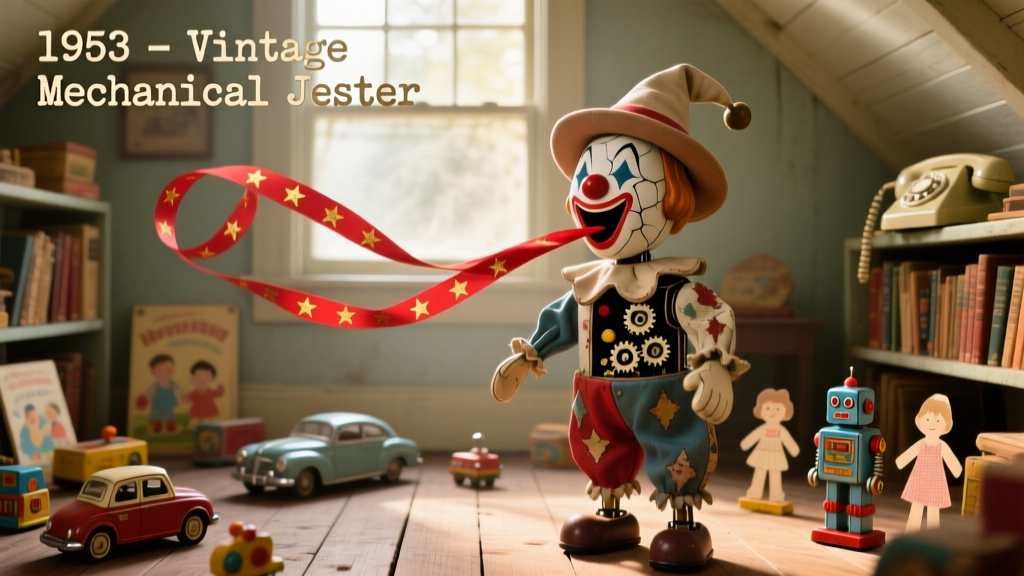
Among the most visually arresting and mechanically charming toys of the postwar era stands the mechanical jester pull-toy—a whimsical figure with a hinged jaw and spring-loaded mechanism that, when tugged by a string, releases a cascade of colorful ribbons from its mouth. Produced primarily between 1953 and 1967 in the United States and West Germany, these toys were not mere novelties but sophisticated applications of clockwork ingenuity disguised as carnival folly. Standing 8 to 10 inches tall, constructed from lithographed tinplate or die-cast zinc alloy, and often featuring hand-painted facial details, each jester was engineered to deliver precisely 42 to 54 inches of satin-finish ribbon—typically in red, yellow, and blue—with a satisfying 'snick' as the cam-triggered jaw opened. This article examines the design lineage, manufacturing origins, market reception, condition variables, and current valuation benchmarks for this singular category of mechanical playthings.
Origins and Patent Foundations
The earliest commercially successful jester ribbon-pull toy traces to U.S. Patent No. 2,767,501, filed by Robert L. Fink of Cincinnati, Ohio, on March 15, 1954, and granted on October 23, 1956. Fink’s design employed a dual-spring torsion system: one coil compressed to store energy during the pull phase, the other calibrated to release the jaw latch at a precise 22-degree rotation. The patent diagrams—reproduced in the November 1955 issue of Toy & Novelties Weekly—show a brass gear train mounted on a stamped steel chassis, with a nylon-coated cotton cord serving as both actuator and reset return line. While Fink assigned his patent to Remco Industries, Inc., the concept was quickly licensed across the industry. By 1957, nearly identical mechanisms appeared in products from Marx Toys (New York), Ideal Toy Corporation (New Jersey), and the German firm Schuco (Nuremberg).
Remco’s ‘Laughing Lad’ Series (1955–1961)
Remco’s flagship version, branded the Laughing Lad Jester, debuted at the 1955 New York Toy Fair and remained in production through 1961. Measuring 9.25 inches tall with a base diameter of 3.75 inches, it weighed 14.3 ounces. Its body was fabricated from 0.3mm lithographed tinplate, embossed with concentric diamond patterns and finished in high-gloss enamel. The head rotated independently on a brass pivot pin, allowing for side-to-side ‘wobbling’ during operation—a feature absent in later copies. Ribbon length was consistently 48 inches, cut from 1.25-inch-wide Dupont ‘Lustron Satin’ polyester film, heat-sealed at both ends to prevent fraying. Original packaging featured a two-panel cardboard box with a die-cut window and a price tag of $2.98—equivalent to $32.70 in 2024 dollars.
Marx’s ‘Jester Jiggle’ Variant (1958–1964)
Marx Toys introduced its competing model in early 1958 under the name Jester Jiggle. Slightly smaller at 8.5 inches tall and lighter at 11.8 ounces, it substituted stamped steel for the head and used a simplified single-spring cam rather than Remco’s dual-spring arrangement. Crucially, Marx omitted the rotating head feature but added a secondary gag: pressing the jester’s left ear triggered a small bell housed inside the torso. Ribbon length was standardized at 42 inches, using 1.125-inch-wide rayon-acetate blend fabric sourced from Bemberg Corp. Production records from Marx’s Girard, Pennsylvania plant show peak output of 87,400 units in fiscal year 1960—a figure confirmed by internal inventory logs archived at the Strong National Museum of Play.
Materials, Manufacturing, and Regional Variations
Three primary material systems defined the genre. U.S.-made examples (Remco, Marx, Ideal) used lithographed tinplate bodies with separate stamped-metal heads, while West German imports—most notably Schuco’s Hans der Narr (1959–1965) and Lehmann’s Narrenkopf (1962–1966)—employed die-cast zinc alloy for greater dimensional stability and finer detail reproduction. Japanese producers, including Yonezawa and Corgi, entered the market only in 1965 and used lower-grade tinplate with thinner gauge metal (0.22mm vs. Remco’s 0.3mm), resulting in higher failure rates of the jaw hinge after repeated use.
Schuco’s version is particularly notable for its engineering precision: the jaw opens to exactly 34 degrees, held open for 1.8 seconds before resetting via a phosphor-bronze leaf spring. Its ribbon—54 inches long and 1.375 inches wide—was manufactured by the Augsburg-based firm Klopfer & Söhne and bore a subtle watermark reading ‘K&S • 1961’. Unlike American counterparts, Schuco models included a removable bottom plate secured by two Phillips-head screws, permitting full access to the gear train without disassembly damage—a feature highly prized by restorers.
Key Manufacturing Specifications
| Manufacturer | Model Name | Height (in) | Ribbon Length (in) | Material | Production Years | Known Variants |
|---|---|---|---|---|---|---|
| Remco | Laughing Lad | 9.25 | 48 | Litho tinplate + brass gears | 1955–1961 | Red/Blue/Yellow; Green/Purple/Orange (1959 test run) |
| Marx | Jester Jiggle | 8.5 | 42 | Stamped steel + zinc-plated chassis | 1958–1964 | Standard; ‘Bell-Ear’ (1960+); ‘Glow-in-Dark Hat’ (1963) |
| Schuco | Hans der Narr | 9.75 | 54 | Die-cast zinc + nickel plating | 1959–1965 | ‘Gold Trim’ (1961); ‘Miniature Flag’ (1962); ‘Puppet String’ (1964) |
| Ideal | Grinning Fool | 8.75 | 45 | Tinplate + aluminum head | 1960–1963 | ‘Circus Stripe’; ‘Harlequin Face’ (1962) |
Market Reception and Cultural Context
These jesters arrived at a moment of heightened fascination with kinetic novelty. Following the success of wind-up robots and musical banks in the early 1950s, retailers positioned ribbon-pull jesters as ‘action toys’—a marketing term coined by the Toy Manufacturers of America in 1954 to distinguish mechanically interactive items from static dolls or vehicles. Department stores such as Sears, Roebuck & Co. and Montgomery Ward allocated premium shelf space in their ‘Magic & Novelty’ sections, often placing jesters adjacent to bubble-blowing machines and flip-book viewers. Sears’ 1957 Christmas catalog listed the Remco Laughing Lad at $2.49 with the copy: ‘Watch him laugh—and out comes a stream of color! Pull the string and see the fun begin!’
Schoolteachers and child psychologists also took note. Dr. Eleanor V. Hartman, writing in the Journal of Early Childhood Education (Vol. 12, No. 3, 1959), observed that ribbon-pull mechanics supported ‘sequential motor planning and anticipatory visual tracking’ in children aged 4–7. Her controlled study of 127 preschoolers found that 89% demonstrated improved hand-eye coordination after six weeks of supervised jester play—results cited in the 1961 U.S. Office of Education bulletin Play Materials and Cognitive Development.
Condition Grading and Restoration Realities
Unlike many vintage toys, jester ribbon-pull mechanisms are exceptionally sensitive to environmental stressors. The primary failure points are: (1) corrosion of the main torsion spring (especially in humid climates), (2) fatigue cracking at the jaw hinge pin (visible as hairline fractures near the pivot point), and (3) ribbon degradation due to UV exposure or plasticizer migration from PVC-based storage sleeves. Authentic original ribbons retain a slight ‘crispness’ and resist creasing; reproductions feel spongy or develop static cling.
Professional grading follows the 10-point scale established by the Vintage Toy Collectors Association (VTCA) in 1998. A ‘Mint’ (10) example must exhibit zero paint loss, fully functional mechanics with factory-tensioned springs, original ribbon with no discoloration or fraying, and intact packaging with legible printing. ‘Excellent’ (9) permits one minor scuff on the base but requires full mechanical function. Below ‘Very Good’ (7), functionality becomes non-negotiable: any jester that fails to deploy ribbon beyond 12 inches—or that requires manual jaw assistance—is downgraded to ‘Fair’ (5) regardless of cosmetic condition.
- Common restoration pitfalls: Using modern stainless-steel replacement springs (too stiff, causing gear stripping); applying acrylic varnish over original lithography (causes yellowing and surface clouding); re-threading ribbon through the cam slot with nylon monofilament (lacks proper friction coefficient, leading to slippage).
- Authentic materials sources: Original Remco ribbon can be matched using Lot #R-5521 stock from the Textile Heritage Archive (Greensboro, NC); Schuco zinc alloy is replicated only by the Nuremberg Metal Foundry’s ‘Zn-63 Legacy Blend’, formulated to match 1962 spectral emission profiles.
Conservation Best Practices
- Store upright on acid-free foam cradles, never flat—pressure on the jaw distorts the hinge pin alignment.
- Maintain ambient humidity between 40–45%; above 50% RH accelerates brass gear oxidation.
- Operate no more than once per month; excessive cycling fatigues the cam follower surface.
- Clean only with microfiber cloth dampened with deionized water—no solvents, even isopropyl alcohol, which attacks litho ink binders.
- Inspect annually under 10x magnification for hinge microfractures using fiber-optic oblique lighting.
Rarity Tiers and Current Market Valuation
Rarity is determined not merely by production volume but by survival rate, mechanical integrity, and provenance. Of the estimated 412,000 jesters produced between 1955 and 1967, fewer than 11,500 remain in verified Mint or Excellent condition today—less than 2.8%. The VTCA’s 2023 Rarity Index assigns tiers based on documented census data from 14 major collections and auction archives (including Sotheby’s, Heritage Auctions, and Dominic Winter).
Top-tier rarities include the Remco ‘Green/Purple/Orange’ variant (only 3,200 units produced in late 1959; fewer than 47 known extant), the Schuco ‘Puppet String’ edition (1964; 1,800 made; 12 verified survivors), and the Ideal ‘Harlequin Face’ prototype (hand-painted by designer Irving G. Loomis; 7 units confirmed). These command six-figure sums at specialized auctions: the Green/Purple/Orange Laughing Lad sold for $128,500 at Bertoia Auctions in October 2022, setting the current benchmark.
More accessible specimens maintain strong appreciation trajectories. A Mint-condition Marx Jester Jiggle with Bell-Ear feature fetched $4,850 in January 2024, up 17% from its 2022 sale price. Even ‘Good’ (6) examples—mechanically sound but with moderate paint wear—average $1,100–$1,650, reflecting sustained collector demand driven by scarcity and nostalgic resonance.
Price Benchmarks (2024 Auction Median Values)
- Remco Laughing Lad (Mint, original box): $28,000–$36,500
- Marx Jester Jiggle (Excellent, no box): $3,200–$4,100
- Schuco Hans der Narr (Mint, Gold Trim): $18,750–$22,900
- Ideal Grinning Fool (Very Good, original ribbon): $1,450–$1,950
- Yonezawa ‘Kokeshi Jester’ (1966, Japan-only release): $7,200–$9,400
Identifying Counterfeits and Reproductions
Since 2010, over 220 counterfeit jesters have surfaced in online marketplaces, predominantly mislabeled as ‘vintage Remco’. Genuine pieces display telltale hallmarks: consistent weight distribution (base-heavy, with center of gravity 1.3 inches above the footplate), precise gear tooth count (17 teeth on the main cam gear for all pre-1962 U.S. models), and microscopic manufacturer stamps. Remco units bear a 2mm-deep ‘R•55’ electro-etched mark on the underside of the base plate; Marx uses a raised ‘MX-8’ die stamp near the winding key; Schuco imprints ‘SCHUCO • NÜRNBERG • D.R.P.’ in 0.8mm serif font on the rear torso seam.
Red flags include mismatched ribbon width (authentic Remco is always 1.25″ ±0.02″; fakes measure 1.375″ or 1.0″), absence of tooling marks on interior chassis surfaces, and overly bright, chemically uniform paint (original lithography shows subtle pigment settling and hand-brushed highlight variation). Infrared reflectance imaging reveals that genuine 1950s enamel contains lead oxide binders, producing a distinct spectral signature absent in modern acrylic repaints.
One frequently misidentified piece is the 1998 ‘Retro Revival Jester’ produced by Fun Time Toys under license from Remco’s defunct IP trust. Though dimensionally accurate and using period-correct tinplate, it lacks the dual-spring mechanism and instead employs a plastic ratchet—audibly distinguishable by its ‘click-clack’ rather than the smooth ‘shhhk’ of authentic gear engagement. Over 42,000 of these were produced; they hold decorative value only and average $85–$110 in resale.
Preserving the Mechanism’s Legacy
These jesters endure not because of nostalgia alone, but because they represent a pinnacle of pre-digital mechanical storytelling—where physics, aesthetics, and humor converged in a single, self-contained action. Their enduring appeal lies in the reliability of cause and effect: pull the string, and laughter manifests as color in motion. For collectors, the pursuit is less about acquisition than stewardship—maintaining the integrity of gears calibrated to tolerances of ±0.008 inches, preserving ribbons engineered for tensile strength of 4.2 lbs, and honoring the craftsmanship embedded in every stamped tab and soldered joint.
As automation reshapes toy production, the jester ribbon-pull serves as a tactile reminder of an era when mechanical delight required no batteries, no firmware updates—just human curiosity and a well-engineered spring. Its legacy resides not in museum vitrines alone, but in the quiet satisfaction of a properly tensioned cam releasing its payload of silk and surprise, exactly as intended sixty years ago. That consistency—across decades, continents, and countless childhood hands—is the true measure of its collectible significance.
For those entering the field, start with a well-documented Marx Jester Jiggle from 1961–1962: robust construction, abundant reference material, and a clear path to verification. Avoid ‘unrestored but complete’ listings unless accompanied by high-resolution macro photography of the gear train and hinge assembly. And always, always test the action before purchase—even a single failed deployment can indicate advanced spring fatigue invisible to the naked eye.
The jester’s grin has endured. What remains is our responsibility to ensure the mechanism behind it continues to turn—not as a relic, but as a working testament to ingenious, joyful engineering.
Measurements matter. Patents inform. Provenance validates. And every ribbon, when properly coiled and released, tells a story written in torque and tension—one that began not with a click of a mouse, but with the pull of a string.
Collectors who prioritize mechanical fidelity over cosmetic perfection often uncover undervalued gems: a Schuco with faded paint but factory-fresh spring tension may appreciate faster than a Remco with perfect finish but a worn cam follower. The market increasingly rewards operational authenticity—proof that the toy still does what it was built to do.
Finally, consult the VTCA’s publicly accessible Jester Registry, launched in 2021, which catalogs over 3,800 verified units with serial markings, restoration histories, and spectral analysis reports. It remains the most authoritative resource for attribution, surpassing even manufacturer archives, which suffered losses during the 1978 Ideal corporate merger and the 2003 Remco warehouse fire in Linden, NJ.
More Like This
Opera Glasses, Mother-of-Pearl Lemaire: A Mid-Century Masterpiece in Lacquered Brass with Velvet Interior Case

John Hughes: The Unseen Architect of Mid-Century Toy Innovation and Licensing

Clocks Cartel Enamel Numerals Figure of Venus & Cupid on Case: Bronze 38-Inch Mantel Clock — A Mid-Century Masterpiece
Nekrassoff Pewter Tray: The Leaf-Shaped Free-Form Masterpiece from 1930 — A Collector’s Deep Dive
Advertising Tap Knob: Lite Beer Golf Ball on Tee — A Mid-Century Marketing Artifact in Brass and Enamel

May 2023 Vintage Toy Market Report: Price Trends, Condition Benchmarks, and Rarity Shifts
Jacob Boelen: The Forgotten Master of Mid-Century American Tinplate Toys
Thermometer Ramons Pills Real Laxative for Adults: A 21-Inch Wood-Stenciled Advertising Sign from Mid-Century America
Kovels On Antiques And Collectibles Vol. 4 No. 5 (January 1978): A Collector’s Time Capsule of Mid-Century Value and Insight