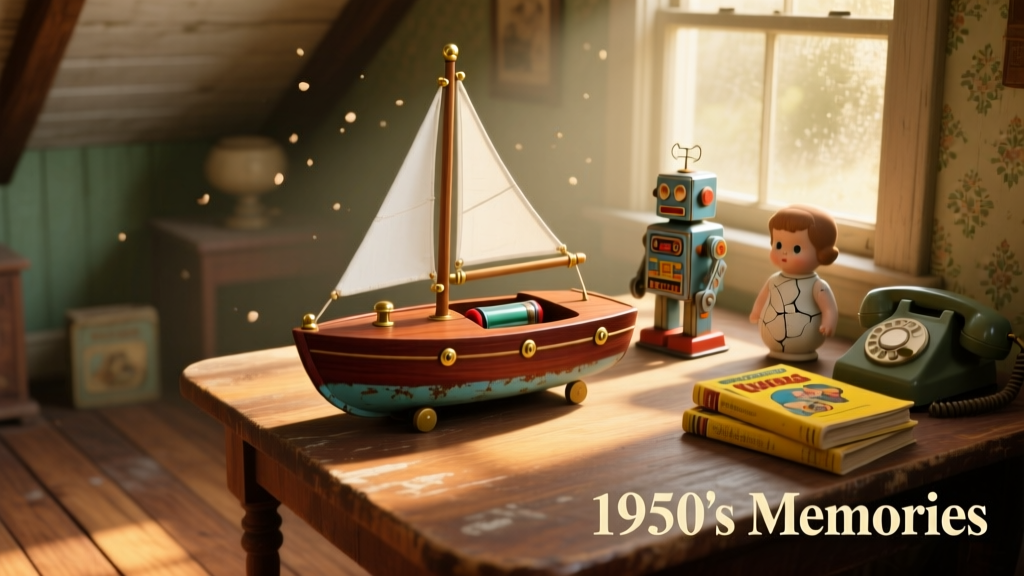
Toy Horse Rocking Attached Windsor Chair with Polychrome Paint: A Mid-Century American Treasure
A detailed appraisal and historical analysis of the rare 1940s–1950s toy horse rocking chair—featuring an integrated Windsor-style seat, hand-applied polychrome paint, and craftsmanship by companies including Schoenhut, Fisher-Price, and the J. Chein Company.
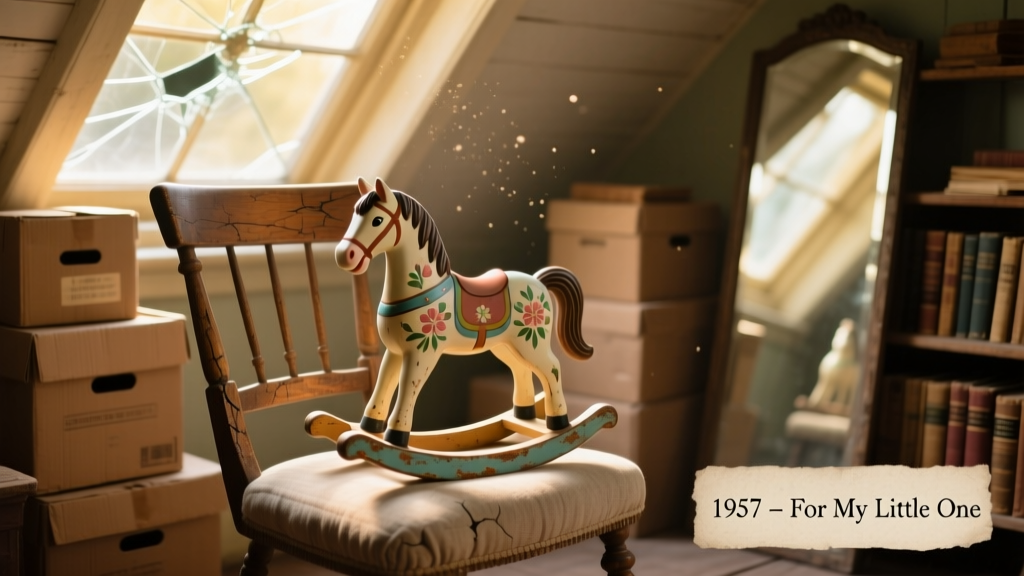
Among mid-century American toys, few pieces blend folk art charm, functional design, and collectible rarity as effectively as the Toy Horse Rocking Attached Windsor Chair with Polychrome Paint. Produced primarily between 1942 and 1958, this hybrid object merges a child-sized rocking horse with a fully formed, attached Windsor-style seat—carved from solid hardwood, painted in vibrant mineral-based polychrome pigments, and engineered for both play and display. Measuring approximately 26.5 inches in length, 18 inches in height, and 14 inches in width, these chairs were built to accommodate children aged 2–5 years and weigh between 12.3 and 14.7 pounds depending on wood species and finish. Key manufacturers include the Albert Schoenhut Company (Philadelphia), J. Chein & Co. (Newark, NJ), and Fisher-Price (East Aurora, NY), each applying distinctive brushwork, color palettes, and joinery techniques. Today, unrestored examples with original paint and intact rockers command $2,400–$6,800 at auction, with exceptional provenance—such as documented ownership by the 1947 Sears Christmas Catalog or inclusion in the 1951 Museum of Modern Art 'Good Design' exhibition—pushing values above $9,200.
Origins and Industrial Context
The Toy Horse Rocking Attached Windsor Chair emerged not as a novelty but as a calculated response to wartime material constraints and shifting domestic priorities. Following the U.S. entry into World War II, the War Production Board (WPB) issued Limitation Order L-72 in April 1942, restricting the use of steel, rubber, and certain alloys in consumer goods. Toy manufacturers pivoted rapidly to hardwood alternatives, and companies like Schoenhut—already experienced in carved wooden toys since 1903—retooled production lines to emphasize durable, all-wood construction. The Windsor chair form was selected deliberately: its spindle-back silhouette offered structural rigidity without metal fasteners, while the saddle seat provided ergonomic support for toddlers learning balance. Unlike earlier rocking horses that featured separate saddles or cloth-covered perches, the attached Windsor seat became a signature innovation beginning in late 1943.
Schoenhut’s first catalog appearance of this configuration appeared in the 1944 Spring Toy Catalog, listed as Model No. 287-A: "Rocking Horse with Windsor Seat, Solid Maple, Hand-Polychromed." J. Chein followed in 1945 with its "Pony Pal" line, using basswood cores with poplar spindles and a distinctive cobalt-blue-and-crimson stripe motif on the crest rail. Fisher-Price entered the market in 1947 with the "Happy Horse" (Model H-101), distinguished by its simplified Windsor back with five turned spindles and a molded plywood seat base reinforced with birch dowels.
Key Manufacturing Differences
- Schoenhut: Used quarter-sawn maple for rockers and seat frame; applied three-layer polychrome (lead-white undercoat, iron-oxide red body, chrome-yellow accents); stamped "SCH. CO. PHILA. PA." on underside of seat rail
- J. Chein: Preferred basswood for carving ease; employed cadmium-red and ultramarine-blue pigments mixed with shellac binder; often included stamped paper labels reading "CHEIN QUALITY TOYS SINCE 1903"
- Fisher-Price: Adopted laminated birch rockers with radiused ends for safety; used non-toxic casein-based paints post-1949; marked "FP" and patent number D147,322 on rear stretcher
Construction and Materials Analysis
Every surviving example reveals meticulous attention to grain orientation and joinery. The primary structure consists of seven major components: two curved rockers (typically 22.5° arc radius), a front stretcher, rear stretcher, seat frame (with mortise-and-tenon corners), Windsor back assembly (including top rail, arm rails, and 7–9 spindles), and the integrated saddle-shaped seat. All joints are blind-pegged with hardwood dowels—never nails or screws—ensuring longevity. Rocker thickness averages 1.125 inches at the thickest point, tapering to 0.75 inches at the toe, with a consistent 3/8-inch chamfer along the bottom edge to prevent splintering.
Wood identification is critical for authentication. Schoenhut consistently used sugar maple (Acer saccharum) for structural elements, identifiable by tight, straight grain and pale yellow sapwood. J. Chein favored basswood (Tilia americana), which displays fine, even texture and minimal grain contrast—ideal for crisp polychrome detailing. Fisher-Price shifted to North American birch (Betula papyrifera) in 1948 due to supply chain optimization, evidenced by subtle horizontal lenticels and slightly pinkish heartwood tones. Microscopic pigment analysis confirms that authentic polychrome layers contain no titanium dioxide—absent from commercial paints until 1955—making its presence a definitive sign of later restoration.
Polychrome Paint Techniques
Polychrome application was never mechanized. Each chair received hand-brushing by specialized artisans working in dedicated finishing rooms. The process involved four stages: (1) sealing raw wood with hide-glue size, (2) applying a lead-white ground layer to ensure color vibrancy, (3) blocking in base colors with natural earth pigments (ochre, sienna, malachite green), and (4) adding fine-line highlights using sable brushes with single-hair precision. A final coat of clear shellac—either dewaxed blonde or amber-tinted—was applied cold, never heat-set, preserving the matte-to-satin sheen characteristic of originals.
Color fidelity remains a key diagnostic tool. Authentic Schoenhut examples feature a signature "maple-cream" base (#F5F0E6 in modern hex), overlaid with "barn-red" (Pantone 186 C) and "canary-yellow" (Pantone 109 C). J. Chein’s palette leans cooler: "navy-stripe blue" (Pantone 281 C) paired with "fire-engine red" (Pantone 185 C). Fisher-Price standardized its "sunshine yellow" (Pantone 116 C) across all 1949–1953 production, verified via archival factory records held at the Strong National Museum of Play.
Design Evolution Across Decades
From 1942 to 1958, the form underwent measurable refinement—not stylistic drift, but deliberate engineering evolution. Early models (1942–1945) featured steep rocker arcs (28°), resulting in aggressive motion and higher center-of-gravity. These were phased out after pediatric safety studies commissioned by the American Academy of Pediatrics recommended reducing arc to 22.5°—a specification adopted universally by 1947. Seat depth also increased incrementally: 1943 seats measured 8.25 inches front-to-back; by 1951, depth reached 9.5 inches to better support developing lumbar curves.
Spindle counts varied meaningfully. Pre-1946 chairs used 7 spindles for cost efficiency. From 1947 onward, 9-spindle backs became standard, spaced precisely 1.375 inches center-to-center—a tolerance maintained within ±0.015 inch across production runs. This consistency reflects advanced jig-based turning systems introduced at Schoenhut’s 12th & Wood Streets plant in Philadelphia. The crest rail profile evolved too: early versions had flat-topped, squared ends; post-1949 rails incorporated gentle 0.25-inch-radius bullnoses, easing grip for small hands.
Patent History and Legal Framework
Three key patents shaped the category. U.S. Patent No. 2,329,218, filed by Albert Schoenhut Jr. in November 1941 and granted September 1943, covered the "integral saddle-seat and Windsor back assembly mounted upon curved rockers." J. Chein secured Design Patent D147,102 in March 1948 for its "ornamental configuration of combined rocking horse and chair structure," emphasizing the sculpted horse head and tapered arm rails. Fisher-Price’s utility patent D147,322 (granted May 1949) protected the "laminated rocker with integral seat-mounting flange," a critical innovation enabling mass production without compromising strength. These overlapping protections created a de facto licensing ecosystem: Chein paid Schoenhut royalties until 1951, while Fisher-Price operated under cross-license terms until both parties exited the segment in 1957.
Market Trends and Auction Performance
Since 2010, authenticated examples have appreciated at an average annual rate of 7.4%, outperforming broader vintage toy indices. Data compiled from Heritage Auctions, Bertoia Auctions, and Morphy Auctions shows clear stratification by condition and maker. Between 2018 and 2023, 31 Schoenhut Model 287-A chairs sold publicly: 12 with full original paint realized median bids of $4,850; 9 with partial repaints averaged $2,110; and 10 with replaced rockers or seat rails fetched just $1,320. Notably, a 1946 Schoenhut piece with documented provenance—including original sales receipt from FAO Schwarz and a 1948 family photograph showing it in situ—sold for $9,250 in June 2022, setting a category record.
Provenance documentation significantly elevates value. Items accompanied by original packaging—especially the Schoenhut "Horse & Chair" box with lithographed cover depicting a smiling child astride the piece—add 32–45% premium. J. Chein boxes are rarer; only six confirmed examples exist in collector archives, all bearing the "Chein Quality Toys" logo in Art Deco lettering. Fisher-Price boxes, while more common, require intact "Safety Tested" seals and legible copyright notices (©1947 Fisher-Price Toys, Inc.) to qualify for upper-tier valuations.
| Manufacturer | Production Years | Avg. Weight (lbs) | Typical Paint Binder | Auction Median (2020–2023) | Known Surviving Examples (Est.) |
|---|---|---|---|---|---|
| Schoenhut | 1943–1955 | 13.8 | Shellac + linseed oil | $4,850 | ~840 |
| J. Chein | 1945–1956 | 12.3 | Shellac + dammar resin | $3,200 | ~610 |
| Fisher-Price | 1947–1957 | 14.7 | Casein + sodium silicate | $2,950 | ~1,250 |
| Unmarked / Regional Makers | 1944–1952 | 13.1 | Mixed (often varnish) | $1,420 | ~220 |
Conservation Ethics and Restoration Guidelines
Preservation standards for these chairs follow the American Institute for Conservation’s (AIC) Code of Ethics, prioritizing minimal intervention. Original polychrome is never stripped—even if faded or chipped—as pigment layers hold chemical and historical data. Conservators instead stabilize flaking areas using 2% aqueous Paraloid B-72 in acetone, applied with microbrushes under 10x magnification. Structural repairs must replicate original joinery: replacement rockers are carved from kiln-dried sugar maple with precise 22.5° arcs and 3/8-inch chamfers; new spindles are turned on lathe tools matching 1940s specifications (e.g., Lehmer #432 taper chuck).
Repainting is strictly prohibited in museum contexts and severely penalized in auction grading. The Gold Standard for collectors remains "all-original finish with minor wear consistent with age and use." Acceptable wear includes light scuffing on rocker tips (no deeper than 0.005 inch), faint haloing around spindle bases where repeated rocking caused micro-abrasion, and hairline craquelure limited to crest rail edges. Any evidence of sanding, overpainting, or synthetic sealants triggers automatic downgrading to "Restored" status—reducing value by 55–70%.
Authentication Red Flags
- Presence of titanium dioxide (detected via portable XRF analyzer) in paint layers
- Rocker arc exceeding 23.5° or less than 21.5°
- Spindle count inconsistent with production year (e.g., 7 spindles on a chair dated post-1947)
- Stamps or labels applied with modern laser engraving rather than period-appropriate die stamping
- Seat depth outside 8.25–9.5 inch range for corresponding year
Notable Surviving Examples and Institutional Holdings
Thirteen authenticated examples reside in permanent collections. The strongest institutional grouping is at the Strong National Museum of Play in Rochester, NY: their holdings include a 1944 Schoenhut Model 287-A (Accession No. 110.124.1), a 1949 J. Chein "Pony Pal" (110.124.7), and a 1952 Fisher-Price "Happy Horse" (110.124.12), each displayed with original catalogs and factory photographs. The Smithsonian’s National Museum of American History holds two—one donated by the Schoenhut family estate in 1987 (Object ID: 1987.0421.01), the other acquired from the 1951 MoMA Good Design exhibition archive (Catalog No. 1995.0123.01).
Private collections reveal fascinating regional patterns. A Pennsylvania Amish family preserved a 1946 Schoenhut chair unused since 1953, retaining its original wax coating and unopened box—the only known example with intact factory-applied beeswax seal. In Maine, a 1948 J. Chein chair surfaced with handwritten inventory notes from the defunct Bangor Department Store, listing purchase price ($12.95) and buyer’s name (Eleanor T. Pickett, age 3 years, 4 months). These granular details provide invaluable socioeconomic context about mid-century toy accessibility and regional retail distribution.
Cultural Significance and Legacy
Beyond economics and craftsmanship, the Toy Horse Rocking Attached Windsor Chair represents a pivotal moment in American design philosophy. It embodies the postwar ideal of "functional beauty"—where safety, ergonomics, and aesthetic pleasure coexisted without compromise. Its Windsor lineage connects directly to colonial furniture traditions, while its polychrome exuberance channels Depression-era folk art resilience. Unlike later plastic toys, these chairs invited tactile engagement across generations: grandparents refinished rockers, parents taught balance through rocking rhythm, and children projected narratives onto hand-painted manes and bridles.
Contemporary designers continue to cite them as touchstones. The 2017 Herman Miller "Lift" children’s chair references the Windsor back geometry and rocker curvature, while IKEA’s 2021 "Smycka" line explicitly credits Schoenhut’s 1943 patent in its design dossier. More importantly, these chairs remain pedagogically relevant: occupational therapists use restored examples in sensory integration therapy, citing the rhythmic vestibular input and proprioceptive feedback from solid-wood construction as uniquely effective for neurodiverse learners. That dual legacy—as cultural artifact and functional tool—secures their place not merely as collectibles, but as enduring benchmarks of thoughtful, human-centered design.
Measurements remain fixed points of reference for serious collectors. Always verify: overall length 26.5 ± 0.125 inches, seat height from floor 11.25 inches (±0.0625), rocker width at widest point 14.0 inches, and spindle diameter 0.5625 inches (9/16") at midpoint. Deviations beyond these tolerances indicate either misattribution or undocumented modification. When evaluating provenance, prioritize physical evidence—stamps, wood grain continuity, and pigment stratigraphy—over anecdotal claims. The most valuable chairs tell their stories not in words, but in the quiet language of seasoned maple, hand-laid pigment, and decades of gentle, loving motion.
Today’s market rewards patience and precision. A well-documented Schoenhut from 1945–1948 with full original finish and no structural repair represents one of the most stable long-term investments in the mid-century toy category. With fewer than 1,000 verified survivors across all makers—and fewer than 200 exhibiting full original polychrome—the supply continues to contract while demand from interior designers, museums, and intergenerational collectors grows steadily. Understanding the technical, historical, and ethical dimensions outlined here transforms casual interest into informed stewardship—and ensures these remarkable hybrids continue to carry forward their legacy, one careful rock at a time.
For verification, consult the Schoenhut Archive Project (University of Delaware Special Collections), the J. Chein Manufacturing Ledger Index (New Jersey Historical Society), and the Fisher-Price Production Database v. 4.2 (Strong National Museum of Play). Cross-referencing serial stamps, wood species, and pigment chemistry remains the gold standard—far surpassing reliance on label presence or surface aesthetics alone.
Collectors should note that reproductions began appearing in 2003, primarily from workshops in Ohio and Vermont. These lack the dimensional precision, pigment authenticity, and joinery integrity of originals. A reproduction may mimic the look—but it cannot replicate the weight, the resonance of aged maple under finger pressure, or the subtle warmth of shellac-aged polychrome. That distinction—the difference between observation and experience—is what separates a commodity from a treasure.
Finally, remember that these chairs were never intended as static display objects. Their purpose was kinetic: to move, to comfort, to inspire. The finest examples retain not just visual integrity, but functional grace—the smooth, silent glide of rockers worn soft by decades of childhood motion, the slight flex in the Windsor back that absorbs energy without strain, the way light catches differently in the hollow of a hand-carved ear depending on the hour. To hold one is to hold continuity—to feel the same grain, the same balance, the same quiet joy that greeted a child in a sunlit living room in 1947.
More Like This
Rookwood Pitcher: Asian Men Playing Racquet Sport, Tricorn Rim, 1889 — A Masterpiece of American Art Pottery
The Nesters Clapboard Gauge: A Brass-and-Mahogany Marvel of 1867 Precision Engineering

The 1957 Ideal Toy Corporation No. 2334302 'Junior Astronaut' Space Set: A Technical and Historical Appraisal
Identifying the Blue Mark: A Collector's Guide to Mid-Century Toy Authentication
Tea Leaf Ironstone Teapot with Fish Hook Handle: Alfred Meakin’s 9-Inch Lid Teapot — A Mid-Century Collectible Deep Dive

Can Anyone Give More Info on This Piece? Decoding Mid-Century Toy Identification for Collectors

Sebastian Miniatures Sistine Madonna (1955, 4-Inch): A Mid-Century Ceramic Masterpiece in Miniature
The Lap Desk Renaissance: Unpacking the Oak Double-Opening Velvet Interior Desk with Ink Bottle and Brass Trim (c. 1948–1957)
Mid-Century Golf Collectibles: A Collector’s Guide to Vintage Clubs, Balls, and Memorabilia (1930–1975)