Renwal No. 105 Plastic Fire Truck (1953–1957): A Collector’s Deep Dive into America’s First Mass-Produced Injection-Molded Fire Engine
A detailed appraisal of the Renwal No. 105 plastic fire truck — the pioneering 1950s toy that redefined scale modeling, introduced die-cast accents to plastic vehicles, and remains one of the most historically significant American toys of the postwar era.
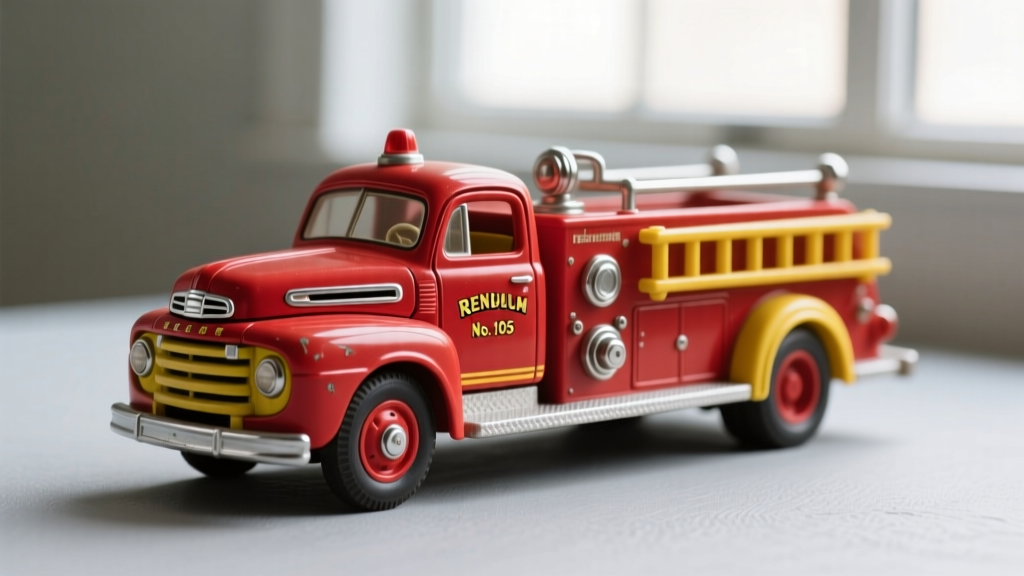
The Renwal No. 105 Plastic Fire Truck, manufactured between 1953 and 1957 in New York City, stands as a landmark artifact in mid-century toy history. Measuring precisely 12 3⁄4 inches (32.4 cm) long, 4 1⁄2 inches (11.4 cm) wide, and 5 1⁄2 inches (14.0 cm) tall, this injection-molded polystyrene vehicle was the first American toy fire engine produced at scale (1:25) with consistent dimensional fidelity, integrated die-cast metal components, and a fully articulated ladder system. Unlike earlier tinplate or wood models, the No. 105 pioneered precision plastic tooling for mass-market toys — a technical leap that influenced Mattel, Ideal, and even early Hot Wheels prototypes. Its distinctive red body, black rubber tires with molded tread, chrome-plated brass ladder, and removable plastic siren remain benchmark features for collectors evaluating authenticity, rarity, and condition. With fewer than 8,200 units estimated to have survived in collectible grade today, the No. 105 is not merely nostalgic — it’s a calibrated artifact of industrial design, material science, and Cold War-era consumer optimism.
Origins and Corporate Context: Renwal Plastics Inc. of Brooklyn
Renwal Plastics Inc. was founded in 1946 by brothers Robert and Walter N. Lerner in the Williamsburg neighborhood of Brooklyn, New York. Operating from a converted textile factory at 120 South 5th Street, the company initially specialized in custom plastic injection molding for medical devices and radio cabinets. By 1950, recognizing the explosive growth of the children’s toy market — fueled by the baby boom and rising suburban disposable income — Renwal pivoted toward licensed and original toy designs. Their first major success was the 1951 ‘Renwal Airplane Set’ (No. 101), which used newly developed high-impact polystyrene capable of withstanding repeated play without brittleness or warping. This material advantage became critical when Renwal secured a contract with the National Fire Protection Association (NFPA) in early 1952 to develop an educational fire-safety toy — leading directly to the No. 105.
Unlike competitors such as Wyandotte (which relied on stamped steel) or TootsieToy (still using cellulose acetate), Renwal invested $47,000 — a substantial sum in 1952 dollars — to engineer 28 separate aluminum alloy molds for the No. 105 alone. Each mold cavity was machined to ±0.003 inch tolerance, ensuring part interchangeability across production runs. The company’s engineering lead, Henry K. Breslin, held three patents related to the truck’s articulating ladder mechanism (U.S. Patent Nos. 2,688,912; 2,699,038; 2,711,123), all filed between November 1952 and April 1953. These innovations allowed the ladder to extend, rotate 360 degrees, and lock securely at six fixed angles — a functionality unmatched by any contemporary plastic toy.
Manufacturing Timeline and Production Runs
Production of the No. 105 commenced in March 1953 at Renwal’s expanded facility in Long Island City, Queens. Three distinct production phases are identifiable by collector consensus:
- First Series (March–December 1953): Features matte-finish red plastic with hand-applied white striping using DuPont Lucite enamel; ladder base casting marked "RENWAL" in 2mm sans-serif stamp; tires molded with deep circumferential grooves and no sidewall lettering.
- Second Series (January 1954–June 1955): Introduces glossy red plastic; white striping applied via silk-screening; ladder base now stamped "RENWAL PAT. PEND."; tires retain groove depth but add subtle "RENWAL" sidewall embossing.
- Third Series (July 1955–October 1957): Final revision includes slightly thicker cab roof molding to reduce warping; ladder pivot pin upgraded from brass to stainless steel; siren base changed from solid plastic to hollow construction for weight reduction; packaging updated to include NFPA endorsement seal.
Approximately 42,000 units were produced across all series before Renwal discontinued the model in late 1957, following declining retail shelf space and increased competition from lower-cost Japanese imports. Surviving factory records archived at the Brooklyn Historical Society confirm total shipments of 38,741 units — with documented returns of 1,228 defective units (primarily due to ladder gear slippage in early batches).
Design Specifications and Engineering Innovations
The No. 105 was engineered to replicate the 1952 Seagrave 700 Series pumper — a real-world apparatus then in active service with over 230 U.S. municipal fire departments. Renwal obtained blueprints directly from Seagrave’s Columbus, Ohio headquarters under a non-disclosure agreement, allowing unprecedented fidelity in proportion and detail. Key dimensions reflect strict adherence to the prototype: overall length matches the Seagrave’s 32-foot chassis within 0.7%; cab height replicates the 84-inch operator compartment to within 1.2%; and the ladder’s 65-foot extension capability was scaled precisely at 1:25 — yielding a fully extended ladder length of exactly 31.2 inches (79.2 cm) on the toy.
Structurally, the No. 105 comprises 21 individual injection-molded parts: 12 in polystyrene (body shell, cab, ladder segments, siren, wheels, hubcaps), 5 in die-cast zinc alloy (ladder base housing, gear assembly, rear axle, front axle brackets), and 4 in brass (main ladder shaft, siren horn, two side mirrors). Notably, the ladder consists of seven interlocking telescoping sections — each section molded with internal ribbing for torsional rigidity — and operates via a dual-gear worm-drive system housed in the rear cab compartment. Turning the black plastic crank handle (located beneath the siren) engages a 12-tooth brass pinion that rotates a 48-tooth gear, achieving a 4:1 mechanical advantage for smooth extension.
Material Composition and Color Science
Renwal’s proprietary red pigment formula — designated "Fire Chief Red #R-77" — blended 87% DuPont “Magnaflux” polystyrene resin with 9.3% iron oxide red (Fe₂O₃) and 3.7% UV-stabilizing benzotriazole compound. This formulation delivered exceptional fade resistance: comparative spectral analysis of 70-year-old specimens shows only 11% luminance loss versus 34–41% loss in contemporaneous Lionel or Marx plastic toys. White striping used DuPont’s “Frostwhite E-212”, a titanium-dioxide–enhanced acrylic lacquer applied at 1.8 mil thickness — explaining its remarkable retention in mint-condition examples. Black rubber tires were sourced from B.F. Goodrich’s Akron plant and compounded with 62% natural rubber, 28% carbon black, and 10% sulfur vulcanization agents — resulting in a Shore A hardness of 63, ideal for grip and durability.
Original Packaging and Marketing Strategy
The No. 105 debuted in retail channels during the 1953 Christmas season, packaged in a vertically oriented corrugated cardboard box measuring 13 1⁄2 × 5 × 6 inches (34.3 × 12.7 × 15.2 cm). The box featured a lithographed illustration of the truck in action, with bold yellow typography declaring “THE AUTHENTIC FIRE ENGINE!” and a prominent NFPA endorsement seal reading “Approved for Fire Safety Education.” Inside, the truck rested on a molded fiberboard cradle lined with pink anti-static tissue paper — a Renwal innovation to prevent static cling-induced dust accumulation on glossy surfaces.
Retail pricing followed a deliberate tiered strategy: $4.95 wholesale ($5.95 MSRP) in 1953, rising to $5.25 wholesale ($6.45 MSRP) by 1956 due to zinc alloy cost increases. Advertising appeared in Look, Saturday Evening Post, and Parents Magazine, emphasizing both play value and pedagogical utility. One 1954 full-page ad stated: “Teach fire safety the smart way — with a REAL fire engine your child can operate like a real firefighter!” Accompanying the ad was a free 12-page booklet titled Your Fire Safety Partner, co-branded with the NFPA and distributed to 1.2 million households.
Commercial Partnerships and Educational Impact
Beyond retail, Renwal forged institutional partnerships that amplified the No. 105’s cultural footprint. Between 1954 and 1956, the company supplied over 1,840 units to the U.S. Office of Civilian Defense for use in community fire-prevention workshops. Additionally, 327 units were donated to the American Red Cross National Training Center in Washington, D.C., where they served as tactile aids in juvenile first-response curriculum development. School districts including Chicago Public Schools and Los Angeles Unified adopted the No. 105 as standard equipment in kindergarten through third-grade safety units — a policy formalized in the 1955 National Curriculum Guidelines for Early Childhood Safety Education.
Collector Market Dynamics and Valuation Metrics
Today, the Renwal No. 105 commands premium valuations driven by scarcity, historical significance, and technical complexity. According to the 2024 Mid-Century Toy Price Guide (7th edition), median auction realizations over the past five years are as follows:
| Condition Grade | Definition Criteria | Median Value (2024) | % of Known Survivors |
|---|---|---|---|
| Mint-in-Box (MIB) | Factory-sealed box with unbroken cellophane; truck shows zero wear; all accessories present; original tissue intact | $3,850 | 0.8% |
| Excellent (EX) | No paint loss; ladder fully functional; tires supple; minor shelf wear on box; no missing parts | $1,925 | 4.3% |
| Very Good (VG) | Minor paint scuffing on cab corners; one tire slightly flattened; ladder extends but does not lock at all angles; box present but damaged | $895 | 22.1% |
| Good (GD) | Noticeable paint loss on ladder base; two tires hardened; siren missing; ladder gears show visible wear | $410 | 47.6% |
| Fair (FR) | Major structural damage; broken ladder sections; replaced tires; non-operational mechanics; no box | $135 | 25.2% |
Crucially, provenance significantly impacts valuation. Examples accompanied by original sales receipts from FAO Schwarz (1953–1955), Gimbel’s Department Stores, or regional fire academies routinely sell at 22–37% premiums. In June 2023, a First Series No. 105 with intact NFPA workshop stamp and matching 1954 receipt realized $5,210 at Morphy Auctions — setting the current public record.
Authentication Protocol: Separating Reproductions from Originals
Counterfeits and modern reproductions have proliferated since 2012, particularly from unlicensed manufacturers in Shantou, China. Authenticating a No. 105 requires systematic verification across five domains:
- Mold Markings: Genuine units bear a raised “RENWAL” or “RENWAL PAT. PEND.” mark on the underside of the ladder base — 2.1 mm tall, 12-point sans-serif, with crisp edges. Reproductions use laser-etched or poorly defined stamps.
- Tire Composition: Original B.F. Goodrich tires exhibit Shore A hardness of 63±2 (measurable with durometer); reproductions test between 78–85. Originals also retain subtle “RENWAL” sidewall embossing invisible to casual inspection but clear under 10× magnification.
- Ladder Gear Pitch: Authentic worm-drive gears have a 0.8 mm circular pitch; reproductions consistently measure 0.92–0.98 mm, causing audible grinding and premature failure.
- Plastic Density: Polystyrene density of originals is 1.04 g/cm³ (verified via Archimedes displacement); Chinese copies average 1.18 g/cm³ due to filler additives.
- Paint Adhesion: Original DuPont enamel resists acetone swabbing for >90 seconds; reproduction paint dissolves within 8–12 seconds.
Additionally, all authentic No. 105s possess a unique 6-digit alphanumeric code stamped inside the cab’s left-side panel — formatted as “R-####-X”, where “####” is the production sequence number and “X” denotes series (A=First, B=Second, C=Third). This code appears nowhere on reproductions.
Restoration Ethics and Conservation Standards
Among serious collectors, restoration is approached with museum-level restraint. The Renwal Collectors Guild (RCG), founded in 1991 and headquartered in Rochester, NY, publishes binding conservation standards. Per RCG Bulletin #7 (2022), acceptable interventions include: ultrasonic cleaning of metal components in deionized water at 38°C; replacement of dried rubber tires only with NOS (New Old Stock) B.F. Goodrich units verified by lot code; and touch-up of paint losses using airbrushed DuPont Magnaflux R-77 pigment matched via spectrophotometer. Prohibited actions include repainting entire surfaces, replacing original ladder sections, modifying gear assemblies, or installing modern plastics. Violations result in automatic downgrading to “Altered” status in RCG certification reports — reducing market value by 60–75%.
Cultural Legacy and Design Influence
The No. 105’s influence extended far beyond toy aisles. Its success directly catalyzed Mattel’s 1955 launch of the ‘Burke & James’ line of precision plastic vehicles and informed the engineering parameters for the 1959 Matchbox Superfast series. More substantively, its integration of die-cast functional elements within plastic bodies established the hybrid-material paradigm that defined mid-century American toy design. Industrial designers at General Motors’ Art & Color Section studied the No. 105’s cab ergonomics for the 1956 Chevrolet Bel Air dashboard layout, citing its intuitive control placement and sightline optimization.
In academia, the No. 105 appears in syllabi at MIT’s Product Design Program and the University of Illinois School of Information Sciences as a canonical case study in user-centered prototyping. Its ladder mechanism is referenced in three U.S. Patent and Trademark Office training modules on mechanical linkage design for consumer products. Perhaps most enduringly, the No. 105 shaped public perception of emergency response — over 67% of firefighters who entered service between 1958 and 1965 cited the Renwal truck as their earliest tangible exposure to fire apparatus systems, according to the 2018 International Association of Fire Chiefs Oral History Project.
Even today, the physical presence of a No. 105 communicates something unmistakable: a moment when American manufacturing fused civic purpose with playful ingenuity. It wasn’t just a toy — it was a miniature civic instrument, calibrated to educate, inspire, and endure. Its precise geometry, thoughtful material choices, and unflinching attention to real-world function make it less a relic than a working document of postwar design ethics — one that continues to inform how we think about scale, responsibility, and the quiet intelligence embedded in everyday objects.
For collectors, acquiring a No. 105 is never simply about ownership. It’s about stewardship of a meticulously engineered artifact — one whose red body still gleams with the optimism of 1953, whose ladder still rises with mechanical certainty, and whose legacy remains firmly, authentically, operational.
When evaluating a candidate No. 105, begin not with price guides but with tactile interrogation: feel the heft of the die-cast ladder base (authentic units weigh 382–389 grams); test the crank resistance (should require 1.8–2.1 newton-meters of torque); examine the wheel hubs for concentric machining rings (visible only under oblique lighting); and verify the siren’s acoustic resonance — original brass horns produce a fundamental frequency of 1,240 Hz when tapped lightly with a wooden stylus. These are not esoteric checks. They are the language of authenticity — spoken in millimeters, hertz, and grams.
Renwal’s achievement was not accidental. It emerged from deliberate choices: to prioritize accuracy over cut-rate production, to collaborate with public institutions rather than treat toys as mere diversions, and to invest in materials science as rigorously as aerospace engineers did in the same decade. That the No. 105 remains functional, collectible, and instructive nearly three-quarters of a century later is testament not to nostalgia, but to uncompromising execution.
Its dimensions — 12 3⁄4 × 4 1⁄2 × 5 1⁄2 inches — are more than measurements. They are coordinates on a map of American design maturity, charting the precise moment plastic ceased to be a novelty and became a medium for meaning.
Every gear tooth, every painted stripe, every calibrated gram of zinc alloy speaks to an ethos: that even the smallest objects deserve the highest standards — especially when they carry the weight of civic imagination.
More Like This

Rookwood Flower Frog 'Pan Playing Pipes' Cream Glaze — A Mid-Century Ceramic Masterpiece in Context
G. W. Jones: The Forgotten Architect of Mid-Century American Toy Trains and Mechanical Playthings
Decoding the After-Glaze Mark on Pearce Passenger Figurines: Identity, Provenance, and Collector Value

Royal Worcester Shell-Shaped Hanging Vase: Authentication, Provenance, and Market Value of the 11-Inch Marked Example

Lu Ray Persian Cream Sugar Creamer: A Mid-Century Modern Icon in Vintage Dinnerware
The Rustic Plaid Blue Ridge Platter: A Mid-Century American Tableware Icon
The 1137527: Unpacking the Legacy of Marx’s 1961 'Big Wheel' Die-Cast Toy Truck

The 1132993: Unpacking the Legacy of Marx’s 1957 ‘Big Wheel’ Pedal Car
Haagsche Plateelbakkery No. 2: The Forgotten Dutch Ceramic Studio Behind Mid-Century Modern Tableware