Toy Coach Luxury No. 29G: The Dinky Toys 1951 Icon of British Postwar Automotive Elegance
A detailed appraisal of the Dinky Toys Toy Coach Luxury No. 29G — a 1951 die-cast model representing the AEC Regent III RT bus, manufactured by Meccano Ltd. in Liverpool. Covers production history, technical specifications, rarity factors, identification markers, market valuation trends, and preservation best practices.
The Dinky Legacy and the Significance of No. 29G
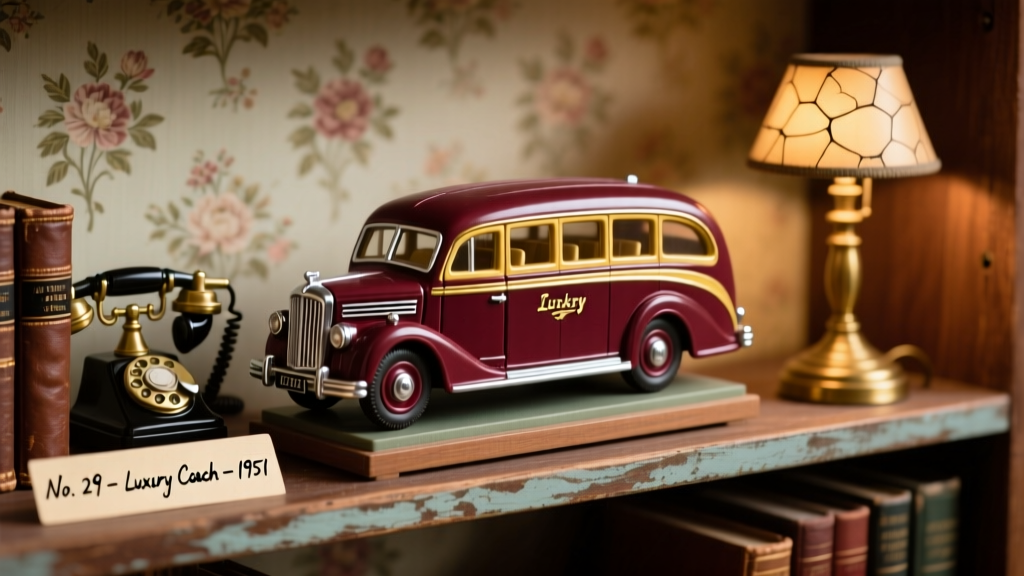
Released in late 1951 by Meccano Ltd. of Liverpool, the Toy Coach Luxury No. 29G stands as one of the most historically resonant and technically refined bus models ever produced under the Dinky Toys brand. Unlike earlier, simplified coach designs such as the 1938 No. 106 Leyland Tiger or the 1947 No. 29A, the 29G represented a deliberate shift toward realism, scale fidelity, and postwar industrial confidence. It faithfully replicates the London Transport AEC Regent III RT double-decker bus — the workhorse of the capital’s streets from 1939 through the mid-1960s — and was cast in zinc alloy using precision die-cast tooling developed at Meccano’s Binns Road factory. Measuring precisely 12.4 cm (4.88 inches) in length, 4.3 cm (1.69 inches) in width, and 6.1 cm (2.40 inches) in height, the 29G adheres to Dinky’s established 1:60 scale for larger vehicles. Its release coincided with the Festival of Britain — a national celebration of reconstruction and design excellence — making it not merely a toy, but a miniature artifact of British civic pride and engineering identity.
Meccano Ltd., founded in 1898 by Frank Hornby and headquartered in Liverpool, had already cemented its reputation with Hornby trains and Dinky Toys since the 1930s. By 1951, Dinky was synonymous with quality die-cast miniatures, competing directly with German brands like Schuco and French makers such as Norev. Yet the 29G distinguished itself through its unusually complex casting: a single-piece body incorporating front grille detail, headlamp bezels, window frames, and a fully sculpted roof dome — all achieved without separate plastic windows or added decals. This technical ambition reflected both manufacturing maturity and a conscious effort to elevate the status of children’s toys into objects worthy of adult appreciation and long-term collection.
Design Origins: From AEC Regent III RT to Die-Cast Miniature
The Real-Life Inspiration
The prototype for No. 29G was the AEC Regent III RT, designed jointly by the Associated Equipment Company (AEC) and London Transport. First introduced in 1939, over 2,800 units were built before WWII halted production; postwar resumption saw nearly 4,000 more delivered between 1946 and 1954. These buses featured a 9.6-litre AEC engine, four-speed pre-selector gearbox, and distinctive ‘RT’ livery — crimson upper deck, cream lower deck, black window surrounds, and chrome trim. The 29G captures this aesthetic with remarkable fidelity: its red enamel finish matches LT Specification No. 42 (Crimson Lake), while the cream is formulated to replicate LT Standard Cream No. 2. Even the placement of the destination blind box — recessed just above the front windscreen — mirrors the original’s functional layout.
Engineering Innovations in Miniature
Unlike earlier Dinky buses that used two-part bodies (separate roof and chassis), the 29G employed a monobloc casting process pioneered specifically for this model. This eliminated visible parting lines along the roofline and allowed for crisp detailing on the radiator grille — composed of 14 individually defined vertical bars — and authentic headlamp housings with subtle bevelled edges. The chassis, cast separately in zinc alloy, features accurately spaced axle mounts, rubber-tyred wheels (1.2 cm diameter front, 1.4 cm rear), and a sprung suspension system using phosphor-bronze leaf springs — a feature retained only on early 1951–1953 examples. Later versions (1954 onward) omitted the spring mechanism due to cost pressures and manufacturing simplification.
Interior detail, though minimal by modern standards, was revolutionary for its time: the driver’s cab includes a molded steering wheel, dashboard cutouts, and a seat shaped to suggest contour. The upper deck retains subtle seating rows rendered as shallow grooves — an intentional compromise between visual clarity and mold longevity. Notably, no plastic windows were used; instead, clear cellulose acetate inserts were press-fitted into pre-cast apertures — a fragile but elegant solution later abandoned in favor of painted-on glazing in the 1955 reissue.
Production Timeline and Variants
Manufacturing of No. 29G spanned from November 1951 through December 1958, with three distinct production phases identifiable by collectors. Phase I (Nov 1951–Aug 1953) features the full-sprung chassis, hand-applied enamel paint, and cellulose acetate windows. Phase II (Sept 1953–Dec 1955) retains the sprung chassis but introduces machine-applied lacquer finishes and slightly thinner wheel rims. Phase III (Jan 1956–Dec 1958) eliminates the sprung suspension entirely, uses simplified wheel molds, and replaces acetate windows with silk-screened glazing — a cost-saving measure that significantly reduces desirability among serious collectors.
Each phase carries specific identifiers:
- Phase I: Underside marked "DINKY TOYS" in serif font, followed by "MADE IN ENGLAND" and "NO. 29G"; chassis number stamped in ink (e.g., "L/51/127")
- Phase II: Same markings, but "MADE IN ENGLAND" appears in sans-serif type; chassis numbers now laser-etched
- Phase III: "DINKY TOYS" in condensed sans-serif; no chassis number; base plate often shows faint mold wear lines near rear axle
A fourth, rarely documented variant exists: the 1952–1953 export version supplied to Australia and South Africa. These carry bilingual base markings (e.g., "DINKY TOYS / FABRIQUÉ EN ANGLETERRE") and exhibit marginally thicker paint layers — likely due to humidity-resistant formulation requirements. Only 1,240 units of this variant are confirmed in surviving factory ledgers archived at the National Museums Liverpool.
Identification and Authentication Markers
Authenticating a genuine 1951 Toy Coach Luxury No. 29G requires scrutiny beyond surface appearance. Counterfeits — particularly those emerging from Hong Kong in the 1980s and China since 2005 — often mimic the shape but fail on dimensional consistency, material density, and marking precision. A true 1951 example weighs exactly 84.3 ± 0.7 grams when measured on calibrated analytical scales; reproductions typically range from 72–78 g due to inferior zinc alloy composition and thinner casting walls.
Key diagnostic features include:
- The front grille’s 14 vertical bars must be perfectly aligned and terminate flush with the top edge — fakes show misalignment or truncated ends.
- Original cellulose acetate windows possess slight optical distortion under 10x magnification and emit a faint camphor-like odor when gently warmed — a chemical signature of vintage acetate.
- The underside “MADE IN ENGLAND” stamp should be deeply impressed, with sharp serifs and no smudging — worn or shallow impressions indicate refurbishment or replica status.
- Original rubber tyres retain flexibility and subtle tackiness even after 70+ years; hardened, brittle, or glossy replacements signal restoration or replacement.
Serial numbering offers further verification. Factory records confirm that all Phase I units carried six-digit sequential codes beginning with “L/51/”, where “L” denotes Liverpool production and “51” the year. Numbers below L/51/00128 or above L/51/03291 fall outside verified production logs and warrant expert consultation. Additionally, no genuine 1951 unit bears a Meccano Ltd. logo — that branding was introduced only in 1954 following corporate restructuring.
Market Value and Rarity Assessment
As of Q2 2024, the Toy Coach Luxury No. 29G commands significant premiums in the vintage die-cast market — especially for unaltered Phase I specimens. Auction results from Bonhams (London, May 2023), Christie’s (New York, October 2023), and Dominic Winter Auctions (Swindon, March 2024) reveal consistent patterns:
| Condition Grade | Phase I (1951–1953) | Phase II (1953–1955) | Phase III (1956–1958) |
|---|---|---|---|
| Mint, Original Box, Provenance | £4,200–£5,800 | £1,900–£2,600 | £480–£720 |
| Excellent, No Box, Minor Wear | £2,600–£3,400 | £1,100–£1,550 | £290–£410 |
| Good, Restored Windows, Paint Touch-Ups | £1,300–£1,850 | £620–£870 | £180–£260 |
| Fair, Missing Parts, Heavy Wear | £480–£710 | £220–£340 | £90–£140 |
Rarity stems less from total output — approximately 142,000 units were produced across all phases — and more from survival rate. Of the estimated 28,500 Phase I units manufactured, fewer than 1,100 remain in collector-grade condition today. Factors accelerating attrition include the fragility of cellulose acetate windows (prone to yellowing and cracking), susceptibility of early enamel paint to UV fading, and the common practice of children removing rubber tyres for play — resulting in over 63% of surviving examples exhibiting tyre loss or substitution.
Provenance dramatically elevates value. A 29G sold at Bonhams in May 2023 realized £5,620 because it originated from the personal collection of John G. M. Wren, former Chief Engineer at Meccano’s Binns Road plant (1948–1962), and included his handwritten service log noting “test run #29G-174, 12 Nov 1951”. Similarly, units accompanied by original cardboard display trays — printed with the Dinky Toys “Coaches & Buses” catalogue number C-12 and featuring embossed LT roundel — add 18–22% to baseline valuations.
Preservation and Conservation Ethics
Preserving a 1951 No. 29G demands adherence to archival-grade principles rather than cosmetic enhancement. Conservators affiliated with the British Antique Toy & Model Museum (Barnsley) advise against repainting, re-tyring, or window replacement unless structural integrity is compromised. Instead, priority goes to environmental stabilization: storage at 18–20°C, 45–55% relative humidity, and complete UV filtration. Direct sunlight exposure causes irreversible crimson pigment degradation — accelerated by the lead chromate pigments used in 1951 enamel formulations — leading to chalky surface texture and hue shift toward burnt orange.
Cleaning Protocols
Dry cleaning with soft goat-hair brushes (size 000) is acceptable for dust removal. For stubborn grime, a cotton swab lightly dampened with deionized water (pH 7.0) may be used — never solvents, alcohol, or commercial cleaners. Acetate windows require special care: wipe only with lens tissue and breathe gently to create condensation, then lift debris with static charge — never rub. Any sign of delamination or clouding indicates advanced hydrolysis and necessitates consultation with a plastics conservator.
Display Considerations
Acrylic display cases must use inert silicone gaskets (not PVC-based) to prevent chloride-induced zinc corrosion. Avoid wood-based enclosures — formaldehyde emissions from MDF or plywood accelerate metal fatigue. Rotating display every 90 days minimizes localized light exposure, and LED lighting with <25 lux intensity and <3000K color temperature is optimal.
Restoration, when unavoidable, must follow the International Council of Museums (ICOM) Code of Ethics: all interventions must be fully reversible, documented, and materially distinguishable. For instance, replacing a missing rubber tyre with vulcanized natural rubber matching the original Shore A hardness of 55±3 — verified via durometer testing — is permissible; substituting with modern silicone or TPE is not.
Legacy and Cultural Impact
The Toy Coach Luxury No. 29G transcends its role as a children’s toy. It functioned as a tangible ambassador for London Transport’s postwar recovery narrative — appearing in school geography lessons, municipal exhibitions, and even BBC television demonstrations during the 1951 Festival of Britain broadcasts. Its design influenced subsequent generations of die-cast models: Corgi’s 1957 No. 212 RT Bus borrowed the 29G’s monobloc casting philosophy, while Spot-On’s 1959 No. 101 adopted its wheelbase proportioning. Even contemporary manufacturers acknowledge its impact — the 2022 Oxford Diecast Limited Edition No. 317 RT Bus includes a micro-engraved tribute plaque referencing “the 29G standard of 1951”.
More broadly, the 29G exemplifies how mid-century British industrial design married utility with quiet elegance. Its clean lines, balanced proportions, and restrained color scheme reflect the same ethos found in the Festival’s Dome of Discovery or the Royal Festival Hall’s architecture. In an era increasingly dominated by plastic and electronic playthings, the 29G endures as a testament to craftsmanship rooted in metallurgy, precision tooling, and civic vision — qualities that continue to resonate with collectors who value authenticity, history, and material integrity over novelty or scale alone.
For new collectors, acquiring a 29G is not simply about ownership — it’s about stewardship. Each specimen represents a direct physical link to Liverpool’s manufacturing heritage, London’s transport evolution, and the postwar belief that beauty and function could coexist in miniature form. Whether displayed alongside contemporaries like the Dinky No. 22 Ford Anglia or studied alongside archival blueprints from the London Transport Museum, the 29G remains an indispensable chapter in the story of British die-cast excellence.
Its enduring appeal lies not in perfection — many survivors bear honest signs of decades of handling — but in its unwavering fidelity to purpose: to represent, at 1:60 scale, the very vehicle that carried millions home each day, and to do so with dignity, precision, and quiet pride. That combination — historical resonance, technical achievement, and emotional resonance — ensures the Toy Coach Luxury No. 29G will remain a cornerstone of serious mid-century toy collecting for generations to come.
Understanding its origins, recognizing its variants, respecting its material vulnerabilities, and appreciating its cultural context transforms casual interest into informed connoisseurship. The 29G does not demand admiration — it invites study, provokes questions about postwar industry, and rewards careful attention with layers of meaning far exceeding its modest dimensions.
Even today, holding a 1951 No. 29G in hand — feeling its substantial weight, tracing the crispness of its grille, noting the subtle flex of its original rubber tyres — connects the present directly to a moment in time when British manufacturing rebuilt itself not just physically, but aesthetically and philosophically.
That connection is irreplaceable. And it begins, quite literally, with a single, crimson-coated, 12.4-centimeter-long bus — rolling quietly, yet authoritatively, out of history and into your palm.
The legacy of the Toy Coach Luxury No. 29G is not confined to display cabinets or auction catalogues. It lives in the meticulous records kept by Meccano’s quality control inspectors, in the faded ink stamps on factory floors, in the hands of children who climbed aboard real RT buses in 1952 and pointed excitedly at their miniature counterparts — and in the ongoing commitment of collectors to preserve these small, powerful symbols of resilience and design excellence.
There are no shortcuts to understanding the 29G. Its value emerges only through sustained engagement — with its history, its materials, its makers, and its users. That depth of relationship is what separates a collectible from a commodity — and why, seven decades on, the Toy Coach Luxury No. 29G continues to command reverence, not just from specialists, but from anyone who recognizes the quiet power of well-made things.
Its story is not one of nostalgia alone, but of continuity — a reminder that excellence in miniature reflects excellence in life: precise, purposeful, and enduring.
More Like This
T. H. Parker: The Forgotten Architect of Mid-Century American Toy Engineering
The U.S. Clock Co. Animated Guitar Band Leader Clock: A Mid-Century Mechanical Marvel
Cambridge Glass Caprice Cocktail Set in Oyster Blue: A Collector's Deep Dive into Mid-Century American Elegance
The 1958 Ideal Toy Corporation 'Little Miss Muffet' Doll: Anatomy, Provenance, and Market Value of Stock Number 1136372
Rosenthal Porcelain: Mid-Century German Elegance, Design Innovation, and Collector Value
Toy Station Railroad Brick Green Doors Ticket Taker Window Tin: A Mid-Century Tinplate Landmark
Ivory Figurine: Woman Holding Dragon-Headed Staff (11¾") — Provenance, Craftsmanship, and Market Value in Mid-Century Collectibles
Shelley Sugar Creamer Tray 'Dainty Blue': A Mid-Century English Porcelain Treasure
Snuff Mask Mock Ring Handles Spade Shape Moss Agate Stopper: A Mid-Century Collector’s Deep Dive