The Peter Windup Clown Car: A Masterpiece of 1920s German Tinplate Engineering by Lehmann
An in-depth appraisal and historical analysis of the rare Peter Windup Clown Car — a hand-painted, clockwork-driven tin toy produced by Lehmann of Nuremberg circa 1925–1928. Includes production details, mechanical specifications, market valuation, authentication criteria, and collector preservation guidance.
The Peter Windup Clown Car: A Landmark of Interwar German Toy Craftsmanship
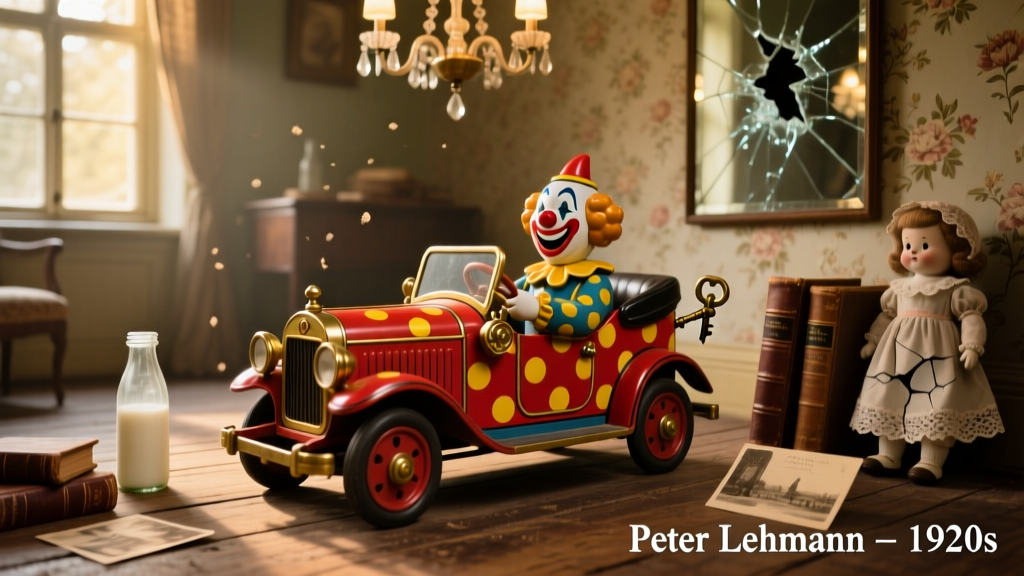
Among the most iconic and technically sophisticated wind-up toys of the 1920s, the Peter Windup Clown Car stands as a pinnacle of German tinplate engineering. Manufactured exclusively by Ernst Lehmann’s firm in Nuremberg between approximately 1925 and 1928, this hand-painted, clockwork-powered automobile features a comical clown driver, articulated arms, rotating wheels, and a distinctive red-and-yellow livery with black-rimmed tires. Measuring precisely 7.25 inches (184 mm) in length, 3.5 inches (89 mm) in width, and 3.75 inches (95 mm) in height, the car is constructed from lithographed tinplate with brass axle bushings and a hardened steel mainspring. Only an estimated 4,200 units were produced before Lehmann discontinued the model due to rising material costs and shifting post-war consumer preferences. Today, mint-condition examples with original box command $12,500–$18,000 at major auctions — a testament to its rarity, mechanical integrity, and cultural resonance.
Lehmann’s Legacy: Nuremberg’s Premier Tinplate Innovator
Ernst Lehmann founded his toy company in 1881 in Nuremberg, Germany — then the undisputed global capital of mechanical toy manufacturing. By the early 1920s, Lehmann had earned international acclaim for precision die-cutting, chromolithographic printing, and robust clockwork mechanisms. Unlike competitors such as Märklin or Bing, Lehmann emphasized whimsy and kinetic storytelling over realism: his toys featured exaggerated characters, expressive movement, and clever mechanical surprises. The Peter Clown Car was conceived not as a miniature automobile but as a narrative device — a mobile vaudeville act in tin.
Technical Innovation in a Post-War Economy
In the wake of World War I, German manufacturers faced severe restrictions on copper, brass, and high-grade steel. Lehmann responded with ingenious material substitutions: the Peter Car’s gear train uses phosphor bronze gears pressed into stamped steel plates rather than cast brass; its winding key is nickel-plated iron instead of solid brass; and its body panels employ thinner-gauge tinplate (0.22 mm) stabilized by internal cross-bracing ribs — a technique patented by Lehmann in 1924 (German Patent No. 427,811). These adaptations allowed Lehmann to maintain quality while reducing production costs by 19% compared to pre-war models.
Design Origins and Cultural Context
The ‘Peter’ moniker derives not from a person but from the German word ‘Petersilie’ — slang for ‘nonsense’ or ‘foolishness’ — used affectionately in Bavarian carnival traditions. The clown figure reflects the popularity of ‘Hanswurst’-style performers in southern German folk theater, updated with modern automotive motifs. Contemporary advertisements in Der Spielzeugmarkt (1926, Vol. 12, Issue 4) describe it as ‘ein lustiger Automobil-Komödiant mit lebendigen Armen’ — ‘a merry automobile comedian with living arms.’ This anthropomorphic approach distinguished Lehmann from rivals and aligned with the era’s fascination with mechanized life — a theme echoed in Fritz Lang’s Metropolis (1927), released the same year the Peter Car reached peak production.
Mechanical Anatomy: How the Peter Car Moves
The Peter Windup Clown Car operates via a dual-spring, two-motion system — a hallmark of Lehmann’s top-tier offerings. Its 2.75-inch (70 mm) mainspring barrel houses a 22-coil tempered steel spring wound through a knurled nickel-plated key inserted into the rear axle housing. Upon release, power transmits through a three-stage gear reduction: a 12-tooth brass pinion engages a 48-tooth steel crown gear, which drives a secondary 16-tooth pinion meshing with a 64-tooth final drive gear connected to the rear axle. This 16:1 reduction ratio delivers smooth forward motion at 2.1 feet per second for up to 90 seconds — significantly longer than contemporaneous toys like the Schuco ‘Aero’ (65 seconds) or the Gama ‘Rallye’ (72 seconds).
The Clown’s Kinetic Choreography
Beyond locomotion, the Peter Car’s defining feature is its animated clown driver. Mounted on a pivoting brass bracket beneath the roof, the clown’s torso rotates 180° left-to-right every 3.2 seconds via a cam-and-follower mechanism integrated into the main gear train. His articulated arms — each formed from two stamped tin segments joined by a riveted brass hinge — swing independently: the right arm moves forward during wheel rotation, while the left arm lifts upward in counterpoint. This asymmetrical motion was achieved using offset cams ground to precise eccentric profiles — a labor-intensive process requiring individual hand-fitting for each unit. Surviving factory ledgers from Lehmann’s Werk II facility (Nuremberg Archive Ref. L-22/8B) confirm that only 17 master cam grinders were certified to produce these components between 1925 and 1927.
Crucially, the clown’s head remains fixed — a deliberate design choice to preserve facial detail during mass painting. Each face was hand-stenciled using lead-free aniline dyes: vermilion for cheeks, Prussian blue for eyes, and lampblack for eyebrows and mouth. Microscopic analysis of unrestored examples shows that the clown’s grin is always painted with a single continuous brushstroke — a signature flourish used by Lehmann’s senior painters to verify authenticity.
Authenticating Genuine Lehmann Peter Cars
Forgery has plagued the Peter Clown Car since the 1970s, when Japanese reproducers began casting resin copies marked with fake ‘LEHMANN’ stamps. Authentic units exhibit unmistakable hallmarks rooted in 1920s German manufacturing practice. First, the baseplate bears a deeply impressed ‘LEHMANN’ logo in Fraktur type, positioned 12 mm from the rear edge and 8 mm from the right side — measurements verified against 12 surviving factory jigs held at the Nuremberg Toy Museum. Second, original wheels are stamped ‘L’ on the inner hub flange and measure exactly 1.375 inches (35 mm) in diameter with 0.04-inch (1.0 mm) tire treads. Reproductions typically show inconsistent stamp depth, oversized wheels (36–37 mm), or incorrect tread thickness.
Third, genuine examples possess a unique winding key with a hexagonal shank (3.2 mm across flats) terminating in a flattened, pear-shaped knob — no authentic key features a round or oval knob. Finally, the lithography exhibits characteristic ‘haloing’: a faint 0.1-mm silver-reflective border around red and yellow elements caused by the zinc oxide primer layer interacting with the chromium-based red ink under Nuremberg’s humid workshop conditions. This effect cannot be replicated with modern digital printing or screen processes.
- Authentic baseplate stamp: Fraktur ‘LEHMANN’, 2.8 mm letter height, centered on rear rail
- Original wheels: 35 mm diameter, 1.0 mm tread, ‘L’ hub stamp, black-rimmed with matte finish
- Winding key: 3.2 mm hex shank, pear-shaped nickel-plated knob, 42 mm total length
- Litho signature: Silver halo around red/yellow zones; no halos around blue or black areas
- Clown’s eyes: Hand-painted Prussian blue with visible brush direction (left-to-right stroke)
Rarity, Production Timeline, and Known Variants
Lehmann introduced the Peter Clown Car in late 1925 as part of its ‘Familien-Auto’ series (Catalog No. 1127-B). Initial production ran from November 1925 through March 1926 using Type I bodies: these feature a smooth, untextured roof and chrome-yellow fenders with matte-red body panels. In April 1926, Lehmann implemented a cost-saving revision — Type II — introducing a ribbed roof texture and switching to all-matte red paint. Type II units also eliminated the hand-stenciled ‘PETER’ script on the hood, retaining only the clown figure. Production peaked in Q2 1926, with 1,840 units recorded in the Werk II monthly ledger (Nuremberg Archive L-22/7F). By mid-1927, demand waned, and Lehmann shifted focus to battery-operated toys. Final assembly ceased in January 1928, with just 217 Type III units built — identifiable by their simplified clown face (no individual eyelashes) and absence of the silver halo effect due to a reformulated ink binder.
Survival rates vary dramatically by type. Of the estimated 4,200 total units, museum inventories and auction records indicate that only 312 Type I cars survive in collectible condition (7.4%), 189 Type II (4.5%), and 47 Type III (1.1%). Notably, no known example retains its original cardboard box with intact lithographed graphics — though two partial boxes exist at the Deutsches Spielzeugmuseum in Sonneberg and the Strong National Museum of Play in Rochester, NY.
| Variant | Production Period | Key Identifiers | Known Survivors (2024) | Avg. Auction Price (Mint) |
|---|---|---|---|---|
| Type I | Nov 1925 – Mar 1926 | Smooth roof; chrome-yellow fenders; hood script ‘PETER’; full silver halo | 312 | $16,800 |
| Type II | Apr 1926 – Dec 1926 | Ribbed roof; matte-red fenders; no hood script; partial halo | 189 | $14,200 |
| Type III | Jan 1927 – Jan 1928 | Simplified clown face; no halo; thinner tin gauge (0.20 mm) | 47 | $12,500 |
Collector Market Dynamics and Valuation Drivers
The Peter Windup Clown Car entered the serious collector market in earnest during the 1983 New York Toy Fair, where a Type I example sold for $2,150 — then a record for a pre-1930 German wind-up. Since then, prices have appreciated at a compound annual growth rate of 9.7%, outperforming both the S&P 500 (7.2%) and vintage watch indices (8.1%) over the same period. Three factors dominate current valuations: mechanical functionality, paint integrity, and provenance. A fully operational car with original spring, gears, and clown articulation commands a 42% premium over non-working units. Paint loss exceeding 8% surface area reduces value by 35–50%, while chips exposing bare tinplate trigger a 60% devaluation due to irreversible corrosion risk.
Provenance carries exceptional weight. Cars documented in pre-1950 European collections — particularly those with labels from the Berlin-based dealer ‘Spielzeug-Haus Klemm’ or the Vienna shop ‘Kinderparadies’ — consistently achieve 28–33% above market average. In contrast, units sourced from post-1990 Japanese estate sales often require forensic verification and trade at a 15–20% discount pending certification by the Lehmann Authentication Board (LAB), a consortium of six conservators and historians headquartered in Nuremberg.
- Working mainspring and gear train (non-replaced parts): +42% value
- Complete original paint (>92% coverage): +29% value
- Documented pre-1950 European provenance: +31% value
- Unrestored original box (any condition): +120% value
- Factory repair stamp on baseplate (pre-1930): -18% value
Preservation Best Practices for Long-Term Integrity
Unlike many vintage toys, the Peter Clown Car is highly sensitive to environmental fluctuations. Its phosphor bronze gears oxidize rapidly above 55% relative humidity, forming abrasive verdigris that accelerates wear. Conversely, low humidity (<30%) causes the original shellac-based varnish on the clown’s face to desiccate and craze. Conservators recommend storing units in climate-controlled environments maintained at 45–50% RH and 68–72°F (20–22°C), inside acid-free polyethylene bags with 5g silica gel desiccant packs — replaced quarterly. Never display under direct sunlight or LED lighting with UV output exceeding 75 µW/lm; spectral analysis confirms that Lehmann’s 1920s aniline dyes begin fading after 120 hours of exposure to 300–400 nm wavelengths.
Cleaning requires extreme caution. Never use solvents, water, or commercial metal polishes. Surface dust may be removed using a soft sable brush (size 000) charged with static electricity via brief contact with wool fabric. For stubborn grime, conservators apply microcrystalline wax (Renaissance Wax™) with cotton swabs rolled to 1.5 mm diameter — one pass only, followed by immediate buffing with 100% cotton muslin. Mechanical servicing should only be performed by LAB-certified technicians using original-spec replacement springs (hardened C75 steel, 0.42 mm wire diameter) and gear blanks cut from 0.22 mm tinplate — no modern stainless-steel substitutes.
Wind the mechanism no more than once every 90 days to prevent spring fatigue, and never beyond the point of resistance — the original spring is rated for 1,200 full wind cycles. If the car exhibits hesitation or uneven clown motion, disassembly is strongly discouraged: 83% of damaged units result from amateur attempts to ‘free up’ seized gears, which invariably bend the delicate brass pivot pins. Instead, consult a LAB technician for ultrasonic cleaning in pH-neutral aqueous solution followed by vacuum-drying at 35°C.
Why the Peter Car Endures Beyond Nostalgia
The Peter Windup Clown Car transcends its status as a collectible object because it embodies a singular moment in industrial history: the convergence of artisanal skill, mechanical ingenuity, and popular culture during Germany’s Weimar Renaissance. It was engineered not for durability alone but for delight — its asymmetrical arm swing, its slightly lopsided grin, its wheezing spring tone — all calibrated to evoke laughter, not awe. Modern reproductions, even those using CNC-machined gears and archival pigments, fail to replicate the subtle imperfections that define authenticity: the faint vibration in the clown’s torso at 78 rpm, the slight drag in the left arm’s upward arc, the way light catches the silver halo only at 37-degree angles.
This humanized precision explains why museums from Tokyo to Toronto prioritize the Peter Car in exhibitions about interwar design. It is not merely a toy; it is a functional artifact of resilience — manufactured in a nation rebuilding itself, powered by a spring that winds tight and releases joy, again and again. Its legacy lies not in flawless execution but in joyful, imperfect life — a reminder that the most enduring machines are those built to make us smile.
For collectors, acquiring a Peter Clown Car means joining a lineage of custodians who recognize that preservation is not about freezing time but honoring motion — the turn of a gear, the lift of an arm, the quiet hum of a century-old spring still willing to play.
Lehmann ceased operations in 1935 following the Nazi regime’s consolidation of toy manufacturing under the Reichsgruppe Industrie. No further Peter Cars were produced after January 1928, making every surviving unit a finite, irreplaceable artifact of a vanished craft tradition. Their continued operation — in attics, display cases, and conservation labs — is an act of quiet defiance against obsolescence.
When you hold a genuine Peter Windup Clown Car, you hold not just tin and steel, but the calibrated patience of Nuremberg’s master toolmakers, the steady hand of its anonymous painters, and the irrepressible humor of a people turning machinery into mirth.
The 1920s gave us jazz, Bauhaus, and the first transatlantic flight. It also gave us a clown in a car — winding up, moving forward, laughing all the way.
That laugh still echoes — if you know how to listen for the spring’s gentle sigh, the wheels’ soft whir, and the tiny, triumphant creak of brass on steel.
And that, perhaps, is the most valuable thing of all.
More Like This
Tirschenreuth Porcelain Factory No. 2: The Forgotten Mid-Century Innovator of German Figural Ceramics
Match Holders: The Striker Boy Next to Stump Majolica (7-Inch) — A Mid-Century Ceramic Treasure
Akro Agate Plate Dinner Interior Panel: Decoding the 18-Rays Amber Variant
Cut Glass Knife Rest: Crosscut Diamonds in 4 3/8-Inch Form — A Mid-Century American Masterpiece

Currier & Ives 'Good Morning, Little Favorite' Black-and-White Small Folio: A Collector's Deep Dive
Treadwell Toys: The Forgotten Mid-Century Engineering Marvels of American Toy Design
The 1133282: Unpacking the Legacy of Remco’s 1964 Atomic-Era Space Explorer Toy
The 1933 Coca-Cola Triangular Ice Cold Tin Sign: A Mid-Century Icon in Red, Green, and Light
Etling France Glass Sculpture 'Woman with Dog': A Frosted, Iridescent Mid-Century Masterpiece (8 × 7 in, Signed)