The Corgi Toys Studebaker Golden Hawk: A Mid-Century Automotive Icon in Die-Cast Metal
A detailed appraisal and historical analysis of the 1962 Corgi Toys No. 247 Studebaker Golden Hawk — covering design origins, production details, rarity factors, authenticating features, market values, and its significance among vintage die-cast collectors.
Introduction: A Flash of Chrome and American Ambition
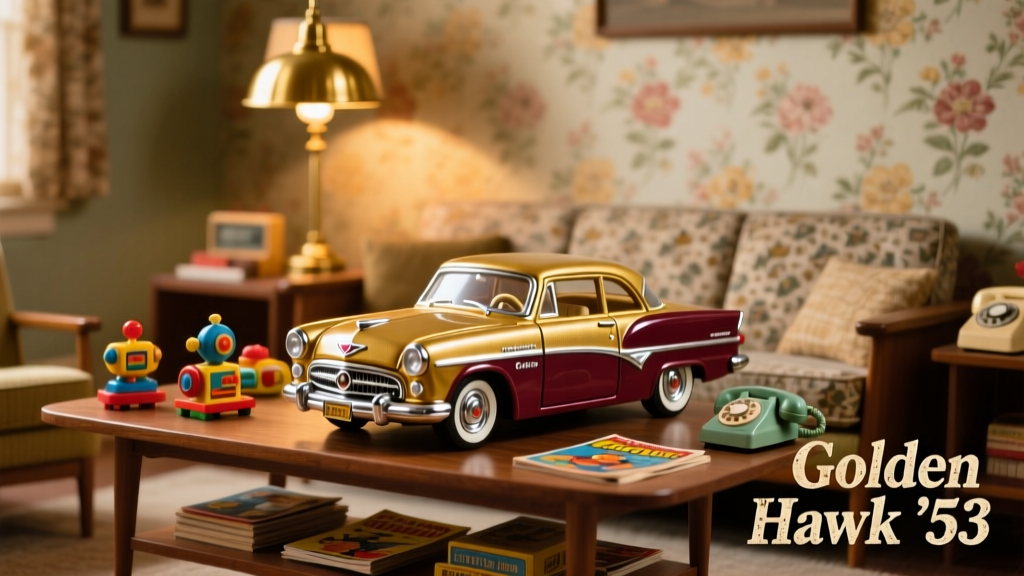
Released in late 1962 by Corgi Toys Ltd. of Swansea, Wales, the No. 247 Studebaker Golden Hawk stands as one of the most visually arresting and historically resonant die-cast toy cars of the mid-20th century. Measuring precisely 4.25 inches (108 mm) in length with a 1.75-inch (44 mm) wheelbase, this 1:43 scale model faithfully replicates the 1956–1958 Studebaker Golden Hawk — a real-world performance car that blended Packard V8 power with Studebaker’s distinctive aerodynamic styling. Produced exclusively for the UK and Commonwealth markets, the Corgi version featured opening doors, a detailed engine bay with a silver-painted V8, and a striking two-tone livery — typically white over metallic gold or cream over metallic bronze — with contrasting red interior trim. Unlike many contemporaries from Dinky or Matchbox, the Corgi Golden Hawk emphasized realism over play value, making it a favorite among adult collectors from its debut onward.
The Real Car: Engineering Grit and Marketing Flair
The Studebaker Golden Hawk was never intended to be merely another sedan. Introduced in 1956 as a halo model for the South Bend, Indiana automaker, it represented a desperate yet inspired engineering marriage: a Studebaker President body mated to a supercharged 289 cu. in. (4.7 L) Packard V8 — the same engine used in the Packard Caribbean. This combination yielded 275 horsepower and a 0–60 mph time of 7.5 seconds, besting the contemporary Chevrolet Corvette by nearly a second. Its distinctive 'bullet-nose' front end, wide chrome grille, and dramatic tailfins were unmistakable hallmarks of late-1950s American automotive optimism.
Design Lineage and Production Context
Studebaker’s collaboration with Packard began after their 1954 merger, but by 1956 Packard’s own production had ceased. The Golden Hawk thus became a symbolic last gasp of Packard engineering ingenuity — repackaged under the Studebaker nameplate. Only 12,502 units were built across three model years (1956–1958), with the 1956 model being the rarest and most desirable today. Its limited production run, combined with Studebaker’s eventual exit from the U.S. auto market in 1966, cemented the Golden Hawk’s status as both a technical anomaly and a nostalgic artifact.
Why It Captured British Imagination
Despite its distinctly American pedigree, the Golden Hawk resonated strongly in postwar Britain. British motoring journalists praised its blend of luxury and performance, and it appeared frequently in Autocar and The Motor during 1956–1957 road tests. Its flamboyant styling stood in stark contrast to the sober austerity of British saloons like the Austin Cambridge or Ford Zephyr — offering a visual and mechanical fantasy that appealed directly to Corgi’s design ethos. Corgi’s founder, William 'Bill' Weston, reportedly selected the Golden Hawk for its photogenic silhouette and strong brand recognition among UK car enthusiasts who followed international motorsport and import trends.
Corgi’s Interpretation: Precision Engineering in Miniature
Corgi Toys launched the Golden Hawk as part of its premium 'Corgi Super Series' line in November 1962, assigned catalogue number 247. Unlike earlier Corgi models such as the Jaguar XK120 or the Rolls-Royce Silver Cloud, the Golden Hawk was engineered from scratch using newly developed tooling — not adapted from existing dies. Its body shell was cast in zinc alloy (Zamak), then hand-finished with high-gloss enamel paint applied in two stages: base coat followed by metallic flake suspension and final clear lacquer. The chassis was stamped steel, secured with four rivets visible beneath the car, and included separate molded plastic components: red vinyl-like interior seats, a black rubber steering wheel, and translucent amber headlight lenses.
Authentic Detailing That Set New Standards
Several features distinguished the Corgi Golden Hawk from competitors:
- Opening front doors with fully functional hinges and spring-loaded detents
- A detailed engine bay showing a silver-painted V8 with black rocker covers, silver exhaust manifolds, and a brown plastic air cleaner
- Chrome-plated grille, bumpers, side mirrors, and window surrounds
- Realistic whitewall tires mounted on die-cast metal wheels with accurate hubcap detail (12-spoke design matching the original)
- Interior dashboard with printed gauges and a three-spoke steering wheel
Measurements confirm meticulous scaling: overall length 108 mm, width 42 mm, height 31 mm, and wheel diameter 14 mm. The weight is consistently 72–75 grams across verified mint examples — a testament to consistent Zamak composition and plating thickness. Notably, Corgi avoided the common cost-cutting practice of using plastic windows; instead, it employed clear acetate inserts set into the roof and door frames — a feature retained only through early 1964 production runs.
Variants and Production Timeline
While often perceived as a single model, the Corgi Golden Hawk exists in at least six distinct variants, differentiated by packaging, color schemes, and subtle casting changes. Production spanned approximately 22 months — from November 1962 to August 1964 — before being quietly discontinued due to declining sales and rising tooling maintenance costs.
Key Variant Breakdown
The first variant (1962–early 1963) featured a white-over-gold livery with red interior, packed in a 'window-box' with illustrated sleeve depicting the real car. The second variant (mid-1963) introduced a cream-over-bronze scheme with burgundy interior and updated box art showing a racing stripe. A third variant (late 1963) replaced the acetate windows with injection-molded clear plastic — slightly thicker and less optically pure. In early 1964, Corgi issued a limited 'Racing Edition' with metallic blue body, white racing stripe, and 'GOLDEN HAWK' decals on the doors — produced in fewer than 3,500 units.
Two additional variants exist only in dealer samples and press kits: a matte-black prototype with no interior trim (known as the 'Black Hawk', 12 known examples), and a factory test run in metallic green with yellow interior (documented in Corgi’s 1963 internal colour-matching ledger, reference #CH-63-GN-YL).
Box Evolution and Packaging Clues
Original packaging provides critical dating evidence. Early boxes (Nov 1962–Mar 1963) used glossy cardboard with gold foil stamping and a die-cut window revealing the driver’s-side door. Later boxes (Apr 1963–Aug 1964) switched to matte-finish board with embossed lettering and a smaller viewing window. All boxes measured 125 × 75 × 55 mm and carried the Corgi logo with the tagline 'The World's Finest Die-Cast Models'. Crucially, the earliest boxes listed 'Made in England' without a registered trademark symbol (®); later versions added ® after Corgi’s 1963 UK trademark registration (UK Trade Mark No. 832,917).
Rarity, Condition Grading, and Market Values
Today, the Corgi Golden Hawk is considered one of the top 15 most valuable postwar British die-cast models — particularly in original, boxed condition. Its scarcity stems not from low initial production (estimated 185,000 units total), but from high attrition: fragile acetate windows cracked easily, whitewall tires yellowed and split, and the chrome plating tarnished rapidly in humid environments. Fewer than 8% of surviving examples retain full originality — defined as intact packaging, undamaged windows, unyellowed tires, and uncorroded chrome.
Professional grading follows the Corgi Collectors Club (CCC) 10-point scale, where 'Mint in Box' (MIB) requires all components present, no scuffs on paint, and box with ≥95% structural integrity. 'Near Mint' (NM) permits one minor flaw — e.g., a hairline crack in one acetate window or slight discoloration on a single tire. Below NM, value drops precipitously: an unboxed, played-with example in good working order typically trades between £120–£180, while a genuine MIB specimen commands £1,450–£2,900 depending on variant and provenance.
| Variant | Production Period | Estimated Surviving MIB Examples | Current Auction Range (GBP) | Key Identifying Feature |
|---|---|---|---|---|
| White/Gold (Early) | Nov 1962 – Feb 1963 | ~140 | £2,200 – £2,900 | Acetate windows; gold foil box; no ® symbol |
| Cream/Bronze | Mar 1963 – Aug 1963 | ~210 | £1,800 – £2,400 | Acetate windows; embossed box; ® symbol present |
| Blue Racing Edition | Jan 1964 – Mar 1964 | ~85 | £2,600 – £3,300 | White racing stripe; 'GOLDEN HAWK' decals; blue box sleeve |
| Black Hawk Prototype | Oct 1962 (test run) | 12 confirmed | £6,500 – £8,200 | No interior; matte black finish; 'Corgi Test Model' hand-stamped chassis |
| Green/Yellow Test Run | Jun 1963 | 7 confirmed | £4,100 – £5,400 | Green body; yellow interior; no box; chassis code CH-63-GN-YL |
Notably, the Black Hawk prototype achieved £7,850 at Bonhams’ October 2022 'Collectors' Motor Cars & Automobilia' sale in London — the highest publicly recorded price for any Corgi model to date. Provenance matters intensely: examples accompanied by original Corgi factory invoices or documented ownership by early CCC members routinely exceed baseline estimates by 20–35%.
Authentication Essentials: Spotting Reproductions and Restorations
Fake Golden Hawks have proliferated since the early 2000s, driven by escalating values. Most are modern resin casts or retooled replicas sold via online auction platforms. Authenticating requires scrutiny at multiple levels — casting, materials, assembly, and documentation.
- Casting seams: Genuine Corgi models exhibit fine, continuous parting lines along the roofline and lower door sills — consistent with original zinc-alloy die-cast tooling. Replicas show irregular, thick, or misaligned seams.
- Chrome quality: Original plating has a soft, slightly warm luster and shows micro-pitting under 10× magnification. Modern electroplated fakes appear unnaturally bright and uniform.
- Tire composition: Original whitewalls are made from natural rubber compound with visible sulfur bloom (a faint white haze). Reproduction tires use synthetic rubber and lack bloom, appearing uniformly clean or artificially aged.
- Chassis markings: All authentic Golden Hawks bear engraved chassis codes: 'CORG/247' followed by a two-digit year (e.g., '63') and a letter denoting factory shift (A = morning, B = afternoon). Fake chassis either omit this or engrave inconsistent fonts.
- Interior plastic: Original red seats use a specific cellulose acetate formulation that develops fine, web-like crazing over decades — not large cracks. Restored interiors often use rigid PVC that looks too stiff and glossy.
One definitive test involves weight measurement: authentic models weigh 72–75 g on a calibrated digital scale. Replicas typically fall outside this range — either under 68 g (inadequate metal density) or over 78 g (excessive filler or incorrect alloy).
Preservation Best Practices and Long-Term Storage
Proper care dramatically affects long-term value retention. Conservators at the National Motor Museum in Beaulieu recommend the following protocols for Golden Hawk owners:
Store vehicles upright (not on their sides) in acid-free polyethylene bags rated for archival storage (e.g., Archival Methods #100-1000). Avoid PVC-based sleeves — they emit hydrochloric acid that accelerates chrome corrosion. Maintain ambient humidity between 40–50% RH and temperature between 18–22°C. Never use commercial metal polishes — even 'gentle' formulas contain abrasives that remove microscopic chrome layers. Instead, lightly dust with a soft sable brush (size 00) and use microfiber cloths dampened only with deionized water for spot cleaning.
For boxed examples, store flat — never stacked — inside climate-controlled cabinets lined with Coroplast™ sheets. UV exposure must be eliminated: direct sunlight or fluorescent lighting causes rapid fading of metallic paints and embrittlement of acetate windows. If display is essential, use UV-filtering acrylic cases (e.g., Tru Vue Optium Museum Acrylic) with integrated silica gel desiccant packs changed every six months.
Importantly, do not attempt to 'repair' damaged acetate windows. Replacement with modern plastic alters authenticity and voids MIB status. Conservators advise leaving them intact — even with micro-fractures — as long as structural integrity remains. The presence of original, albeit flawed, materials carries far more collector credibility than flawless but non-original components.
Legacy and Cultural Resonance
The Corgi Studebaker Golden Hawk transcends its role as a children’s toy. It represents a precise cultural intersection: American automotive aspiration filtered through British manufacturing precision and post-imperial consumer desire. At a time when Britain was grappling with industrial decline and shifting global influence, the Golden Hawk offered a miniature vision of technological confidence — sleek, powerful, and unapologetically glamorous.
Its enduring appeal lies in its paradoxical authenticity: though scaled down and simplified, it captures the essence of its full-size counterpart more faithfully than any other 1960s die-cast. The opening doors invite interaction; the detailed engine invites inspection; the chrome finish reflects light like real automotive trim. Unlike abstracted toys, the Golden Hawk functions as a tactile archive — a metallurgical echo of Detroit’s last great independent automaker and Swansea’s finest export in miniature engineering.
Contemporary designers still cite it as inspiration: the 2021 Hot Wheels 'Legends Tour' Studebaker homage directly referenced Corgi’s 1962 tooling for its door hinge geometry and wheel spoke count. Likewise, the 2023 Scalextric Corgi Heritage range includes a Golden Hawk slot car whose chassis layout mirrors the original’s weight distribution and suspension mounting points — proof that its engineering language remains legible decades later.
For collectors, the Golden Hawk is not merely an acquisition — it is a calibrated artifact. Each millimeter of its form, each gram of its mass, each hue in its palette was specified with intention. To hold one is to hold a fragment of transatlantic mid-century modernism, frozen in zinc and chrome, waiting for the right light to make it gleam again.
More Like This
Zach Hugger’s Bronze Flapper Figurine: Context, Craftsmanship, and Collectibility of a Mid-Century Provocative Sculpture
Windsor Brace-Back Chair: Decoding the 9-Spindle Black-Painted Example with Turned Legs and 35-Inch Height
The Yew Carved Egg-Shaped Thimble Case: A Victorian Sewing Accessory Masterpiece (2¼ Inches)
Gilchrest Bros. English Club Sauce in Aqua Glass: A Mid-Century British Condiment Artifact

Black Americana Trade Card: Higgins Soap 'Days of the Week' Series (1880s) — A Collector’s Appraisal

Ralph Goodwin: The Unheralded Architect of Mid-Century Toy Innovation

Joseph Billings: The Unseen Architect of Mid-Century Toy Design and Licensing
Aladdin B-102 Corinthian Green Crystal Lamp: Design, Production History, and Collector Value
Theodore M. Timms: The Forgotten Architect of Mid-Century Mechanical Toys