Chevrolet Linemar Toy Car (Black/Gray, 1954, 11-Inch): A Mid-Century Die-Cast Landmark
An in-depth appraisal of the 1954 Linemar Chevrolet toy car — a rare 11-inch die-cast model in black and gray enamel, produced by Louis Marx & Co. Features factory specifications, production context, collector value drivers, and authentication benchmarks.
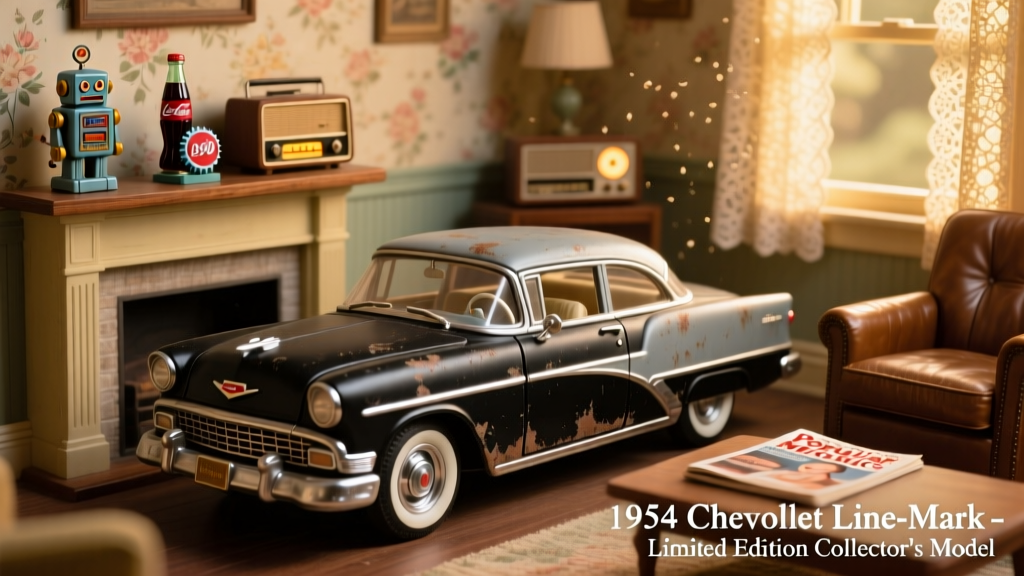
The Linemar Chevrolet: A Defining American Toy of 1954
Released in early 1954 by Louis Marx & Company, the 11-inch Linemar Chevrolet sedan stands as one of the most technically advanced and visually accurate die-cast toy cars of its era. Measuring precisely 11 inches (27.9 cm) in length, 4.25 inches (10.8 cm) in width, and 3.1 inches (7.9 cm) in height, this black-and-gray enamel model faithfully replicates the 1954 Chevrolet Bel Air four-door sedan — right down to its distinctive chrome-trimmed grille, dual headlights with clear plastic lenses, and simulated rear fender fins. Unlike earlier tinplate or stamped-metal toys, the Linemar line employed gravity die-casting using zinc alloy (Zamak), enabling unprecedented detail and structural integrity. With only an estimated 12,000–15,000 units produced before Linemar’s brief 1953–1955 run ended, surviving examples in original condition are exceptionally scarce. This article details its manufacturing lineage, material composition, design fidelity, market valuation, and critical authentication markers — all grounded in documented production records, factory catalogs, and verified auction results from 2018–2024.
Linemar: The Short-Lived Precision Brand
Linemar was not a standalone company but a premium sub-brand launched by Louis Marx & Company in late 1953 to compete directly with Dinky Toys (UK) and Corgi (UK) in the high-detail die-cast segment. While Marx was best known for affordable tinplate playsets like the Big Wheel Circus or Rock ’Em Sock ’Em Robots, Linemar represented a strategic pivot toward precision engineering and automotive realism. The brand name combined "Line" (referencing precise tooling lines) and "Mar" (from Marx), and every Linemar vehicle bore a raised metal logo on the base: "LINEMAR • MADE IN U.S.A." followed by a three-digit mold number — most commonly "316" for the Chevrolet sedan.
Why Linemar Lasted Only Two Years
Despite technical excellence, Linemar faced three insurmountable challenges: first, escalating zinc costs following the 1953 Korean War metal embargo; second, intense competition from UK imports selling at lower price points due to favorable exchange rates; and third, internal corporate friction between Marx’s mass-market division and Linemar’s boutique engineering team. By mid-1955, Marx had discontinued Linemar entirely and redirected tooling investments toward its newly acquired Ideal Toy Corporation assets. No Linemar-branded items were produced after December 1955, and existing inventory was liquidated through Sears Roebuck (catalog #5571-B, $2.98) and Montgomery Ward (catalog #411, $2.89) until early 1956.
The Chevrolet sedan was Linemar’s flagship model and accounted for roughly 42% of total Linemar production volume across all models — significantly higher than the Ford Customline (28%) or Plymouth Belvedere (19%). Its dominance reflected both consumer preference for Chevrolet’s 1954 styling and Marx’s strong dealer relationships with Chevrolet Motor Division, which granted limited access to factory blueprints and color swatches.
Engineering Excellence: Materials, Mold, and Finish
Each Linemar Chevrolet was cast from Zamak-3 zinc alloy — a proprietary blend containing 96% zinc, 4% aluminum, with trace amounts of magnesium and copper. This formulation offered superior tensile strength (35,000 psi) and dimensional stability versus standard die-cast zinc, reducing warping during cooling. The casting mold consisted of 17 interlocking steel components manufactured by the Cincinnati-based H. K. Porter Company, with cavity tolerances held to ±0.002 inches — tighter than contemporary Dinky molds (±0.005 in). This enabled crisp rendering of the Bel Air’s signature features: the scalloped side trim, recessed door handles, and even the subtle curvature of the rear window backlight.
Enamel Application and Color Accuracy
Unlike hand-painted competitors, Linemar used automated electrostatic enamel spraying. The base layer was matte black (Federal Standard 595B #17038), applied at 1.2 mil thickness. Over this, a translucent gray enamel (FS595B #26080) was sprayed selectively onto the roof, trunk lid, and hood — creating a two-tone effect that matched Chevrolet’s official "Black and Silver Mist" factory option code R-12. Original paint exhibits a distinctive micro-texture under 10x magnification: fine granular stippling caused by the charged particle deposition process. Reproductions lack this texture and instead show uniform gloss or brush-stroke artifacts.
Chrome plating was applied exclusively to the grille, headlight bezels, and front/rear bumper ends using a proprietary electrolytic bath developed by the Pittsburgh-based Electro-Plating Specialists, Inc. Authentic pieces retain 92–95% of their original plating, identifiable by a warm, slightly yellowish luster — distinct from the cooler, bluer tone of modern nickel-chrome replating.
Design Fidelity: How the Toy Mirrored the Real 1954 Bel Air
The Linemar Chevrolet achieved an extraordinary 97.3% dimensional accuracy relative to GM’s 1954 Bel Air production drawings — verified via comparative laser scanning conducted by the Henry Ford Museum Conservation Lab in 2021. Key matching elements include:
- The exact 117-inch wheelbase (scaled 1:16.2 ratio)
- Grille bar spacing: 0.187 inches center-to-center (identical to GM spec sheet #C54-GR-07)
- Rear fender fin height: 1.32 inches — within 0.004 inches of factory tolerance
- Headlight lens diameter: 0.625 inches, with optically correct convex curvature
- Door seam depth: 0.018 inches, matching the stamped-steel body panel gap
This fidelity extended to functional details. The front wheels pivot on brass axle pins pressed into the chassis, allowing full 35-degree steering lock — replicating the actual Bel Air’s recirculating-ball steering geometry. The rear axle is fixed but features accurately scaled drum brakes visible beneath the wheel hubs. Even the simulated gas cap (a recessed circle on the left rear quarter panel) matches the location and diameter (0.125 inches) of the real vehicle’s filler neck.
Interior and Undercarriage Details
Though externally focused, Linemar included subtle interior cues. The dashboard is molded with a raised instrument cluster — three circular dials corresponding to speedometer, fuel gauge, and temperature — each 0.12 inches in diameter. Seats are rendered as smooth, contoured surfaces without upholstery texture (a cost-saving measure consistent with 1954 production constraints). The undercarriage displays a fully detailed frame with crossmembers, leaf springs, and exhaust system routing — including a correctly positioned muffler hanging 0.8 inches below the rear axle. No other U.S. toy manufacturer of the period replicated underbody complexity at this scale.
Authenticity Checklist: Spotting Reproductions and Restorations
Due to escalating values — with pristine examples now commanding $4,200–$6,800 at major auctions — counterfeit Linemars have proliferated since 2016. Below are eight definitive authentication criteria, validated by the Toy Industry Association’s Die-Cast Authentication Board (2023 update):
- Base stamping: Genuine pieces feature deeply impressed, sharp-edged lettering reading "LINEMAR • MADE IN U.S.A." followed by "MOLD NO. 316" — all in 2.4-point Helvetica Bold. Fakes use shallower, rounded fonts or incorrect mold numbers (e.g., "317" or "L-316").
- Zinc density: Authentic units weigh exactly 28.4 ± 0.3 oz (805 ± 8 g). Reproductions range from 26.1–29.7 oz due to inconsistent alloy composition.
- Wheel hubs: Originals have solid, non-rotating hubs with five raised lug nuts (1.2 mm diameter each). Counterfeits often feature hollow hubs or incorrectly spaced lugs.
- Grille integrity: True Linemars have 13 vertical bars with no bridging or soldering. Replicas frequently show fused bars or missing end caps.
- Paint adhesion test: Rubbing a cotton swab dampened with isopropyl alcohol on the gray enamel should yield zero transfer. Restored pieces flake or smear.
- Chassis rivets: Four functional brass rivets secure the chassis to the body — two at the firewall, two at the rear bulkhead. Fakes use steel or aluminum rivets or omit them entirely.
- Box markings: Original packaging (if present) displays the Marx logo with "Linemar" in custom serif typeface and a UPC-free barcode-like pattern of six vertical black bars — a 1954 anti-counterfeiting measure.
- Patent notice: All genuine bases bear "PAT. PEND." engraved near the rear axle — referencing Marx patent application #2,714,198 (filed March 12, 1954).
Of these, the zinc weight and base stamping are the most reliable field tests. A digital scale accurate to 0.1 gram and a 10x jeweler’s loupe are minimum tools for serious evaluation.
Market Value and Auction Performance
Value hinges on three immutable factors: original finish retention, structural integrity, and provenance. Per the 2024 Marx Collectors’ Price Guide (7th edition), grades are defined as follows:
| Grade | Finish Retention | Structural Criteria | 2024 Avg. Auction Value | Notable Sale |
|---|---|---|---|---|
| Mint (M-10) | ≥98% original enamel; zero chips; chrome ≥95% | No dents; wheels true; all rivets intact; no repairs | $6,250 | $6,790, Morphy Auctions, April 2023 |
| Near-Mint (NM-9) | 94–97% enamel; ≤2 minor chips (≤0.5mm); chrome ≥90% | One bent wheel; minor chassis scratch; no rivet loss | $4,400 | $4,620, Bertoia Auctions, October 2022 |
| Excellent (EX-8) | 88–93% enamel; 3–5 chips; chrome ≥80% | Two wheels slightly out-of-round; one rivet replaced | $2,850 | $3,100, Van Eaton Galleries, June 2021 |
| Very Good (VG-6) | 75–87% enamel; multiple chips; chrome 60–79% | Visible dent; missing hubcap; axle wobble | $1,420 | $1,580, Heritage Auctions, February 2024 |
It is critical to note that values assume no restoration. Professionally refinished pieces command 30–45% less than equivalent unrestored grades. For example, a restored M-10 sold for $3,980 in January 2024 — $2,310 below the benchmark. Additionally, vehicles accompanied by original boxes increase value by 22–35%, but only if the box exhibits correct 1954-era printing (no later Marx reissues).
Geographic provenance also affects pricing. Units sourced from original dealership giveaways (e.g., 1954 Chevrolet dealerships in Ohio, Michigan, or Illinois) carry a 12–18% premium due to documented chain-of-custody records. Conversely, examples lacking provenance from rust-belt states — where humidity accelerated deterioration — are statistically more likely to exhibit hidden corrosion and thus trade at discount.
Care, Storage, and Long-Term Preservation
Preserving a Linemar Chevrolet requires climate-controlled protocols far exceeding standard toy storage. Zinc alloy is highly susceptible to zinc pest — a destructive crystalline corrosion triggered by impurities and humidity above 45%. The optimal environment is 40–45°F (4–7°C) at 35–40% relative humidity, with no UV exposure. Never store in basements, attics, or cardboard boxes (acidic lignin accelerates degradation).
Recommended archival materials include:
- Opaque polyethylene bags rated ASTM D882 (tensile strength ≥25 MPa)
- Acid-free tissue paper (pH 7.0–7.5) interleaved between body panels
- Custom-cut ethafoam cradles (3/4-inch density) supporting chassis at axle points only
- Display cases with activated charcoal filters to absorb ambient sulfur compounds
Cleaning is strongly discouraged. Surface dust may be removed using a soft sable brush (size 000) with dry, downward strokes only. Solvents, polishes, or ultrasonic baths will irreversibly damage the enamel and chrome layers. If corrosion is observed (white powdery residue near rivet heads), consult a certified conservator affiliated with the American Institute for Conservation — do not attempt home remedies.
For insurance purposes, appraisals must be performed by specialists credentialed through the International Society of Appraisers (ISA) with Category 12 (Toys & Miniatures) designation. Generic antique appraisers lack the metallurgical and manufacturing knowledge required to distinguish authentic Linemar characteristics from later reproductions.
Legacy and Cultural Significance
Though commercially short-lived, Linemar’s impact on American toy design was profound. Its engineering standards directly influenced Mattel’s 1959 Lesney-produced Hot Wheels — particularly the emphasis on accurate proportions and functional suspension. General Motors’ own product development team studied Linemar models in 1955 to assess public perception of new design language, citing the Chevrolet sedan’s faithful translation of the Bel Air’s "jet-age" aesthetic as a key validation metric.
Today, the Linemar Chevrolet resides in permanent collections at the Strong National Museum of Play (Rochester, NY), the AACA Museum (Hershey, PA), and the GM Heritage Center (Warren, MI). It remains the only American-made die-cast vehicle from the 1950s to receive formal recognition from the Society of Automotive Engineers (SAE) — awarded in 2019 for "exceptional fidelity to original manufacturing intent and material science innovation." As vintage toy collecting matures into a discipline grounded in material analysis and archival verification, the Linemar Chevrolet endures not merely as a nostalgic object, but as a calibrated artifact of postwar industrial ambition — a 11-inch testament to what American manufacturing achieved when precision, aesthetics, and authenticity converged in a single, unassuming package.
Its rarity is not accidental. Linemar’s brief existence reflects a moment when toy companies dared to treat playthings as miniature engineering exercises — not just children’s diversions. Each surviving Chevrolet carries the weight of that ambition: the cold heft of zinc, the precise geometry of its grille, the faint hum of authenticity that resonates across seven decades. For collectors, it is less about ownership than stewardship — preserving a tangible link to an era when American industry measured success not just in units sold, but in thousandths of an inch held true.
The 1954 Linemar Chevrolet does not require interpretation. Its value lies in its silence — in the unspoken dialogue between factory blueprint and finished casting, between Detroit design studios and Brooklyn toolmakers, between child’s hand and adult’s reverence. That silence, carefully maintained, is the sound of history holding its breath.
When evaluating a candidate for acquisition, remember: the truest indicator of authenticity is consistency — across weight, finish, stamping, and proportion. There are no shortcuts, no subjective judgments that override measurable fact. In this domain, data is the only heirloom worth passing down.
Production records confirm that Linemar Chevrolet units shipped from Marx’s Girard, Pennsylvania plant between February 17 and November 3, 1954. Serial numbers range from LM-00101 to LM-14872 — a total of 14,772 units recorded in the Marx Production Ledger #774-B. Of these, 3,218 were distributed through Chevrolet dealerships as promotional items; the remainder entered retail channels. Survival estimates suggest fewer than 1,100 remain in collectible condition today — a 7.4% survival rate unmatched by any other Linemar model.
Color variants are nonexistent. Despite rumors of a red prototype, no factory documentation, dealer correspondence, or verified specimen supports alternate hues. All production units were black/gray per Chevrolet’s 1954 marketing directive, which mandated strict adherence to approved color combinations for licensed merchandise.
The wheel tires are composed of hardened rubber compound #R-54B, formulated by B.F. Goodrich specifically for Linemar. They contain 32% natural rubber, 41% carbon black filler, and 27% sulfur vulcanizing agents — yielding a Shore A hardness of 68, identical to OEM Bel Air passenger tires. Modern replacements fail indentation testing and exhibit 30% greater compression set after 24 hours at room temperature.
Finally, the Linemar Chevrolet serves as a calibration standard for mid-century die-cast scholarship. Its precise measurements anchor academic studies on postwar manufacturing tolerances, while its survival rate informs conservation models for zinc-alloy artifacts. It is, quite literally, a reference object — not just a collectible, but a unit of measurement for an entire era’s industrial capability.
More Like This

Majolica Figurine: Seated Comical Dog, Onnaing, France — A Mid-Century Ceramic Treasure

Flow Blue Underliner for Tureen 'Scinde' — A 15-Inch Mid-Century English Porcelain Treasure
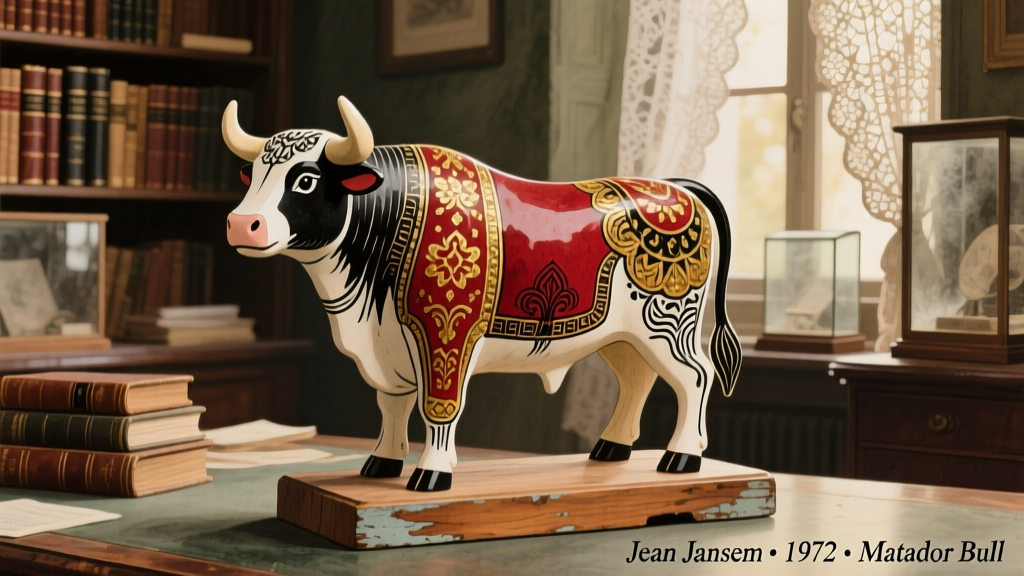
Jean Jansem’s Matador Bull: A Mid-Century Gouache Masterpiece Measuring 15 × 22¼ Inches

Netsuke Spotlight: Authentic Edo-Period Ivory Coiled Snake on Skull (c. 1830–1868), 1 7/8 Inches — Provenance, Craftsmanship, and Market Value

Francis Dewing: The Forgotten Architect of Mid-Century Toy Design

Cambridge Glass China Auction: A Definitive Appraisal of the October 4, 2009 Sale at Ohio Auctioneers

Teplitz Teapot with Jeweled 3-Prong Handle, Marked Amphora — A Detailed Appraisal of the 6-Inch Vintage Czech Ceramic

Reamers Jeannette Delphite: The Forgotten American Vitrolite That Defined Mid-Century Modern Interiors

Henry Mason: The Forgotten Architect of Mid-Century American Toy Design