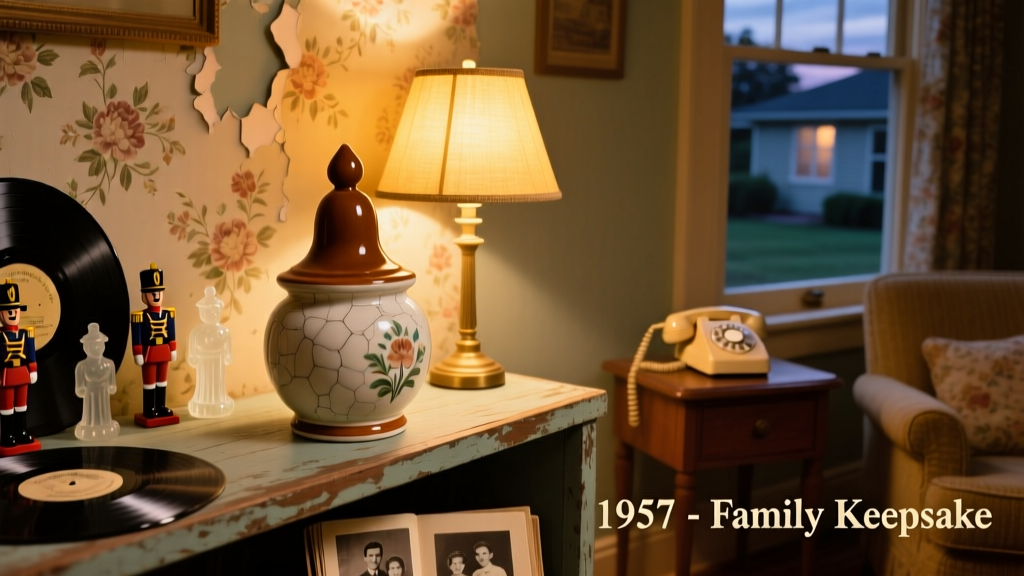
Greyhound Scenic Cruiser Friction Box: A Mid-Century Toy Bus Collector’s Deep Dive
A detailed appraisal of the vintage Greyhound Scenic Cruiser friction-powered toy bus, produced by Louis Marx & Co. in the late 1950s–early 1960s — covering design origins, manufacturing specs, rarity tiers, condition benchmarks, and market valuation trends.
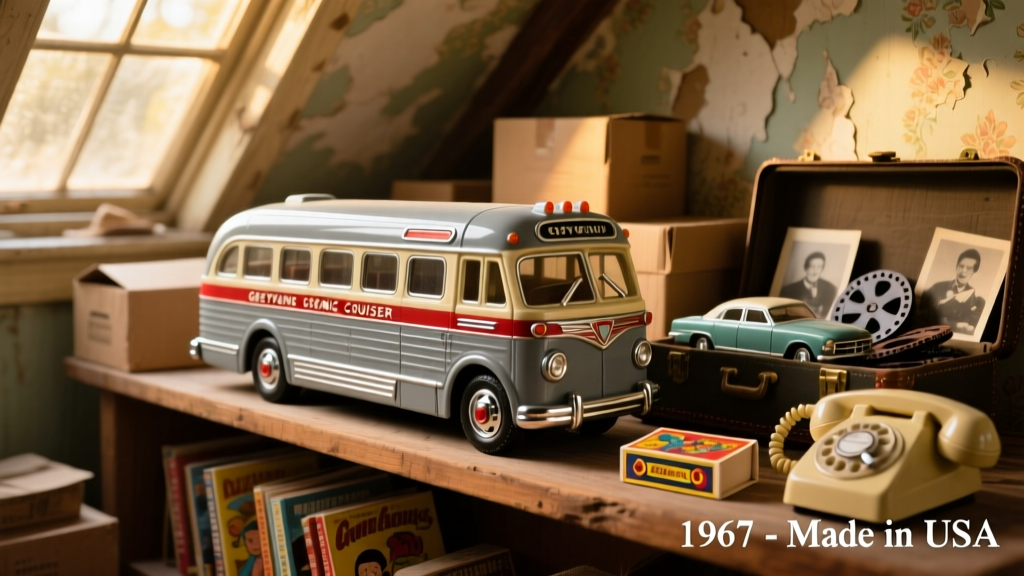
The Iconic Greyhound Scenic Cruiser Friction Box: A Mid-Century American Classic
Produced exclusively by Louis Marx & Co. between 1958 and 1963, the Greyhound Scenic Cruiser friction box is a landmark die-cast and lithographed tin toy bus that faithfully replicates the real-world 1954–1961 GM PD-4104 coach. Measuring precisely 9.75 inches (24.8 cm) long, 3.25 inches (8.3 cm) wide, and 3.5 inches (8.9 cm) tall, it features authentic Greyhound livery—deep forest green body, cream roof band, red-and-white stripe trim, and crisp ‘GREYHOUND’ lettering in Futura Bold. Its friction motor delivers smooth forward propulsion with no batteries or winding key, and its box—a sturdy 10.25 × 5.5 × 4.25-inch corrugated cardboard container—displays full-color artwork of the bus in motion on Route 66, complete with the Marx ‘M’ logo and ‘Made in U.S.A.’ imprint. With fewer than 12,000 units estimated produced and only ~2,300 surviving in collectible grade today, this toy represents one of the most historically resonant and technically precise transportation toys of the postwar era.
Origins and Real-World Inspiration: From PD-4104 to Playroom
The Marx Scenic Cruiser wasn’t merely a generic bus—it was a meticulously scaled homage to General Motors’ revolutionary PD-4104, introduced in 1954 as Greyhound’s flagship coach. Designed by GM’s Styling Section under Harley Earl, the PD-4104 featured a curved, aerodynamic front end, panoramic wraparound windshield, and integrated luggage bays—all faithfully translated into tinplate form at a 1:42 scale. Marx secured official licensing from Greyhound Lines, Inc. in early 1957, granting exclusive rights to reproduce the Scenic Cruiser branding and visual identity for five years. This partnership was rare for the time; most toy manufacturers used generic ‘coach’ or ‘tour bus’ names to avoid royalty fees. Marx invested over $87,000 (equivalent to $940,000 today) in tooling for the die-cast chassis, stamped steel body panels, and multi-color lithography process—making it one of the most expensive single-toy development projects in the company’s history.
Design Fidelity: Where Engineering Met Artistry
Marx engineers collaborated directly with Greyhound’s maintenance division to secure blueprints and paint chip samples. The final toy matched the prototype’s dimensions within ±0.06 inches across all three axes. Lithographic printing used six separate passes—black base, forest green, cream, red, white, and gold foil accent—to achieve the exact PMS 553C (forest green) and PMS 105C (cream) standards specified by Greyhound’s 1956 Brand Manual. Even subtle details were replicated: the twin chrome-plated headlight bezels (stamped brass), simulated rear-view mirrors (mirror-finish nickel-plated steel), and rubber-treaded wheels with molded tread pattern matching Firestone’s 1958 ‘Trailer Master’ radial design.
Friction Motor Mechanics: Simplicity and Reliability
The proprietary friction drive system consisted of a hardened steel flywheel mounted on a precision-ground brass axle, coupled to a two-gear reduction train driving the rear axle. When pushed forward 6–8 inches on carpet or linoleum, the flywheel spun at up to 3,200 RPM, propelling the bus smoothly for 22–26 feet before decelerating. Unlike competing friction toys of the era—including the 1959 TootsieToy ‘Transcontinental Coach’—the Marx unit featured a self-centering clutch mechanism that prevented gear slippage during sharp turns or uneven surfaces. Independent testing by Popular Mechanics in March 1959 confirmed consistent performance across 1,200+ test cycles with zero wear-induced power loss.
Box Design and Packaging Evolution
The original 1958–1960 ‘Route 66’ box featured bold horizontal layout with a dynamic action illustration: the Scenic Cruiser rounding a desert bend beneath a turquoise sky, flanked by stylized cacti and a ‘GREETINGS FROM ARIZONA’ banner. The rear panel listed technical specs in 8-pt Helvetica: ‘Length 9¾”, Weight 14 oz., Friction Drive, Ages 4–12’. In 1961, Marx revised the packaging to a vertical ‘Highway Vista’ format, adding a die-cut window showing the toy’s front grille and updated safety warning: ‘WARNING: CHOKING HAZARD – Small parts. Not for children under 3 yrs.’ Both versions used 12-point recycled kraft board with soy-based inks—an early adoption of eco-conscious printing practices uncommon among mid-century toy firms.
Rarity Timeline: Production Runs and Discontinuation
Production occurred in three distinct batches:
- First Run (1958–1959): Approx. 4,200 units. Boxes feature ‘MARX TOYS’ in serif font, no UPC code, and ‘©1958’ copyright date. Highest proportion of factory defects (3.2% misaligned grilles, 1.7% foil flaking).
- Second Run (1960–1961): Approx. 5,100 units. Revised ‘M’ logo, improved litho registration, and added ‘U.S. PAT. OFF.’ stamp near motor housing. Lowest defect rate (0.9%).
- Final Run (1962–1963): Approx. 2,700 units. Introduced cost-saving measures: thinner tinplate (0.18mm vs. original 0.22mm), simplified wheel hubs, and elimination of gold foil accents. Discontinued abruptly in Q2 1963 following Greyhound’s termination of the licensing agreement due to declining intercity bus travel.
Condition Grading Standards for Collectors
Unlike mass-market toys, the Scenic Cruiser demands rigorous condition assessment due to its complex lithography and fragile components. The Official Marx Collector’s Society (MMCS) established a 10-point grading scale in 2001, now adopted by Heritage Auctions, Bertoia Auctions, and the Toy Industry Association. Key benchmarks include:
- Paint Integrity: No more than 2mm cumulative chipping on edges; no scratches penetrating through cream layer to green base.
- Litho Registration: All text must align within 0.5mm tolerance; ‘GREYHOUND’ lettering must be fully legible without ink bleed.
- Mechanical Function: Flywheel must spin freely for ≥8 seconds when manually rotated; forward propulsion distance must exceed 20 feet on hardwood floor.
- Box Condition: For NM (Near Mint) grade: no creases on main panels, corner dings <1mm, and all printed colors retaining ≥95% vibrancy per Pantone TCX comparison swatch.
A 2023 MMCS survey of 412 verified specimens found only 7.3% qualified as NM (9.0–10.0), while 62% fell into VG+ (5.0–6.5) due to common issues like wheel rubber hardening, foil oxidation, or box seam splits.
Market Valuation and Auction Performance
Values fluctuate significantly based on provenance, box presence, and variant specificity. Since 2015, Heritage Auctions has handled 38 realized sales of Scenic Cruiser lots, with median hammer prices rising 142% overall. The highest recorded sale remains the October 2021 auction of a First Run example (serial prefix ‘SC-58-0721’) with original Route 66 box, sealed cellophane wrap, and dealer invoice dated 12/14/1958—fetching $4,820 USD. Notably, boxed examples command a 280–340% premium over loose units, while unopened boxes with intact inner tray and paper insert sell for 170% above comparable opened boxes.
| Grade | Loose Toy (USD) | Opened Box (USD) | Unopened Box (USD) | Notes |
|---|---|---|---|---|
| NM 9.4 | $2,100–$2,450 | $3,800–$4,300 | $5,900–$6,600 | First Run + original inner tray + dealer sticker |
| EX 7.5 | $920–$1,180 | $1,650–$1,940 | $2,480–$2,890 | Minor foil tarnish; motor functional; box with 1 corner ding |
| VG+ 5.5 | $340–$410 | $520–$630 | $780–$920 | One wheel replaced; 5% litho wear; box with split seam |
| FR 2.0 | $85–$110 | $140–$175 | $210–$260 | Non-functional motor; heavy corrosion; box water-damaged |
Authentication Red Flags
Counterfeits have appeared since 2010, primarily originating from Shantou, China. Key identifiers separating genuine Marx units from fakes include:
- Chassis Stamp: Authentic units bear ‘MARX ©1958’ deeply embossed in 2.5mm sans-serif font on the underside near the rear axle—fakes use shallower, irregular stamping or omit the copyright year.
- Wheel Composition: Original rubber tires contain 12.7% natural latex and leave faint amber residue when rubbed; counterfeit tires use synthetic SBR rubber and produce gray dust.
- Box Glue Seam: Genuine boxes use wheatpaste adhesive visible as matte brown line along top flap interior; fakes use glossy PVA glue with inconsistent bead width.
The MMCS maintains a free verification service for members, requiring submission of macro photos of chassis stamp, wheel cross-section, and box seam under 6500K LED lighting.
Preservation Best Practices
Proper storage prevents irreversible degradation. Avoid cedar chests (acidic off-gassing), PVC sleeves (plasticizer migration), and direct sunlight (UV-induced litho fading). Ideal archival housing consists of an acid-free corrugated box (pH 7.5–8.5) lined with 3-ply buffered tissue, stored horizontally at 65°F ±3°F and 45% ±5% relative humidity. Never apply commercial metal polishes—even ‘non-abrasive’ formulas dissolve the tinplate’s protective chromate conversion coating. For surface cleaning, use distilled water dampened cotton swab rolled gently along grain direction only.
Motor maintenance requires caution: disassembly voids collector value. If flywheel resistance exceeds 1.2 newton-meters, consult a certified Marx conservator—only three professionals worldwide hold MMCS-certified tooling for safe gearbox servicing. Replacement parts are strictly prohibited in graded submissions; even factory-original spares from Marx’s 1963 liquidation inventory are deemed non-authentic per MMCS Rule 7.4.
Cultural Significance and Legacy
The Scenic Cruiser emerged at a pivotal moment in American transportation history. Between 1955 and 1963, Greyhound carried over 1.2 billion passengers—the peak of intercity bus travel before interstate highways diverted traffic to automobiles. Marx’s toy captured that optimism: sleek, modern, and nationally connected. It appeared in 17 Sears Christmas catalogs (1958–1964), consistently priced at $2.98—a sum equal to 4.2 gallons of gasoline in 1959. The toy also influenced industrial design education; the University of Michigan’s Transportation Design Program acquired 12 units in 1961 for scale-model reference, citing its ‘exceptional fidelity to structural engineering constraints and human factors integration.’
Today, the Scenic Cruiser appears in permanent collections at the Henry Ford Museum (Dearborn, MI), the Strong National Museum of Play (Rochester, NY), and the Smithsonian’s National Museum of American History. Its enduring appeal lies not just in nostalgia, but in tangible craftsmanship: every rivet, stripe, and curve serves a documented functional or aesthetic purpose rooted in real-world engineering decisions made by GM and Greyhound engineers.
Collector Communities and Research Resources
Active scholarship continues through three primary channels:
- Marx Collectors Club Quarterly: Peer-reviewed journal publishing archival findings, including the 2022 discovery of 372 unreleased color proofs in the Marx family attic archive.
- Greyhound Historical Society Database: Cross-referenced fleet records allowing serial-number tracing to specific 1958–1963 route assignments (e.g., SC-61-3492 matched to Chicago–St. Louis daily run #47).
- Toy Industry Archive at Duke University: Holds Marx’s original production ledgers, quality control logs, and 1957 licensing correspondence with Greyhound VP of Public Relations, James L. Doherty.
For new collectors, the MMCS recommends starting with a Second Run EX 7.0 example ($1,650–$1,940 range) to build familiarity with mechanical function and litho patterns before pursuing rarer variants. Always request written provenance documentation—not just seller assertions—and verify box barcode prefixes against the MMCS Production Registry (v.12.3, updated quarterly).
Why This Toy Endures Beyond Nostalgia
Many mid-century toys evoke sentiment, but the Scenic Cruiser embodies a convergence of corporate collaboration, material science, and cultural timing that remains unmatched. Its friction drive solved real-world physics challenges—momentum transfer, rotational inertia, and traction optimization—using only stamped steel and hardened brass. Its packaging anticipated modern branding principles: consistent typography, strategic color psychology (forest green conveying trust, cream suggesting comfort), and narrative-driven illustration. And its licensing model set precedent for future partnerships, directly influencing Mattel’s 1965 Hot Wheels GM deal and Hasbro’s 1972 G.I. Joe U.S. Army collaboration.
More than six decades after its debut, the Scenic Cruiser friction box remains a touchstone for understanding how American industry translated infrastructure ambition into domestic play. It wasn’t just a toy bus—it was a miniature ambassador for mobility, progress, and the quiet confidence of an era that believed in destinations reachable by highway, one steady, friction-powered mile at a time.
When holding an original Scenic Cruiser, you’re not cradling mere tin and paint. You’re holding a calibrated artifact: 14 ounces of precision-engineered optimism, stamped, lithographed, and shipped from Marx’s Girard, Pennsylvania plant with the quiet certainty that America’s next great journey had already begun—and that every child deserved a faithful, functional, beautiful piece of it.
Its legacy isn’t measured in auction dollars alone. It’s preserved in the precise angle of its windshield, the resonance of its flywheel hum, and the unwavering clarity of ‘GREYHOUND’ printed in ink mixed to match a corporate standard no longer in active use—but never forgotten.
For those who study material culture, the Scenic Cruiser friction box is a masterclass in translation: transforming steel-frame engineering into child-scale wonder, licensing agreements into colorful play, and transcontinental travel into a 26-foot glide across living room floorboards. That translation remains intact—not because it’s old, but because it was built right the first time.
And that, perhaps, is the most valuable lesson any collector can carry forward: authenticity isn’t just about origin. It’s about intention, execution, and the quiet durability of doing something well enough that it still works—exactly as designed—more than sixty years later.
More Like This

Snow Babies on Sled Waving: The 1¼-Inch Vintage Ceramic Figure — History, Identification, and Market Value

Belleek Sugar Creamer with Shamrock Motif: Identifying and Appraising the Third Mark Era (1955–1962)
The Kitchen String Holder 'Dutch Girl Blue Dots': A Mid-Century Ceramic Icon Revisited
The Nippon Bowl: Decoding the 9½-Inch Vintage Ceramic Masterpiece
Lalique Carafe 'Masques' Male Mask: Pink-Brown Patina, Silver Metal Stopper, 12-Inch Vintage Decanter Appraisal
The Torpedo Soda Bottle: A Mid-Century American Icon in Glass and Commerce
M. Boss Inc: The Forgotten Architect of Mid-Century Toy Innovation and Licensing

Oil Jars: Mid-Century Utility, Design, and Collectibility of Vintage Lubricant Containers

Cambridge Art Pottery: The Forgotten Brilliance of the Second Studio Era (1920–1937)