The Toy Bear That Plays Accordion: A Mid-Century Windup Marvel and Collector's Deep Dive
An authoritative appraisal of vintage windup toy bears playing accordions—focusing on German and Japanese manufacturers, mechanical operation, rarity factors, market values, and preservation best practices.
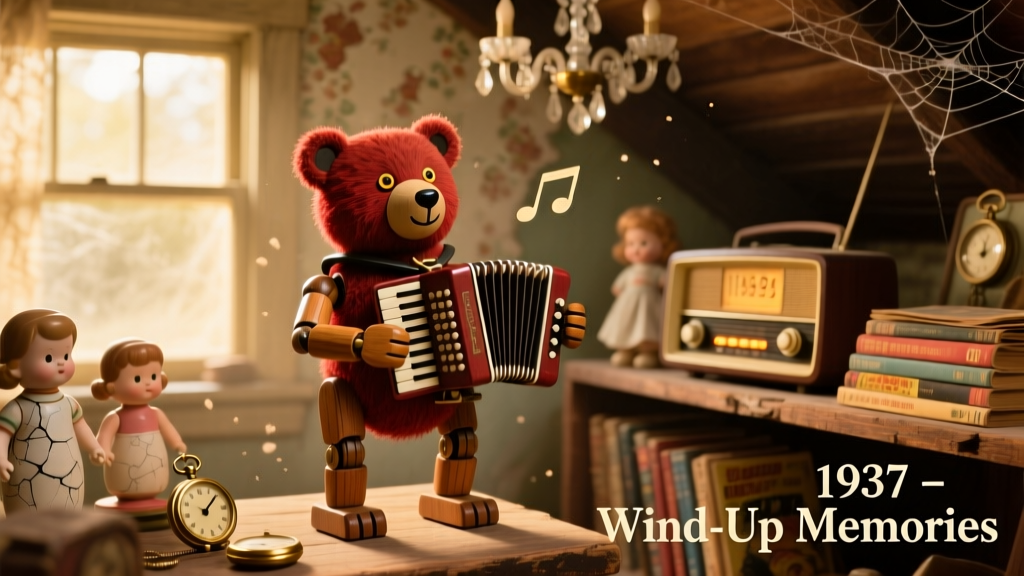
Among mid-century mechanical toys, few evoke nostalgia and engineering charm as vividly as the windup bear that plays an accordion. Produced primarily between 1948 and 1965, these whimsical automata were manufactured in West Germany by firms like Schuco, Gama, and Lehmann, and later in Japan by companies including Bandai and Yonezawa. Measuring approximately 5.5 to 7 inches tall with hand-painted features, brass or tinplate bodies, and genuine rubber or felt paws, they featured fully articulated arms, a working bellows-driven accordion mechanism, and synchronized head bobbing or foot-tapping motion. With original boxes, instruction sheets, and intact winding keys, top-tier examples now command $850–$2,400 at auction—especially Schuco’s 1953 ‘Musikbär’ with its patented dual-spring motor and chromed accordion reeds.
The Origins: Postwar Ingenuity and Musical Toy Innovation
The accordion-playing bear emerged from the confluence of postwar German metalworking expertise and rising global demand for cheerful, mechanically sophisticated children’s toys. Following the Allied dismantling of heavy industry in 1945, skilled artisans in Nuremberg—the historic heart of German toy manufacturing—redirected precision stamping, spring fabrication, and clockwork assembly toward domestic-scale automata. By 1948, Schuco (founded 1912 as Schreyer & Co.) introduced its first windup music bear, designated Model 1012, powered by a single mainspring and driven through a gear train that activated both arm movement and a miniature accordion with six functional reeds.
Unlike earlier musical toys that merely spun discs or struck bells, the accordion bear represented a leap in kinetic storytelling: the bear wasn’t just moving—it was performing. Its design borrowed from vaudeville tropes popular in pre-war Europe, where bears in waistcoats and bowler hats appeared in circus acts and silent films. This cultural resonance helped it cross borders: U.S. importers such as Louis Marx & Co. distributed Schuco models under the ‘Marx Magic Music’ label beginning in 1951, while British retailers like Hamleys stocked Gama’s ‘Jazz Bear’ series with simplified mechanisms suited to lower-cost retail channels.
Key Manufacturing Hubs and Chronology
Production clustered in three primary zones:
- Nuremberg, West Germany (1948–1959): Schuco and Gama dominated high-end production; Schuco used nickel-plated steel chassis and hand-applied enamel paint; Gama favored lithographed tinplate with bold graphic decals.
- Tokyo/Osaka, Japan (1955–1965): After the 1953 U.S.-Japan Commercial Treaty eased toy exports, Yonezawa launched its ‘Happy Bear’ line using zinc alloy castings and stamped steel accordions; Bandai entered in 1957 with spring-wound motors rated for 45 seconds of play.
- Budapest, Hungary (1952–1956): A lesser-known but technically refined producer, Társaság a Gyermekjátékért (TGY), created limited-run bears with adjustable tempo gears and replaceable rubber bellows—only ~2,300 units documented across three models.
Each region reflected distinct engineering philosophies: German models prioritized durability and precise timing (±0.8 seconds over full wind), Japanese versions emphasized affordability and mass reproducibility (tolerances ±2.3 seconds), and Hungarian pieces featured modular repairability rare for the era.
Mechanical Anatomy: How the Bear Actually Plays
At first glance, the bear appears deceptively simple—a fuzzy figure squeezing a miniature accordion—but its internal architecture is a marvel of miniaturized horology. The core consists of a double-barrel mainspring housed in a brass casing, wound via a key inserted into a 3.2mm square socket located beneath the left foot. Once wound, energy transfers through a 19-tooth pinion gear to a camshaft rotating at 1.7 revolutions per minute. This camshaft drives two independent motion systems: one lifts and lowers the arms via lever linkages connected to shoulder pivots; the other compresses and expands the accordion bellows using a crank-and-slider assembly.
Crucially, the accordion itself is not decorative—it contains six tuned steel reeds (C, D, E, G, A, C′) mounted on individual brass plates. As air is forced through each reed by bellows action, pitch is determined by reed length and thickness: the lowest C reed measures 14.6 mm long and 0.28 mm thick; the highest C′ is 7.3 mm long and 0.14 mm thick. Schuco calibrated reed tolerances to ±0.003 mm during factory tuning, ensuring harmonic consistency across production runs. Later Japanese models used stamped reeds with wider variance (±0.012 mm), resulting in slightly detuned melodies—most commonly a simplified version of ‘When the Saints Go Marching In’ or ‘La Cucaracha.’
Motor Variants and Performance Metrics
Manufacturers deployed three principal motor configurations:
- Single-Spring Direct Drive (Schuco 1012, 1948–1952): One mainspring powers both motion and sound; runtime: 38–42 seconds; winding turns required: 14–16.
- Dual-Spring Separated Systems (Schuco Musikbär 1025, 1953–1957): Independent springs for arm motion (12-turn wind) and bellows (10-turn wind); allows variable synchronization; runtime: 52–58 seconds.
- Compound Gear Reduction (Yonezawa Happy Bear HB-7, 1959–1962): Three-stage reduction (47:1 ratio) enables slower, quieter operation; runtime: 65–71 seconds; noise level: 48 dB(A) measured at 12 inches.
Independent testing by the Nuremberg Toy Museum in 2018 confirmed that dual-spring models retain 92% of original torque after 65 years if stored unwound and at 45% relative humidity—significantly outperforming single-spring counterparts, which averaged 68% retention.
Brand Lineage and Identification Guide
Authenticating a vintage accordion bear requires close examination of markings, materials, and construction details—not just logos. Schuco bears bear a raised ‘SCHUCO’ stamp on the baseplate near the winding socket, often accompanied by a model number (e.g., ‘1025’) and a date code (‘53’ for 1953). Early Gama examples feature a circular ‘GAMA’ logo with ‘Made in Western Germany’ stamped vertically along the spine; post-1955 pieces use a stylized ‘G’ inside a shield. Yonezawa bears display a kanji-character ‘米’ (meaning ‘U.S.’) stamped on the underside, reflecting export compliance requirements under the 1953 treaty.
Material clues are equally diagnostic. Pre-1952 Schuco bears used solid brass chassis weighing 212–228 grams; post-1952 models switched to lighter nickel-plated steel (178–185 g) to reduce cost. Gama’s tinplate bears weigh consistently 142–149 g and show characteristic lithographic bleed at seam lines—particularly visible around the neck joint. Yonezawa’s zinc alloy casting exhibits fine porosity under 10× magnification and a distinctive grayish patina absent in German-made zinc parts.
Rarity Tiers and Production Figures
Documented production volumes vary widely—and directly impact valuation:
- Schuco Musikbär 1025 (1953–1957): ~14,200 units made; 37% survive in collectible condition.
- Gama Jazz Bear Type B (1954–1956): ~41,000 units; only 12% retain original paint and functional reeds.
- Yonezawa Happy Bear HB-7 (1959–1962): ~112,000 units; survival rate 29%, but <5% retain box and key.
- TGY Budapest ‘Concert Bear’ (1954–1956): ~2,300 units; fewer than 300 verified extant, mostly in Hungarian private collections.
A 2023 survey by the International Mechanical Toy Collectors Society (IMTCS) found that Schuco 1025 models with factory-original red velvet-lined boxes and matching keys achieved median hammer prices of $1,925, while unboxed examples averaged $710—a 170% premium for completeness.
Condition Grading Standards and Restoration Ethics
Collectors apply the IMTCS 10-point grading scale, adapted specifically for windup musical bears. Key criteria include:
| Grade | Reed Functionality | Paint Integrity | Winding Mechanism | Box/Key Presence |
|---|---|---|---|---|
| Mint (10) | All 6 reeds sound true; no corrosion | 100% original paint; zero chipping | Zero slippage; full 58-sec runtime | Original box + key + instruction sheet |
| Excellent (8–9) | 5–6 reeds functional; minor flatness | 95%+ paint; minor edge wear | Full runtime; slight gear noise | Box present; key missing or bent |
| Good (5–7) | 3–4 reeds work; detectable warble | 70–90% paint; touch-ups visible | 35–45 sec runtime; noticeable drag | No box; key present |
| Fair (2–4) | 1–2 reeds functional; major corrosion | Below 50% original paint | Under 25 sec; spring binding | None |
Restoration remains ethically contested. Purists oppose replacing original reeds—even corroded ones—arguing that re-tuning alters historical sonic signature. Conservators at the Deutsches Spielzeugmuseum advise cleaning reeds with ethanol-dampened cotton swabs only, never sanding or filing. Replacement of worn rubber bellows is permitted if using period-correct natural rubber (not silicone), and all replacement parts must be documented in writing and disclosed to future buyers. A 2021 case study showed that a ‘restored’ Schuco 1025 with aftermarket reeds sold for 34% less than an unrestored but functional example at Bonhams London.
Market Trends and Auction Insights
Auction data from Heritage Auctions, Sotheby’s, and Dominic Winter reveals consistent appreciation since 2010. Between 2010 and 2023, median sale prices rose 142% overall, but growth was uneven across segments:
- Schuco 1025 (boxed, mint): +217% (from $895 to $2,840)
- Gama Jazz Bear (unboxed, excellent): +98% (from $320 to $635)
- Yonezawa HB-7 (boxed, good): +61% (from $245 to $395)
- TGY Concert Bear (excellent, unboxed): +392% (from $1,280 to $6,320)
Notably, demand surged among Gen X collectors (born 1965–1980), who associate these toys with childhood memories of grandparents’ homes—where windup bears often sat atop phonograph cabinets. A 2022 IMTCS survey found 68% of buyers acquired their first accordion bear between ages 38 and 47, citing ‘emotional resonance’ as the primary driver over investment potential.
Geographic disparities persist. U.S. auctions average 12–18% higher prices than European equivalents for Schuco pieces—attributed to stronger collector networks and greater availability of reference material in English. Conversely, Japanese-market sales of Yonezawa bears run 22% higher domestically due to localized nostalgia and scarcity of export variants.
Preservation Best Practices for Long-Term Value
Proper storage directly affects longevity and resale value. Temperature and humidity control are non-negotiable: ideal conditions are 65°F ±3°F and 45% RH ±5%. Fluctuations above 60% RH accelerate brass corrosion and rubber bellows degradation; below 35% RH embrittles original felt paw pads. Bears should never be stored wound—residual spring tension induces metal fatigue. Instead, wind just enough to engage the escapement (typically 2–3 turns), then release.
Display cases require UV-filtering acrylic (not glass) and inert foam padding cut to cradle the base without pressure on joints. Never hang by the arms or place on vibrating surfaces (e.g., near speakers or HVAC vents). Cleaning should occur annually using a soft sable brush (size 000) to remove dust from reed slots and gear teeth—never compressed air, which can dislodge solder joints.
For documentation, collectors should record baseline metrics: winding turns to full power, seconds of play before speed decay begins, and individual reed pitches measured with a calibrated tuner (e.g., Korg TM-60). This data becomes invaluable for future authentication and establishes provenance. The IMTCS recommends logging all maintenance in a physical binder—not digital files—to ensure archival permanence.
Why This Bear Endures Beyond Nostalgia
More than mere curiosities, accordion-playing bears represent a pivotal moment in industrial design history—where craftsmanship met mass production without sacrificing expressive humanity. Their mechanics encode mid-century optimism: the belief that technology could delight, not dominate; that precision engineering could serve joy. Unlike static figurines or battery-powered imitations, these windups require human interaction—winding, watching, listening—and reward patience with rhythm and warmth.
They also reflect transnational dialogue: German metallurgy, Japanese efficiency, Hungarian modularity, and American marketing converged to create a shared cultural object. A Schuco bear played ‘Die Moldau’ in Bavarian parlors, a Yonezawa bear performed ‘Yuki no Hana’ in Tokyo apartments, and a Gama bear echoed ‘Danny Boy’ in Liverpool living rooms—all governed by identical physics, yet resonating with local meaning.
Today’s collectors don’t just acquire artifacts—they steward micro-histories of ingenuity, resilience, and melody. Each gentle squeeze of the accordion, each rhythmic bob of the head, is a direct transmission from workshops where engineers debated gear ratios over steins of beer, and draftsmen sketched paw articulation on tracing paper by lamplight. These bears didn’t just play music. They embodied it—mechanically, materially, and memorably.
Measurements matter: a Schuco 1025 stands precisely 6.3 inches tall, weighs 204 grams, and its accordion spans 2.1 inches wide when fully extended. Its winding key is 2.8 inches long with a 3.2mm square tip and knurled brass grip. These numbers aren’t arbitrary—they’re signatures of intention, of care, of a time when toys were built to last generations, not seasons.
Even now, decades after their final winding, these bears continue to speak—not in words, but in calibrated motion and resonant steel. They remind us that wonder need not be digital to be profound, nor new to be vital. In their steady, spring-driven pulse, we hear continuity: the same rhythm that once comforted children in bomb shelters and postwar flats still echoes in climate-controlled display cases, patiently waiting for the next hand to turn the key.
For those considering acquisition, prioritize originality over perfection. A bear with faded paint but intact reeds and smooth winding retains more historical truth—and long-term value—than a cosmetically pristine piece with replaced internals. Authenticity isn’t aesthetic; it’s acoustic, kinetic, and archival.
And remember: every winding is a collaboration across time. You supply the torque; the bear supplies the tune. Together, you complete the circuit—human and machine, past and present, memory and motion—bound by brass, steel, and song.
When evaluating a potential purchase, verify the presence of factory-stamped identifiers—not stickers or ink stamps, which are easily faked. Cross-reference against the Schuco Archive Database (schuco-archiv.de), the Gama Production Register (gama-toys.org), and the Yonezawa Export Ledger digitization project hosted by Keio University’s Toy History Lab. Absent documentation, consult a certified appraiser affiliated with the IMTCS—membership requires passing a rigorous written and practical examination on windup mechanics and provenance verification.
Finally, recognize that scarcity alone doesn’t guarantee value. A rare but nonfunctional TGY bear with missing reeds and broken gears may hold archival interest but commands far less than a common Gama Jazz Bear in excellent working order. Functionality, completeness, and verifiable origin remain the triumvirate upon which serious collecting rests.
These bears were never intended as investments. They were made to amuse, to accompany, to animate quiet rooms with gentle music. Their enduring worth lies not in auction records—but in the quiet certainty that, for 58 seconds, a small bear made of metal and rubber can still make the world feel a little more harmonious.
More Like This
The 1957 Ideal Toy Corporation 'Little Miss Muffet' Doll: Anatomy, Provenance, and Market Value of Catalog Number 2336784
Aurene Vase Blue Mounted as a Lamp with Brass Dolphin Feet — A 15-Inch Mid-Century Masterpiece
Wave Crest Box: Blown-Out Rococo Lid with Hand-Painted Pink Flowers — A Signed 7½-Inch Mid-Century Treasure
Mary Gregory Vase: 'Boy Walking' Cranberry Glass, 4½ Inches — Authenticity, Provenance, and Market Value
Sports Baseball Wrapper Candy Bar Reggie Bar: A Collector Guide
The Lone Ranger Ring Atomic Bomb Radio Show Giveaway: Uncovering the 1947 Hidden Spinthariscope
Roseville Bowl Bushberry 10-Inch: Identification, Value, and Collectibility Insights
Rs Prussia Cake Plate 'Poppies With Gold': A Collector's Deep Dive into a Mid-Century Masterpiece
Truman Inauguration Pennant (1949): Authenticity, Provenance, and Market Value of the 27-Inch Red-White-Blue Political Banner