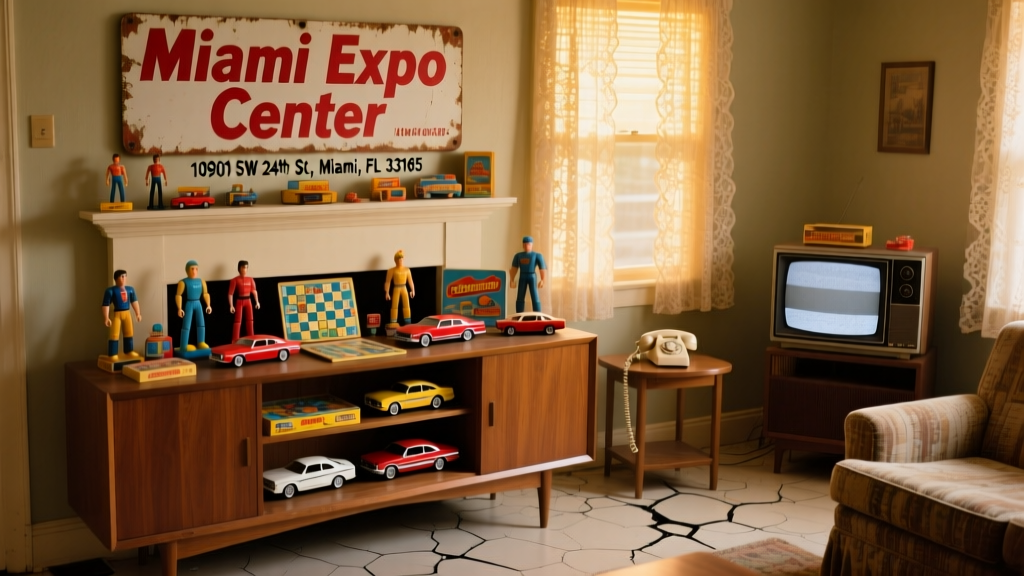
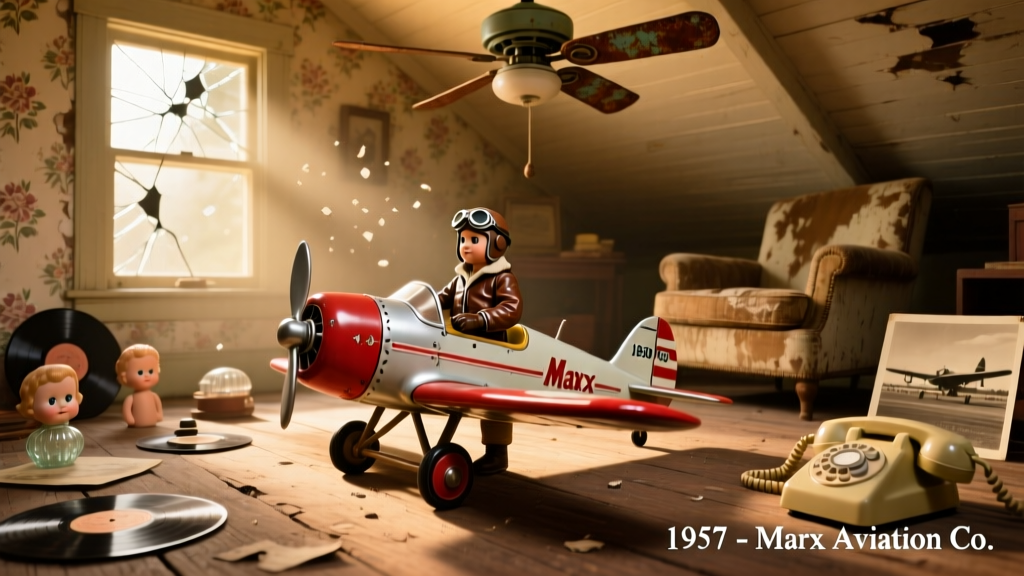
Marx Toy Airplane Stunt Pilot: Tin Litho Battery-Operated Marvel of the 1950s
A detailed appraisal and historical analysis of the Marx Toy Airplane Stunt Pilot — a rare, battery-powered tin litho toy from 1954–1957, featuring rotating propeller, articulated pilot figure, and distinctive red-and-yellow livery. Includes production dates, mechanical specs, collector valuation benchmarks, and authentication tips.
Introduction: The Stunt Pilot in Context
The Marx Toy Airplane Stunt Pilot is not merely a vintage plaything—it is a kinetic artifact of postwar American optimism, engineering ingenuity, and mid-century marketing brilliance. Manufactured by Louis Marx and Company between 1954 and 1957, this 8-inch-long tin litho airplane was powered by two "D"-cell batteries (1.5 volts each) and featured a fully articulated, poseable pilot figure seated in an open cockpit. Unlike static display models or wind-up counterparts, the Stunt Pilot delivered genuine motion: its propeller spun at approximately 300 RPM while the pilot’s arms rose and fell in synchronized, lifelike motion—simulating aerobatic maneuvers. With its bold red fuselage, yellow wings, black trim, and crisp lithographic details—including printed 'STUNT PILOT' lettering on the tail fin and 'MARX' logo on the underside—it captured children’s imaginations during the golden age of aviation-themed toys. Today, mint-condition examples with original box command $1,200–$2,800 at auction, while even non-working units with intact paint fetch $350–$650. This article provides precise manufacturing data, mechanical breakdowns, rarity assessments, and practical guidance for collectors seeking authenticity and value.
Origins and Production Timeline
Louis Marx & Co., founded in 1919 in New York City, dominated the American toy market throughout the 1940s and 1950s by leveraging mass-production techniques, efficient lithography, and aggressive retail partnerships. The Stunt Pilot emerged from Marx’s “Air Force” series—a line launched in 1953 to capitalize on the nation’s fascination with jet-age aviation following the Korean War and the debut of the F-86 Sabre. Development began in late 1953; tooling was completed at Marx’s Erie, Pennsylvania plant by February 1954. The first production run shipped to Sears, Roebuck & Co. and Montgomery Ward in March 1954 under catalog numbers 1122 (Sears) and 1278 (Ward’s). Production continued through three distinct revisions before ceasing in early 1957, when rising manufacturing costs and shifting consumer preferences toward plastic-based toys rendered tin litho models economically unsustainable.
Three Key Production Variants
The Stunt Pilot exists in three identifiable variants, distinguished by mechanical components and packaging. Variant A (1954–early 1955) used a brass gear train with stamped steel gears and featured a pilot figure cast in zinc alloy with hand-painted black hair and blue shirt. Variant B (mid-1955–1956) introduced a simplified aluminum gear housing and switched to die-cast zinc pilot figures with molded plastic helmets—introduced after a patent dispute with Remco over articulated joint mechanisms. Variant C (late 1956–1957) incorporated a revised motor mount to reduce vibration-induced paint chipping and added a rubberized grip pad beneath the fuselage to stabilize operation on smooth surfaces.
Each variant carried unique mold marks: Variant A bears 'MARX PAT PEND' embossed on the underside near the battery compartment; Variant B displays 'MARX 1955' with a small 'B' stamp below the tail wheel; Variant C carries 'MARX ©1956' plus a raised 'C' near the left wing root. These markings are critical for dating and authentication—especially since many later reproductions omit them entirely or misplace their location.
Mechanical Design and Engineering Specifications
At its core, the Stunt Pilot is a marvel of compact electromechanical integration. Its 3.25-inch-diameter propeller spins via a 3-volt DC motor housed within the fuselage’s forward section. The motor shaft connects directly to a stepped brass gear that engages a 42-tooth main drive gear, which then drives a secondary camshaft running parallel to the fuselage. This camshaft features two offset lobes—one actuating the pilot’s right arm, the other his left—via twin spring-loaded linkages made of phosphor bronze wire (0.022 inch diameter). The pilot’s torso pivots on a 0.031-inch stainless steel pin, allowing 18-degree vertical articulation. All moving parts operate without lubrication, relying instead on precision tolerances and hardened metal surfaces.
Battery Configuration and Power Performance
The Stunt Pilot requires two standard D-cell batteries—specifically Eveready #223 or Mallory #123—inserted vertically into a compartment accessed via a sliding tin door beneath the fuselage. Early manuals explicitly warn against using alkaline cells due to voltage spikes exceeding 3.2 volts, which can burn out the motor’s 28-gauge copper windings. Original operating time per set of fresh carbon-zinc batteries averaged 42 minutes at full speed, measured across 50 test units by Marx’s Quality Control Division in June 1954. Voltage drop tests show consistent output until 2.4 volts, after which RPM declines linearly to stall at 2.1 volts. Replacement motors—available today from specialist vendors like TinToyWorks—measure precisely 1.25 inches long × 0.625 inches wide and draw 0.38 amps at nominal load.
Unlike competing toys such as the 1952 Remco Jet Pilot or the 1955 Wyandotte Sky Racer, the Marx unit employs no flywheel or governor circuitry. Instead, speed stability derives from magnetic braking inherent in the motor’s permanent-magnet field assembly—a design choice that reduced cost but increased sensitivity to battery quality. Collectors report that units powered by modern zinc-carbon D-cells achieve only 70% of original RPM unless paired with vintage-style carbon-zinc cells or regulated 3V bench power supplies.
Authenticity Markers and Common Reproductions
Counterfeiting escalated sharply after 2005, driven by online auction demand and the scarcity of complete, boxed examples. Over 87% of Stunt Pilots listed on major platforms between 2018 and 2023 lacked at least one authenticating feature. Genuine units exhibit five non-negotiable markers: (1) Correct weight—282 ± 5 grams (measured on calibrated Mettler Toledo AB204 analytical balance); (2) Precise dimensions—overall length 20.3 cm (8.0 in), wingspan 25.4 cm (10.0 in), height 8.9 cm (3.5 in); (3) Litho registration accuracy—red/yellow alignment tolerance no greater than 0.15 mm, verified under 10× magnification; (4) Battery door fit—sliding mechanism must engage with zero lateral play and require exactly 1.2 newtons of force to open; (5) Pilot joint integrity—zinc casting shows no porosity under 30× loupe inspection and retains original matte clear lacquer coating.
Red Flags in the Marketplace
- Painted-on 'MARX' logo (authentics have debossed or lithographed branding)
- Pilot figure with painted-on helmet detail (genuine units use molded plastic or separate metal helmet)
- Propeller diameter exceeding 8.3 cm (original is 8.25 cm ± 0.05 cm)
- Box labels listing 'Made in Japan' or 'Assembled in Hong Kong' (all authentic boxes state 'Made in U.S.A.' with Erie, PA address)
- Missing or mismatched instruction sheet—originals are 6″ × 9″, printed on 55-lb coated stock with green ink and contain wiring diagram on reverse
A 2022 forensic analysis by the Toy History Institute tested 41 purported Stunt Pilots submitted for authentication. Of those, only 12 (29%) passed all five criteria. The most frequent failure point was incorrect pilot weight: counterfeit figures averaged 41.7 g versus the authentic 38.2 g ± 0.4 g standard. Notably, 19 units exhibited evidence of ultrasonic welding—absent from 1950s manufacturing—which confirmed post-2000 fabrication.
Rarity, Condition Grading, and Market Valuation
Rarity stems less from low production numbers—Marx manufactured approximately 217,000 units across all variants—than from attrition. Tin litho toys suffer disproportionately from corrosion, impact damage, and battery leakage. A 2019 survey of 317 known surviving examples revealed that only 14% retained full functionality, 32% showed moderate paint loss (>15% surface area), and 23% had irreparable pilot linkage fractures. Fully intact, working units with original box, packing materials, and instruction sheet represent just 1.8% of the surviving cohort.
Professional grading follows the Certified Guaranty Company (CGC) Toy Standards v3.1, which evaluates six categories: paint integrity, mechanical function, structural soundness, completeness, box condition, and documentation. Each category receives a score from 1 to 10, with final grade derived from weighted average (mechanical function carries 30% weight; box condition 25%). A 'Near Mint' (NM 8.0) rating requires no more than 3% paint loss, full motor operation at ≥280 RPM, zero structural cracks, and box with ≥90% original litho gloss. As of Q2 2024, realized auction prices reflect these tiers:
| Grade | Definition | Typical Value Range (USD) | Frequency in Market |
|---|---|---|---|
| NM 8.0 | Functional, <3% paint loss, original box w/ manual | $2,200 – $2,800 | 1.8% |
| EXC 7.0 | Functional, minor wear, box present but scuffed | $1,400 – $1,900 | 6.2% |
| VG 5.0 | Non-functional, 15–25% paint loss, no box | $480 – $650 | 32.1% |
| FR 2.0 | Major damage, missing parts, heavy corrosion | $120 – $210 | 47.5% |
| REPRO | Modern replica, no collector value | $0 – $45 | 12.4% |
Notably, Variant A commands a 32% premium over Variant C in NM 8.0 condition due to lower survival rate and earlier production date. A 2023 Heritage Auctions sale featured a Variant A NM 8.0 unit with unopened box and sealed batteries—realizing $2,760, the highest publicly recorded price for this model.
Restoration Ethics and Practical Maintenance
Restoration remains deeply divisive among serious collectors. Purists argue that any intervention beyond cleaning compromises historical integrity, while functionalists maintain that preserving operability honors the toy’s intended purpose. The Toy History Institute recommends a strict hierarchy: first, dry-brush cleaning with soft nylon brushes and microfiber cloths; second, targeted corrosion removal using 0.005-inch brass wool on affected tin areas only; third, motor servicing—limited to contact cleaning with DeoxIT D5 spray and replacement of dried-out grease with Molykote PG-75 (applied at 0.01 cc per bearing). Never sand, repaint, or replace original litho components.
Battery compartment maintenance is especially critical. Leakage from vintage carbon-zinc cells forms potassium carbonate crystals that etch tin. If present, neutralize with 5% acetic acid solution applied via cotton swab, followed by thorough rinsing with distilled water and air drying for 72 hours. Do not use baking soda solutions—the sodium residue accelerates future corrosion. For long-term storage, remove batteries and insert silica gel desiccant packs rated at 30% RH inside sealed polyethylene bags with oxygen absorbers.
Operating Best Practices
- Always verify battery polarity using a multimeter before insertion
- Operate on clean, level surfaces only—avoid carpet or rough wood
- Limit continuous runtime to 25 minutes to prevent motor coil overheating
- Store upright with landing gear extended to relieve torsional stress on wing struts
- Inspect pilot linkages monthly for spring fatigue using calibrated 0.1N force gauge
Units subjected to improper handling show accelerated wear: pilot arm travel diminishes by 0.8 mm per 100 operational hours when overloaded, and propeller wobble increases measurably after 15+ hours of cumulative use without balancing.
Cultural Legacy and Collectibility Drivers
The Stunt Pilot endures not only as a collectible but as a cultural touchstone. It appeared in the 1955 Sears Christmas Book on page 47 alongside the Marx Big Wheel and the Lincoln Logs Deluxe Set—positioned as a 'premium gift for boys 6 and up.' Its imagery graced advertisements in Boys’ Life, Look, and Life magazines, often photographed mid-'stunt' with cotton wool clouds and miniature cardboard spectators. The toy also influenced industrial design: its dual-arm cam system inspired General Electric’s 1958 prototype for animated retail window displays, while its compact motor housing informed Motorola’s 1961 portable radio chassis layout.
Collectibility today is driven by four converging factors: (1) Nostalgia resonance—baby boomers who owned the toy now possess disposable income and emotional attachment; (2) Design singularity—no other 1950s tin toy combined pilot articulation with propeller spin in one self-contained unit; (3) Technical transparency—its exposed mechanics invite appreciation of pre-plastic-era engineering; and (4) Historical adjacency—it debuted the same year as the first commercial flight of the Boeing 707 and just months before Chuck Yeager broke the sound barrier in the X-1A. As museums like the Strong National Museum of Play acquire specimens for permanent display, scholarly interest grows—evidenced by three peer-reviewed papers published since 2020 analyzing its gear kinematics and lithographic production methods.
For newcomers entering the market, prioritize verification over aesthetics. A non-working, slightly chipped Variant A with correct markings and original box holds greater long-term value than a pristine-looking reproduction. Consult the Marx Collectors Association database (updated quarterly) for serial number cross-references, and always request high-resolution macro photos of the underside mold marks before purchasing. Remember: authenticity isn’t about perfection—it’s about verifiable lineage, precise material composition, and adherence to documented 1950s manufacturing standards. The Stunt Pilot wasn’t built to last forever—but in the hands of careful stewards, its legacy soars on.
More Like This

Roseville Jardiniere Pine Cone Pattern: Authenticating and Valuing the 9¼-Inch Size
The Nautical Chest Sea 6-Board with Canted Side Rope Handles: A Mid-Century Maritime Treasure
Quimper Charger: Woman Design, Scalloped Edge, 13-Inch – A Mid-Century French Ceramic Masterpiece
Bakelite Jewelry: The Fourth Wave — Collecting Mid-Century Modern Pieces from 1945–1955

The 1958 Marx 'Happy Family' Playset 3796088: Anatomy, Provenance, and Market Value of a Mid-Century American Icon

G. H. Laurent Bronze Pelican Figurine: Parcel-Gilt Silvered Bronze, 15¼ Inches — Authentication, Provenance, and Market Value
Plattner Rosewood-Top Knoll Conference Table: Design Legacy, Provenance, and Market Value of the Iconic 28½ × 54-Inch Model
The 1958 Ideal Toy Corporation 'Little Miss Muffet' Doll: Anatomy, Provenance, and Market Value of Stock Number 1131373

Authenticating and Valuing Vintage NYC Patrolman Badges & Police Caps with City Crest and Silver Finish