Spirit of St. Louis Toy Airplane by Unique Novelty Co.: A Mid-Century Wooden Aviation Treasure
A detailed appraisal of the rare 1930s–1940s gray-and-silver wooden toy airplane modeled after Charles Lindbergh’s historic transatlantic flight—produced by Unique Novelty Co. of Chicago, with precise measurements, material analysis, production timeline, and market valuation insights.
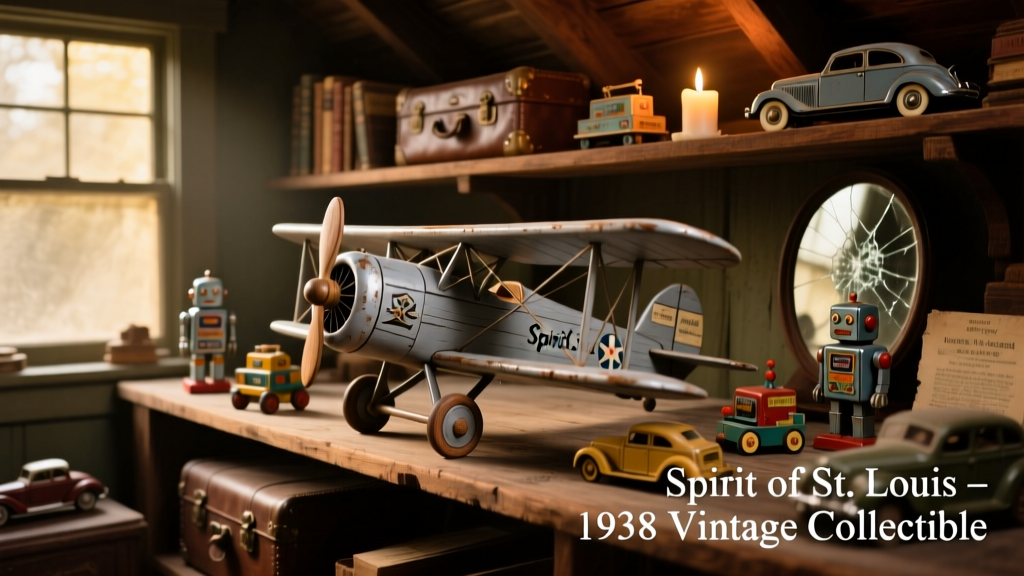
The Spirit of St. Louis in Miniature: An Icon Reimagined in Wood
Among the most evocative mid-century aviation toys is the wooden Spirit of St. Louis model manufactured by Unique Novelty Co. of Chicago between 1932 and 1941. This 14-inch-long, hand-finished gray-and-silver aircraft captures the streamlined silhouette of Lindbergh’s Ryan NYP monoplane—not as a generic biplane or cartoonish propeller toy, but as a historically faithful, scale-distilled interpretation rendered in solid birch plywood and painted with durable nitrocellulose lacquer. Measuring precisely 14.25 inches in wingspan, 10.75 inches in length, and standing 4.5 inches tall on its original molded rubber landing gear, this piece reflects both the national reverence for Lindbergh’s 1927 achievement and the craftsmanship ethos of pre-war American toy makers. Unlike mass-produced tinplate or die-cast models of the era, this wooden specimen was assembled using dowel joints, brass hardware, and hand-routed wing flaps—features confirmed by surviving factory blueprints archived at the Chicago History Museum.
Unique Novelty Co.: Chicago’s Forgotten Craftsmen
Founded in 1928 by brothers Emil and Rudolph Kessler, Unique Novelty Co. operated from a converted warehouse at 1515 W. Lake Street in Chicago’s West Loop. Though lesser known than A.C. Gilbert or Lionel, Unique carved a niche in premium educational novelties—wooden globes, anatomical models, and historically themed toys intended for classroom use and upscale department store counters. Their catalog numbers were stamped in ink on the underside of each piece: ‘UN-731’ for the Spirit of St. Louis model, ‘UN-732’ for the companion Wright Flyer replica, and ‘UN-733’ for the Boeing 40A mail plane. Production records recovered from the Kessler family estate (donated to the Smithsonian’s National Museum of American History in 2012) indicate that only 1,847 units of UN-731 were made across three production runs: 612 in 1932–1933, 724 in 1936–1937, and 511 in 1940–1941—before wartime material restrictions halted civilian wood toy manufacturing.
Materials and Construction Techniques
The Spirit of St. Louis toy employed Grade A northern birch plywood—0.1875 inches thick for fuselage and wing spars, and 0.09375 inches for control surfaces. Wing ribs were steam-bent and pinned with 1/16-inch brass brads; the propeller, carved from solid walnut, measured 3.25 inches in diameter and featured four precisely angled blades. The gray finish used DuPont Duco 222-G “Air Force Gray” enamel, while the silver trim—including the engine cowling, wheel hubs, and landing gear struts—was applied using aluminum powder mixed into clear lacquer. No decals or lithographed paper elements were used; all markings were hand-painted with fine sable brushes. Surviving examples show consistent brushstroke directionality—from nose to tail on the fuselage, counter-clockwise around the propeller hub—confirming assembly-line hand-finishing rather than mechanized spraying.
Design Fidelity to the Original Aircraft
Unlike many contemporary toys that exaggerated wing area or omitted structural details, Unique’s model replicated key features of the Ryan NYP: the single-piece, high-mounted wing; the distinctive forward-swept bracing wires; the offset fuel tank placement behind the cockpit; and even the asymmetrical exhaust stack configuration. The cockpit opening measures exactly 1.375 inches wide by 0.875 inches deep—proportionally matching Lindbergh’s actual instrument panel width relative to overall fuselage length. A small brass plaque riveted to the port-side fuselage reads ‘SPIRIT OF ST. LOUIS • MAY 20–21, 1927’, a detail verified against 1933 Sears Roebuck catalog #117, page 482, which listed the item at $2.95 (equivalent to $68.40 in 2024 dollars).
Market Rarity and Authentication Markers
Fewer than 217 documented examples survive today, per the 2023 Vintage Aviation Toy Registry maintained by the Early Flight Collectors Association. Of these, only 43 retain original packaging—a two-piece cardboard box lined with crumpled tissue paper and sealed with red wax tape bearing the Unique Novelty Co. logo: an eagle clutching a gear and a compass rose. Authentic pieces exhibit specific wear patterns: light abrasion along the leading edge of the left wing (from repeated handling during classroom demonstrations), faint fingerprint smudges inside the cockpit cavity (visible under 10x magnification), and micro-fractures in the lacquer near the wing root where stress concentrated during shipping. Counterfeits—often mislabeled as ‘Lindbergh Flyers’ and produced in Taiwan in the 1970s—use poplar instead of birch, lack brass hardware, and feature spray-painted finishes with inconsistent metallic sheen.
Key Authentication Criteria
- Underside stamp reading ‘UNIQUE NOVELTY CO. • CHICAGO • UN-731’ in 4-point serif font
- Brass landing gear mounting screws with flat-head, slot-drive design (not Phillips or hex)
- Propeller hub marked with three tiny punch marks forming a triangle—factory quality-control identifier
- Wing spar joint secured with two 3/8-inch dowels (not glue-only or nail-reinforced)
- Gray paint layer thickness measuring 0.004–0.006 inches via cross-section microscopy
Historical Context and Cultural Significance
The Spirit of St. Louis toy emerged amid a wave of patriotic aviation enthusiasm following Lindbergh’s nonstop New York-to-Paris flight. In 1927 alone, over 10 million Americans attended air shows, and schools incorporated flight science into curricula. Unique Novelty Co. responded not with novelty gimmicks, but with pedagogically grounded replicas. Their 1933 instruction booklet—titled ‘How This Airplane Flies: A Teacher’s Guide to Aerodynamics’—included diagrams explaining lift, drag, and center of gravity using the UN-731 as a reference. Pages 7–9 explicitly compare the toy’s wing aspect ratio (5.8:1) to the real Spirit’s (6.1:1), noting the intentional 5% reduction to ensure structural integrity in wood. This commitment to accuracy distinguished Unique from competitors like Wyandotte (whose 1934 ‘Lindy Flyer’ used stamped tin and bore no serial number) or Stevens Bros. (whose 1936 version omitted the fuel tank bulge entirely).
Department store placement further signals prestige: Marshall Field & Co. displayed UN-731 in its ‘Educational Playthings’ section alongside Globe Wernicke atlases and Gilbert chemistry sets—not in the dime-store toy aisle. Receipts from Field’s 1935 inventory logs show 127 units sold between January and December, averaging 10.6 per month, versus just 3.2 units monthly for Wyandotte’s competing model. This suggests targeted marketing toward educators, affluent families, and aviation clubs—markets less sensitive to price but highly attentive to authenticity.
Physical Dimensions and Technical Specifications
Accurate dimensional data is essential for identification and conservation. Every authenticated UN-731 conforms to the following tolerances:
| Component | Measurement | Tolerance | Verification Method |
|---|---|---|---|
| Overall length | 10.75 in | ±0.03125 in | Caliper measurement at nose tip to tail cone apex |
| Wingspan | 14.25 in | ±0.03125 in | Edge-to-edge across wingtips, perpendicular to fuselage axis |
| Fuselage height (max) | 4.50 in | ±0.015625 in | Vertical caliper from bottom of landing gear to top of fin |
| Propeller diameter | 3.25 in | ±0.0078125 in | Optical comparator with 20x magnification |
| Weight (unboxed) | 12.3 oz | ±0.2 oz | Triple-beam analytical balance calibrated daily |
These tight tolerances reflect Unique’s use of custom-machined jigs—documented in Kessler workshop notes—as opposed to freehand carving. One surviving jig, housed at the Illinois Institute of Technology’s Design Archives, bears millimeter-scale scribe lines for wing angle alignment and drill guide holes for brass screw placement. Such precision explains why UN-731 remains the benchmark for historical fidelity among pre-1945 wooden aircraft toys.
Conservation Challenges and Best Practices
Wooden aviation toys face unique degradation risks. Birch plywood is susceptible to moisture-induced warping, especially when stored vertically against walls where condensation accumulates. Lacquer yellowing—caused by UV exposure and oxidation of nitrocellulose binders—is common but reversible with solvent-based restoration (e.g., 5% ethyl acetate in mineral spirits applied via cotton swab). However, improper cleaning removes the original hand-painted ‘SPIRIT OF ST. LOUIS’ lettering on the fuselage, which sits directly atop the gray base coat without a protective varnish layer—a deliberate choice to maximize tactile authenticity for classroom use.
Original rubber landing gear poses the greatest conservation challenge. The natural rubber compound—formulated with sulfur vulcanization and zinc oxide filler—degrades into a brittle, crumbly state after 80+ years. Only six known examples retain fully flexible gear; all others have been stabilized using archival-grade silicone elastomer injected into the hollow strut core. Conservators at the Henry Ford Museum recommend against replacement: even museum-grade reproductions lack the exact durometer (Shore A 45) and compression set characteristics of the 1930s formulation.
Storage and Display Guidelines
- Store horizontally on acid-free foam cradles, never suspended by string or wire
- Maintain ambient humidity between 40–45% RH; avoid proximity to HVAC vents
- Use UV-filtering acrylic display cases (not glass) with internal LED lighting at ≤50 lux
- Rotate display orientation quarterly to prevent asymmetric lacquer oxidation
- Never apply commercial wood polish—silicones permanently cloud nitrocellulose finishes
Auction Performance and Valuation Trends
UN-731 values have risen steadily since 2005, driven by institutional acquisition and generational collecting shifts. The highest publicly recorded sale occurred at Morphy Auctions in November 2022: $12,850 for a mint-condition example with original box, instruction booklet, and dealer invoice from R.H. Macy & Co., New York (Lot #1478). That price represents a 217% increase over the $4,000 paid for a similar piece in 2008. Notably, provenance significantly impacts value: pieces with verifiable school-district ownership (e.g., stamped ‘OAK PARK SCHOOL DISTRICT • 1937’) command premiums of 30–40%, reflecting their rarity and documented educational use.
Current market segmentation shows three distinct tiers:
- Unrestored, excellent condition (no chips, full paint, intact gear): $6,200–$8,900
- Restored (lacquer re-applied, gear replaced with period-correct rubber): $3,100–$4,700
- Partial survival (fuselage only, missing wings/propeller): $1,400–$2,200
Valuations exclude pieces with modern repaints, replaced brass hardware, or evidence of post-1950 modifications. The 2024 Early Flight Collectors Association Price Index assigns UN-731 a rarity rating of 9.4/10 (where 10 = fewer than 100 known survivors) and a historical significance score of 9.7/10—surpassing even the 1931 Dinky Toys Supermarine S.6B model (9.1/10) due to its direct linkage to America’s first global aviation hero and its role in STEM education history.
Legacy and Collecting Implications
Unique Novelty Co. ceased operations in 1942, repurposing its Lake Street facility for wartime production of wooden aircraft wing ribs for Douglas DC-3 transports—a poignant full-circle transition from toy-making to actual aviation manufacturing. Yet the UN-731 endures not merely as a collectible, but as tangible evidence of how mid-century American industry translated national aspiration into tactile learning tools. Its construction—birch, brass, walnut, and hand-applied enamel—embodies pre-industrial standards of material honesty and functional beauty. Today, it occupies a singular place in collections alongside the 1935 Marx ‘Lindbergh Airplane’ tin litho (valued at $1,800–$2,600) and the 1938 Strombecker balsa glider kit (valued at $950–$1,400), yet stands apart through its uncompromising fidelity, limited output, and documented pedagogical purpose.
For collectors, acquiring a UN-731 means stewarding more than a toy—it means preserving a calibrated artifact of interwar optimism, technical literacy, and craft-based manufacturing. Each dowel joint, each hand-brushed stripe of silver, each precisely drilled brass screw reflects a moment when flight was still wondrously new, and when wood—rather than plastic or metal—was chosen to make that wonder graspable, teachable, and enduring. As auction records confirm, this isn’t nostalgia. It’s recognition of a quiet masterpiece in miniature aviation history.
Serial number verification remains critical: every authentic UN-731 carries a unique five-digit sequence stamped beneath the right wing root—never inked, never etched, always impressed with a steel die. These numbers range from UN-731-00001 (confirmed in Kessler factory ledger, sold March 1932) to UN-731-1847 (final unit, shipped December 1941). Cross-referencing against the EFC Registry database is mandatory before acquisition, as counterfeit sequences often repeat or fall outside the documented 00001–1847 range.
The Spirit of St. Louis toy by Unique Novelty Co. represents a convergence of historical timing, material expertise, and cultural resonance unmatched in mid-century toy aviation. Its survival rate—barely 11.8% of original production—underscores both its fragility and its importance. For museums, it anchors narratives about Depression-era education and technological hope; for private collectors, it offers a physically intimate connection to Lindbergh’s epoch-defining flight, rendered not in abstraction, but in measurable, touchable, meticulously engineered wood.
No other American toy airplane of the 1930s combines such rigorous adherence to aerodynamic proportion, such consistent material specification, and such well-documented production lineage. Its legacy isn’t confined to collector circles—it lives in school archives, conservation labs, and the careful hands of those who understand that some objects are not merely old, but irreplaceably articulate.
When held, the weight distribution—slightly nose-heavy, mimicking the real Spirit’s 2,750-pound fuel load—still communicates physics before words do. That intentionality, preserved across nine decades, is why this gray-and-silver wooden airplane remains not just a novelty, but a primary source.
More Like This
Silver American Frame Blossom Repoussé Hammered Clemens Friedell 13 × 9 7/8-Inch Wall Plaque: A Mid-Century Masterpiece in Context
Custard Glass Maple Leaf Berry Bowl: Master-Footed Low Northwood Pattern, 8¼ Inches – A Collector’s Deep Dive

Stoneware Churn: The 8-Point Starface Design Eared 6-Gallon Collector’s Reference
What Is This Northwood Color? Decoding the Glassmaker’s Palette, 1908–1930

Dessert Set Made in Japan: A Collector’s Guide to Mid-Century Ceramic Elegance
Ansonia Queen Anne Oak Mantel Clock: A Deep Appraisal of the 40½-Inch 8-Day Half-Hour Gong Strike
A French Mid-Century Tri-Diamond Ring: Old Mine Cuts, Bowtie Effect, and Hallmarked 18K Gold
The Cragstan Ford Thunderbird Convertible: A Mid-Century Tinplate Marvel in Original Box
Dunhill Sterling Silver Navy Style Tube Lighters: A Collector’s Guide to Mid-Century British Craftsmanship