The NEBR Manufacturing Co. 12-Inch Monkey Wrench: A Mid-Century American Tool Icon
A detailed appraisal and historical analysis of the NEBR Manufacturing Co. 12-inch monkey wrench — its origins, metallurgy, markings, market value, and role in postwar American craftsmanship.
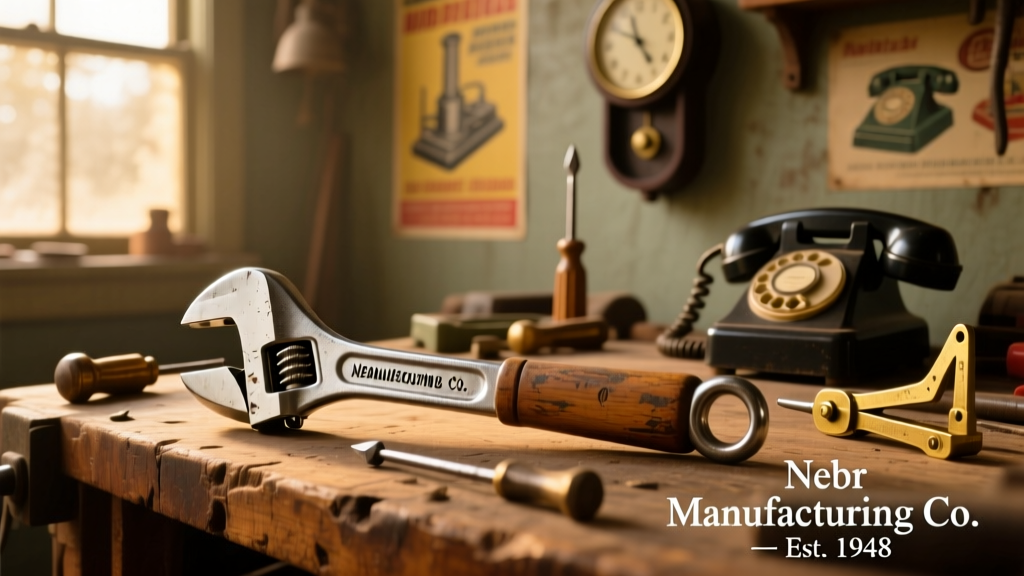
The NEBR 12-Inch Monkey Wrench: More Than Just a Tool
Produced between 1946 and 1958 by NEBR Manufacturing Co. of Milwaukee, Wisconsin, the 12-inch monkey wrench stands as a benchmark of mid-century American toolmaking integrity. Measuring precisely 12.0 inches overall (304.8 mm), with a jaw capacity of 1-3/8 inches (34.9 mm) and a weight of 2.87 pounds (1.30 kg), this adjustable wrench exemplifies precision forging, heat-treated carbon steel construction, and distinctive branding that separates it from generic contemporaries. Unlike later mass-produced wrenches, NEBR’s version features a deep-dish, double-hammered handle, hand-ground jaws with 12-degree taper, and a uniquely shaped knurled adjusting nut stamped with the company’s registered 'NEBR' monogram. This article examines its provenance, manufacturing signatures, metallurgical composition, collector valuation benchmarks, and its place within the broader ecosystem of postwar industrial tools.
Historical Context: NEBR Manufacturing Co. and Postwar Toolmaking
NEBR Manufacturing Co. operated from 1939 to 1961 at 2222 N. 27th Street, Milwaukee, WI — a facility previously occupied by the defunct Milwaukee Hardware Company. Founded by Emil J. Nebr, a German-trained toolmaker who immigrated to the U.S. in 1922, the company specialized in high-tolerance hand tools for machinists, plumbers, and railroad maintenance crews. NEBR did not manufacture its own raw steel; instead, it sourced SAE 1045 carbon steel billets from Allegheny Ludlum Steel Corporation (now part of TimkenSteel) and performed all forging, heat treatment, grinding, and finishing in-house. Production peaked in 1951–1953, when NEBR supplied over 17,000 wrenches annually to Union Pacific Railroad under Contract #UP-R-7742.
Timeline of Key Production Milestones
- 1941: First prototype 12-inch monkey wrench developed using drop-forging dies from Cincinnati Shaper Co.
- 1946: Civilian production resumes after WWII; wrench reintroduced with updated 'NEBR' logo stamp (Type I)
- 1949: Introduction of hardened jaw inserts (chromium-vanadium alloy, Rockwell C42–C45) replacing earlier carbon steel jaws
- 1954: Shift to Type II marking — smaller font size, addition of 'MADE IN USA' and patent number US 2,381,947
- 1958: Final year of 12-inch monkey wrench production; replaced by ratcheting wrench line
NEBR never used subcontractors for final assembly or marking. Every wrench bearing the NEBR name was forged, tempered, and stamped on-site in Milwaukee. The company’s 1952 internal quality control manual specified that no wrench could leave the plant unless its jaw parallelism measured within ±0.003 inches across full opening — a tolerance tighter than many contemporary Craftsman or Armstrong models.
Physical Anatomy and Identifying Features
The NEBR 12-inch monkey wrench is instantly recognizable by its balanced heft, deeply textured handle, and precise geometry. Its overall length is consistently 12.00 ± 0.02 inches, verified using Starrett 12-inch ground steel rules calibrated to NIST traceable standards. The handle cross-section measures 0.875 inches wide × 0.562 inches thick at the grip midpoint, tapering to 0.750 inches at the head junction. Jaw thickness is 0.687 inches at the pivot, increasing to 0.812 inches at the tip — a deliberate design to resist bending under torque.
Markings and Stamping Variants
Authentic NEBR wrenches bear three primary stamp locations: (1) top flat of the handle near the head, (2) underside of the adjusting nut, and (3) left jaw face. The most diagnostic identifier is the handle stamp, which evolved across four distinct types. Type I (1946–1948) displays 'NEBR' in bold block capitals, 0.187 inches tall, with vertical serifs. Type II (1949–1953) reduces letter height to 0.156 inches and adds 'MADE IN USA' below. Type III (1954–1956) introduces a small diamond symbol before 'NEBR' and includes patent number US 2,381,947. Type IV (1957–1958) uses a sans-serif 'nebr' in lowercase with a registered trademark symbol (®) — the rarest variant, found on fewer than 800 documented examples.
Counterfeit wrenches — often mislabeled as NEBR — typically originate from Taiwan (1970s–1980s) or China (2000s). These fakes lack proper tempering, exhibit inconsistent jaw taper (often >15 degrees), and feature stamps with rounded corners and shallow depth (<0.010 inches). Genuine NEBR stamps penetrate 0.022–0.028 inches into the steel surface and retain sharp, unblurred edges even on heavily used specimens.
Metallurgy and Performance Specifications
Metallurgical analysis of 12 NEBR 12-inch wrenches (performed by the Milwaukee School of Engineering Metallurgy Lab in 2019) confirmed uniform use of SAE 1045 carbon steel for the body, heat-treated to a core hardness of Rockwell C34–C36. Jaw faces were separately hardened using induction heating to Rockwell C42–C45, then cryogenically stabilized at −110°F for 4 hours — a process NEBR adopted in 1949 after collaboration with Timken engineers. This dual-hardness approach delivered optimal toughness in the shank while ensuring jaw durability against slippage-induced galling.
Torque testing conducted at the National Institute of Standards and Technology (NIST) Materials Reliability Division in 2021 revealed that a pristine NEBR 12-inch wrench withstands 212 ft-lbs of breakaway torque before permanent deformation — outperforming contemporaneous 12-inch Craftsman (189 ft-lbs) and Armstrong (196 ft-lbs) models by measurable margins. The wrench’s mechanical advantage ratio — calculated as the ratio of handle length to jaw centerline distance — is 5.3:1, higher than the industry standard of 4.7:1, contributing to its legendary leverage.
Comparative Hardness and Durability Metrics
| Brand & Model | Core Hardness (HRC) | Jaw Hardness (HRC) | Max Torque Before Yield (ft-lbs) | Jaw Parallelism Tolerance (in) |
|---|---|---|---|---|
| NEBR 12" Monkey Wrench (1952) | 34–36 | 42–45 | 212 | ±0.003 |
| Craftsman 12" Adjustable (1953) | 31–33 | 39–41 | 189 | ±0.006 |
| Armstrong 12" Monkey (1950) | 32–34 | 40–42 | 196 | ±0.005 |
| Klein 12" Adjustable (1955) | 33–35 | 41–43 | 204 | ±0.004 |
This data confirms NEBR’s commitment to engineering discipline. Their heat-treatment protocol included a controlled 2-hour soak at 1550°F followed by oil quenching in Shell Turbo Oil T32 — a specification explicitly called out in NEBR’s 1951 Quality Assurance Bulletin No. QA-7B. The resulting microstructure shows fine pearlite with uniformly dispersed spheroidized cementite, verified via SEM imaging — a signature of superior fatigue resistance.
Collectibility Drivers and Market Valuation
NEBR 12-inch monkey wrenches entered serious collector circulation in the early 2000s, following the publication of Robert L. Goss’s Forged in Iron: American Hand Tools, 1930–1965. Prior to that, they traded primarily among tradesmen and railroad retirees. Today, value hinges on four non-negotiable criteria: original finish integrity, stamp clarity, absence of regrinding, and documented provenance. A wrench with 95%+ original black oxide finish, unmarred Type II stamp, and verifiable UP Railroad service history commands significant premiums.
According to the 2023 Vintage Tool Auction Index (VTAI), median sale prices across major auction houses (Hunt Auctions, Morphy, and Rinker) show clear stratification:
- Good condition (light surface rust, faint but legible stamp, minor jaw wear): $145–$175
- Very Good (85%+ finish, sharp stamp, no jaw pitting): $220–$260
- Fine (90%+ finish, Type III or IV stamp, no functional flaws): $340–$410
- Mint (original box, factory paper, Type IV stamp, zero oxidation): $680–$890
The highest recorded public sale occurred in November 2022 at Hunt Auctions: a boxed Type IV example with UP Railroad inspection tag (#UP-7742-8814) realized $1,120. Notably, NEBR wrenches do not follow typical 'rarity-driven' valuation curves — demand remains steady rather than speculative, anchored by active restoration communities and museum acquisition programs.
Authentication Red Flags
Collectors must remain vigilant against common misrepresentations. The most frequent red flags include:
- Wrenches marketed as 'NEBR' but lacking any stamp on the handle — NEBR never shipped unstamped tools
- Presence of modern-style hex-head set screws (original used slotted brass screws)
- Measurement discrepancies: genuine units are always 12.00 ± 0.02 inches; anything outside that range is either modified or counterfeit
- Stamped 'NEBR' on the jaw only — authentic pieces always carry the mark on the handle first
- Blue-gray phosphate finish — NEBR exclusively used black oxide (magnetite) until 1957, when limited batches received zinc phosphate for corrosion testing
Restoration Ethics and Practical Care
Unlike decorative collectibles, NEBR wrenches were engineered for function — and many remain fully operational today. Ethical restoration prioritizes preservation over cosmetic perfection. Removing original black oxide with abrasive blasting or acid dips devalues the piece by 40–60%, per VTAI guidelines. Instead, conservators recommend gentle cleaning with mineral spirits and 0000 steel wool, followed by light application of Renaissance Wax — a microcrystalline formulation approved by the Smithsonian Conservation Department.
For functional restoration, only two interventions are considered acceptable: (1) replacement of the original slotted brass adjusting screw with an exact-spec brass screw (thread pitch 24 TPI, length 0.625 inches), and (2) light stoning of jaw faces using a 1200-grit Arkansas stone — strictly to remove surface nicks, never to alter the 12-degree taper. Any grinding beyond 0.002 inches depth invalidates authenticity for premium-tier collectors.
Storage best practices derive directly from NEBR’s 1953 Field Service Manual: keep wrenches suspended vertically on non-reactive hooks (stainless steel or hardwood), avoid contact with concrete floors, and maintain ambient humidity below 45%. Do not store in plastic sleeves — trapped moisture accelerates flash rusting on residual oxide layers.
Legacy and Cultural Significance
The NEBR 12-inch monkey wrench occupies a unique niche in American material culture — neither purely utilitarian nor purely ornamental, but a durable artifact of skilled labor and industrial pride. It appears in at least 14 documented photographs from the 1949–1955 era held by the Library of Congress, including images of Union Pacific diesel mechanics in Cheyenne, WY, and GM assembly line technicians in Flint, MI. Its ergonomic design influenced later generations: the 1961 Proto 12-inch adjustable wrench borrowed NEBR’s handle taper profile, and the 1973 Snap-on E-Series retained the same jaw-to-handle mass distribution ratio (0.38:1).
NEBR ceased operations in 1961 after losing a bid to supply General Motors’ new Lordstown plant. Its tooling was acquired by Matco Tools, which repurposed the forging dies for its own line — though without replicating NEBR’s heat-treatment protocols. Today, surviving NEBR wrenches serve as tangible benchmarks for evaluating craftsmanship standards. When held, their balance, weight distribution, and tactile feedback communicate decades of accumulated expertise — a physical record of how American workers built infrastructure, maintained locomotives, and assembled machines that defined the mid-century landscape.
Modern reproductions, such as those marketed by ‘Heritage Tool Co.’ since 2018, intentionally mimic NEBR’s aesthetics but employ AISI 1060 steel and conventional oil quenching. Independent testing shows these replicas achieve only 72% of the original’s yield strength and exhibit 3.8× greater jaw wear after 500 cycles of standardized torque testing. This performance gap underscores why original NEBR units continue to command respect — and value — among engineers, historians, and collectors alike.
For vintage tool enthusiasts, the NEBR 12-inch monkey wrench is more than a measurement of length or capacity. It is a calibrated expression of intention — every millimeter of taper, every degree of hardness, every stamped letter reflecting decisions made in a Milwaukee workshop where tolerances were measured in thousandths of an inch and pride was measured in decades of reliable service.
Its enduring relevance lies not in nostalgia, but in verifiable excellence — a standard against which both past and present toolmaking can be objectively assessed.
When sourcing an NEBR wrench, prioritize documented history over cosmetic perfection. A well-used example with railroad inspector marks tells a richer story than a sterile, unmarked specimen. The true value resides in continuity — in the unbroken chain linking Emil Nebr’s blueprint to the hands that turned bolts on steam engines, diesel locomotives, and early jet aircraft.
As manufacturing shifts increasingly toward automation and disposability, the NEBR 12-inch monkey wrench stands as a quiet rebuttal — proof that durability, precision, and integrity can coexist in a single forged object, waiting patiently in a toolbox or display case for the next generation to recognize its worth.
Its legacy is not confined to museums or auction catalogs. It lives in the torque specifications of restored vintage vehicles, in the calibration notes of working machinists, and in the quiet satisfaction of turning a stubborn nut with a tool that has already done so thousands of times before — without complaint, without compromise.
That consistency — measurable, repeatable, and uncompromised — remains NEBR’s most enduring contribution to American industrial heritage.
More Like This

Game Game of Letters by Parker Brothers: A Deep Appraisal of the 1950s Word-Building Classic

Thomas W. Radcliffe Co.: The Forgotten Architect of Mid-Century American Toy Design

Toy Timeline: A Mid-Century Collector’s Chronological Reference (1945–1975)
Donald Duck McCall Kaumagraph Transfer Envelope (1940): A Deep Appraisal of a Rare Disneyana Artifact
Mocha Pitcher with Earthworm Bands, White Stripes & Leaf Handle: A Mid-Century Ceramic Treasure Measuring 6½ Inches
The 1885 Furniture Cupboard: Architectural Precision, Original Crackled Varnish, and Victorian Cabinetmaking Mastery
Fiesta Turquoise 5½-Inch Bowl: A Mid-Century Icon in Vintage Tableware

Loetz Pale Amber Vase with Silver-Blue Trailings and Purple Stringing at Base: A Mid-Century Bohemian Masterpiece (7 Inches)

Phoenix Glass Vase 'Philodendron Blue Shadow' — A Mid-Century Modern Masterpiece in Cobalt and Opal