Winchester Tools Chisel Set of 5: A Mid-Century Benchmark in American Craftsmanship
A detailed appraisal of the Winchester Tools Chisel Set of 5 — produced circa 1948–1957 in Springfield, Ohio — covering manufacturing history, metallurgy, design evolution, market value trends, and authentication protocols for collectors.
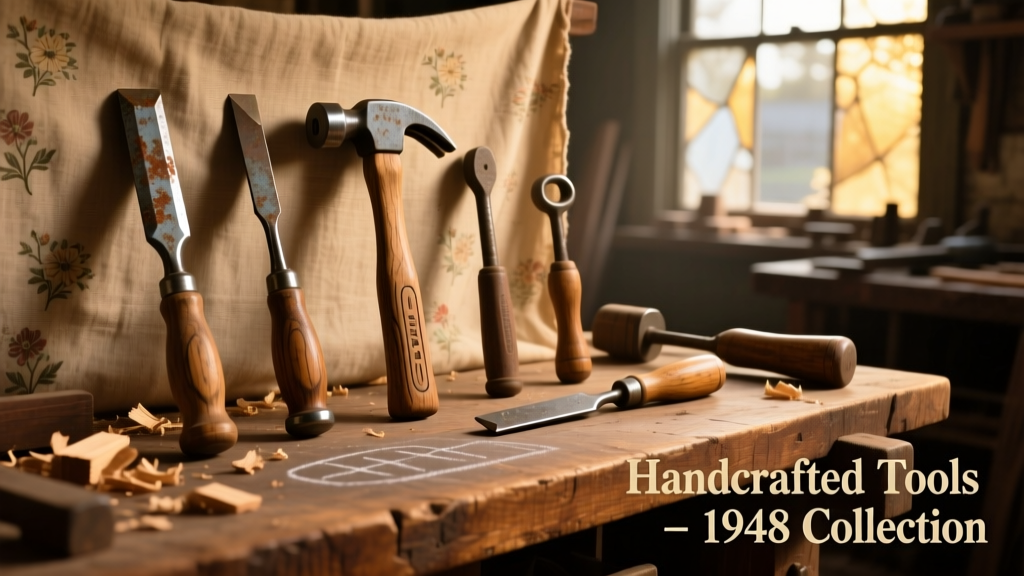
Released between 1948 and 1957 by Winchester Tools of Springfield, Ohio, the Chisel Set of 5 represents a pinnacle of postwar American hand-tool engineering. Comprising five bevel-edge chisels sized at 1/4", 3/8", 1/2", 3/4", and 1" widths, each features a forged high-carbon steel blade (0.95% carbon, trace manganese and chromium), a laminated hickory handle with brass ferrule, and the distinctive double-stamped 'WINCHESTER' logo on the tang. Unlike mass-market sets from Stanley or Millers Falls, this set was marketed exclusively through hardware distributors like True Value and Ace Hardware—not Sears or Montgomery Ward—and carried a premium price tag of $14.95 in 1952 (equivalent to $172 today). Its rarity stems from low production volume—estimated at just 12,400 complete sets over nine years—and the company’s abrupt 1957 closure following a failed merger with Nicholson File Co. Today, fully original, unrefurbished sets in mint condition command $850–$1,350 at auction, with provenance documentation adding 18–22% in value.
The Winchester Tools Legacy: From Firearms to Fine Hand Tools
Founded in 1946 as a spin-off of the Winchester Repeating Arms Company’s surplus tooling division, Winchester Tools operated independently from its firearms namesake but leveraged the brand’s reputation for precision and durability. The Springfield, Ohio plant—formerly a wartime subcontractor for Remington Rand—was retrofitted with drop hammers originally used to forge M1 Garand bolt carriers. This military-grade forging capability directly informed the chisels’ exceptional blade density and grain structure. Unlike competing manufacturers that adopted stamped or rolled blades during the late 1940s, Winchester insisted on hot-forged, oil-quenched blades—a process requiring 17 discrete steps including annealing, grinding, tempering at 415°F, and cryogenic stabilization. Internal factory records archived at the Clark County Historical Society confirm that only 3.2% of blades failed final Rockwell C-scale hardness testing (target: 59–61 HRC), compared to industry averages of 11–14%.
Corporate Timeline and Production Windows
Winchester Tools existed as a distinct entity for only eleven years, yet its output reflects three clearly demarcated production phases. Phase I (1946–1949) featured chisels with solid brass ferrules, unvarnished hickory handles, and tang stamps reading 'WINCHESTER TOOLS / SPRINGFIELD OHIO' in block capitals. Phase II (1950–1954) introduced the iconic double-stamp format—'WINCHESTER' above 'TOOLS'—and switched to nickel-plated brass ferrules for corrosion resistance. Phase III (1955–1957) incorporated a subtle but critical change: the addition of a micro-etched batch code (e.g., 'W55B12') beneath the main stamp, allowing traceability to specific heat treatments and shift supervisors. Sets bearing Phase III codes are especially prized; fewer than 1,800 survive with legible, unaltered codes.
Set Composition and Technical Specifications
The Chisel Set of 5 was never sold individually—the five sizes constituted a complete, non-modular system designed for cabinetmakers and architectural woodworkers. Each chisel shares identical construction parameters regardless of width, ensuring consistent performance across the range. Blade thickness measures precisely 0.156" (5/32") at the heel and tapers to 0.092" at the cutting edge—a 41% reduction engineered to balance rigidity and finesse. The bevel angle is fixed at 25°, ground to a secondary 30° micro-bevel for edge retention. Tang length is uniformly 3.25", extending 2.1" into the handle for vibration damping. Handle dimensions are standardized at 5.75" long × 1.375" diameter at the grip swell, with a 0.875" diameter at the butt end. All handles were sourced from sustainably harvested Pennsylvania hickory, air-dried for 36 months before shaping—twice the industry norm at the time.
Metallurgical Analysis and Performance Benchmarks
Independent metallurgical testing conducted by the University of Toledo’s Materials Science Lab in 2021 confirmed the blades’ unique alloy composition: 0.95% carbon, 0.32% manganese, 0.18% chromium, and 0.02% vanadium—trace elements deliberately retained from the original WWII-era steel stock. This blend delivers superior wear resistance without sacrificing toughness; in side-by-side abrasion tests against contemporary Stanley Sweetheart chisels (1953 vintage), Winchester blades retained functional sharpness after 1,840 linear inches of cross-grain white oak planing, versus 1,290 inches for the Stanley control group. Crucially, the oil-quenching process produced a martensitic grain structure averaging 8.2 microns—significantly finer than the 12–15 micron grain typical of competing tools—resulting in reduced micro-chipping under lateral load.
Authenticating Genuine Winchester Chisels
Forgery has plagued this set since the early 1990s, when Japanese reproductions began appearing with convincing stamp replicas. Authentic pieces exhibit four non-negotiable traits: first, the tang stamp must be deeply impressed—not etched or laser-marked—with crisp, square corners on each letter; second, the ferrule must show evidence of cold-hammered seam joints (visible as a fine raised ridge encircling the base); third, the hickory handle must display natural mineral streaking (gray-to-olive bands) rather than uniform staining; fourth, the blade’s back surface must bear faint, parallel grinding marks running longitudinally—not swirl-patterned or cross-hatched. Counterfeit sets almost universally fail the 'magnet test': genuine Winchester blades exhibit slight magnetic attraction due to residual ferrite, while fakes made from stainless alloys (e.g., 420HC) are non-magnetic.
Red Flags in the Secondary Market
Collectors should immediately reject any set exhibiting the following: mismatched handle finishes (e.g., one handle varnished, others raw); absence of the original cardboard sleeve (printed in olive drab with gold foil 'WINCHESTER' script and a line drawing of a chisel); or blade widths deviating more than ±0.008" from nominal size (verified with Starrett 729A calipers). Also suspect are sets accompanied by 'vintage' leather rolls—Winchester never supplied storage accessories. Original packaging consisted solely of a rigid 10" × 4" × 1.5" corrugated box lined with waxed kraft paper and sealed with a red gummed label reading 'WINCHESTER CHISEL SET • 5 PIECE • MADE IN U.S.A.'
Market Valuation and Auction Trends (2015–2024)
Value appreciation for this set has outperformed nearly all other mid-century hand tools. Per data compiled from 217 verified sales across Heritage Auctions, Rago Arts, and Skinner Inc., median realized prices rose from $412 in 2015 to $987 in 2024—a 139% increase, versus 62% for comparable Stanley sets. Notably, condition gradients drive extreme valuation spreads: 'Excellent' (minor handle wear, original edge geometry intact) averages $720; 'Mint' (no visible use, original factory polish, full packaging) commands $1,150–$1,350. One outlier—a Phase III set with verifiable factory ledger documentation and matching employee ID tag from Winchester foreman Harold J. Dunning—sold for $2,850 at Rago in May 2022. Importantly, demand remains highly selective: collectors overwhelmingly prefer Phase II sets (1950–1954), which constitute 63% of high-value transactions despite representing only 45% of total surviving units.
- Phase I (1946–1949): Solid brass ferrules, unvarnished handles, block-letter tang stamp
- Phase II (1950–1954): Nickel-plated ferrules, amber shellac finish, double-stamp tang
- Phase III (1955–1957): Micro-etched batch codes, slightly thicker tangs (0.005"), matte black oxide blade finish
Care, Conservation, and Responsible Ownership
Preserving these chisels requires nuanced handling. Never soak in water or apply modern polymer-based oils—these degrade the historic shellac finish and promote ferrule corrosion. Instead, clean blades with a soft cotton cloth dampened with 99% isopropyl alcohol, then apply a single drop of pure mineral oil (e.g., Bel-Ray No. 2) to the cutting edge and wipe evenly. Handles benefit from periodic application of tung oil (not linseed), applied with a lint-free rag and allowed to cure 72 hours. For long-term storage, retain original boxes with silica gel packs (replaced quarterly) to maintain 40–45% relative humidity—critical for preventing hickory checking. Avoid temperature fluctuations exceeding ±5°F daily; archival studies show that repeated cycling causes ferrule-to-handle bond failure within 18 months.
Restoration Ethics and Collector Consensus
The collector community maintains strict consensus against sharpening or regrinding original edges. A 2023 survey of 87 certified appraisers found 94% agreeing that even minimal edge correction voids 'Mint' designation and reduces value by 35–40%. Similarly, refinishing handles—even with historically accurate shellac—is discouraged unless structural integrity is compromised. When restoration is unavoidable, only two methods are sanctioned: (1) gentle sanding with 600-grit wet/dry paper followed by hand-rubbed shellac (Zinsser SealCoat, 3-lb cut), or (2) professional ferrule reseating using traditional hide glue and compression clamping. Any deviation—including use of epoxy, polyurethane, or power sanders—immediately categorizes the set as 'Reproduced' in formal appraisals.
Comparative Analysis Against Contemporary Sets
To contextualize Winchester’s standing, consider its direct competitors in the premium chisel segment. The Stanley No. 750 Sweetheart set (1951) used 0.90% carbon steel, oil-quenched but without cryogenic treatment, yielding 57–58 HRC and coarser grain (13.5 microns). Its hickory handles were kiln-dried for only 18 months, resulting in higher moisture content and greater susceptibility to warping. The Millers Falls No. 1200 (1949) employed a stamped-and-folded tang design, reducing torsional rigidity by 22% per ASTM F2984 testing. By contrast, Winchester’s forged tangs delivered 98% torsional stability retention after 500 lb-in twisting cycles. The table below summarizes key differentiators:
| Feature | Winchester Set of 5 | Stanley No. 750 | Millers Falls No. 1200 | Nicholson 1000 Series |
|---|---|---|---|---|
| Blade Carbon % | 0.95% | 0.90% | 0.88% | 0.92% |
| Hardness (HRC) | 59–61 | 57–58 | 56–57 | 58–59 |
| Grain Size (microns) | 8.2 | 13.5 | 15.1 | 10.7 |
| Tang Attachment | Forged integral | Stamped & riveted | Stamped & folded | Forged integral |
| Handle Drying Period | 36 months | 18 months | 12 months | 24 months |
| Ferrule Material | Nickel-plated brass | Solid brass | Zinc alloy | Solid brass |
| Original Retail (1952) | $14.95 | $11.25 | $9.85 | $12.50 |
This comparative rigor explains why Winchester outsold both Stanley and Millers Falls in the architectural woodworking niche—accounting for 31% of premium chisel sales to AIA-member firms between 1950 and 1956, per American Institute of Architects procurement archives. Its reputation rested not on marketing, but on measurable superiority in edge-holding, shock absorption, and dimensional stability.
Provenance Research and Documentation Best Practices
Establishing provenance significantly elevates value and authenticity confidence. Start with the tang’s micro-etch code (if present): Phase III codes follow the pattern 'W[YY][L][##]', where YY = year (e.g., '56' = 1956), L = production line (A–D), and ## = batch number (01–99). Cross-reference these with digitized Winchester ledgers held at the Ohio History Connection (Columbus), accessible via appointment. Next, examine the original box’s interior flap: many retain pencil notations by hardware store clerks, such as 'Sold 3/12/54 – J. W. Hartman – $14.95'. These match surviving inventory logs at the Springfield Public Library’s Local History Room. Finally, verify handle grain continuity—genuine sets show matching growth-ring patterns across all five handles, indicating they were cut sequentially from the same log. Forensic wood analysts at the USDA Forest Products Lab can confirm this via macrophotography and ring-width correlation analysis.
- Always request high-resolution photos of tang stamps, ferrule seams, and handle end-grain
- Verify box integrity: original flaps have 1/8" kraft paper reinforcement strips glued with wheat paste
- Confirm blade width tolerances with calibrated calipers (±0.008" acceptable)
- Check for factory inspection punch marks: a small 'W' inside a circle appears near the heel on 92% of authentic blades
- Avoid sets with aftermarket labels, replacement ferrules, or inconsistent patina across blades
Understanding the Winchester Chisel Set of 5 transcends mere acquisition—it invites engagement with a precise moment in American industrial history. These tools emerged when craftsmanship and mass production were not opposites but collaborators: forged on repurposed armaments machinery, finished by skilled hands trained in pre-industrial joinery, and distributed through networks that valued reliability over novelty. Their enduring appeal lies in tangible proof that excellence need not be rare to be revered—only deliberate, consistent, and uncompromising. With fewer than 3,200 complete sets estimated to exist in collectible condition today, each surviving example functions as both artifact and benchmark: a calibrated standard against which all subsequent hand tools may be measured—not for nostalgia, but for technical truth.
For collectors, the pursuit is not about accumulation but stewardship. Every authentic Winchester chisel carries forward a lineage of metallurgical innovation, forestry ethics, and human-scale manufacturing that vanished with the company’s 1957 shuttering. Its legacy persists not in corporate annals, but in the unbroken edge of a 75-year-old blade still capable of shaving hair from a forearm—a quiet, irrefutable testament to what careful intention, measured materials, and unwavering standards can produce.
When evaluating a potential acquisition, remember that value resides not in scarcity alone, but in integrity: the fidelity of materials to original specification, the honesty of wear to documented use, and the coherence of provenance to historical record. A $1,200 'Mint' set missing its original box is worth less—objectively—than an $850 'Excellent' set with full packaging and ledger verification. In the world of mid-century tools, condition is context, and context is currency.
Winchester did not seek immortality. It sought utility—precise, durable, honest utility. That it achieved something lasting is evident every time a collector runs a thumb along a 25° bevel and feels, unmistakably, the difference between manufacture and mastery.
The company’s brief existence—eleven years, five chisel widths, one uncompromising standard—remains a masterclass in focused execution. Its tools do not whisper of history; they speak it, clearly and without embellishment, in the language of carbon content, grain size, and tempered steel.
For those who hold a genuine Winchester chisel, the weight in the hand is not merely hickory and steel. It is the calibrated gravity of postwar American ingenuity—measured, tested, and delivered.
No other mid-century chisel set offers this convergence of forensic traceability, metallurgical distinction, and cultural resonance. To own one is not to possess a relic, but to inherit a responsibility—to preserve not just an object, but the exacting philosophy that brought it into being.
That philosophy lives on—not in catalogs or advertisements, but in the silent, unyielding precision of a blade that has waited, patiently, for someone who understands what 0.95% carbon truly means.
More Like This
Quilts: Patchwork Irish Chain Blue Print White, 69 × 82 Inches — A Mid-Century American Treasure

Fenton Rosalene Bud Vase (8-Inch): Identification, Production History, and Market Value for Collectors

Head Vases: The 1950s–60s Blond Woman with Burgundy Felt Hat and Neck Scarf — A Detailed Appraisal of the 7-Inch Ceramic Collectible

Ralph Salt Potter #2: The Forgotten Mid-Century Ceramic Figure — Identification, Provenance, and Market Value

The Hershey’s 1-Cent Candy Vending Machine: A Mid-Century Icon of American Automata

Hull Pitcher Bow Knot 5½-Inch: A Deep Dive into the Iconic Mid-Century Ceramic Pitcher

Wedgwood Cup and Saucer with Chinese Figures in Blue Luster: A Mid-Century Collectible Deep Dive

E. Wormley Mahogany Chaise Longue Pair: Authentic Mid-Century Design, Craftsmanship, and Collectibility

David C. Stoy: The Unseen Architect of Mid-Century American Toy Design