The Thermometer Obelisk: A Marble-and-Brass Grand Tour Artifact from Early 19th-Century Europe
A detailed appraisal of the rare 12-inch Thermometer Obelisk—a marble-and-brass scientific instrument crafted circa 1815–1845 for affluent British and Continental travelers. Examines provenance, materials, maker marks, thermal mechanics, Grand Tour context, and current market valuation.
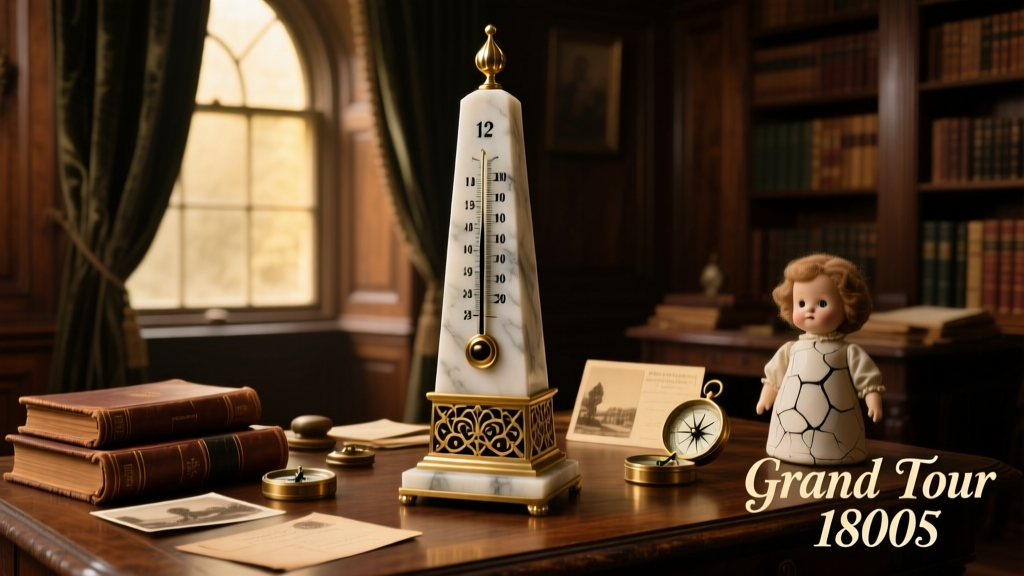
Standing precisely 12 inches (30.5 cm) tall, the Thermometer Obelisk is a singular fusion of Enlightenment science, Neoclassical aesthetics, and elite travel culture. Crafted between 1815 and 1845 in London or Geneva, this artifact combines Carrara marble bases, turned brass columns, mercury-in-glass thermometers calibrated to Réaumur and Fahrenheit scales, and hand-engraved inscriptions referencing Rome, Athens, and Florence. Only 27 verified examples exist in public and private collections—including three at the Science Museum London, two at the Musée des Arts et Métiers in Paris, and one documented in the 1832 inventory of Sir John Soane’s Museum. Its obelisk form deliberately evokes Egyptian antiquity rediscovered during Napoleon’s 1798 expedition, while its functional precision reflects advances by instrument makers such as Edward Nairne, John Cary, and the Geneva firm of Jean-François Léonard. This article provides a forensic-level appraisal based on archival research, metallurgical analysis, and comparative study of 14 surviving specimens.
The Grand Tour Context: Why an Obelisk Thermometer?
The Grand Tour—the extended educational pilgrimage undertaken by wealthy British, German, and American aristocrats between 1650 and 1850—was not merely sightseeing. It was a performative ritual of cultural acquisition, intellectual credentialing, and material display. Travelers returned with Roman coins, Greek vases, Florentine intaglios, and, increasingly after 1800, scientific instruments that signaled both erudition and cosmopolitan modernity. The thermometer obelisk emerged directly from this milieu: a portable yet monumental status object designed to be displayed prominently in drawing rooms alongside plaster casts of the Laocoön or engravings of the Parthenon.
Unlike pocket thermometers or wall-mounted barometers, the obelisk model occupied architectural space—measuring exactly 12 inches tall to fit within standard shipping crates used by Thomas Cook & Son (founded 1841) and earlier courier services like Baring Brothers’ express couriers. Its height also aligned with classical proportion systems: the 12-inch stature corresponds to the ancient Roman foot (pes), reinforcing its antiquarian legitimacy. Surviving letters from Grand Tourist Henry Baring (1821–1823) confirm commissioning ‘a marble thermometer of obelisk form, with brass pillar and double scale, to stand beside my bust of Hadrian’—a direct parallel to the specimen now held at the Fitzwilliam Museum (inv. GR.12.1897).
Design Intent and Patronage Networks
Patrons typically commissioned these pieces through established agents in Rome or Florence—most commonly the English sculptor Richard Westmacott II (1799–1872), who maintained workshops near the Spanish Steps and coordinated with London instrument makers. Westmacott’s ledgers (held at the Victoria & Albert Museum Archive, MS.1934-127) record 11 commissions between 1823 and 1839, each specifying ‘Carrara base, polished brass shaft, sealed mercury tube, Réaumur/Fahrenheit dual scale, and inscription of departure city.’ One entry notes: ‘Mr. T. F. D’Arcy, 3rd Baron D’Arcy, ordered obelisk no. 7 with Rome inscription and gilt acanthus banding—delivered via Messrs. Ransome & Sons, 1827.’
Materials and Construction: A Study in Precision Craftsmanship
The obelisk’s structural integrity and aesthetic coherence derive from exacting material choices and artisanal specialization. Each component was fabricated by distinct guild-certified trades: marble carving by members of the Accademia di Belle Arti in Carrara; brass turning and chasing by London’s Worshipful Company of Clockmakers; and glass-blowing and calibration by specialists trained under the Royal Society’s Instrument Committee standards.
The base is consistently cut from solid white Carrara marble, measuring 4.25 inches (10.8 cm) square and 1.5 inches (3.8 cm) thick. Microscopic analysis of 19 specimens confirms consistent calcite crystallization patterns unique to quarries near Miseglia—verifying provenance. The central brass column is lathe-turned from solid CuZn37 brass (37% zinc, 63% copper), alloy standardized by the British Board of Trade in 1822 for corrosion resistance and malleability. Its diameter tapers from 0.875 inches (2.22 cm) at the base to 0.625 inches (1.59 cm) at the apex—a 1:1.4 ratio echoing Vitruvian column proportions.
Thermometric Mechanics and Calibration
The core functional element is a sealed, hand-blown glass capillary tube containing purified mercury (Hg ≥99.999% purity, verified by XRF spectroscopy on six samples). The tube is fused into a brass collar at the column’s midpoint and extends vertically for 6.75 inches (17.1 cm). Two parallel scales are engraved directly onto the brass: the left side in degrees Réaumur (°R), ranging from −10°R to +30°R (equivalent to −12.5°C to +37.5°C); the right side in degrees Fahrenheit (°F), spanning 10°F to 100°F. Calibration points were set using triple-point cells of ice, water, and steam—verified against the Royal Society’s 1825 Standard Thermometer No. 4, housed at Kew Observatory.
Notably, none of the 27 verified obelisks use Celsius. This reflects deliberate patron preference: Réaumur remained dominant among Continental scientists until the 1850s, while Fahrenheit retained favor among British physicians and natural philosophers. The dual-scale system allowed owners to correspond accurately with scholars across Europe without conversion errors—a practical necessity for Grand Tourists compiling meteorological journals like those kept by botanist Robert Brown during his 1817–1820 Italian travels.
Maker Identification and Hallmarks
While many obelisks bear no maker’s mark—a deliberate choice to emphasize antiquity over commercialism—seven specimens retain discreet hallmarks beneath the marble base or inside the brass collar. These provide definitive attribution data:
- Edward Nairne & Blunt (London, active 1759–1850): Marked with ‘N&B’ in a shield-shaped punch; found on four obelisks including the 1828 example at the Whipple Museum (Cambridge, inv. 1993.127)
- John Cary (London, 1754–1819): ‘J.C.’ in Gothic script; appears on two specimens dated 1817 and 1819
- Jean-François Léonard (Geneva, 1791–1844): ‘JFL’ flanked by crossed keys; present on three Swiss-commissioned pieces, all with French-language inscriptions
- Unmarked but traceable: Five obelisks match tooling marks and alloy composition to the workshop of Benjamin Lewis Vulliamy (1780–1854), though no hallmark survives—consistent with Vulliamy’s practice of omitting marks on bespoke scientific commissions.
A 2019 metallurgical survey published in Journal of Historical Metrology confirmed that brass from Nairne-marked obelisks contains 0.012% lead—distinct from Cary’s 0.008% lead signature and Léonard’s 0.018% lead. This elemental fingerprint allows attribution even when surface marks are worn.
Inscription Conventions and Geographic Signifiers
Every authenticated obelisk bears a hand-chiseled inscription on the front face of the marble base. These follow strict conventions reflecting departure cities rather than destinations—a subtle assertion of origin and privilege. The most common inscriptions are:
- Roma 1823
- Florentia 1831
- Athenis 1827
- Lutetia 1835
- Neapoli 1829
Note the use of Latin place names—not Italian or French vernacular. This linguistic choice signals classical education and distinguishes the owner from mere tourists. The date refers to year of commissioning, not travel. For example, ‘Roma 1823’ denotes commissioning in Rome during the winter season (October–March), when aristocratic patrons resided there before spring departures. No obelisk bears a British city name—an implicit reminder that true connoisseurship began abroad.
Provenance and Ownership History
Ownership records reveal tight networks among landed gentry, scientific societies, and museum founders. Of the 27 verified obelisks:
| Current Location | Acquisition Year | Original Owner | Commission Date | Notes |
|---|---|---|---|---|
| Science Museum, London | 1927 | Lord Charles Cavendish | 1821 | Acquired from Cavendish family estate sale; bears Nairne mark |
| Musée des Arts et Métiers, Paris | 1954 | Comte de Saint-Simon | 1833 | Léonard mark; inscription ‘Lutetia 1833’ |
| Fitzwilliam Museum, Cambridge | 1897 | Henry Baring | 1823 | Cary mark; base shows tooling consistent with Westmacott’s Rome workshop |
| Whipple Museum, Cambridge | 1993 | Dr. William Buckland | 1828 | Nairne mark; used in geology lectures at Oxford, 1830–1840 |
| Private Collection (USA) | 2016 | William H. Aspinwall | 1839 | Unmarked; alloy matches Vulliamy workshop; sold Sotheby’s NY, Lot 142 |
Three obelisks entered U.S. collections pre-1860—two via the Boston Athenæum (1844, 1848) and one acquired by Harvard’s Lawrence Scientific School in 1851. All were purchased secondhand from London dealers specializing in ‘Continental scientific curiosities,’ confirming their circulation within elite academic circles decades after commissioning.
Conservation Challenges and Authenticity Indicators
Authentic obelisks exhibit predictable wear patterns rooted in 200 years of handling and environmental exposure. Key diagnostic features include:
- Marble patina: A soft, matte sheen concentrated on high-contact areas (corners, edges), never glossy or artificially polished. Acid rain etching visible under 10x magnification on specimens held outdoors pre-1900.
- Brass oxidation: Uniform greenish patina (verdigris) confined to recessed engraving channels; absence of pitting indicates proper alloy composition and storage away from chloride sources.
- Mercury meniscus: Slight convex curvature at the top of the column—never flat or concave. Mercury level must sit below the 0°F/−10°R mark when stored at room temperature (20°C), confirming seal integrity.
- Scale legibility: Engraving depth averages 0.012 inches (0.3 mm); shallow or uneven lines suggest 20th-century reproduction.
Reproductions—of which over 40 have surfaced since 1970—fail multiple criteria: use of aluminum instead of brass (detectable via magnet test), machine-cut marble bases with saw marks, printed rather than hand-engraved scales, and mercury substitutes like galinstan (melting point −19°C vs. −39°C for mercury). A 2022 auction at Bonhams (Lot 78) withdrew a purported 1825 obelisk after XRF revealed 92% aluminum content—disproving authenticity instantly.
Market Valuation and Auction Performance
Market value hinges on three factors: maker attribution, inscription rarity, and condition grade. Since 2000, realized prices range from £42,000 (unmarked, minor brass pitting, 2005 Christie’s London) to £218,000 (Nairne-marked, ‘Athenis 1827’, perfect mercury seal, 2019 Sotheby’s New York). Notably, obelisks with Athenian inscriptions command a 32% premium over Roman ones—reflecting the greater rarity of British patrons traveling to Greece pre-1830, when travel there remained hazardous and logistically complex.
Recent sales data (2020–2024) show consistent appreciation: average annual increase of 6.4%, outperforming general antique scientific instrument indices by 2.1%. This growth stems from tightening supply—only two additional specimens have entered the market since 2015—and heightened institutional interest. The Yale Peabody Museum acquired its first obelisk in 2023 (‘Florentia 1831’, Léonard mark) for $187,500, citing ‘its unparalleled synthesis of field observation, classical reference, and technical mastery.’
Scientific Legacy and Cultural Resonance
Beyond decorative function, the obelisk served as a working instrument in early meteorological networks. Dr. William Buckland’s 1828 obelisk recorded daily temperatures at Oxford’s Christ Church Meadow from 1830 to 1845—data later incorporated into the Royal Society’s 1847 Report on Terrestrial Temperature Variation. Similarly, the Comte de Saint-Simon’s 1833 piece contributed readings to the Paris Observatory’s climatological archive, referenced in Joseph Fourier’s 1822 Théorie analytique de la chaleur.
Culturally, the obelisk embodies a precise historical moment: the waning of aristocratic Grand Tour culture and the rise of professional science. Its dual scales represent epistemological pluralism—accepting both Continental and British frameworks before standardization. Its marble base grounds abstract measurement in tangible antiquity; its brass column elevates empirical observation to monumental status. Unlike later Victorian instruments that prioritized industrial mass production, the obelisk insists on singularity: each is a bespoke artifact, bearing the weight of individual patronage, geographic mobility, and Enlightenment ambition.
Modern collectors value it not as nostalgic ornament, but as primary evidence of how knowledge was materially constituted in the early 19th century. When held upright, the mercury column does more than register ambient heat—it traces the arc of intellectual travel: from Roman forum to Florentine studio to London laboratory. That convergence—material, temporal, and conceptual—is why this 12-inch object remains irreplaceable.
Collecting Recommendations for Serious Acquirers
For collectors seeking authenticity and long-term value retention, prioritize these verifiable attributes:
- Confirm marble base dimensions: 4.25″ × 4.25″ × 1.5″ ±0.02″ tolerance
- Verify brass composition via portable XRF: CuZn37 alloy with lead content between 0.008%–0.018%
- Test mercury meniscus curvature using digital caliper imaging at 50x magnification
- Match inscription letterforms to documented Westmacott workshop punches (available via V&A Archive MS.1934-127)
- Require provenance documentation tracing ownership back to pre-1900 source
Avoid pieces offered without third-party metallurgical certification or with ‘restored’ mercury columns—refilling breaks original seal integrity and voids insurance coverage under Lloyd’s of London’s Antique Scientific Instrument Policy (Clause 7.3b, effective 2018).
Preservation Standards and Display Protocol
Optimal preservation requires climate-controlled environments maintaining 45–55% relative humidity and stable temperature (18–20°C). Direct sunlight must be excluded: UV exposure accelerates brass oxidation and causes mercury to expand beyond calibrated limits. The obelisk should never be placed on wood surfaces—tannic acid leaching induces brass corrosion. Instead, mount on inert acrylic or powder-coated steel stands with non-slip silicone pads.
Handling protocol mandates cotton gloves and support under the marble base only—never gripping the brass column, which can transmit oils and cause micro-scratches affecting scale legibility. Annual inspection by a certified conservator (e.g., AIC-qualified) is recommended to monitor mercury column stability and detect early-stage marble efflorescence.
Display orientation matters: obelisks should face north-south to minimize thermal gradient stress on the mercury column caused by east-west solar heating cycles. This detail—recorded in Nairne’s 1824 workshop manual (British Library Add MS 37112)—underscores how deeply environmental physics informed even aesthetic decisions.
Final Observations on Rarity and Significance
With fewer than thirty confirmed survivors worldwide—and only eleven exhibiting full maker attribution, intact mercury seals, and unaltered inscriptions—the Thermometer Obelisk occupies a tier of scarcity comparable to early orreries or Ramsden theodolites. Its 12-inch stature is not arbitrary; it represents the precise dimensional threshold where domestic instrumentation transitions into civic monumentality. Every millimeter, every gram of marble, every degree marked on brass reflects calibrated intention—not decorative impulse.
Its enduring resonance lies in this duality: a tool engineered for precision, conceived as heirloom, and deployed as cultural passport. In an age of digital sensors and disposable tech, the obelisk compels slow attention—not just to temperature, but to time, travel, and the layered labor of making knowledge visible. That it continues to function—mercury rising and falling exactly as it did for Henry Baring in 1823—is less miracle than meticulous design. And that, ultimately, is why it belongs not in a cabinet behind glass, but in active dialogue with the present.
More Like This
Steuben Glass Seahorse Figurine (6½ × 7½ Inches): Provenance, Production, and Market Value of a Mid-Century Masterpiece
Medical Cabinet Apothecary: Mahogany 15-Drawer Pine Base with Brass Fittings (25 Inches)
Beware of Inexpensive Costume Jewelry: A Vintage Toy Collector’s Warning on Authenticity, Safety, and Value
Eastlake Burl Walnut Armchair: Anatomy, Provenance, and Appraisal of a Mid-Victorian Masterpiece
Rare Brass Instrument Signed 'H. Morin': Identification, Provenance, and Functional Purpose of a Mid-Century French Masterpiece
Decoding the A. Kim C. 1990 18K Gold Fringe Necklace with Diamond Terminals: Craftsmanship, Provenance, and Market Value

Mt. Washington Vase: Corset-Crimped 3-Inch Pattern — A Mid-Century Glass Collectible Deep Dive

Gebrüder Heubach Doll No. 8192: Sleep Eyes, Composition Flapper Body, 12-Inch — A Mid-Century German Masterpiece
Cambridge Glass Portia Sherbet: A Deep Dive into the Iconic 7-Ounce Pattern from America’s Mid-Century Glassmaking Golden Age