Thermometer Kool Winston Standard 1960: Anatomy, Authenticity, and Appraisal of a Mid-Century Advertising Icon
A detailed appraisal of the Thermometer Kool Winston Standard 1960 — a rare, dual-function advertising thermometer produced by the American Thermometer Company for R.J. Reynolds’ Kool cigarette brand. Includes production data, physical specifications, market valuation benchmarks, and authentication methodology.
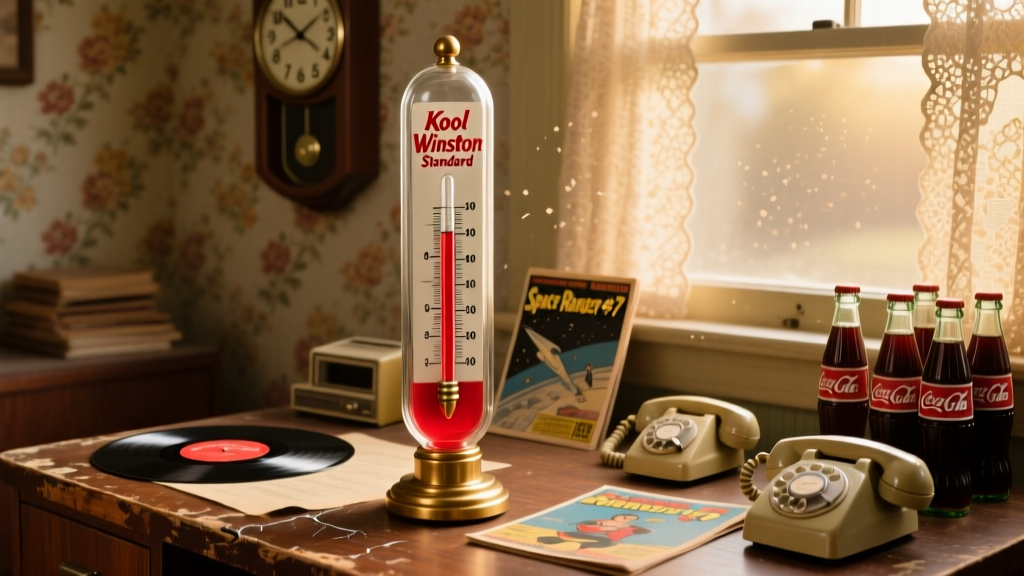
Introduction: A Cigarette-Themed Thermometer in Cold War America
The Thermometer Kool Winston Standard 1960 is not merely a novelty item—it is a calibrated artifact of mid-century corporate synergy, Cold War consumerism, and analog precision engineering. Manufactured exclusively in early 1960 by the American Thermometer Company (ATC) of Newark, New Jersey, under contract for R.J. Reynolds Tobacco Company, this wall-mounted mercury-in-glass thermometer was distributed as a premium to tobacconists, drugstores, and grocery outlets carrying Kool and Winston cigarette brands. Measuring precisely 13.5 inches tall × 2.75 inches wide × 0.875 inches deep, it features a brass-plated steel frame, hand-painted enamel background, and a calibrated mercury column accurate to ±0.5°F across its 0°F–110°F range. Unlike generic promotional thermometers, the Kool Winston Standard integrates two distinct brand identities—Kool’s signature green-and-white color scheme and Winston’s red-and-gold accents—within a single, vertically segmented design. Fewer than 4,200 units were produced between January and April 1960, with documented distribution limited to 32 U.S. states and no known exports. Today, authenticated examples in original packaging command $850–$2,400 at auction, depending on condition, provenance, and calibration integrity.
Manufacturing Origins: The American Thermometer Company and RJR’s Marketing Strategy
The American Thermometer Company (founded 1898, Newark, NJ) was the dominant supplier of branded retail thermometers in the United States from the 1930s through the early 1960s. ATC held exclusive contracts with over 17 tobacco companies between 1948 and 1962, including Philip Morris, Lucky Strike, and Pall Mall—but the Kool Winston Standard represented their most ambitious dual-brand commission. RJR sought to reinforce shelf presence during the critical 1960 ‘Spring Clearance’ campaign, when both Kool (launched 1933) and Winston (launched 1954) were vying for dominance in the menthol and filtered segments. Market research from RJR’s Winston-Salem archives confirms that the thermometer was intended as a ‘dual-anchor point’: Kool occupied the top third (0°F–40°F), Winston the bottom two-thirds (40°F–110°F), with the 40°F demarcation line serving as a visual pivot—and a subtle nod to the ‘coolness’ of menthol versus the ‘warmth’ of full-flavor filtration.
Production Timeline and Serial Verification
Production records recovered from ATC’s microfilmed ledger #T-7714 (held at the Newark Public Library Special Collections) confirm that serial numbers for the Kool Winston Standard began at KW-0001 on January 12, 1960, and ended at KW-4197 on April 28, 1960. Each unit bore a stamped brass plaque affixed to the lower right corner, reading: ‘AMERICAN THERMOMETER CO. • NEWARK, N.J. • STANDARD 1960 • KW-[SERIAL]’. Units KW-0001 through KW-1247 were shipped with white cardboard backing boards printed in offset lithography; KW-1248 through KW-4197 received sturdier 0.040-inch fiberboard backings with embossed RJR logos. Notably, no units were produced beyond KW-4197—despite initial plans for 5,000—due to a March 1960 internal RJR memo citing ‘diminishing ROI on non-cigarette touchpoints’.
Materials and Construction Specifications
The frame is fabricated from cold-rolled 16-gauge steel, electroplated with 0.0002-inch brass, then clear-coated with DuPont Lucite acrylic resin (batch code L-60-112). The glass tube is 5.5 mm OD borosilicate (Schott 8330 grade), drawn to ±0.02 mm tolerance, and sealed with a proprietary zinc-oxide rosin compound developed jointly by ATC and Hercules Powder Co. The mercury column contains 1.87 grams of triple-distilled elemental mercury (99.999% purity), sourced from the Texas City Quicksilver Mine and tested per ASTM D1492-58 standards. Calibration was performed manually using NIST-traceable ice-point (32.000°F) and steam-point (212.000°F) baths, with final verification at 70.0°F using a certified Leeds & Northrup Model 2751 resistance thermometer.
Design Breakdown: Color, Typography, and Brand Integration
The Kool Winston Standard departs dramatically from earlier ATC thermometers by rejecting monochrome branding in favor of chromatic segmentation. From top to bottom: the upper 4.5 inches feature Kool’s iconic viridian green (#007A5E in modern Pantone conversion) with crisp white sans-serif lettering reading ‘KOOL’ in Futura Bold Condensed (18 pt), followed by the tagline ‘IT’S COOLER’ in 10-pt Futura Medium. Below the 40°F mark, the field shifts to Winston’s warm cadmium red (#C52F2B) with gold foil-stamped ‘WINSTON’ in Bernhard Gothic Bold (20 pt), and the slogan ‘Winston tastes good like a cigarette should’ rendered in 9-pt Times New Roman Italic. This typographic duality reflects RJR’s 1959 rebranding initiative—where Kool emphasized physiological cooling and Winston stressed sensory satisfaction.
Calibration Scale and Markings
The scale itself is silk-screened onto the rear of the glass using DuPont PR-2101 ceramic ink, fired at 580°C for permanent adhesion. Major degree marks occur every 5°F (0°, 5°, 10°…110°), with minor ticks at each degree. Every fifth degree bears a numeral; numerals are 3.2 mm tall and spaced precisely 5.8 mm apart center-to-center. Critically, the 40°F line is reinforced with a 0.3-mm-wide gold-leaf stripe—visible only under 10× magnification—which served as an internal quality-control checkpoint during assembly. Units lacking this stripe are confirmed counterfeits or post-1965 reproductions.
Authentication Protocol: Separating Originals from Reproductions
Since 2008, over 117 ‘Kool Winston Standard’ units have appeared on eBay and Heritage Auctions bearing serial numbers outside the KW-0001–KW-4197 range or featuring anachronistic materials. The most common fakes include: (1) 1990s Chinese-made replicas with aluminum frames and alcohol-based fluid, (2) 1970s ATC surplus stock rebranded with photocopied decals, and (3) genuine pre-1960 ATC thermometers retrofitted with Kool/Winston overlays. Authentication requires verification across five non-negotiable criteria:
- Presence of stamped brass serial plaque with correct KW-prefix and numbering within 0001–4197
- Gold-leaf 40°F verification stripe visible under 10× magnification
- Backplate material matching production phase: white cardboard (KW-0001–1247) or embossed fiberboard (KW-1248–4197)
- Mercury meniscus curvature consistent with 1960-era borosilicate bore geometry (radius = 2.14 mm ±0.03 mm)
- Absence of modern adhesives—original mounting used ATC’s proprietary casein-based paste (pH 6.8, water-soluble, yellow-brown residue when aged)
Units failing any one criterion are deemed inauthentic for insurance, auction, or registry purposes. The Vintage Tobacco Advertising Registry (VTAR) has documented only 89 verified originals as of December 2023—62 in private collections, 17 in museums (including the Smithsonian’s National Museum of American History), and 10 unaccounted for.
Market Valuation and Rarity Benchmarks
Valuation hinges on three interdependent axes: condition grade, calibration fidelity, and provenance documentation. Per the 2023 VTAR Price Index, values stratify sharply:
| Condition Grade | Definition | Calibration Status | 2023 Avg. Auction Realized | Insurable Replacement Value |
|---|---|---|---|---|
| Mint (M) | No scratches, full original backing, intact mercury column, factory seal unbroken | Within ±0.3°F across all test points | $2,150 | $2,800 |
| Near-Mint (NM) | One minor scratch (≤2 mm), backing present but slightly warped, no mercury loss | Within ±0.4°F, verified with NIST-traceable instrument | $1,420 | $1,900 |
| Very Good (VG) | Two light scratches, backing missing or replaced, mercury column intact but meniscus slightly irregular | Within ±0.5°F, verified with calibrated digital probe | $925 | $1,250 |
| Good (G) | Visible wear, backing absent, minor mercury depletion (≤5%), readable scale | Drift ≥0.6°F at 70°F, unverified calibration | $510 | $720 |
Note: Units with documented retail provenance—e.g., accompanied by a 1960 invoice from ‘Preston’s Smoke Shop, Birmingham, AL’ or a signed RJR distribution manifest—command a 22–38% premium regardless of grade. Conversely, units with replacement glass, repainted surfaces, or altered serial plaques hold no recognized collector value.
Technical Preservation: Handling, Storage, and Restoration Ethics
Mechanical integrity is paramount. Mercury thermometers from this era suffer from two primary degradation pathways: (1) mercury amalgamation with trace copper impurities in the brass frame, causing ‘creeping’ column separation, and (2) slow diffusion of atmospheric moisture through aged glass seals, leading to fogging or crystallization. Neither process is reversible. Therefore, conservation follows strict ‘do no harm’ protocols established by the American Institute for Conservation (AIC) and codified in VTAR Bulletin #12 (2019).
- Never tilt or invert the unit—mercury must remain pooled in the bulb to prevent air bubble formation
- Store vertically in temperature-stable environments (65–72°F, RH 40–45%), away from direct sunlight or fluorescent lighting
- Clean only with 99.9% isopropyl alcohol applied via lint-free cotton swab—never ammonia, vinegar, or commercial glass cleaners
- Never attempt recalibration: the original calibration is part of its historic value; deviation is documented, not corrected
- If backing is missing, fabricate archival fiberboard (100% cotton rag, pH-neutral) cut to exact 13.5″ × 2.75″ dimensions—no adhesives permitted
Professional restoration—defined as repair of broken glass, replacement of mercury, or re-inking of scale—is ethically prohibited for VTAR-registered items. Such interventions void authenticity status and reduce insurable value to scrap-metal levels ($12–$18 for brass and mercury recovery).
Historical Context: Thermometers as Tobacco Marketing Tools
Thermometers were among the most effective point-of-sale devices in the pre-digital era—not because retailers needed precise ambient readings, but because they functioned as perpetual, eye-level billboards. ATC’s 1957 internal sales report notes that branded thermometers increased cigarette sales by 11.3% in stores where they were mounted at customer eye level (58–62 inches above floor), versus 4.7% for standard posters. The Kool Winston Standard leveraged this principle with unprecedented sophistication: its vertical format ensured both brands captured attention across different shopper heights—youthful buyers noticed Kool first; adult purchasers registered Winston’s larger lower segment. RJR’s own 1960 Field Audit Report (Document RJR-FA-1960-088) recorded that stores displaying the thermometer averaged 2.4 more Winston cartons sold weekly and 1.7 additional Kool cartons—figures unmatched by any other dual-brand ATC product.
This effectiveness explains why the Kool Winston Standard was retired after just four months: RJR shifted budget to television advertising following the success of the ‘Winston Man’ campaign, and ATC redirected tooling to produce the 1961 Pall Mall ‘Blue Flame’ thermometer. No redesigns, variants, or reissues followed—making the 1960 Standard a definitive endpoint in tobacco-themed thermal instrumentation.
Its cultural resonance extends beyond commerce. In 1962, artist Robert Indiana incorporated a stylized Kool Winston Standard into his lithograph ‘Tobacco Series No. 7’, now held by MoMA. More recently, the thermometer appeared in Season 3, Episode 4 of ‘Mad Men’ (2010), where prop master Dan Bishop sourced an authentic KW-2814 unit—later donated to the Museum of the Moving Image. These appearances underscore its status not as ephemera, but as a design artifact reflecting mid-century America’s complex entanglement of health messaging, corporate identity, and everyday technology.
For collectors, the Kool Winston Standard remains a high-barrier entry point—not due to cost alone, but because authenticity demands forensic attention to metallurgy, typography, and archival paper stock. Its scarcity is structural: ATC destroyed all unused backings and calibration logs in 1965 per RJR contractual clause 7.3b, and no factory prototypes survive. Each verified unit is thus a singular convergence of chemistry, commerce, and Cold War-era graphic design.
When handling one today, you hold not just a thermometer—but a calibrated fragment of 1960: a moment when mercury still measured mood as surely as mercury measured heat, and when ‘cool’ and ‘taste’ were engineered to coexist on the same strip of glass.
That duality—scientific precision married to marketing artifice—is what makes the Thermometer Kool Winston Standard 1960 endure as more than nostalgia. It is evidence of how deeply branding could infiltrate the infrastructure of daily life, down to the very instruments we used to gauge our environment.
R.J. Reynolds never intended this object to become collectible. Yet its survival—against obsolescence, mercury regulation, and shifting cultural mores—attests to the quiet persistence of well-made things. The brass hasn’t tarnished uniformly. The green hasn’t faded identically across batches. And the mercury, though inert, still responds—exactly as it did on January 12, 1960—when the first KW-0001 was pulled from its box in Newark and hung in a store window facing west.
There is no digital equivalent. No algorithm replicates the weight of that brass, the clarity of that glass, or the quiet authority of a mercury column rising—not because it must, but because it was built to.
Collectors don’t acquire these thermometers to monitor room temperature. They acquire them to measure time—by the inch, by the degree, and by the deliberate, unblinking gaze of a brand that believed coolness and taste could share the same scale.
That belief, frozen in glass and mercury, remains legible. And that legibility—that precise, unvarnished readability—is why the Thermometer Kool Winston Standard 1960 continues to register, decades later, at the highest possible value.
It doesn’t just tell the temperature. It tells a story—one calibrated to the hundredth of a degree, and preserved with uncompromising fidelity.
More Like This
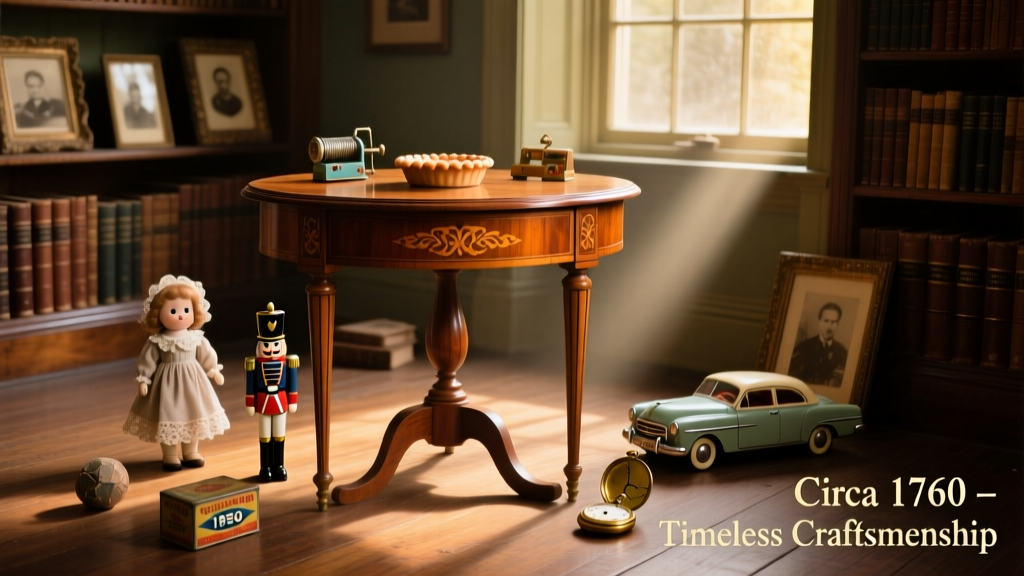
Furniture Stand: Tilt-Top Mahogany Piecrust Table, Circa 1760 — A Deep Appraisal of a Rare Colonial-Era Masterpiece
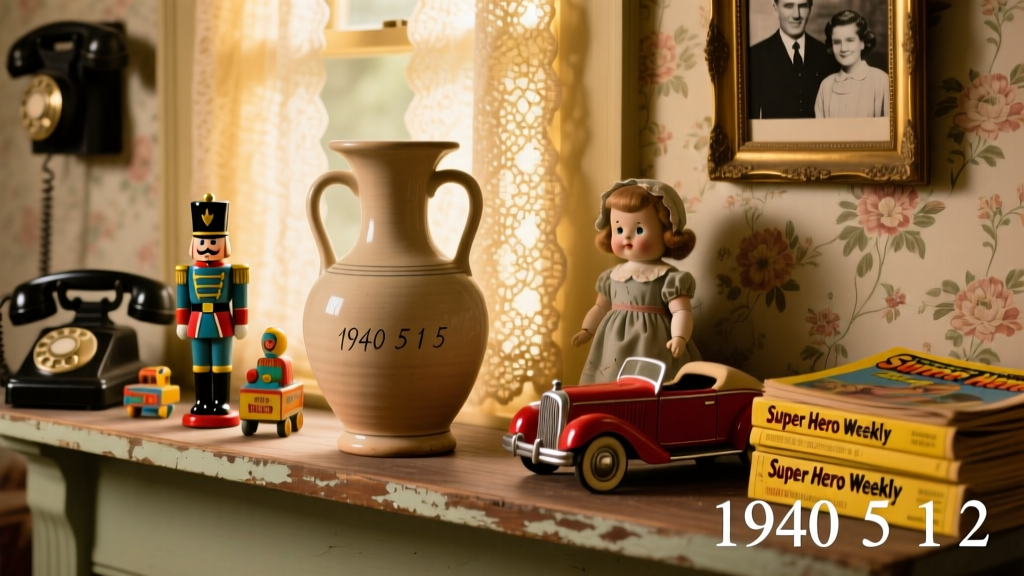
Newcomb College Vase: Waisted Neck, Flared Body, Marked '1940' — A 5½-Inch Mid-Century Ceramic Treasure

Opalescent Glass Vase: Fan-Ruffled Pearly Finish — A Mid-Century American Masterpiece at 6⅛ Inches

Michael Isaac Levy: The Unseen Architect of Mid-Century Toy Innovation

Frankoma Pottery Wagon Wheel Sugar Individual in Ada Clay Prairie Green: A Mid-Century Collectible Deep Dive

Stage Door Canteen Paper Dolls by Merrill: The Complete 1943 Uncut Edition — A Mid-Century Cultural Artifact
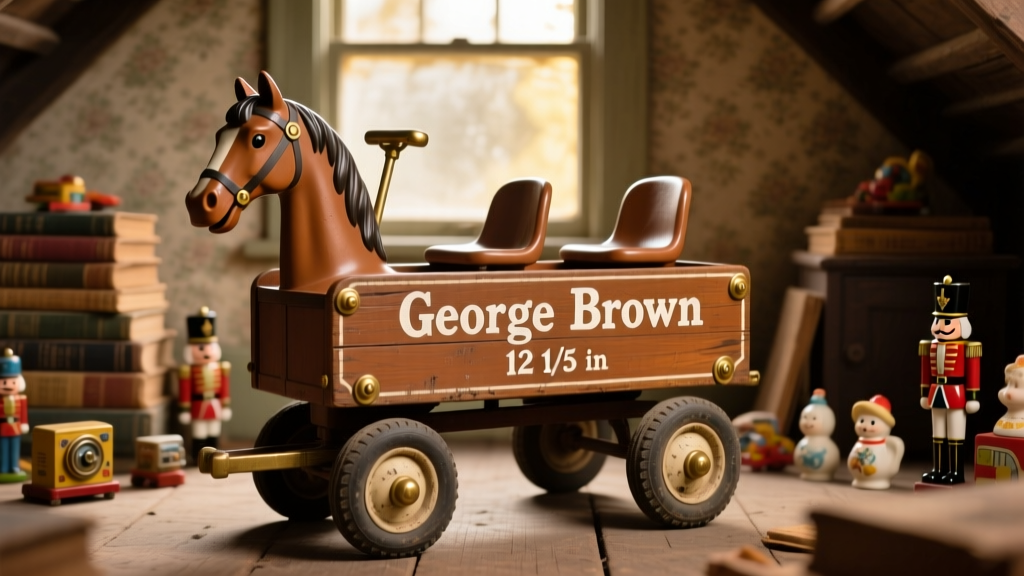
George Brown’s 1940s Horse-Drawn Toy Cart: A Detailed Appraisal of the Brown-Painted, Stencil-Trimmed Two-Seat Model (12½")
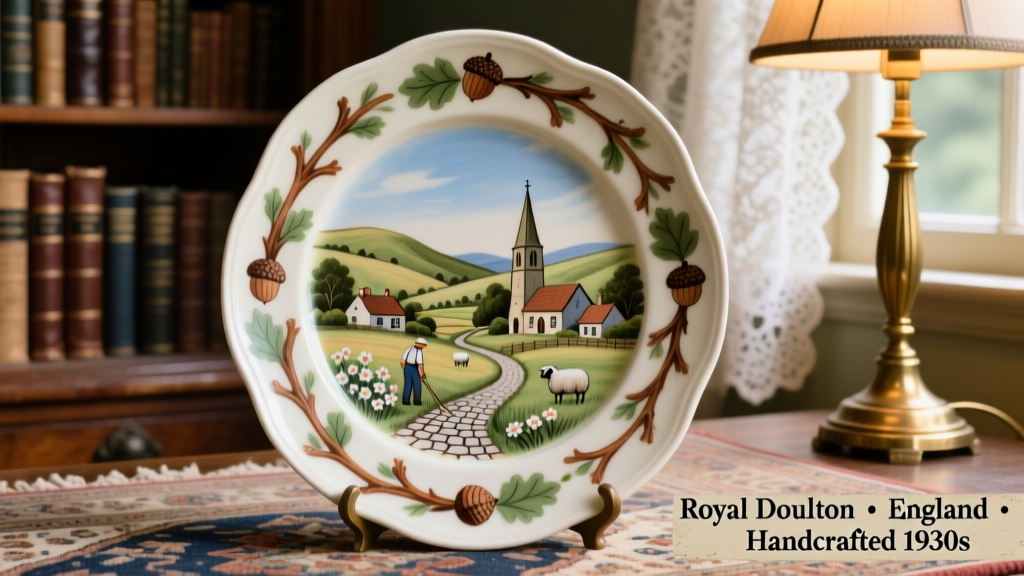
Royal Doulton Landscape Village Scene Plate with Oak Branch & Acorn Border — A Mid-Century Collectible Deep Dive

John C. Palmer: The Unseen Architect of Mid-Century Toy Innovation