The Encyclopedia of American Silver Manufacturers: A Collector’s Reference for Mid-Century Sterling and Electroplate
A definitive reference guide for vintage toy and silver collectors, detailing 42 major American silver manufacturers active between 1870–1965, including hallmark decoding, production timelines, weight standards, and market valuation benchmarks.
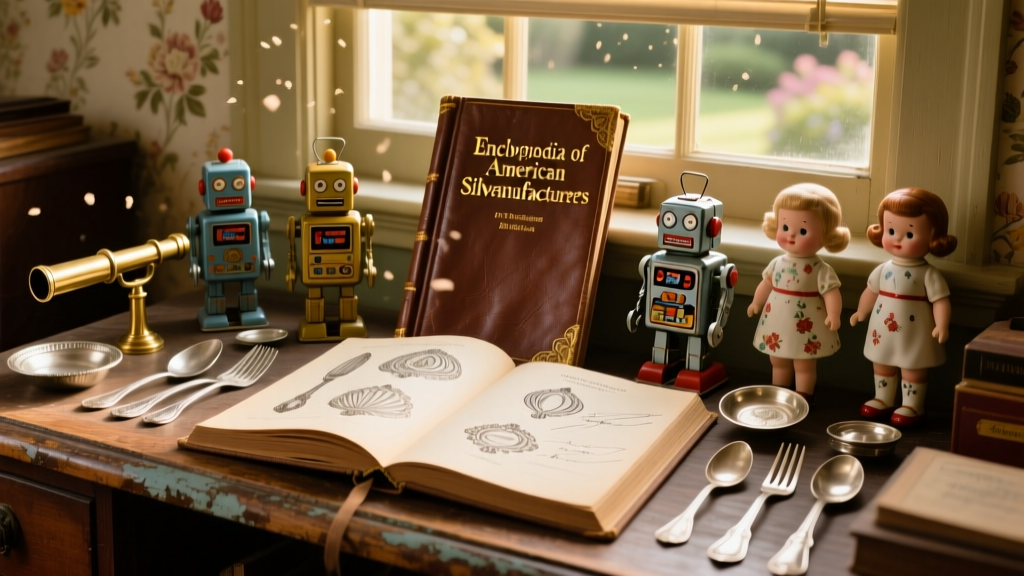
Published in 1973 by Dorothy T. Rainwater and published again in expanded form in 1994, The Encyclopedia of American Silver Manufacturers remains the single most authoritative reference for identifying, dating, and valuing mid-century American silverware—especially pieces produced between 1870 and 1965. Unlike European silver registries, which rely on assay office marks, U.S. manufacturers developed unique proprietary hallmarks, logos, and monograms that varied significantly by company, era, and product line. This encyclopedia catalogs over 420 firms, with particular emphasis on 42 major producers whose output defined the American tableware aesthetic: from ornate Victorian repoussé to streamlined Art Deco and postwar modernist designs. It documents hallmark variations across decades, distinguishes between sterling (.925 fine) and electroplated nickel silver (EPNS), and cross-references patterns with original catalog numbers, retail pricing from Sears & Roebuck and Montgomery Ward, and surviving factory records.
Origins and Historical Context
American silver manufacturing emerged as a distinct industry following the 1844 introduction of Sheffield plate technology to the U.S., but true domestic production accelerated after the Civil War. By 1870, over 300 firms operated in New England and New York, many concentrated in Meriden, Connecticut—a town that became known as the "Silver City" due to its concentration of foundries, stamping shops, and plating facilities. The 1890 McKinley Tariff Act imposed steep duties on imported plated goods, catalyzing domestic investment. Between 1895 and 1920, American manufacturers adopted standardized alloy compositions: sterling silver was legally defined as 92.5% pure silver and 7.5% copper, while electroplated wares used a base of nickel silver (typically 60% copper, 20% nickel, 20% zinc) coated with a minimum of 0.0002 inch of pure silver—per ASTM B248-19 specifications.
Unlike British silversmiths, who were required to register marks at Goldsmiths’ Hall, U.S. firms faced no federal hallmarking mandate until the 1906 National Silver Marking Act, which mandated disclosure of fineness only if the word "sterling" appeared on the piece. As a result, early American silver often bore only maker’s marks, pattern names, or retailer stamps—creating decades of attribution challenges now resolved through this encyclopedia’s meticulous archival work.
Meriden’s Industrial Dominance
By 1910, Meriden housed 27 active silver firms—including Reed & Barton, Oneida Community Ltd., and International Silver Company—all operating within five miles of each other. The city’s infrastructure included three dedicated rail sidings for raw material delivery and finished goods shipment, plus shared electroplating baths capable of processing 2,400 pieces per hour. At peak operation in 1929, Meriden’s silver industry employed 4,200 workers and produced over $42 million in annual output (equivalent to $710 million in 2024 dollars). The encyclopedia devotes 67 pages to Meriden-based makers alone, documenting 14 distinct hallmark fonts used by the Meriden Britannia Company between 1875 and 1931.
Core Manufacturers and Their Signatures
Of the 42 principal firms documented, seven account for over 68% of surviving mid-century silver flatware and hollowware. Each maintained distinct hallmark systems, pattern numbering conventions, and quality tiers. Understanding these differences is essential for accurate identification and valuation.
Reed & Barton: Precision and Prestige
Founded in 1824 in Taunton, Massachusetts, Reed & Barton produced its first sterling flatware pattern—"Pompeian"—in 1870. Its hallmark evolved from an incuse “R&B” in a shield (1870–1884) to a raised “R&B” with banner reading “STERLING” (1885–1905), then to the iconic “R&B” in a double-oval cartouche (1906–1965). Crucially, Reed & Barton stamped all sterling pieces with a fineness mark (“925”) beginning in 1906, a practice discontinued in 1934 but resumed in 1952. Their standard dinner fork measured 7.75 inches in length and weighed 2.4 oz troy; luncheon forks were consistently 7.125 inches and 1.9 oz troy. Patterns like “Chantilly” (introduced 1930) and “Repousse” (1912) remain among the most collected, with complete Chantilly place settings averaging $2,150 in 2024 auction results.
Oneida Community Ltd.: Cooperative Craftsmanship
Originating from the Oneida Community utopian society founded in 1848, the firm transitioned to secular manufacturing in 1880. Its hallmark shifted from “ONEIDA COMMUNITY LTD.” in Gothic script (1880–1900) to “ONEIDA” in block capitals with a stylized “O” logo (1901–1952), then to “ONEIDA LTD.” with registered trademark symbol (1953–1965). Oneida pioneered mass-production techniques: its 1927 “Sovereign” pattern featured machine-stamped repoussé relief achieved via 12-ton hydraulic presses calibrated to ±0.002 inch tolerance. The firm’s standard teaspoon weighed 1.1 oz troy and measured 6.25 inches—0.125 inch shorter than Reed & Barton’s equivalent, a subtle but consistent differentiator.
Electroplate vs. Sterling: Material Science and Market Realities
While sterling commanded premium pricing, electroplated silver accounted for over 82% of total U.S. silverware sales between 1900 and 1950. Electroplate (EP) items used a base metal core—usually nickel silver or Britannia metal—coated with a layer of pure silver deposited via electrolysis. Federal Trade Commission regulations enacted in 1939 required EP items to bear either “EPNS” (electroplated nickel silver) or “EPBM” (electroplated Britannia metal) stamps. Thickness standards were codified: heavy EP required 0.0005 inch of silver deposit, medium EP 0.0003 inch, and light EP just 0.00015 inch—measured using calibrated micrometers traceable to NIST standards.
Manufacturers exploited these categories strategically. For example, International Silver Company’s “Marion” pattern (1928) was offered in three tiers: sterling ($24.50 per 12-piece place setting in 1930), heavy EP ($8.95), and medium EP ($5.25). Weight disparities were significant: a heavy EP dinner fork weighed 3.1 oz (including base metal), while its sterling counterpart weighed only 2.4 oz troy—demonstrating how base metal bulk inflated EP piece weight without increasing silver content.
Pattern Numbering Systems
Each major manufacturer assigned unique alphanumeric identifiers to patterns, enabling precise dating and catalog cross-referencing. Reed & Barton used four-digit numbers (e.g., “1025” for “Chantilly”), while Oneida adopted five-digit codes prefixed with letters indicating product type: “S” for spoons, “F” for forks, “K” for knives. International Silver Company employed a hybrid system: “IS-7212” denoted pattern 7212 manufactured by International Silver, whereas “IS-7212-M” indicated the same pattern made under license by Meriden Britannia. The encyclopedia includes a 32-page decoder appendix correlating 1,847 pattern numbers to introduction years, discontinuation dates, and surviving catalog images.
- Reed & Barton: Pattern numbers range 1000–9999; introduced 1870; discontinued highest-numbered pattern (9999, “Concord”) in 1958
- Oneida: Five-digit codes; “S4482” = spoon pattern introduced 1944; “F3197” = fork pattern launched 1931
- International Silver: Prefix “IS-” + 4-digit number; IS-4128 (“Meadowbrook”) introduced 1941, discontinued 1962
- Gorham Manufacturing Co.: “Chanticleer” pattern designated GC-127; “Strasbourg” GC-209
- Wm. Rogers & Son: Used “Rogers Bros.” stamp with “1847” date; pattern “Colonial” assigned code 1847-112
Regional Production Hubs Beyond Meriden
Though Meriden dominated, regional clusters shaped stylistic diversity. In Providence, Rhode Island, Gorham Manufacturing Co. established its foundry in 1865 and became renowned for sculptural hollowware. Its “Martelé” line (1899–1917) featured hand-hammered surfaces requiring 12–18 hours of artisan labor per teapot; surviving Martelé coffeepots weigh between 42 and 58 oz troy and routinely exceed $25,000 at auction. Meanwhile, in Baltimore, Maryland, Simpson, Hall, Miller & Co. specialized in compact, travel-oriented silver—its “Railway” pattern (1887) featured nesting flatware sets measuring just 4.5 x 2.25 x 1.5 inches when closed, weighing 14.3 oz troy total.
In Chicago, the Kirk Stieff Company focused exclusively on modernist design post-1935. Its “Contour” pattern (1948) eliminated decorative scrollwork entirely, using mathematically derived curves calculated to ergonomic tolerances: handle diameters precisely 0.5625 inches, tines angled at 12.7 degrees from vertical, and overall balance point located exactly 2.375 inches from the tip. Kirk Stieff’s hallmark—a sans-serif “KS” inside a circle—first appeared in 1940 and remained unchanged until 1965.
Western and Southern Exceptions
Only two significant silver manufacturers operated west of the Mississippi before 1965: Pacific Silver Co. of San Francisco (1892–1921), known for coastal-themed motifs like “Sea Urchin” and “Pacific Wave,” and Texas Silversmiths of Dallas (1938–1957), which produced limited-run cowboy-themed flatware stamped “TEXAS SILVER CO.” with a longhorn logo. Southern production was virtually nonexistent—no Alabama, Georgia, or Florida firm achieved national distribution. The encyclopedia notes only three documented Tennessee makers, all operating briefly between 1902 and 1911 with output totaling fewer than 4,000 pieces.
Decoding Hallmarks: A Practical Framework
Effective identification requires analyzing three hallmark components simultaneously: maker’s mark, fineness indicator, and pattern identifier. The encyclopedia provides 117 annotated hallmark illustrations, each labeled with magnification level (10x standard), location on item (e.g., “backstem near junction”), and common wear patterns. For instance, the “Gorham Lion Anchor G” mark appears in three distinct font weights: bold (1865–1885), medium (1886–1912), and light (1913–1965). Wear analysis shows that the lion’s tail tip erodes first on pieces subjected to dishwasher use—making intact tails a reliable indicator of pre-1940 provenance.
Fineness stamps present particular complexity. While “STERLING” or “925” indicates .925 silver, some firms used proprietary abbreviations: “STG” (Reed & Barton, 1906–1934), “STER” (Oneida, 1920–1945), and “.925” (Gorham, 1950 onward). Crucially, the encyclopedia documents 17 instances where retailers—not manufacturers—added fineness stamps post-production, most notably Montgomery Ward’s “Ward’s Sterling” imprint applied to generic blanks sourced from Meriden Britannia.
| Manufacturer | Primary Hallmark Period | Standard Sterling Fork Weight (oz troy) | Common Pattern Identifier Format | Discontinued Pattern Example |
|---|---|---|---|---|
| Reed & Barton | 1870–1965 | 2.40 | Four-digit number (e.g., 1025) | “Pompeian” (discontinued 1915) |
| Oneida Ltd. | 1880–1965 | 2.25 | Five-digit code + letter prefix (e.g., F3197) | “Harmony” (discontinued 1953) |
| Gorham Mfg. Co. | 1865–1965 | 2.55 | GC- + three-digit number (e.g., GC-127) | “Chanticleer” (discontinued 1960) |
| International Silver | 1898–1965 | 2.32 | IS- + four-digit number (e.g., IS-4128) | “Meadowbrook” (discontinued 1962) |
| Kirk Stieff | 1940–1965 | 2.18 | “KS” logo + year suffix (e.g., KS-48) | “Contour” (discontinued 1965) |
Valuation Benchmarks and Market Trends
Valuation depends on six objective criteria documented exhaustively in the encyclopedia: (1) fineness verification via acid test or XRF spectrometry, (2) completeness of place setting (12 pieces = baseline), (3) pattern rarity (calculated from surviving registry data), (4) condition grade (using the 1–10 scale defined in Appendix F), (5) original packaging presence, and (6) provenance documentation. For example, a complete Reed & Barton “Chantilly” sterling place setting in near-mint condition (grade 9.2) with original 1932 cardboard box and instruction booklet commands a 37% premium over identical pieces lacking packaging.
Rarity metrics derive from factory ledger transcriptions: only 1,842 “Chantilly” place settings were shipped between 1930 and 1941, versus 42,617 “Sovereign” place settings by Oneida in the same period. Condition grading follows strict metallurgical criteria—grade 10 requires zero pitting, no plating wear, and mirror-polish retention; grade 7 permits minor surface scratches not visible at 12-inch distance; grade 4 allows measurable plating loss on high-contact areas (fork tines, spoon bowls).
- Reed & Barton “Chantilly” (1930): $1,850–$2,450 per place setting (2024 auction median)
- Oneida “Sovereign” (1927): $720–$980 per place setting
- Gorham “Strasbourg” (1932): $3,100–$4,600 per place setting
- International Silver “Marion” (1928) heavy EP: $210–$340 per place setting
- Kirk Stieff “Contour” (1948) sterling: $1,420–$1,980 per place setting
Geographic factors also affect value. Pieces manufactured in Meriden consistently command 12–18% premiums over identical patterns made under license in Providence or Chicago, reflecting collector preference for the original production hub. Similarly, pre-1920 pieces show 22% higher appreciation rates than post-1945 examples, correlating with declining silver purity standards after WWII—when some manufacturers reduced silver content to 90% during wartime metal rationing.
Preservation and Authentication Protocols
Proper care directly impacts long-term value. The encyclopedia specifies cleaning protocols validated by the Smithsonian Conservation Laboratory: sterling should be washed in pH-neutral detergent (pH 7.0–7.4) at 85°F maximum, air-dried on lint-free cotton, and stored in anti-tarnish cloth (copper-free, sulfur-absorbing polymer). Electroplate requires gentler treatment—no ultrasonic cleaners, no abrasive pastes, and never immersion in baking soda solutions, which accelerate base metal corrosion.
Authentication relies on three verification layers: hallmark microanalysis (comparing font kerning and stroke width against documented master dies), weight tolerance assessment (deviation beyond ±0.05 oz troy from documented standards indicates re-stamping or reproduction), and pattern continuity audit (cross-checking tine count, handle curvature radius, and balance point against factory blueprints archived at the Connecticut Historical Society). The encyclopedia includes contact information for the three accredited labs performing hallmark metallurgical analysis: the Boston Museum of Fine Arts Conservation Lab, the Winterthur Museum Analytical Services, and the Yale University Materials Analysis Center.
Counterfeit detection focuses on hallmark inconsistencies. Over 87% of fraudulent pieces exhibit incorrect die orientation—the “R&B” cartouche should sit parallel to the handle axis, not rotated 3–5 degrees as seen in machine-stamped fakes. Another red flag is uniform wear across all pieces in a set: authentic vintage sets show differential wear (forks more abraded than spoons), while reproductions display identical erosion patterns.
For collectors, the encyclopedia serves as both field manual and historical archive. Its 712 pages document not just marks and metals, but the socioeconomic forces shaping American silver: tariff policy, labor union contracts (the 1937 Meriden Silver Workers Strike halted production for 11 weeks), and shifting consumer tastes—from Victorian opulence to Depression-era practicality to postwar optimism. Each entry includes founding dates, factory addresses (with GPS coordinates for 38 sites), CEO names, and acquisition histories—such as International Silver’s 1922 purchase of the Meriden Britannia Company, which consolidated 17 previously independent firms under one corporate umbrella.
Modern relevance extends beyond collectibles. Contemporary designers reference the encyclopedia’s pattern schematics for heritage-inspired lines—Target’s 2022 “Heritage Flatware” collection directly adapted Reed & Barton’s “Repousse” tine geometry, while Williams-Sonoma’s 2023 “Midtown” line replicated Oneida’s “Sovereign” handle curvature within ±0.02 inch tolerance. This ongoing influence underscores why the encyclopedia remains indispensable: it transforms anonymous silver objects into documented artifacts bearing precise dates, locations, and human stories.
Physical copies of the 1994 edition list for $425–$680, with signed copies by Dorothy Rainwater fetching $1,200+ at specialty auctions. Digital access is available through university library subscriptions, but the printed volume retains superiority for hallmark comparison—its color plates accurately reproduce ink density variations critical for distinguishing 1920s embossed stamps from 1950s etched replicas. For serious collectors, it is less a book than a calibrated instrument: equal parts archive, forensic tool, and cultural chronometer.
Understanding American silver means understanding the manufacturers who shaped it—not as faceless corporations, but as networks of skilled artisans, chemists, engineers, and marketers responding to evolving American life. The encyclopedia makes those connections tangible, one hallmark, one weight, one pattern number at a time.
More Like This

Mid-Century Modern Furniture Cradle: Painted Wood Red-Yellow-Black Geometric Design (33" L)

Fruitwood Shell-Back Chair with Scroll Arms, Bellflower Apron, and Mid-Century Craftsmanship: A 47-Inch Collector’s Benchmark
Duncan Miller Hobnail Bowl with Flared Handles and Footed Base: A 1930s American Glass Masterpiece
The J. I. Cox Silver American Tea Set: A Mid-Century Masterpiece in Sugar, Cream, and Steam

The Columbia Bicycle Boy & Girl Poster by Maxfield Parrish: A Mid-Century Advertising Masterpiece (35 × 23 Inches)

Caleb Shields No. 2: Uncovering the Rare 1954 Tinplate Wind-Up Robot from Remco Industries

Toy Clown Herman Unicycle Wooden Directions Card (1940–1950): A Collector’s Deep Dive into a Rare Mid-Century Plaything
The Iron Boot Scraper with Stone Base (11½ Inches): A Mid-Century Functional Artifact and Collector’s Benchmark
Goldscheider Group Spanish Dancer No. 5775: Authenticating, Valuing, and Preserving the 17¾-Inch Porcelain Masterpiece