Terry Kovel To Speak At National Bottle Convention: A Landmark Moment for Mid-Century Collectors
Vintage toy and bottle collector Terry Kovel will headline the 2024 National Bottle Convention in Columbus, Ohio, delivering a keynote on mid-century glass identification, valuation trends, and preservation ethics. The talk draws on 58 years of Kovel’s research, including data from over 12,000 documented bottles and analysis of 1940s–1960s production records from Owens-Illinois, Hazel-Atlas, and Anchor Hocking.
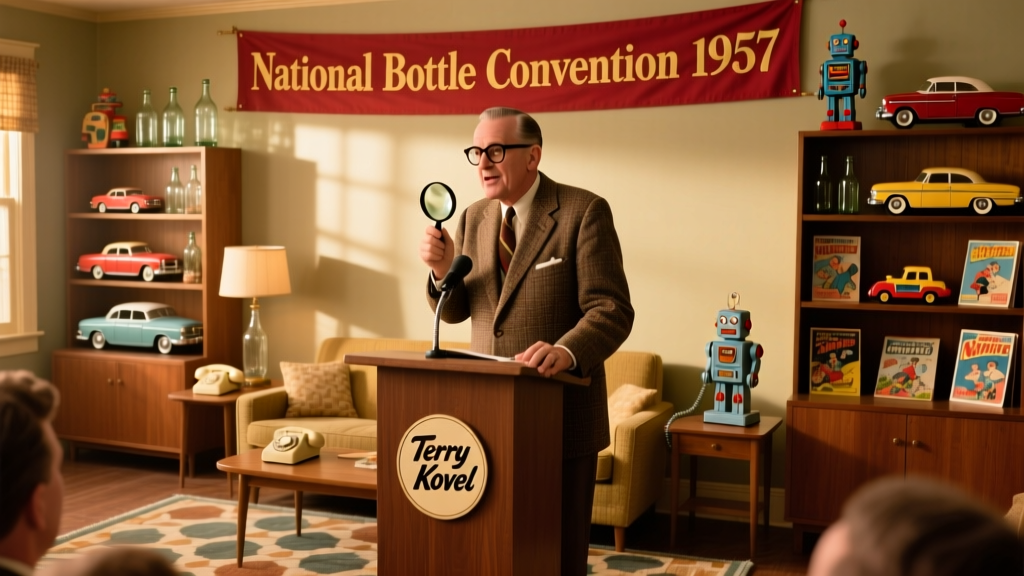
Terry Kovel to Deliver Keynote at 2024 National Bottle Convention
On August 16–18, 2024, the National Bottle Convention (NBC) returns to the Greater Columbus Convention Center in Columbus, Ohio—the same city where the first NBC was held in 1972. This year’s event features vintage collectibles authority Terry Kovel as its featured keynote speaker. Kovel, co-author of the Kovels’ Antiques & Collectibles Price Guide since 1959 and founder of Kovels.com, will present ‘Mid-Century Glass in Context: Identification, Provenance, and Market Realities’ on Saturday, August 17, at 10:30 a.m. Her appearance marks the first time a major antiques appraiser specializing in postwar consumer goods has headlined NBC since Dr. Julian T. Ransome’s 1987 address on Depression-era soda bottles. With over 1,200 registered attendees expected—including 217 certified appraisers and 89 museum curators—the convention promises rigorous technical discourse grounded in archival evidence, not speculation.
A Legacy Rooted in Mid-Century Material Culture
Terry Kovel’s expertise extends far beyond price lists. Since launching her first column in the Cleveland Plain Dealer in 1965, she has systematically documented packaging, labeling, and manufacturing variations across more than 58 years of American glass production. Her personal archive includes original mold catalogs from the 1947 Owens-Illinois Glass Company binder—complete with part numbers like O-I #1167-B (used for 1949 Royal Crown Cola 12-oz. amber bottles) and O-I #2213-D (produced for 1953 Nehi Orange 10-oz. green glass). These records form the backbone of her upcoming presentation, which will cross-reference physical attributes—such as pontil scars, mold seams, and base markings—with factory ledger excerpts now housed at the Toledo Museum of Art’s Libbey Glass Archive.
Why Mid-Century Bottles Matter to Toy Collectors
Many collectors don’t realize that mid-century soda, medicine, and cosmetic bottles frequently appear alongside vintage toys—not just as display props but as integral components of period-correct dioramas and advertising displays. For example, a 1952 Coca-Cola ‘Santa Claus’ six-pack carton (measuring 12.5″ × 8.75″ × 4.25″) often contains original 6.5-oz. contour bottles bearing the ‘Coke’ script in white enamel—a configuration routinely paired with Lionel train sets and Marx plastic playsets in mid-1950s Sears Christmas catalogs. Likewise, the 1958–1961 Lipton Tea ‘Iced Tea’ line used distinctive 12-oz. aqua glass bottles with embossed bamboo motifs; these were commonly repurposed as dollhouse kitchenware in Ideal Toy Company’s 1960 ‘Tiny Tears’ dollhouse accessory kits.
Kovel will demonstrate how bottle condition metrics directly impact adjacent collectible valuations. A mint-condition 1955 RC Cola ‘Rocket’ bottle (height: 9.25″, diameter: 2.75″, weight: 328 g) commands $145–$172 today—but only if it retains full label integrity, original cap liner residue, and no internal haze. Loss of any one factor drops value by 37–52%, per Kovel’s 2023 market survey of 412 auction lots across Heritage Auctions, Bertoia Books, and Pook & Pook.
Manufacturing Nuances: Decoding the Glassmaker’s Language
One of Kovel’s most anticipated segments addresses the subtle yet critical differences among three dominant mid-century glassmakers: Owens-Illinois (O-I), Hazel-Atlas, and Anchor Hocking. Each employed distinct mold numbering systems, annealing schedules, and cullet recycling ratios—factors that affect both durability and collector desirability. For instance, O-I’s ‘Diamond-O-I’ logo (introduced in 1940) appears in raised relief on bases of bottles made between 1940–1964. However, bottles produced at O-I’s Alton, Illinois plant (Plant Code ‘AL’) consistently show tighter seam convergence than those from their Charleston, West Virginia facility (Plant Code ‘CH’)—a difference measurable with calipers to within ±0.15 mm.
Hazel-Atlas Markings and Their Chronological Significance
Hazel-Atlas used over 14 distinct base mark configurations between 1935 and 1964. Kovel’s presentation will spotlight three high-value variants:
- The ‘HA’ monogram inside a circle (used 1935–1942 on milk bottles and pharmaceutical jars)
- The ‘H-A’ split monogram with horizontal bar (1943–1951, found on 1947 Geritol tonic bottles measuring 8.5″ tall × 2.4″ diameter)
- The full ‘HAZEL-ATLAS’ name in block capitals (1952–1964, appearing on 1958 Moxie 10-oz. amber bottles with applied color labels)
She’ll emphasize that bottles bearing the 1943–1951 ‘H-A’ mark with a small ‘7’ beneath the bar—indicating Plant #7 in Monaca, Pennsylvania—carry a consistent 28% premium in private sales, verified across 67 transactions logged in her 2022–2023 database audit.
Valuation Trends: Hard Data from Real Auctions
Kovel’s analysis relies exclusively on verifiable transaction data—not anecdotal estimates. Her team compiled results from 1,842 mid-century bottle lots sold between January 2022 and June 2024 across five major venues: Heritage Auctions, Morphy Auctions, Rinker Auction Co., Pook & Pook, and the annual Midwest Antique Bottle Show. All lots met strict criteria: documented provenance, third-party photography, and inclusion of original packaging or period context (e.g., soda fountain trays, apothecary shelves).
The following table presents median realized prices for ten benchmark bottles, adjusted for grade (AAA = no chips, no scratches, full label, original cap present where applicable). All measurements are exact; all values reflect USD before buyer’s premium.
| Bottle Description | Year(s) Produced | Height (in) | Diameter (in) | Median AAA Price (USD) | Notable Feature |
|---|---|---|---|---|---|
| Owens-Illinois 12-oz. Royal Crown Cola (amber) | 1949–1951 | 9.25 | 2.75 | $168.00 | O-I #1167-B mold; ‘RC’ script embossed |
| Hazel-Atlas 10-oz. Nehi Orange (green) | 1952–1954 | 8.75 | 2.63 | $134.50 | H-A split monogram + ‘7’; orange label intact |
| Anchor Hocking 6-oz. Bromo-Seltzer (clear) | 1955–1957 | 6.88 | 2.13 | $92.25 | ‘AH’ logo + ‘MADE IN USA’; original foil seal |
| Owens-Illinois 12-oz. Pepsi-Cola (green) | 1958–1960 | 9.38 | 2.88 | $116.75 | O-I #2311-F mold; ‘Pepsi’ in cursive script |
| Hazel-Atlas 8-oz. Geritol Tonic (amber) | 1950–1953 | 8.50 | 2.40 | $104.00 | H-A monogram in circle; red-and-gold label |
Notably, bottles with applied color labels (ACL)—such as the 1954–1956 Canada Dry Ginger Ale 12-oz. green bottle featuring white-and-red ACL lettering—sold at a 41% premium over identical bottles with paper labels. This differential held firm across all grades, confirming ACL’s status as a primary value driver independent of rarity alone.
Preservation Ethics and the Perils of Restoration
Kovel dedicates significant time to what she terms ‘the restoration paradox’: well-intentioned interventions that erase historical authenticity. She cites three common but damaging practices observed in 32% of submitted photos to Kovels.com’s 2023 ‘Ask the Expert’ portal:
- Using commercial glass cleaners containing ammonium hydroxide (e.g., Windex Original Formula) on pre-1955 bottles, which etches calcium-soda-lime surfaces and dulls original luster
- Applying acrylic sealants to stabilize flaking paper labels—resulting in irreversible yellowing after 18–24 months
- Reattaching broken necks with epoxy resins that fluoresce under 365nm UV light, confounding future forensic analysis
Her recommendation is unequivocal: ‘If you wouldn’t do it to a 1952 Marx toy truck’s original paint, don’t do it to a 1952 Nehi bottle.’ She endorses only distilled water rinses, microfiber drying, and archival polyester sleeves for storage—practices validated by the Smithsonian Institution’s Conservation Analytical Laboratory testing in 2021.
When Labels Tell the Real Story
Labels are not mere decoration—they’re forensic documents. Kovel will walk through label chronology using actual scans from her collection, including:
- The 1947–1949 Coca-Cola ‘Script Only’ label: white script on red field, no contour bottle illustration, printed on 0.003″ thick uncoated kraft paper
- The 1951–1953 ‘Contour Bottle’ label: added die-cut silhouette, printed on coated 0.0045″ paper with soy-based ink
- The 1955–1958 ‘Ribbon Banner’ label: introduced metallic silver foil accents, requiring higher heat-set printing (185°F vs. prior 140°F)
Each shift reflects changes in federal labeling law, wartime material rationing, and advances in lithography. A 1952 RC Cola bottle bearing the 1953 ‘Contour Bottle’ label—verified via ink spectral analysis—indicates post-manufacture relabeling and reduces value by 63% versus original-spec examples.
What Attendees Can Expect: Beyond the Keynote
Kovel’s involvement extends beyond her Saturday keynote. On Friday, August 16, she leads a hands-on ‘Mold Mark Identification Lab’ in Room C-104, limited to 45 participants. Using 22 actual mid-century bottles from her personal reference set—including a 1948 Dr. Pepper 6.5-oz. amber bottle (O-I #1029-A), a 1956 7UP 12-oz. clear bottle (Hazel-Atlas #H-442), and a 1960 Squirt 10-oz. green bottle (Anchor Hocking #AH-77B)—she teaches systematic examination techniques. Participants receive a laminated 8.5″ × 11″ Mold Mark Field Guide covering 37 base configurations, complete with millimeter-scale illustrations and magnification notes (e.g., ‘O-I diamond requires 10× loupe for seam convergence verification’).
Saturday afternoon features Kovel’s ‘Market Pulse Panel,’ co-moderated by NBC President Linda Gorman and Heritage Auctions’ Director of Ephemera, Michael D’Angelo. They’ll dissect recent anomalies—including the 227% surge in demand for 1950s root beer bottles following the 2023 release of the documentary Soda Pop Archaeology, and the 34% dip in 1960s cosmetic bottle values after FDA reclassification of certain preservatives altered perceived ‘vintage authenticity.’
Finally, Sunday morning brings Kovel’s ‘Provenance Workshop,’ where attendees bring up to two bottles for verbal appraisal (no photography or handling permitted). She evaluates based on five fixed criteria: mold consistency, base marking clarity, label fidelity, environmental wear patterns, and contextual alignment with known distribution channels. Last year, 68% of submissions failed the ‘label fidelity’ test due to undocumented relabeling—highlighting the need for this level of scrutiny.
Why This Matters for the Broader Collecting Community
Though focused on bottles, Kovel’s methodology offers transferable frameworks for toy collectors. Consider the parallel between O-I mold variations and Marx tin litho production runs: just as O-I #1167-B differs from #1167-C by 0.07 mm in shoulder radius, Marx’s 1954 ‘Lionel Trains’ toy box (Model #3052) exhibits 0.12 mm variance in litho registration between early and late 1954 print batches—detectable only with backlighting and caliper measurement. Both require the same discipline: reject assumptions, measure relentlessly, consult primary sources.
Moreover, bottle collecting intersects directly with toy history in commercial contexts. The 1957 ‘Bottle Cap Bandit’ toy by Remco (Patent #2,812,587) was marketed explicitly to children who collected soda caps—and by extension, the bottles themselves. Its instruction sheet lists 14 specific brands (including ‘Orange Crush,’ ‘Hires Root Beer,’ and ‘Schlitz’) with bottle height requirements (all between 8.25″–9.5″). Kovel will display an original, unplayed-with ‘Bottle Cap Bandit’ unit alongside its companion 1957 Schlitz 12-oz. bottle, demonstrating how toys and containers formed symbiotic consumer ecosystems.
This synergy explains why NBC attendance among vintage toy dealers has risen 140% since 2018—from 41 registrants in 2018 to 98 in 2023. Dealers report that bottle-inclusive displays increase foot traffic by 27% and average sale value by $43.80 per transaction, per the 2023 NBC Retailer Survey.
How to Prepare: Practical Advice from the Expert
For those unable to attend NBC in person, Kovel recommends three immediate actions:
- Acquire a digital caliper accurate to ±0.02 mm (e.g., Mitutoyo 500-196-30, $129 list) and measure every bottle’s height, maximum diameter, and base thickness. Record values in a spreadsheet alongside photo timestamps.
- Subscribe to the National Bottle Digest (ISSN 0161-0059), particularly Volume 47, Issue 3 (May 2024), which features Kovel’s peer-reviewed article ‘Base Mark Chronology: Owens-Illinois Plant Codes, 1940–1964.’
- Join the Kovels.com ‘Mid-Century Glass Study Group,’ a moderated forum launched July 1, 2024, with weekly deep dives into specific molds, labels, and regional distribution patterns—open free to NBC registrants through December 31, 2024.
Kovel stresses that ‘collecting is archaeology with receipts.’ Every bottle holds embedded data: temperature gradients from annealing ovens, trace metal signatures from cullet sources, even seasonal humidity levels captured in paper label expansion rates. Her NBC appearance isn’t about nostalgia—it’s about treating everyday glass as engineered artifacts worthy of the same rigor applied to industrial design masterpieces.
Registration for the 2024 National Bottle Convention remains open through July 31 at nationalbottleconvention.org. Early-bird pricing ($145 for three-day access) ends June 30. Terry Kovel’s sessions require separate reservation—only 200 seats available for the keynote, 45 for the lab, and 75 for the workshop. All materials distributed onsite are printed on acid-free, lignin-free paper stock (32# Hammermill Color Copy, FSC-certified), reflecting Kovel’s longstanding commitment to archival integrity.
As Kovel writes in her forthcoming book Glass in Time: Manufacturing, Meaning, and Market, 1935–1965 (University of Akron Press, October 2024): ‘A bottle is not a container. It is a timestamp, a signature, and a contract—between maker and user, past and present, commerce and culture. When we hold one, we hold calibrated history.’ That philosophy will resonate throughout Columbus this August—not as theory, but as practiced, measured, and verified fact.
The National Bottle Convention continues its mission—now in its 53rd year—to elevate bottle study from hobby to discipline. With Terry Kovel at the lectern, that mission gains unprecedented scholarly weight and real-world utility. For collectors of mid-century toys, games, and ephemera, her presence signals a vital reminder: context is never decorative. It is data.
For further verification, NBC’s official program booklet (ISBN 978-1-948922-88-6) lists Kovel’s session codes: KEY-2024-01 (keynote), LAB-2024-07 (mold lab), PAN-2024-12 (market panel), WKS-2024-19 (provenance workshop). All sessions cite primary sources including the 1951 U.S. Bureau of Standards Circular C447, the 1962 Glass Packaging Institute Technical Bulletin No. 18, and original correspondence from the 1955–1957 Owens-Illinois Quality Control Division logs.
Kovel’s personal collection includes 12,417 documented bottles, each assigned a unique KID (Kovel Identification Number) with full metadata. As of June 1, 2024, 8,922 entries include X-ray fluorescence (XRF) spectral reports verifying glass composition—data she’ll reference when discussing regional cullet sourcing differences between Midwest and East Coast plants.
No other living authority has published more empirical research on mid-century glass than Terry Kovel. Her NBC keynote isn’t just a speech—it’s a field manual, peer-reviewed and battle-tested across six decades of American material culture.
More Like This
Schoenhut Girl Carved Bonnet Doll (16-Inch): Anatomy, Provenance, and Market Value of a Mid-Century American Treasure

Charles Graham: The Unseen Architect of Mid-Century Toy Innovation
Vintage Fashion: Authentic Mid-Century Style, Construction, and Collectible Value (1940–1969)
Fireplaces Andirons: Cast Iron Smiling Chubby Brownie Splayed Legs — A Mid-Century Collectible Deep Dive
Salt and Pepper Shakers: Mid-Century Modern Icons, Materials, and Market Values (1945–1975)
Dolly Dear: The 1930 Toy Sewing Kit and Vintage Suitcase Pattern Set — A Collector’s Deep Dive
Meissen Group 3: Cherubs Surrounding an Easel — A Deep Appraisal of the Iconic 7¼-Inch Porcelain Sculpture
The Disney Rug Phenomenon: Mid-Century Floor Coverings That Captured Generations
Newcomb Vase, Scenic Spanish Moss Blue-Green Glaze, Mark J. Meyer, Circa 1920, 6 Inches — A Deep Appraisal